To save content items to your account,
please confirm that you agree to abide by our usage policies.
If this is the first time you use this feature, you will be asked to authorise Cambridge Core to connect with your account.
Find out more about saving content to .
To save content items to your Kindle, first ensure no-reply@cambridge.org
is added to your Approved Personal Document E-mail List under your Personal Document Settings
on the Manage Your Content and Devices page of your Amazon account. Then enter the ‘name’ part
of your Kindle email address below.
Find out more about saving to your Kindle.
Note you can select to save to either the @free.kindle.com or @kindle.com variations.
‘@free.kindle.com’ emails are free but can only be saved to your device when it is connected to wi-fi.
‘@kindle.com’ emails can be delivered even when you are not connected to wi-fi, but note that service fees apply.
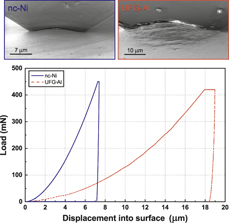
A major limitation in nanoindentation analysis techniques is the inability to accurately quantify pile-up/sink-in around indentations. In this work, the contact area during indentation is determined simultaneously using both contact mechanical models and direct in situ observation in the scanning electron microscope. The pile-up around indentations in materials with low H/E ratios (nanocrystalline nickel and ultrafine-grained aluminum) and the sink-in around a material with a high H/E ratio (fused silica) were quantified and compared to existing indentation analyses. The in situ projected contact area measured by Scanning Electron Microscopy using a cube-corner tip differs significantly from the classical models for materials with low H/E modulus ratio. Using a Berkovich tip, the in situ contact area is in good agreement with the contact model suggested by Loubet et al. for materials with low H/E ratio and in good agreement with the Oliver and Pharr model for materials with high H/E ratio.
The crystal structure of metolazone has been solved and refined using synchrotron X-ray powder diffraction data and optimized using density functional techniques. Metolazone crystallizes in space group P-1 (#2) with a = 8.1976(5), b = 14.4615(69), c = 16.0993(86) Å, α = 115.009(18), β = 90.096(7), γ = 106.264(4)°, V = 1644.52(9) Å3, and Z = 4. The broad (02-1) peak at 3.42° 2θ indicates stacking faults along this direction. The crystal structure consists of alternating polar and hydrocarbon layers parallel to the ac-plane. Only one of the sulfonamide groups acts as a hydrogen bond donor. Both ring nitrogen atoms act as hydrogen bond donors, but one forms an N–H···N hydrogen bond, while the other participates in an N–H···O bond. The powder pattern has been submitted to ICDD® for inclusion in the Powder Diffraction File™, to replace entry 00-066-1624.
In this study, Mg-substituted tricalcium phosphate (Mg-TCP) nanoparticles were synthesized by hydrothermal reactions of Mg-calcite mesocrystals from echinoderm skeletons. Following the biomineralization of echinoderms, Mg-calcite powder was synthesized via the solid-state transition of Mg-amorphous calcium carbonate prepared by a wet-chemical precipitation method, which can also be used to fabricate Mg-TCP. We illustrated that Mg-calcite with a certain level of Mg substitution led to the formation of Mg-TCP through the ion-exchange reactions in the hydrothermal system. Therefore, this study provides a new pathway for the synthesis of Mg-TCP nanoparticles.
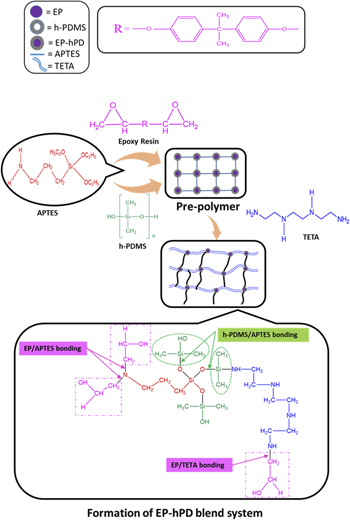
Chemically modified polymer coatings have been synthesized using a blend of soft polymeric material polydimethylsiloxane (h-PDMS) incorporated with stiff polymer epoxy resin (EP) and was cross-linked using silane compatibilizer 3-aminopropyltriethoxysilane (APTES). A comparative analysis has been carried out between neat epoxy coating (N-EP) and epoxy–hydroxy-terminated polydimethylsiloxane (EP-hPD) blends to study the influence of blending ratio on various properties to cater marine applications. An increase of 144.4% in the Young’s modulus (E) and 37.5% increment in adhesion strength at 30 wt% h-PDMS content was observed as compared with N-EP. The water contact angle results demonstrated a substantial increase in contact angle from 52.3° to 90.1° at 30 wt% h-PDMS content as compared to N-EP. Taber abrasion results revealed a decrease in weight loss (mg/1000 cycles) by 24.1 and 17.7% at 10 and 30 wt% loading of h-PDMS in comparison to N-EP. The surface roughness of N-EP and 30 wt% EP-hPD blend were found to be 33.4 nm and 41.4 nm, respectively. To determine the applicability of the developed blend coatings obligatory tests such as field immersion study and chemical resistance evaluation were conducted, and optimum performance was manifested by EP-hPD blend at an EP:h-PDMS ratio of 70:30.
The crystal structure of prednicarbate has been solved and refined using synchrotron X-ray powder diffraction data, and optimized using density functional techniques. Prednicarbate crystallizes in space group P212121 (#19) with a = 7.69990(3), b = 10.75725(3), c = 31.36008(11) Å, V = 2597.55(1) Å3, and Z = 4. In the crystal structure the long axis of the steroid ring system lies roughly parallel to the c-axis. The oxygenated side chains are orientated roughly perpendicular to the steroid ring system and are adjacent to each other, parallel to the ab-plane. The only traditional hydrogen bond donor in the prednicarbate molecule is the hydroxyl group O32–H33, but this does not participate in an O–H···O hydrogen bond. The nearest oxygen atoms to O32 are symmetry-related O32 at 4.495 Å, precluding the expected O–H···O hydrogen bond. The powder pattern has been submitted to ICDD® for inclusion in the Powder Diffraction File™.
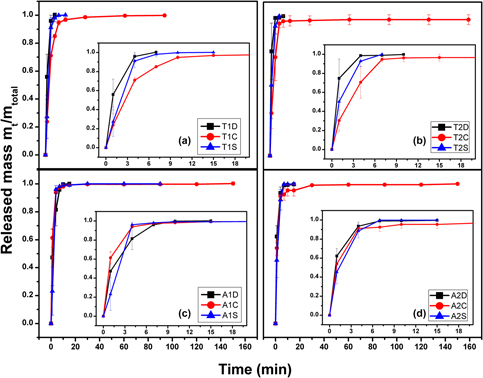
In the present study, TiO2NT coatings grown on simulated body fluid-based electrolyte were investigated as drug delivery devices. Nanotubes (NTs) were grown over commercially pure Ti and Ti6Al4V alloy. Morphology analysis showed that NTs in alloy samples present an inner diameter of 10 nm smaller in average than NTs grown over pure Ti. The surface wettability in water decreased with the anodizing time for both substrates. The application of coatings as drug delivery devices has been studied through the incorporation of ciprofloxacin. To control the drug release, collagen was used as the diffusional barrier. It was observed the drug release follows a Fick’s kinetics. Bioactivity assays showed the absence of hemolytic activity. The concentration of the drug during the release interval remained below the toxic concentration limit, presenting a bacteriostatic activity. All coatings prepared presented a high antibacterial activity, being the area of inhibition of bacterial growth above 13 times the area of the implant.
Crystal structure and electronic structure of YMnO3 were investigated by X-ray diffraction and transmission electron microscopy related techniques. According to the density of states (DOS), the individual interband transitions to energy loss peaks in the low energy loss spectrum were assigned. The hybridization of O 2p with Mn 3d and Y 4d analyzed by the partial DOS was critical to the ferroelectric nature of YMnO3. From the simulation of the energy loss near-edge structure, the fine structure of O K-edge was in good agreement with the experimental spectrum. The valence state of Mn (+3) in YMnO3 was determined by a comparison between experiment and calculations.
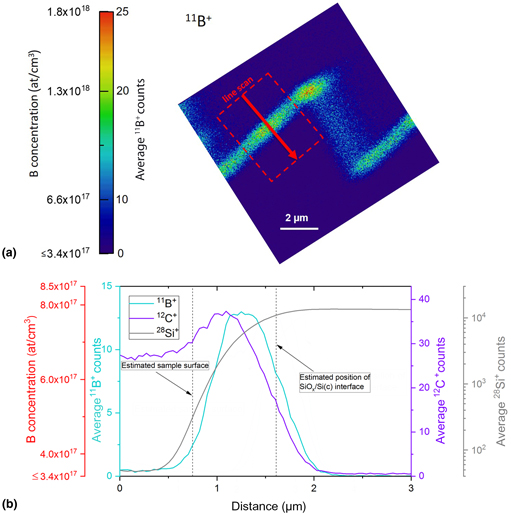
A method for rapid quantitative imaging of dopant distribution using secondary ion mass spectrometry (SIMS) is described. The method is based on SIMS imaging of the cross-section of a reference sample with a known concentration profile. It is demonstrated for the case of boron quantification in silicon in a SIMS imaging mode. A nonlinear relationship between the secondary ion intensity and the concentration is observed. A detection limit of 3 (±2) × 1017 at./cm3 (~6 ppm) is determined with 39 nm pixel-size for the used experimental conditions. As an application example, a boron concentration profile in a passivating contact deposited on a textured Si surface is analyzed.
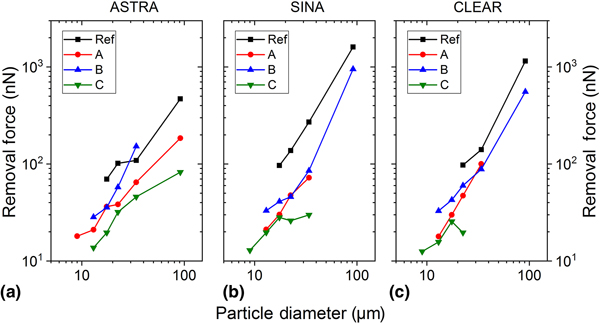
Soiling can lead to severe performance losses of photovoltaic (PV) plants. Within this study, three different anti-soiling coatings (ASC) were applied to three different commercial, solar-grade rolled glasses with different surface structures. Laboratory soiling experiments were performed including wind simulation and a novel rotational force test to assess the influence of different surface structures of the glass substrate on the anti-soiling performance of the coatings. A detailed microscopic evaluation indicates a consistent ranking of the ASC with regard to particle resuspension behavior for both test methods and all substrates. Furthermore, the rotational force test yields a quantitative measure of the median force needed for particle removal from the respective coating, which is independent of the glass substrate surface morphology.
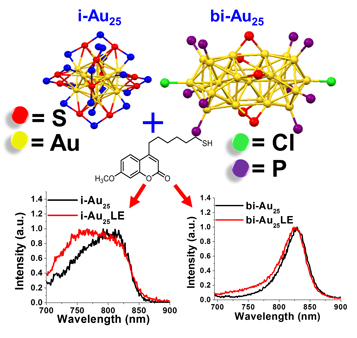
${\rm Au}_{25}\lpar {{\rm C}_6{\rm H}_{14}{\rm S}} \rpar_{18}{}^-$ icosahedron and [Au25(PPh)10(C6H14S)5Cl2]2+ bi-icosahedron clusters were synthesized. Ligand exchange reactions were carried out with a new coumarin-derived fluorophore (Cou-SH) to label both clusters. Labeled and unlabeled Au25 were compared and the changes in the electronic structure were determined. The labeled clusters showed marked changes in electronic states, as evidenced by the quenching in the UV region and enhancement in the near infrared. The quantum yield from Cou-SH decreased and the quantum yield from the labeled Au25 increased. Second, the authors observed changes in the electrochemical band gap.

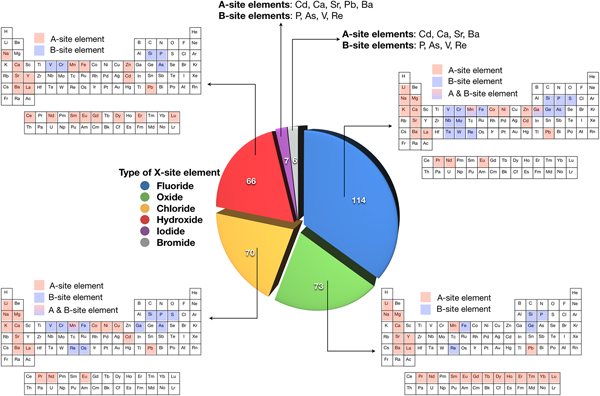
The authors develop a computational approach that integrates machine learning (ML) and density functional theory (DFT) with experimental data to predict formable and thermodynamically stable iodine-containing apatites. This is an important problem because radioactive iodine is toxic and capturing it in solid waste forms have implications in remediation treatments. The authors train ML models using 336 compositions and screen 54 iodine-containing compounds in apatite stoichiometry. ML models predict 18 as formable and 24 as nonformable in the apatite structure; 12 compounds were identified to be uncertain. DFT convex hull predicted two to be thermodynamically stable, one as metastable, and nine as unstable.
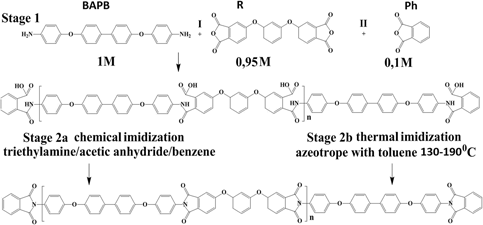
A comparative study of properties of the films based on polyimide powders synthesized by chemical or thermal imidization is presented. It is shown that the imidization method affects the shape, size, bulk density, and size distribution of the synthesized polyimide powder particles, which influences the properties of the films obtained. The method of chemical modification allows to obtain denser powders comparing to the thermally imidized powder. The films were obtained with the help of selective laser sintering (SLS) for the first time. It is shown that the films produced by SLS from chemically imidized polyimide powder are more dense and monolithic as compared to those made from thermally imidized polyimide, which provides, obviously, higher mechanical characteristics of the former. They have the strength higher in 2.5 times and the elastic modulus twice as high than latter one. The optimal laser power is 65 W.
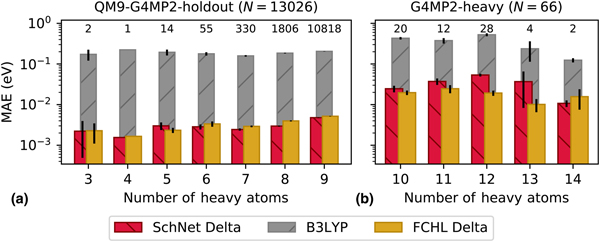
Recent studies illustrate how machine learning (ML) can be used to bypass a core challenge of molecular modeling: the trade-off between accuracy and computational cost. Here, we assess multiple ML approaches for predicting the atomization energy of organic molecules. Our resulting models learn the difference between low-fidelity, B3LYP, and high-accuracy, G4MP2, atomization energies and predict the G4MP2 atomization energy to 0.005 eV (mean absolute error) for molecules with less than nine heavy atoms (training set of 117,232 entries, test set 13,026) and 0.012 eV for a small set of 66 molecules with between 10 and 14 heavy atoms. Our two best models, which have different accuracy/speed trade-offs, enable the efficient prediction of G4MP2-level energies for large molecules and are available through a simple web interface.
Composition-dependent microstructure and mechanical properties of ultrafine-grained Al and Al–Mg films fabricated by DC magnetron sputtering with the novel micro-combinatorial technique were studied by transmission electron microscopy, atomic force microscopy, and nanoindentation. It was revealed that these films have extremely high strength, enabling their potential application as protecting layers. Besides the possible practical applications, the results of the present work also confirm the validity of the modified Hall–Petch relationship for the uniform description of the strength of face-centered cubic metals and solid solution having ultrafine-grain size.
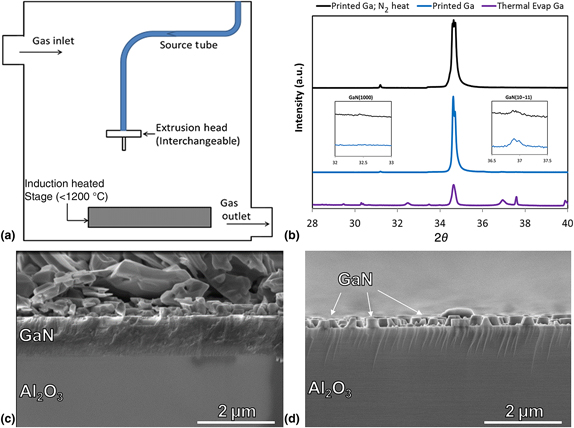
The rise of additive manufacturing (AM) has enabled the rapid production of complex part geometries across multiple material domains. To date, however, AM of inorganic semiconductor materials has not been fully realized due to the difficulty of forming single-crystal materials with traditional AM processes. Here, we demonstrate a novel semiconductor synthesis method using a combination of liquid and gas precursors to additively print gallium nitride. Growth rates of 1–2 µm/min are demonstrated in printed regions while maintaining epitaxial alignment with the substrate. We also outline critical variables for the future development, improvement, and implementation of the proposed process.
Using ethanol adsorption calorimetry, the surface energetics of two carbon substrates and two products in microwave-assisted carbon nanotube (CNT) growth was studied. In this study, the ethanol adsorption enthalpies of the two graphene-based samples at 25 °C were measured successfully. Specifically, the near-zero differential enthalpies of ethanol adsorption are −75.7 kJ/mol for graphene and −63.4 kJ/mol for CNT-grafted graphene. Subsequently, the differential enthalpy curve of each sample becomes less exothermic until reaching a plateau, −55.8 kJ/mol for graphene and −49.7 kJ/mol for CNT-grafted graphene, suggesting favorable adsorbate–adsorbent binding. Moreover, the authors interpreted and discussed the partial molar entropy and chemical potential of adsorption as the ethanol surface coverage (loading) increases. Due to the low surface areas of carbon black–based samples, adsorption calorimetry could not be performed. This model study demonstrates that using adsorption calorimetry as a fundamental tool and ethanol as the molecular probe, the overall surface energetics of high–surface area carbon materials can be estimated.
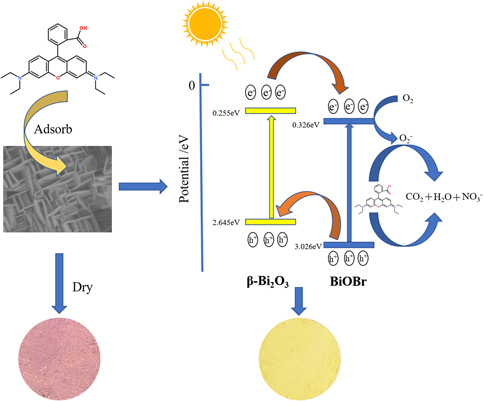
Bismuth (Bi)-based photocatalytic materials are widely used in the field of photocatalytic degradation of wastewater. In this study, β-Bi2O3/BiOBr heterojunction photocatalysts were prepared by an in situ chemical transformation method. BiOBr molecules are arrayed to cross each other to form a pore around β-Bi2O3. The prepared photocatalyst had a large specific surface area and excellent adsorption and photocatalytic properties. The β-Bi2O3/BiOBr with a molecular ratio of 11.1% had the highest catalytic activity. The result of a degradation experiment, performed with Rhodamine B (RhB) as the target pollutant, revealed that the degradation rate reached 99.85% after 25 min under visible light irradiation. The pore structure can adsorb contaminants and the heterojunction facilitates the separation of photogenerated electron–hole pairs to enhance the photocatalytic properties. The high adsorption performance and heterojunction achieved higher photocatalytic efficiency. This semiconductor photocatalyst with high adsorption performance provides a new approach to control water pollution.
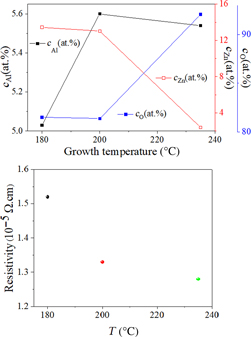
Aluminum-doped zinc oxide films were prepared by atomic layer deposition using diethylzinc, trimethylaluminum, and water. High-purity water was used with low vacuum. The effect of growth temperature on characteristics of the films was investigated. The crystallinity was improved as growth temperature was increased from 180 to 235 °C, with the grain sizes increasing from 32.830 to 47.020 nm. The films possessed high transparency with a 95% transmission window blue shifted with growth temperature. This shift was seen in the energy-band gaps which changed from 3.46 to 3.68 eV, leading to a decreased resistivity from 1.52 × 10⁻⁵ to 1.28 × 10⁻⁵ Ω cm.