To save content items to your account,
please confirm that you agree to abide by our usage policies.
If this is the first time you use this feature, you will be asked to authorise Cambridge Core to connect with your account.
Find out more about saving content to .
To save content items to your Kindle, first ensure no-reply@cambridge.org
is added to your Approved Personal Document E-mail List under your Personal Document Settings
on the Manage Your Content and Devices page of your Amazon account. Then enter the ‘name’ part
of your Kindle email address below.
Find out more about saving to your Kindle.
Note you can select to save to either the @free.kindle.com or @kindle.com variations.
‘@free.kindle.com’ emails are free but can only be saved to your device when it is connected to wi-fi.
‘@kindle.com’ emails can be delivered even when you are not connected to wi-fi, but note that service fees apply.
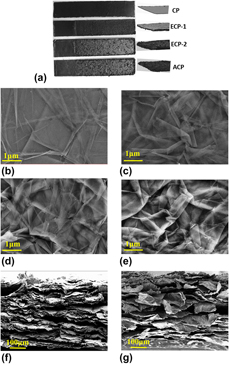
The activated carbon paper (ACP) has been designed as the active electrode material of supercapacitor to improve its capacitive performance. ACP is prepared by electrochemical nitrate ion–assisted exfoliation, sulfate ion–assisted exfoliation, and subsequent hydrothermal reduction processes. The as-prepared ACP shows obviously rougher surface along with the expanded layer distance. ACP exhibits higher specific capacitance of 380 mF/cm2 at 1 mA/cm2 than that of 21 mF/cm2 for carbon paper. ACP electrode shows the cycling capacitance retention of 98% after 5000 cycles at 10 mA/cm2. The symmetric ACP supercapacitor is constructed using ACP electrode and H2SO4 involved polyvinyl alcohol gel electrolyte. ACP supercapacitor presents the specific capacitance of 97 mF/cm2, the energy density of 0.343 mW h/cm3, and the output voltage of 1.6 V at 1 mA/cm2. ACP with high capacitance performance presents the promising supercapacitor application for the electrochemical energy storage.
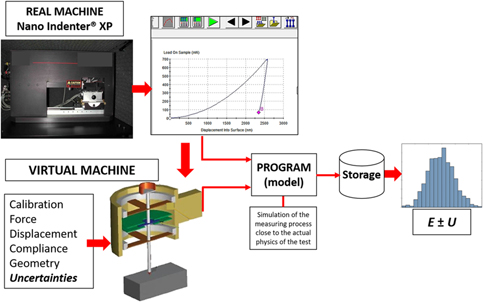
The basis of the virtual machine concept, which is commonly used in coordinate measuring machines, was implemented to determine more realistic uncertainties on the estimation of the elastic modulus obtained from nanoindentation tests. The methodology is based on a mathematical model applied to simulate the testing process and to evaluate the uncertainties through Monte Carlo simulations whose application depends on the studied system (instrument, material, scale, etc.). The methodology was applied to the study of fused silica (FQ) and steel samples tested in a nanoindentation system. The results revealed that the most relevant sources of uncertainty are related to the calibration procedure, particularly to the elastic modulus of the calibration material, and to the contact depth estimation; however, the relevance of the uncertainties is system dependent. This work represents a first insight for a deeper consideration of the uncertainties in instrumented indentation testing.
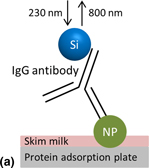
A process for bioconjugation of an IgG antibody and silicon quantum dots (Si-QDs) having the luminescence in the near-infrared (NIR) range was developed. For the bioconjugation, the surface of water-soluble all-inorganic Si-QDs was functionalized by using silane-coupling agents. In amino-functionalized Si-QDs, successful conjugation was achieved without strongly affecting the luminescence property. Detailed analyses revealed that Si-QDs are bound covalently to both the light and heavy chains of an IgG antibody. It was also confirmed that the binding property of an IgG antibody with antigen nucleoprotein was not ruined by the process. The successful conjugation of an IgG antibody and NIR luminescent Si-QDs paves the way for designing environmentally friendly bio-sensing and -imaging processes.
Poly(methyl methacrylate) (PMMA) is one of the most important polymers for application as a dielectric layer in organic electronics, e.g. in organic field-effect transistors. The key to improve the transistor performance is the optimization of the interface between the semiconductor and the dielectric layer. Here, the surface order in thin films of PMMA copolymers with self-organized, semifluorinated (sf) building blocks, and crosslinkable units in single layers and double layers with poly(3-hexylthiophene-2,5-diyl) (P3HT) is investigated. The chemistry of the sf copolymers is systematically varied and the influence on the self-organization in bulk and thin films is examined by a combination of scattering methods. The length of the semifluorinated side chains mainly determines the degree and type of order both in bulk as well as in thin films.
The use of statistical/machine learning (ML) approaches to materials science is experiencing explosive growth. Here, we review recent work focusing on the generation and application of libraries from both experiment and theoretical tools. The library data enables classical correlative ML and also opens the pathway for exploration of underlying causative physical behaviors. We highlight key advances facilitated by this approach and illustrate how modeling, macroscopic experiments, and imaging can be combined to accelerate the understanding and development of new materials systems. These developments point toward a data-driven future wherein knowledge can be aggregated and synthesized, accelerating the advancement of materials science.
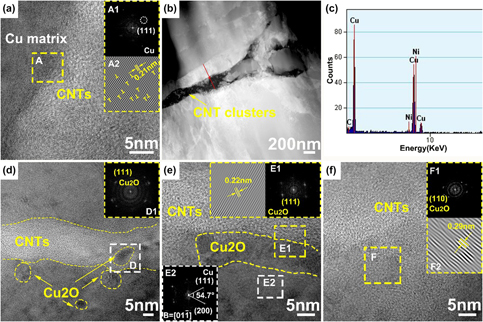
Nonuniform dispersion and weak interfacial bonding between carbon nanotubes (CNTs) and Cu matrix are two critical issues for achieving high strength and good ductility of CNT/Cu composites. Here, acid-treated CNTs precoated with Ni coatings were used to enhance the dispersion uniformity of CNTs and interfacial bonding between CNTs and Cu matrix in the CNT/Cu composites fabricated through spark plasma sintering and subsequently cold rolling. Scanning electron microscopy analysis revealed the homogeneous dispersion of Ni-coated CNTs (Ni-CNTs) in the composite compared with uncoated CNTs. Transmission electron microscope observation indicated that Cu2O nanoparticles were in situ formed at the interface in Ni-CNT/Cu composite, where CNTs were uncovered by Ni coatings. After rolling, the distribution of Ni-CNTs transformed into ribbons aligning along the rolling direction. The ultimate tensile strength (UTS) of 261 MPa was achieved in rolled 1 vol% Ni-CNT/Cu composite, which was 24.3% higher than that before rolling. The UTS of 2 vol% Ni-CNT/Cu composite obviously decreased, which could be attributed to the agglomeration of Ni-CNTs in the Cu matrix due to the increased volume content.
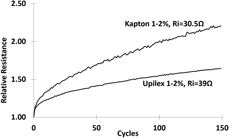
Sintered nanoparticle structures are macroscopically brittle but quite robust if deposited on a flexible substrate. The effects of a polymer substrate on the stretchability of both brittle and ductile coatings and traces are well established. Systematic effects of substrate properties on the fatigue resistance of aerosol printed nano-Ag are slightly more complex. The present work is focused on the early stages of fatigue, where the resistance increases significantly but cracks are not yet visible. Overall, the fatigue behavior is seen to vary with the combination of substrate modulus and viscoelastic deformation properties. Comparing two common polyimides, the rate of damage was seen to increase faster with increasing amplitude on the less compliant one. Consistently with this increasing the minimum strain in the cycle led to a significantly stronger reduction in damage rates. However, the damage rate remained lower on the less compliant substrate at all amplitudes and strain ranges of practical concern.
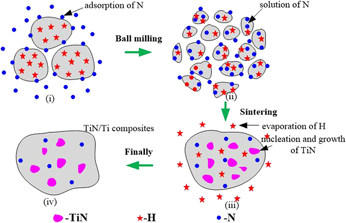
Nano-sized TiN-reinforced Ti metal matrix composites were fabricated by powder metallurgical route, which includes high-energy ball milling pretreatment and subsequent hot-press sintering treatment. The phase composition and microstructure of the sintered samples were characterized by X-ray diffraction, scanning electron microscopy, and transmission electron microscopy. Results showed that N2 was absorbed and solubilized into TiH2 by milling pretreatment, and TiN was formed during sintering process and was fine to a grain size of 20–100 nm. The final phase composition of the composites was αTi, βTi, and TiN with solution N in matrix. Mechanical tests showed that with increasing milling time, the hardness of the composites increased by 31, 58, 93, and 101% compared with pure Ti. The compressive strength initially increased and later decreased to 2440 and 2120 MPa when milled for 1.5 and 2 h, respectively.
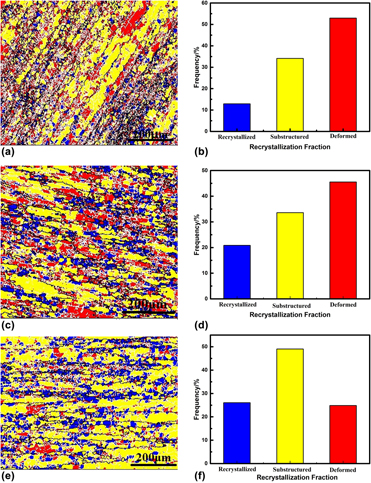
Differences in pipe wall microstructure at various positions throughout the wall thickness of high strength aluminum alloy thick-wall pipes produced by reverse hot extrusion were investigated. The microstructures of the inner wall (IW), outer wall (OW), and half wall (HW) were compared. Further, heterogeneity in the mechanical properties of the pipe throughout the wall thickness was also investigated. Results revealed that the volume fraction of precipitation was highest at the HW position because of the higher Zn and Mg contents. Further, approximately 26% of grains were recrystallized in the OW position due to the greater strain during extrusion, while the recrystallization fractions of the IW and HW positions were 13% and 21%, respectively. The effects of precipitation strengthening and deformation strengthening contribute to the highest ultimate tensile strength and Vickers hardness of the HW position, and to the higher elongation of the IW and OW positions.
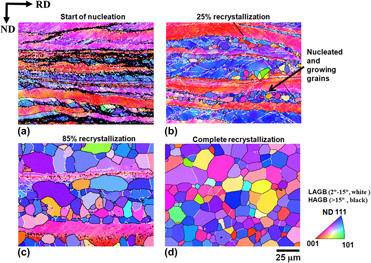
In the present work, a β-Ti alloy (Ti–15V–3Sn–3Cr–3Al) was unidirectionally cold rolled to 80% thickness reduction, followed by recrystallization at two temperatures: (i) 1013 K and (ii) 1053 K. The microstructural developments were studied using light optical microscopy, scanning electron microscopy X-ray peak profile analysis, and electron backscattered diffraction. The bulk texture of deformed and fully recrystallized samples was studied using X-ray diffraction. The deformed microstructures showed the presence of high fraction of shear bands, and these bands were preferentially formed in γ-fiber grains than in the grains with other orientations. Cold rolled β-Ti alloy samples were fully recrystallized in 10 min at 1053 K and in 90 min at 1013 K. Strong α- and γ-fibers were formed after 80% cold rolling, while strong discontinuous γ-fiber (with very strong {111}〈112〉 component) was formed after complete recrystallization. Oriented nucleation was found to be the dominant mechanism for the development of recrystallization texture.
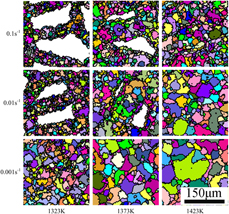
To simulate the effects of hot working parameters on microstructure and flow resistance during dynamic recrystallization (DRX) of a Ni–Cr–Mo-based C276 superalloy, a 2D mesoscopic model has been established using cellular automaton (CA) method. The isothermal hot compression tests were performed on a Gleeble 1500 thermal-mechanical simulator at the temperature range of 1273–1473 K and strain rate range of 0.001–5 s−1. The flow stress behaviors were then obtained and the microstructures of quenching specimen were observed after compression. Then the dislocation density evolution, nucleation and grain growth during hot compression were determined from experiments and integrated to the CA model. The topology of microstructure evolution and deformation resistance were calculated using the developed CA model and compared with the experimental ones. The CA simulation results show reasonable agreements with the experiments, implying the developed CA can capture the effects of processing parameters on the DRX behavior of C276 superalloy.
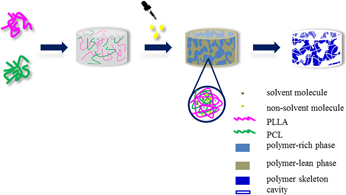
Hierarchically porous poly(L-lactic acid) (PLLA)/poly(ε-caprolactone) (PCL) monolithic composites were fabricated by nonsolvent-induced phase separation (NIPS) method without any template for the first time. A homogeneous hierarchical porous structure with relatively large specific surface area containing both mesopores and macropores was confirmed by pore size distribution plots and scanning electron microscopy images, respectively. Fourier transform infrared analysis (FTIR) revealed that PLLA and PCL were physically blended. Differential scanning calorimeter (DSC) analysis further showed that the two components were physically blended but had a slight thermal compatibility. Meanwhile, X-ray diffraction (XRD) tests indicated that the addition of PCL hindered the crystallization of PLLA. Herein, the formation of the mesopores and macropores during the phase separation process was explained from the microscopic point of view according to the results of XRD and DSC. The present monolithic composites with hierarchically porous structures had promising prospect for applications of tissue engineering.
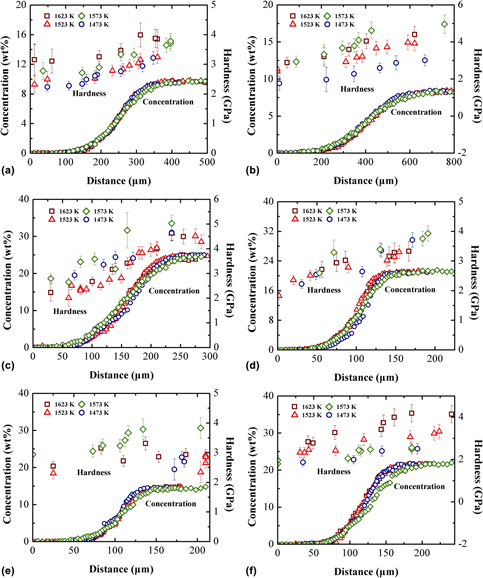
In this paper, the hardness and Young’s moduli along the diffusion paths in fcc Ni–X (X = Rh, Ta, W, Re, Os, and Ir) binary diffusion couples were measured by using the nanoindentation technique. Hardness increases gradually from the pure Ni to the fcc Ni–X alloys, except for the Ni–Os system. While the Young’ moduli in fcc Ni–X alloys scatter much larger and do not show noticeable variation with the addition of element X. After that, the CALPHAD models for description of the composition-dependent hardness and Young’s modulus were proposed, and an in-house code was developed. Based on the present experimental data, the CALPHAD-type descriptions for hardness and Young’s modulus in fcc Ni–X (X = Rh, Ta, W, Re, Os, and Ir) systems were obtained. The model-predicted hardness and Young’s moduli of composition dependence agree with the experimental data in general. It is anticipated that the presently obtained CALPHAD-type hardness and Young’s modulus descriptions, together with the previous thermodynamic and atomic mobility databases, can be used for the future alloy design of novel Ni-based superalloys.
We use density functional theory meta-generalized gradient approximation TPSS + D3(BJ) + U + J calculations to investigate the energetics and geometry of water molecules in the flexible metal-organic framework material Materials of Institut Lavoisier (MIL)-53(Cr) as a function of cell volume. The critical concentration of water to cause the transition from the large pore (lp) to the narrow pore (np) structure is estimated to be about 0.13 water molecule per Cr. At a concentration x = 1 water molecule per Cr, the zero-temperature np and lp configurations each have a hydrogen bond between the H of each framework hydroxyl group and water oxygen (OW). At intermediate volumes, water dimer-like configurations are observed. A concentration x = 1.25 leads to hydrogen bonding between water molecules in the np phase that is absent for x = 1. Our results suggest possible mechanisms for pore closing in hydrated MIL-53(Cr).
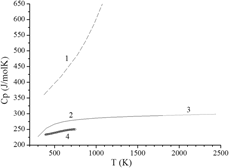
Using the data obtained by Knudsen effusion mass spectrometry, the standard formation thermodynamic properties of La2Hf2O7, Nd2Hf2O7, and Gd2Hf2O7 were calculated in the present study at high temperatures. Based on the results obtained, it was shown that the standard formation Gibbs energies of La2Hf2O7, Nd2Hf2O7, and Gd2Hf2O7 from the elements at the temperature 2445 K were consistent with the empirical rule concerning decrease of stability of pyrochlore hafnate phase with decrease in lanthanoid ionic radius. The La2Hf2O7 and Gd2Hf2O7 heat capacities were obtained in the present study by differential scanning calorimetry. These data were used along with those found earlier to evaluate the standard formation Gibbs energies of La2Hf2O7 and Gd2Hf2O7 from the elements at the temperature 298 K, which equal (−3937 ± 10) kJ/mol and (−3895 ± 10) kJ/mol, respectively. The thermodynamic properties of La2Hf2O7, Nd2Hf2O7, and Gd2Hf2O7 estimated in a wide temperature range allowed consideration of reliability of data available in the literature.
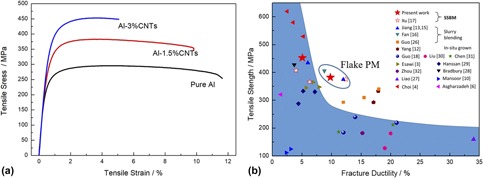
Flat products of carbon nanotubes (CNTs) reinforced Al matrix composites were fabricated using flake powder metallurgy via shift-speed ball milling and hot-rolling. The evolution of CNTs during preparation and the final distribution in the Al matrix were investigated, and the effect of CNT content on mechanical properties were discussed. Due to the combined effect of uniform dispersion of CNTs, structural integrity, interfacial bonding and directional alignment, the balance between high strength and ductility was successfully achieved in the annealed rolled composites with 1.5 wt% CNT addition, with the value of 382.6 MPa in tensile strength and 9.8% in fracture ductility. The load transfer strengthening was the main mechanism of the strength enhancement with CNTs addition. In addition, a strong rotated cube {001}〈110〉 texture was found in the final flat product of rolled composites. This study provides an effective route to produce and improve the mechanical properties of CNT/Al flat products.
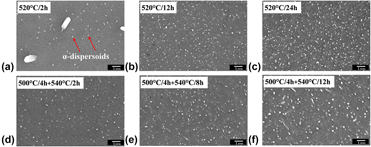
In the present work, Mo was added to an Al–Si–Mg foundry alloy to study its influence on the evolution of dispersoids during various heat treatments. The microhardness and the elevated-temperature tensile properties and creep resistance were measured to evaluate the contribution of dispersoids. Results showed that the addition of Mo greatly promoted the formation of α-dispersoids. During solution treatment, the formation of α-dispersoids started after 8 h at 500 °C. At high temperature (540 °C), the coarsening of dispersoids with increasing time became predominant. The optimum condition of dispersoids can be reached by 520 °C/12 h or 500 °C/4 h + 540 °C/2 h, leading to the highest differences in microhardness between the Mo-containing alloy and base alloy. The tensile strengths were improved at both room temperature and elevated temperatures, while the elongation at elevated temperature was greatly increased. The creep resistance at elevated temperature is further enhanced due to the Mo addition.
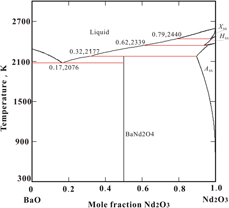
The BaNd2O4 compound and the BaO–Nd2O3 system are of interest for electroceramics. In this work, we synthesized BaNd2O4 by solid-state reaction, measured its heat capacity from 573 to 1273 K by differential scanning calorimetry, and determined its enthalpy of formation from component oxides at 298 K by high-temperature oxide melt solution calorimetry to be −43.75 ± 4.68 kJ/mol. Our newly determined values and available literature data were employed to assess the phase equilibria in the BaO–Nd2O3 system using CALPHAD methodology. A self-consistent thermodynamic database and the calculated phase diagram of the BaO–Nd2O3 system are provided. The optimized thermodynamic parameters are in good agreement with available experimental data. BaNd2O4 is calculated to melt incongruently at 2177 K. This thermodynamic analysis is essential for the optimization of synthesis conditions for materials and for the evaluation of their stability under appropriate technological operating conditions.