To save content items to your account,
please confirm that you agree to abide by our usage policies.
If this is the first time you use this feature, you will be asked to authorise Cambridge Core to connect with your account.
Find out more about saving content to .
To save content items to your Kindle, first ensure no-reply@cambridge.org
is added to your Approved Personal Document E-mail List under your Personal Document Settings
on the Manage Your Content and Devices page of your Amazon account. Then enter the ‘name’ part
of your Kindle email address below.
Find out more about saving to your Kindle.
Note you can select to save to either the @free.kindle.com or @kindle.com variations.
‘@free.kindle.com’ emails are free but can only be saved to your device when it is connected to wi-fi.
‘@kindle.com’ emails can be delivered even when you are not connected to wi-fi, but note that service fees apply.
In the previous chapter, procedures were described that allow prediction of the elastic response of a single lamina when loaded at an arbitrary angle to the fibre axis. It was shown that such uniaxial sheets tend to be highly anisotropic, with much greater stiffness when loaded parallel to the fibres than at significant angles to them. Moreover, other aspects of the elastic response are very different in different directions. For these reasons, it is common to stack laminae into bonded sets (laminates), making the elastic properties (and also the strength) more isotropic, and also opening up the possibility of tailoring the properties of a component to the loads that it will experience in service – potentially a major advantage of composites when compared with more conventional materials. In this chapter, the treatment of individual laminae is extended to the case of a laminate with an arbitrary stacking sequence, supplying an analytical tool of considerable value in the design of composite materials.
The previous chapter covered factors affecting strength, in terms of the stresses at which damage and failure occur in composites. In many situations, however, it is the energy that is absorbed within the material while fracture takes place that is of prime importance. A tough material is one for which large amounts of energy are required to cause fracture. Some loading configurations, such as a component being struck by a projectile, provide only a finite amount of energy that could cause failure. In fact, there are many situations in which toughness, rather than strength, is the key property determining whether the material is suitable. In this chapter, a brief outline is given of the basics of fracture mechanics, with particular reference to the energetics of interfacial damage. This is followed by an appraisal of the sources of energy absorption in composites. Finally, progressive crack growth in composites is examined under conditions for which fast fracture is not energetically favoured (sub-critical crack growth).
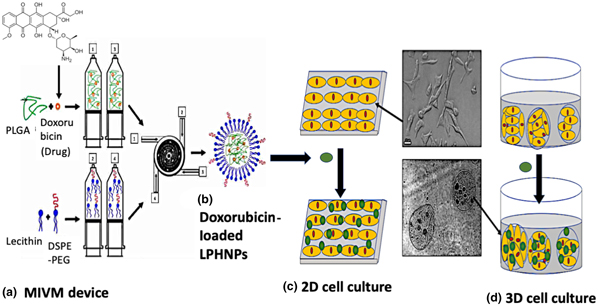
Nanoparticle-mediated drug delivery has the potential to overcome several limitations of cancer chemotherapy. Lipid polymer hybrid nanoparticles (LPHNPs) have been demonstrated to exhibit superior cellular delivery efficacy. Hence, doxorubicin (a chemotherapeutic drug)-loaded LPHNPs have been synthesized by three-dimensional (3D)-printed herringbone-patterned multi-inlet vortex mixer. This method offers rapid and efficient mixing of reactants yielding controllable and reproducible synthesis of LPHNPs. The cytotoxicity of LPHNPs is tested using two-dimensional (2D) and 3D microenvironments. Results obtained from 3D cell cultures showed major differences in cytotoxicity in comparison with 2D cultures. These results have broad implications in predicting in vitro LPHNP toxicology.
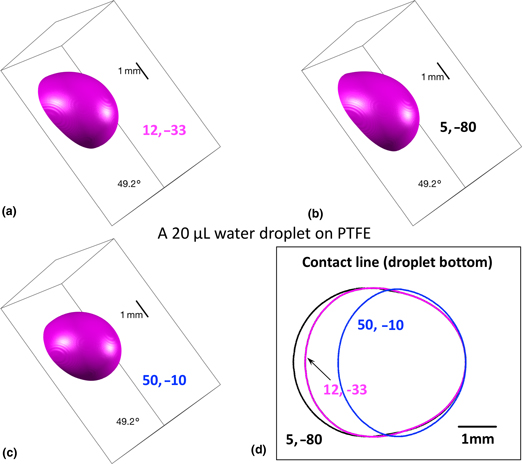
Pseudo-line tensions are used in a continuum approach to simulate contact angle hysteresis. A pair of pseudo-line tensions in the receding and advancing states, respectively, are utilized to represent contact line interactions with a substrate because of the nanoscale topological and/or chemical heterogeneity on the substrate. A water droplet sitting on a horizontal or inclined substrate, whose volume is 4–30 µL, has been studied experimentally and numerically. Our simulation model predicts consistent hysteresis at four different droplet sizes compared with experiments. Meanwhile, the critical roll-off angles captured in simulations match well with experiments.
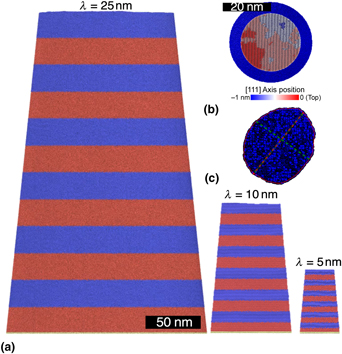
The authors carried out matched experiments and molecular dynamics simulations of the compression of nanopillars prepared from Cu|Au nanolaminates with up to 25 nm layer thickness. The stress–strain behaviors obtained from both techniques are in excellent agreement. Variation in the layer thickness reveals an increase in the strength with a decreasing layer thickness. Pillars fail through the formation of shear bands whose nucleation they trace back to the existence of surface flaws. This combined approach demonstrates the crucial role of contact geometry in controlling the deformation mode and suggests that modulus-matched nanolaminates should be able to suppress strain localization while maintaining controllable strength.
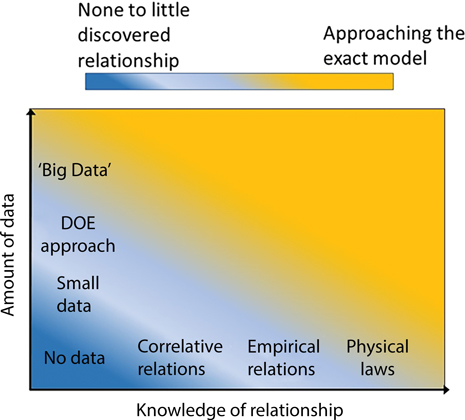
Machine learning (ML) has revolutionized disciplines within materials science that have been able to generate sufficiently large datasets to utilize algorithms based on statistical inference, but for many important classes of materials the datasets remain small. However, a rapidly growing number of approaches to embedding domain knowledge of materials systems are reducing data requirements and allowing broader applications of ML. Furthermore, these hybrid approaches improve the interpretability of the predictions, allowing for greater physical insights into the factors that determine material properties. This review introduces a number of these strategies, providing examples of how they were implemented in ML algorithms and discussing the materials systems to which they were applied.
This fully expanded and updated edition provides both scientists and engineers with all the information they need to understand composite materials, covering their underlying science and technological usage. It includes four completely new chapters on surface coatings, highly porous materials, bio-composites and nano-composites, as well as thoroughly revised chapters on fibres and matrices, the design, fabrication and production of composites, mechanical and thermal properties, and industry applications. Extensively expanded referencing engages readers with the latest research and industrial developments in the field, and increased coverage of essential background science makes this a valuable self-contained text. A comprehensive set of homework questions, with model answers available online, explains how calculations associated with the properties of composite materials should be tackled, and educational software accompanying the book is available online. An invaluable text for final-year undergraduates in materials science and engineering, and graduate students and researchers in academia and industry.
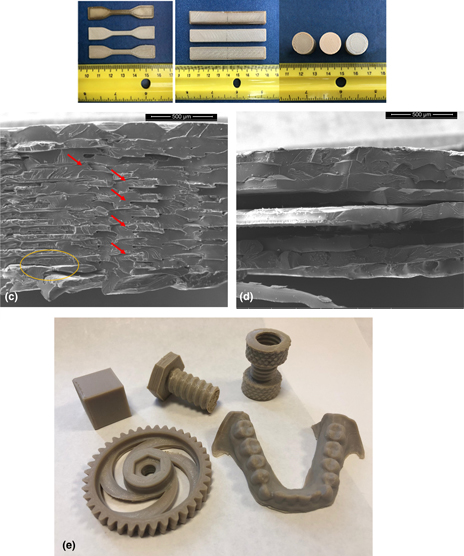
Because of its unique mechanical, chemical, and biological properties, 3D-printed polyether ether ketone (PEEK) has great potential as customized bone replacement and other metal alloy implant replacement. PEEK samples were printed using fused deposition modeling (FDM) and evaluated in terms of their dimensional accuracy, crystallinity, and mechanical properties. Crystallinity and mechanical properties increased with elevated chamber temperature and post-printing annealing. Variations of material properties from three printers are evident. Many factors affect the quality of 3D-printed PEEK. Future FDA regulations for 3D-printed products are needed for this highly customizable manufacturing process to ensure safety and effectiveness for biomedical applications.
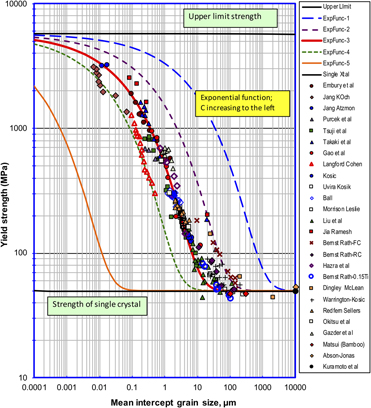
A rigorous analysis of yield strength of pure iron over a wide grain size scale, using an extensive compilation of experimental data, indicates that the common Hall–Petch relationship is not obeyed with large deviations at the extremes of grain size. The author proposes here a phenomenological exponential function to represent the grain size effect on strength over multiple length scales. It is shown that the exponential function describes the grain size dependence of strength remarkably well, on the basis of a large set of experimental data for pure Fe. A nonlinear regression analysis indicated that the function provided a very high degree of correlation of data. The validity of the function is also supported by its conformation to physical boundary conditions at the extremes of grain size, that is, by asymptotically reaching the limiting stress for dislocation nucleation at infinitesimal grain size, and, the strength of single crystal at infinite grain size. The exponential form is a significant improvement over the Hall–Petch relationship and may be used as a guide to develop a reliable theory of grain size strengthening of iron.
History of the development of the reciprocal lattice is reviewed. The reciprocal lattice as an essential tool for the study of diffraction experiments by ordered structures and characterization of their structural properties is widely taught in any text of solid state or chemistry, but usually without discussion of its history. This article aims to give a coherent historical perspective on the reciprocal lattice. First, a basic introduction to the reciprocal lattice concept, its mathematical foundation and physical origin, and its relationship with the direct lattice is provided. Then a detailed chronicle of ideas leading to the concept of the reciprocal lattice is presented, including a review of the contributions of Gibbs, Ewald, and others. The polar lattice concept, the great ancestor of the reciprocal lattice, is presented.
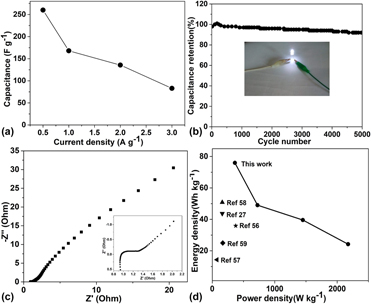
In this work, hierarchical mesoporous Zn–Ni–Co–S–rGO/NF microspheres have been prepared by hydrothermal, sulfurization, and subsequent calcination process. The effect of different sulfurization time on the morphology and capacitance of composites was tested. The high electrochemical performance of (Zn–Ni–Co–S–rGO/NF) composite was obtained when the sulfurization time was 3 h (Zn–Ni–Co–S–rGO/NF-3h), where a specific capacitance of 627.7 F/g at 0.25 A/g and excellent rate capability of about 97.8% capacitance retention at 2 A/g after 4000 cycles were achieved. Moreover, an asymmetric supercapacitor fabricated by (Zn–Ni–Co–S–rGO/NF-3h) composite and activated carbon (AC) as the positive and the negative electrodes, respectively, showed a high energy density of 75.96 W h/kg at a power density of 362.49 W/kg with a remarkable cycle stability performance of 91.2% capacitance retention over 5000 cycles. This incredible electrochemical behavior illustrates that the hierarchical mesoporous Zn–Ni–Co–S–rGO/N-3h microsphere electrodes are promising electrode materials for application in high-performance supercapacitors.
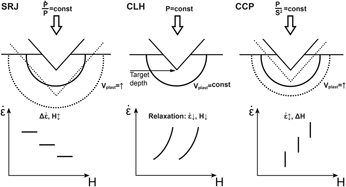
A new constant contact pressure (CCP) indentation creep method is presented, which is based on keeping the mean contact pressure as defined through Sneddon’s hardness constant, until a steady-state strain rate is achieved. This is in contrast to the conventional constant load–hold (CLH) creep experiments, where the load is held constant and relaxation in both hardness and strain rate occurs at the same time. Besides controlling the mean contact pressure, the dynamic stiffness is furthermore used to assess the indentation depth, thereby minimizing thermal drift influence and pile-up or sink-in effects during long-term experiments. The CCP method has been tested on strain rate sensitive ultrafine-grained (UFG) CuZn30 and UFG CuZn5 as well as on fused silica, comparing the results with those of strain rate jump tests as well as the CLH nanoindentation creep tests. With the CCP method, strain rates from 5 × 10⁻⁴ s−1 down to 5 × 10⁻⁶ s−1 can be achieved, keeping the mean contact pressure constant over a long period of time, in contrast to the CLH method. The CCP technique thus offers the possibility of performing long-term creep experiments while retaining the contact stress underneath the tip constant.
Machine learning (ML) and artificial intelligence (AI) are quickly becoming commonplace in materials research. In addition to the standard workflow of fitting a model to a large set of data in order to make predictions, the materials community is finding novel and meaningful ways to integrate AI within their work. This has led to an acceleration not only of materials design and discovery, but also of other aspects of materials research as well, including faster computational models, the development of autonomous and intelligent “robot researchers,” and the automatic discovery of physical models. In this issue, we highlight a few of these applications and argue that AI/ML is delivering real-world, practical solutions to materials problems. It is also clear that we need AI/ML methods and models, “dialects” that are better adapted to materials research.