To save content items to your account,
please confirm that you agree to abide by our usage policies.
If this is the first time you use this feature, you will be asked to authorise Cambridge Core to connect with your account.
Find out more about saving content to .
To save content items to your Kindle, first ensure no-reply@cambridge.org
is added to your Approved Personal Document E-mail List under your Personal Document Settings
on the Manage Your Content and Devices page of your Amazon account. Then enter the ‘name’ part
of your Kindle email address below.
Find out more about saving to your Kindle.
Note you can select to save to either the @free.kindle.com or @kindle.com variations.
‘@free.kindle.com’ emails are free but can only be saved to your device when it is connected to wi-fi.
‘@kindle.com’ emails can be delivered even when you are not connected to wi-fi, but note that service fees apply.
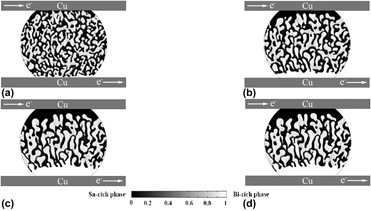
Severe phase coarsening and separation in Sn–Bi alloys have brought increasing reliability concern in microelectronic packages. In this study, a phase field model is developed to simulate the microstructural evolution and evaluate the change in macroscopic physical properties of the flip chip Cu/Sn58Bi/Cu joint under the conditions of isothermal aging, as well as the coupled loads of elastic stress and electric current stressing. Results show that large-sized Bi-rich phase particles grow up at the expense of small-sized ones. Under the coupled loads, Bi atoms migrate along the electron flow direction, consequently Bi-rich phase segregates to form a Bi-rich phase layer at the anode. The current crowding ratio in the solder decreases rapidly first and then fluctuates slightly with time. Current density and von Mises stress exhibit inhomogeneous distribution, and both of them are higher in the Sn-rich phase than in the Bi-rich phase. Electric current transfers through the Sn-rich phase and detours the Bi-rich phase. As time proceeds, the resistance of the solder joint increases, and the average von Mises stress of the solder joint decreases. The Bi-rich phase coarsens much faster under the coupled loads than under the conditions of isothermal aging.
X-ray powder diffraction data, unit-cell parameters, and space group for 17- hydroxy-16-methyl-9,11-epoxypregna-1,4,6-triene-3,20-dione, C22H26O4, are reported [ a = 18.435(1) Å, b = 12.269(3) Å, c = 8.251(5) Å, α = 90°, β = 90°, γ = 90°, unit-cell volume V = 1866.43 Å3, Z = 4, ρcal = 1.261 g cm−3 and space group P212121]. All measured lines were indexed and are consistent with the P212121 space group. No detectable impurities were observed.
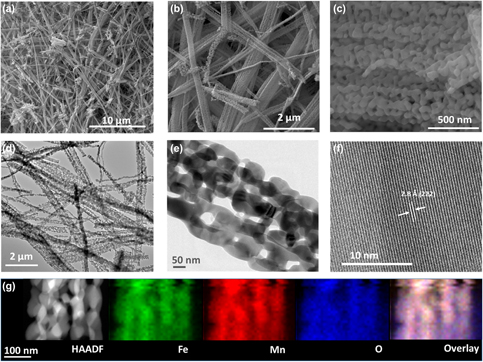
The development of stable and effective earth-abundant metal oxide electrocatalysts is very crucial to improve competence of water electrolysis. In this study, iron manganite (FeMnO3) nanomaterials were synthesized as an affordable electrocatalyst for water oxidation reactions. The structural and chemical properties of FeMnO3 nanomaterials were studied by transmission electron microscopy, scanning electron microscopy, energy-dispersive X-ray, X-ray diffraction, X-ray photoelectron spectroscopy, inductively coupled plasma-optical emission spectrometry, and Brunauer–Emmett–Teller analyses. The microscopy analyses show that the synthesized material has wire morphology, and assembly of approximately 70 nm nanocrystallites forms the wires. XRD patterns confirmed the bixbyite structure of FeMnO3. The potential utility of the synthesized FeMnO3 nanowires (NWs) as an electrocatalyst for oxygen evolution reaction (OER) was investigated in alkaline medium. The FeMnO3 NW modified fluorinated tin oxide (FTO) electrodes demonstrated promising OER activity with onset potential of 1.60 V versus reversible hydrogen electrode and overpotential of 600 mV at 10 mA/cm2 catalytic current density. FeMnO3 NW modified FTO electrode was also observed to be stable during long-term constant potential electrolysis. Therefore, this new material can be considered as a cost-effective alternative to noble metal electrocatalysts for water oxidation and other possible catalytic reactions.
Heterogeneous photocatalytic oxidation technology is currently a technology with the potential to solve environmental pollution and energy shortages. The key to this technology is to find and design efficient photocatalysts. Here, a series of inorganic coordination polymer quantum sheets (ICPQS)@graphene oxide (GO) composite photocatalysts are synthesized by adding GO to the synthesis process of ICPQS: {[CuII(H2O)4][CuI4(CN)6]}n. These composite photocatalysts were characterized by X-ray diffraction, X-ray photoelectron spectroscopy, cyclic voltammetry, scanning electron microscopy, transmission electron microscopy, Zeta potential, and N2 adsorption/desorption isotherms. The photocatalytic degradation of methylene blue showed that the activity of ICPQS@GO composite photocatalysts is better than that of ICPQS. Among ICPQS@GO composite photocatalysts, the 10.6% ICPQS@GO composite photocatalyst has the best activity, which can reach 3.3 mg/(L min) at pH 3. This method of loading low–specific surface area photocatalysts onto GO to improve photocatalytic performance indicates the direction for the synthesis of highly efficient photocatalysts.
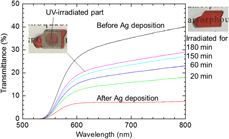
Glasses were prepared in systems based on two stoichiometric sulfides that were selected from Ga2S3, GeS2, and Sb2S3, with the incorporation of excess sulfur and CsCl. We investigated the fundamental properties, including glass transition, density, and optical absorption, and their variations with the incorporation of excess sulfur and CsCl into the pseudo two-component sulfide glasses. The incorporation of CsCl into the GeS2–Sb2S3 glasses shifted the absorption edge at the short-wavelength side to the long-wavelength direction, particularly for glasses with more amount of GeS2 than SbS3/2. In both cases of CsCl incorporation into the Ga2S3–GeS2 glass and Ga2S3–Sb2S3 glass systems, the absorption edges shifted to the short-wavelength direction regardless of the compositions. Ag photodoping behaviors were investigated for the bulk sulfide glasses with excess sulfur and CsCl. The results are discussed based on the diffusion of silver in the glass network that is modified by the incorporation.
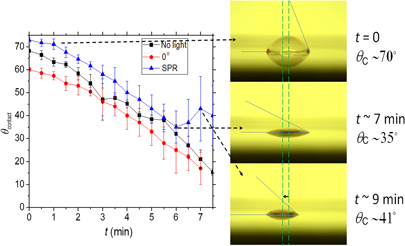
Excitation of surface waves on conducting materials provides a near resistance-free interface capable of a material glissade either by plasmon forces or by optical beam tractors. Analogous to an ice hockey rink, as proof-of-principle plasmon-assisted optical traction, or hoovering, of water drops on a gold surface is demonstrated. Changes in the contact angle provide a novel, low-cost nanoscale method of quantifying observable and potentially tunable changes. Variability in thresholds and movement, including jumps, is observed and can be explained by the presence of significant roughness, measured by scanning electron microscopy, with water tension. The demonstration opens a path to directly integrate various optical and plasmonic traction technologies. Implications of the phenomena and ways of improving transport and potential applications spanning configurable microfluidics, antennas, tunable lenses, diagnostics, sensing, and active Kerr and other devices are discussed.
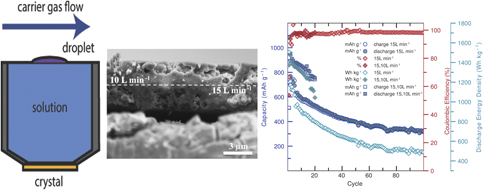
Porosity-graded, conductor- and binder-free porous FeS2 films through the entire thickness were deposited by spray pyrolysis. The film layers deposited at 15 versus 10 L/min are grown in different modes. The film layer deposited at 15 L/min showed Frank–van der Merwe layer-like growth mode whereas the one deposited at 10 L/min showed island growth mode. These growth modes lead to the formation of large pores on the electrolyte side and small ones on the substrate side of the film deposited using 15 and 10 L/min, sequentially. The porosity-graded films showed discharge capacities at C/10 of 879 mA h/g and 754 mA h/g for the 5th and 20th cycles, respectively. Such capacity values are superior to the literature findings for FeS2 powders and nongraded films mixed with conductor and binder additions.
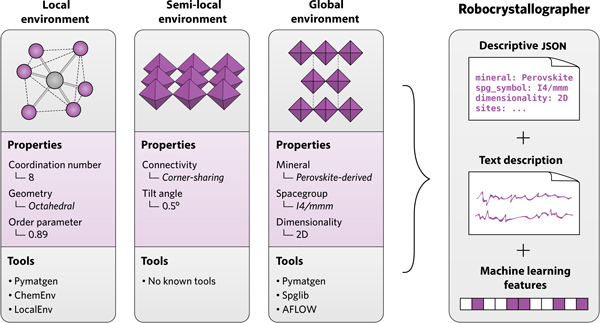
Our ability to describe crystal structure features is of crucial importance when attempting to understand structure–property relationships in the solid state. In this paper, the authors introduce robocrystallographer, an open-source toolkit for analyzing crystal structures. This package combines new and existing open-source analysis tools to provide structural information, including the local coordination and polyhedral type, polyhedral connectivity, octahedral tilt angles, component-dimensionality, and molecule-within-crystal and fuzzy prototype identification. Using this information, robocrystallographer can generate text-based descriptions of crystal structures that resemble descriptions written by human crystallographers. The authors use robocrystallographer to investigate the dimensionalities of all compounds in the Materials Project database and highlight its potential in machine learning studies.
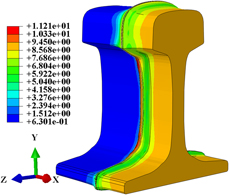
Oxide inclusions such as gray spots are the main defects caused by rail flash butt welding (FBW). An appropriate temperature field and upsetting process are essential for the extrusion of joint impurities. This study constructed a thermomechanical coupling model for the solid-state upsetting process of rail FBW through a combination of finite element simulation and experiment. Subsequently, the effects of different temperature fields and upsetting parameters on the extrusion behavior of impurities were studied. The results show that when the lateral deformation of the joint is not considered, selecting the appropriate upsetting length and increasing the width of the high-temperature plastic zone are beneficial for the extrusion of harmful impurities. Moreover, using variable speed upsetting or increasing the speed of the early upsetting facilitates the extrusion of impurities. However, the impurities in the deeper areas of the rail are difficult to move, and they easily form gray spot defects if the oxide inclusions remain.
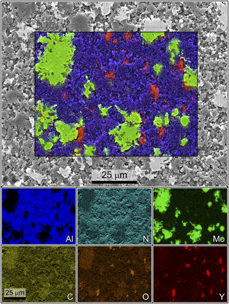
Microstructural analysis and bulk dielectric property analysis (real and imaginary permittivity at 95 GHz) were performed at temperatures ranging from 25 to 550 °C for ceramic composites comprising a hot-pressed aluminum nitride matrix (containing yttria and trace carbon as sintering additives) with molybdenum powder as a millimeter-wave radiation-absorbing additive. Loading percentages in the range of 0.25 vol% to 4.0 vol% Mo were characterized. For the temperature regime evaluated, the temperature-related changes in real and imaginary components of permittivity were found to be relatively modest compared with those driven by Mo loading. Energy-dispersive X-ray spectroscopic analysis of Mo grains and surrounding regions showed the presence of a mixed-phase layer, containing Mo2C, at the AlN–Mo interface. The Mo2C-containing mixed-phase layer, typically a few micrometers thick, surrounded the Mo grains. Further characterization of this mixed-phase layer is required to determine its contribution to the dielectric properties of the composite.
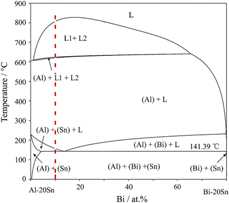
Under conventional solidification conditions, immiscible alloy melt would undergo large-scale composition segregation after liquid–liquid phase separation, resulting in the loss of properties and application value. In the present study, the ternary immiscible Al70Bi10Sn20 alloy was chosen to study the effect of cooling rate on its resultant microstructure by casting the melt under different cooling conditions. The results indicated that the Al–Bi–Sn alloy with a slow cooling rate exhibits a strong spatial phase separation trend during solidification. However, as the cooling rate increases, the decreasing volume fraction of the segregated Bi–Sn-rich regions indicates the efficient suppression of spatial phase separation. The relatively dispersed distribution of Bi–Sn phase in the Al-rich matrix can be obtained by quenching the melt into water. The influence mechanism of cooling rate on the microstructure of the alloy is also discussed. The present study is beneficial to further tailoring the microstructure of immiscible alloys.
In the previous chapter, some background was provided about types of reinforcement and their distribution within different matrices. Attention is now turned to predicting the behaviour of the resulting composites. The prime concern is with mechanical properties. The reinforcement is usually designed to enhance the stiffness and strength of the matrix. The details of this enhancement can be rather complex. The simplest starting point is the elastic behaviour of a composite with aligned long (continuous) fibres. This arrangement creates high stiffness (and strength) in the fibre direction. However, it is also important to understand the behaviour when loaded in other directions, so the treatment also covers transverse loading. In this chapter, and in the following one, perfect bonding is assumed at the fibre/matrix interface. Details concerning this region, and consequences of imperfect bonding, are considered in Chapter 6.
Composites are essentially materials comprising two or more distinct constituents, integrated into a single entity. An important aspect of composite theory concerns the properties that the material exhibits, expressed in terms of those of the constituents and the architecture of the integration. A case of interest is that of a two-constituent system in which one of them is just a void – possibly a vacuum, although more commonly a gas phase. Of course, voids have properties that are substantially different from those of constituents in conventional composites. For example, the stiffness will be effectively zero and the conductivity will tend to be very low. In practice, many materials contain at least some porosity, with the potential to affect certain properties, but in most cases it would not be considered appropriate to classify them as composites. However, very high porosity levels (say, >~30–40%) can justify treatment as a separate type of (composite) material. Sometimes the term ‘foam’ is used in such cases, although the word does carry connotations that would not necessarily apply to all highly porous materials. In this chapter, some composite theory approaches are applied to such materials and information is provided about their ‘microstructure’ (pore architecture), production and potential benefits.
In this chapter, an overview is provided of the types of fibre and matrix in common use and of how they are assembled into composites. Many types of reinforcement, mostly fibres, are available commercially. Their properties are related to atomic structure and the presence of defects, which must be controlled during manufacture. Matrices may be based on polymers, metals or ceramics. Choice of matrix is usually related to required properties, component geometry and method of manufacture. Certain composite properties may be sensitive to the nature of the reinforcement/matrix interface; this topic is covered in Chapter 7. Properties are also dependent on the arrangement and distribution of fibres, i.e. the fibre architecture, an expression that encompasses intrinsic features of the fibres, such as their diameter and length, as well as their volume fraction, alignment and spatial distribution. Fibre arrangements include laminae (sheets containing aligned long fibres) and laminates that are built up from these. Other continuous fibre systems, such as woven configurations, are also covered. Short fibre systems can be more complex and methods of characterising them are also briefly described.
Advanced courses in Applied Crystallography for Nanosciences are not often delivered in Academia and, consequently, require the organization of events specifically tailored to PhD students, postdocs, and young researchers at the very beginning of their scientific careers.