To save content items to your account,
please confirm that you agree to abide by our usage policies.
If this is the first time you use this feature, you will be asked to authorise Cambridge Core to connect with your account.
Find out more about saving content to .
To save content items to your Kindle, first ensure no-reply@cambridge.org
is added to your Approved Personal Document E-mail List under your Personal Document Settings
on the Manage Your Content and Devices page of your Amazon account. Then enter the ‘name’ part
of your Kindle email address below.
Find out more about saving to your Kindle.
Note you can select to save to either the @free.kindle.com or @kindle.com variations.
‘@free.kindle.com’ emails are free but can only be saved to your device when it is connected to wi-fi.
‘@kindle.com’ emails can be delivered even when you are not connected to wi-fi, but note that service fees apply.
To describe the design and psychometric assessment of the Adolescent Home Food Environment Questionnaire (Acronym in Portuguese: QAAD).
Design:
This was a cross-sectional study. Data were collected between August 2021 and January 2022 through self-administered questionnaires via a survey management application accessible by computer or smartphone. The instrument was subjected to analysis by a panel of experts and to a pretest that enabled the adjustment of the language and the reformulation of the questions. The psychometric evaluation included the assessment of test–retest reliability (intraclass correlation coefficient), internal consistency (composite reliability), structural validity (exploratory structural equation modelling and confirmatory factor analysis) and construct validity (Mann‒Whitney test; P< 0·05). The following food environment aspects were evaluated: family eating practices, food availability and accessibility, cooking equipment availability and parental feeding style. Moreover, the weekly frequency of fruit, bean and added sugar beverage consumption was assessed.
Setting:
A public high school in Rio de Janeiro, Brazil.
Participants:
14-to-19-year-old students (n 34 in the test‒retest reliability study; n 501 in the validation analysis).
Results:
The final version of the QAAD included thirty-two questions allowing the assessment of seven dimensions of the home food environment. The QAAD demonstrated satisfactory reliability (ICC ranging from 0·44 to 0·78), adequate internal consistency (composite reliability > 0·70) and satisfactory structural and construct validity.
Conclusions:
The careful QAAD design provided a valid, reliable and consistent instrument for characterising adolescents’ home food environments, which may provide information for tailoring and targeting healthy eating promotion actions aimed at adolescents.
This repeated cross-sectional study assessed the validity and reproducibility of the myfood24® dietary assessment tool against dietary intake biomarkers in healthy Danish adults. The study included 71 healthy adults (14/57 m/f), aged 53.2 ± 9.1 years with an average BMI of 26.1 ± 0.3 kg/m2. Participants were instructed to complete seven-day weighed food records using myfood24® at baseline and 4 ± 1 weeks thereafter. Estimated mean dietary intake was compared with objective measures of energy metabolism and selected dietary intake biomarkers in fasting blood (folate) and in 24-hour urine (urea, potassium). Resting energy expenditure was measured by indirect calorimetry. Application of the Goldberg cut-off classified 87% (n = 62) of participants as acceptable reporters. A strong Spearman’s rank correlation was observed between total folate intake and serum folate (ρ = 0.62). Acceptable correlations were noted for serum folate (ρ = 0.49) and urinary potassium excretion (ρ = 0.44) with estimated and measured protein intake (ρ = 0.45); energy intake and total energy expenditure (ρ = 0.38); potassium intake and potassium excretion (ρ = 0.42); and estimated fruit and vegetable intake. Reproducibility analysis revealed strong correlations (ρ ≥ 0.50) across most nutrients and food groups, except for fish and vitamin D (ρ = 0.30 and ρ = 0.26, respectively). Notably, reproducibility for folate and total vegetable intake exhibited the highest correlations (ρ = 0.84 and ρ = 0.78, respectively). In conclusion, while some limitations exist, myfood24® remains a useful tool for ranking individuals by intake, particularly in studies focusing on relative comparisons.
This study investigated how the belief systems and interests of policy actors shaped their framing of the causes and solutions to obesity and how this influenced policy recommendations.
Design:
Submissions to the Select Committee on Obesity Epidemic in Australia (SCOEA) were collected, and actors were classified according to their interests in commercial and non-commercial groups. A framework grounded in social constructionism was used to code frames and underlying belief systems. The SCOEA report was analysed to identify the representative distribution of belief systems in recommendations.
Setting:
Australia.
Participants:
None.
Results:
150 submissions were collected and analysed. 120 submitters were actors with non-commercial interests, including governments (n 13), non-government organisations (n 49), civil society groups and citizens (n 24) and academia (n 34). Thirty submitters were actors with commercial interests including food industry representatives (n 23) and health enterprises (n 7). Conflicting belief systems in the framing of obesity were identified among policy actors, particularly between commercial and non-commercial groups. Non-commercial actors framed obesity in biomedical, lifestyle and socio-ecological terms, whereas commercial actors exclusively framed obesity as an issue of individual choices and proposed behavioural change interventions. A broad range of belief systems expressed by the submitters was represented in the SCOEA final report.
Conclusion:
These findings illustrate how policy actors’ beliefs and interests shaped their frames and influenced the development of a key policy report. Policymakers seeking to advance obesity prevention policy must critically evaluate strategic framing by various actors and ensure that policy decisions are evidence-based and aligned with health, equity and ecological perspectives.
Protein fermentation in the human gut is often associated with adverse health effects. Hence, understanding the fermentation characteristics of dietary undigested proteins is important for a comprehensive nutritional value of foods. This study investigated the protein fermentation kinetics of diet-derived proteins from thirty-one different foods using an in vitro model and human faecal inoculum. The undigested diet-derived protein substrate originated from porcine ileal digesta obtained from assessment of the digestible indispensable amino acid score (DIAAS) of the foods. Significant variations in fermentation kinetic parameters, particularly in maximum gas production rate (Rmax) and time to reach cumulative gas production (GP) from the substrate (TGPs), were observed. The Rmax ranged from 15·5 (se 0·7) ml/h for wheat bran-derived to 24·5 (se 0·9) ml/h for oatmeal-derived proteins. Egg-derived proteins had the shortest TGPs (14·7 (se 0·7) h), while mushroom-derived proteins had the longest (27·6 (se 7·1) h). When foods were categorised into five groups (‘animal protein’, ‘grains’, ‘legumes’, ‘fungi, algae and microorganisms’ and ‘others’), no significant differences were found in fermentation kinetics parameters. Samples were additionally incubated with porcine inoculum to assess potential donor-species effects. Human inoculum showed significantly lower Rmax, cumulative GP and microbiota turnover than porcine inoculum, indicating reduced fermentative activity. Linear regression analysis revealed correlations between human and porcine-derived inoculum only for Rmax (R2 = 0·78, P < 0·01) and TGPs (R² = 0·17, P < 0·05). These findings underscore the importance of using human inoculum in in vitro studies to better predict health implications of foods with DIAAS values.
To identify trajectories of Indonesian children and adolescent’s BMI-z scores between 1993 and 2014, examine whether the pattern differs by sex and assess associations with host, agent and environmental factors.
Design:
Longitudinal data were from the Indonesian Family Life Survey with up to five measurements of height and weight. Group-based trajectory models investigated changes in BMI-z score across time; differences by sex were investigated using random effect (mixed) models. The association between the trajectories and host, agent and environmental factors were examined using multinomial logistic regression.
Setting:
Thirteen provinces in Indonesia.
Participants:
Indonesian children and adolescents aged 6–18 years (n 27 394 for BMI-z trajectories; n 8805 for risk factor analyses).
Results:
Mean BMI-z score increased from –0·743 sd in 1993 to –0·414 sd in 2014. Four distinct trajectory groups were estimated with mean BMI-z increasing more rapidly in the most recent time periods. One group (11·7 % of participants) had a mean BMI-z entirely within the moderately underweight range; two had trajectories in the normal range and one (5·6 %) had a mean BMI-z starting in the overweight range but within the obesity range by 2014. There were differences in trajectory groups by sex (P< 0·001). Those born in 2000s, frequent consumption of meat, fast foods, soft drinks and fried snacks, and living in urban areas were associated with rapid gain weight.
Conclusions:
These trajectories highlight the double burden of malnutrition and suggest that the prevalence of overweight and obesity is likely to increase substantially unless public health interventions are implemented.
Several dietary strategies are designed to achieve optimal glycaemic control in managing gestational diabetes mellitus (GDM), considering factors such as energy needs, the glycaemic index, high fibre content and the reduction or exclusion of sugary foods and drinks. However, in achieving therapeutic goals, there is a lack of consensus in the formulation of uniform recommendations. This article reviews the literature to assess the impact of dietary interventions on GDM risk – measured by the percentage of at-risk women who develop GDM – and on the progression of GDM pregnancies, including weight gain, hyperglycaemia severity, insulin requirements and perinatal outcomes such as macrosomia, hypertensive disorders, caesarean delivery and neonatal size. We conducted a thorough search of PubMed and the Cochrane Library, focusing on randomised controlled trials, cohort studies, systematic reviews and meta-analyses involving women either at risk of or diagnosed with GDM. These search criteria yielded 2800 articles, whose titles and abstracts were reviewed to determine their relevance to the research objective. In the initial search, 192 relevant articles met the inclusion criteria. The comprehensive analysis of these studies highlights the current uncertainty regarding the long-term consequences of recommended diets during pregnancy, especially among women with GDM. While the available literature is substantial, conclusions drawn from various methodologies and study populations have not yielded a consensus on the most effective diet for reducing perinatal complications. Nonetheless, it is reasonable to advocate for the early initiation of dietary interventions, particularly during pregnancy planning, especially among women exhibiting risk factors for GDM.
The marketing of foods and non-alcoholic beverages (hereafter: food) high in fat, salt and/or sugar (HFSS) is implicated in the development of poor dietary habits, overweight and obesity. Digital media, including video game live streaming platforms (VGLSP), are an increasingly prominent source of food marketing exposure, particularly for young people. This study aimed to experimentally examine the impact of food marketing via VGLSP on eating behaviour in young people.
Design:
A between-subjects randomised controlled trial design was used to explore the impact of exposure to HFSS food marketing in a video game live stream (a static food banner advert present throughout the footage) on immediate consumption of the marketed snack and an ‘alternative brand’ of the same snack in a sample of adolescents (n 91, Mage = 17·8, 69 % female). Relationships with food-advertising-related attentional bias and inhibitory control in relation to branded food cues were also examined.
Setting:
University Psychology laboratory.
Results:
Exposure to HFSS food marketing, compared with non-food marketing, did not significantly impact immediate marketing or overall snack intake. Additionally, no significant effects for attentional bias or inhibitory control were found. However, although the overall model was non-significant, greater weekly use of VGLSP was significantly associated with greater marketed snack intake.
Conclusions:
Findings suggest that while acute exposure to food marketing in VGLSP did not impact snack intake, perhaps more sustained exposure is impactful. Further exploration of this effect is needed, as well as studies investigating the potential impacts of other food marketing formats within VGLSP.
The health benefits of the long-chain omega-3 polyunsaturated fatty acids (PUFA), eicosapentaenoic acid (EPA) and docosahexaenoic acid (DHA) have been known for over 50 years and underpin the UK population recommendation to consume >450 mg EPA + DHA per day. These recommendations, last revised in 2004, are based mainly on epidemiological evidence. Much research has been conducted in the interim. Most randomised controlled trials (RCT) use doses of EPA + DHA of 840 mg/d or more. For anti-inflammatory, triacylglycerol-lowering and anti-hypertensive effects, >1.5 g EPA + DHA per day is needed. Cognitive benefits are also likely to require these higher intakes. Farmed salmon now contains considerably less EPA + DHA relative to farmed fish of 20 years ago, meaning one portion per week will no longer provide the equivalent of 450 mg EPA + DHA per day. Oily fish alone can only provide a fraction of the EPA + DHA required to meet global needs. Furthermore, there is low global oily fish consumption, with typical intakes of <200 mg EPA + DHA per day, and limited intakes in vegans and vegetarians. Therefore, there is an urgent need for affordable, acceptable, alternative EPA + DHA sources, including vegan/vegetarian friendly options, such as bio-enriched poultry, red meat and milk products; fortified foods; enriched oilseeds (for example, genetically modified Camelina sativa); algae and algal oils; and approaches which enhance endogenous EPA/DHA synthesis. In this narrative review, we suggest that current EPA + DHA intake recommendations are too low, consider EPA/DHA from a holistic health-sustainability perspective and identify research, policy and knowledge mobilisation areas which need attention.
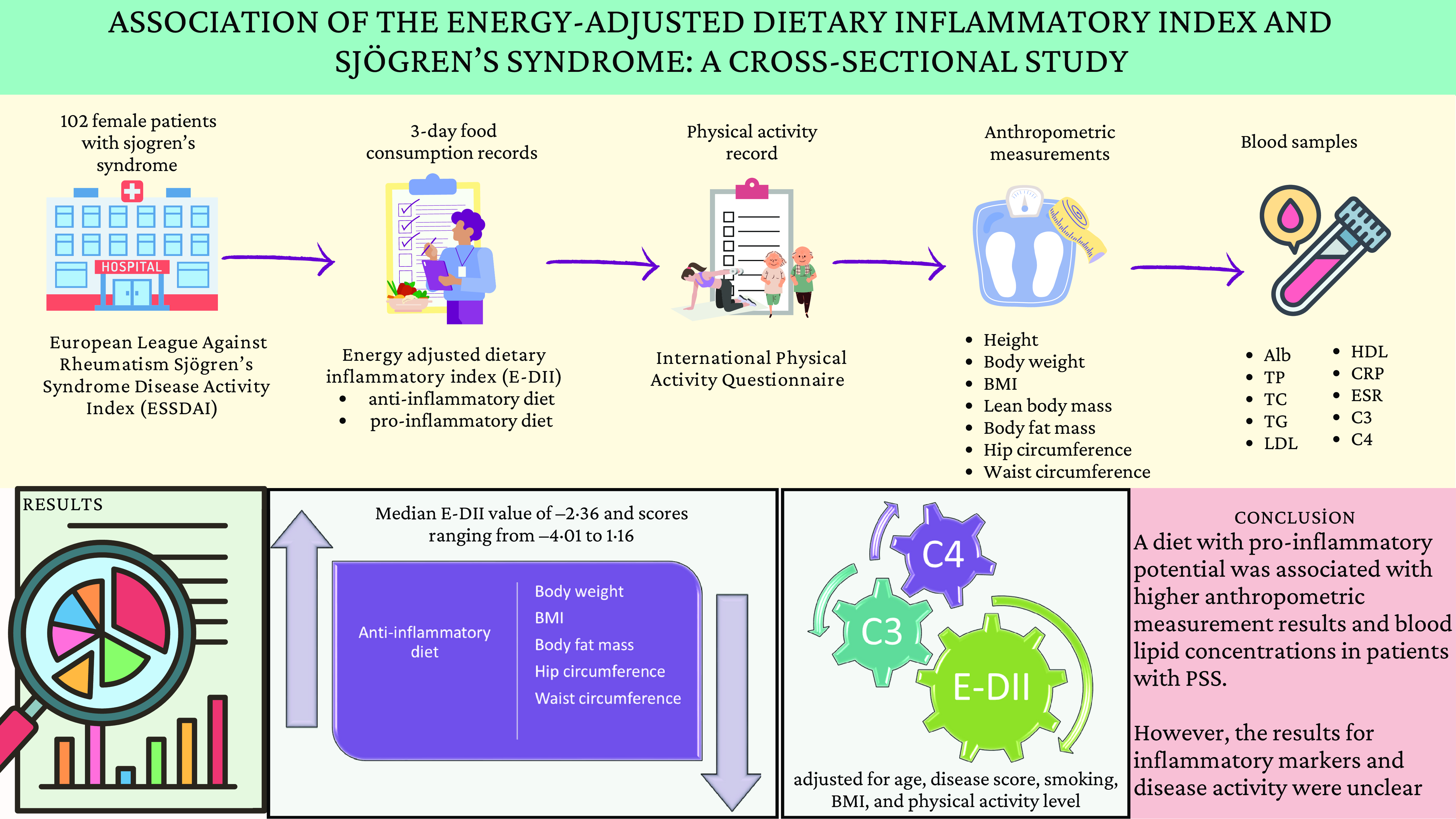
There are no studies in the literature examining the inflammatory content and effects of the diets of patients with primary Sjögren’s syndrome (PSS). This study aimed to investigate the relationship between the Energy-Adjusted Dietary Inflammatory Index (E-DII) and anthropometric measurements, disease activity, inflammatory markers, and blood lipid concentrations in female patients with PSS. A cross-sectional study was conducted between November 2020 and November 2021, including 102 female patients with a confirmed diagnosis of PSS. Dietary intake was assessed using the multiple-pass, 3-day food record method to calculate E-DII scores. Physical activity was evaluated using the International Physical Activity Questionnaire (Short Form), anthropometric measurements were taken, and the European League Against Rheumatism Sjögren’s Syndrome Disease Activity Index (ESSDAI) was used to determine disease activity. Lipid profile and inflammatory markers were analyzed in blood samples. Patients had a median E-DII value of –2·36. An anti-inflammatory diet was associated with lower anthropometric measurements and reduced total cholesterol, triglycerides, and low-density lipoprotein cholesterol concentrations. Logistic regression analysis revealed a significant association between E-DII and complement C3 (OR: 1·03, 95 % CI: 1·00, 1·05, P = 0·021) and C4 (OR: 1·08, 95 % CI: 1·01, 1·13, P = 0·019) after adjusting for age, disease score, drug use for SS, smoking, and physical activity. However, no significant correlation was found between E-DII and ESSDAI scores, C-reactive protein, or erythrocyte sedimentation rate. In conclusion, a pro-inflammatory diet was associated with higher anthropometric measurements and adverse lipid profiles in PSS patients, but its relationship with disease activity and inflammation remains unclear.
Modern Western diets, characterised by a substantial proportion of kilocalories derived from ultra-processed foods (UPF), have been associated with systemic inflammation. This study examines the association between UPF consumption and inflammation, assessed through alterations in C-reactive protein (CRP) concentrations, among Brazilian adolescents. This is a cross-sectional study involving a sub-sample of 6316 adolescents aged 12–17 years, participants in the Study of Cardiovascular Risk in Adolescents (ERICA), from seven capitals in Brazil. Dietary intake was assessed using a 24-hour recall, and foods were categorised based on their degree of processing according to the NOVA classification. UPF consumption was then divided into quartiles. For CRP evaluation, blood samples were collected after a 12-hour fasting period and categorised as > 3 mg/l, indicating low-grade inflammation. Poisson regression models with robust variance were employed to assess the association between UPF consumption and high CRP concentrations. High UPF consumption (highest quartile, ≥ 44·9 % kcal/d) was slightly associated with a higher prevalence of CRP after adjusting for potential confounders (prevalence ratio = 1·039; 95 % CI: 1·006, 1·073), compared with those in the lowest quartile of UPF consumption. However, when evaluating different groups of UPF separately (such as sugary beverages, processed meats and sweets), the previous association was no longer observed. These findings suggest a modest association between overall UPF consumption and early indicators of unhealthy low-grade inflammation in adolescents. Further experimental and cohort studies are necessary to clarify the role of UPF in inflammatory processes.
Energy drinks (ED) can cause cardiovascular, gastrointestinal and other health disorders. These effects are particularly pronounced in youth. The aim of this study was to systematically review the literature on the consumption of ED in European countries.
Design:
A systematic bibliographic search was performed in November 2024 in EMBASE, MEDLINE (Ovid), Scopus and Cochrane databases with no restrictions on country, study period, study design and language.
Setting:
ED are beverages high in caffeine, sugar and other stimulants.
Participants:
A total of 2008 studies were identified and reviewed by four researchers. Ninety-four met the inclusion criteria and were extracted in a table designed ad hoc.
Results:
The included studies showed differences regarding their design, definition of consumption and time frame under study. The most studied frequency of ED consumption was weekly consumption, and the most studied population was school students. An increase in the prevalence of consumption was observed when tracking ED consumption over time. Variables most related to consumption were low socio-economic status, alcohol and tobacco consumption, physical activity, age and sex.
Conclusions:
It is difficult to have a clear picture of the extent of ED consumption in Europe, mainly due to differences in the design of the studies and the lack of periodicity of the estimates in different countries. However, given the health problems that have been associated with ED consumption, regulation of these beverages is essential, especially in youth.
This study aimed to evaluate the association between food addiction (FA), food environment and consumption of ultra-processed foods (UPF) in socially vulnerable women.
Design:
A population-based cross-sectional study was conducted in Favelas and Urban Communities of Maceió-Brazil. The availability of UPF in the food environment was evaluated through the audit of retailers with the support of the AUDITNOVA instrument. The women taking part in the study were interviewed, and a 24-hour food recall was used to assess the proportion of UPF in their diet. The modified Yale Food Addiction Scale 2.0 was also used to determine FA. Association analysis was performed using binary logistic regression and generalised estimation equations.
Participants:
1702 adult women of reproductive age (20–44 years) residents in Favelas and Urban Communities.
Results:
It was found that 14·6 % of the women had FA. The adjusted multivariate association analysis showed that the high availability of UPF in food retail increased the chance of women having FA by up to 47 % (P= 0·02 OR: 1·53; 95 % CI: (1·07, 2·18)). It was also possible to observe that the greater calorific contribution of UPF in the diet increased the chance of women presenting FA by up to 61 % (P< 0·01 OR: 1·39; 95 % CI: (1·48, 1·97)).
Conclusions:
The environment and what is available in it are associated with additive behaviour independent of individual factors, and UPF consumption increases the chance of FA. This demonstrates the need for changes in the food environment in Brazilian favelas, contributing to improving women’s health.
This study aims to investigate diet-related cancer risk awareness and behaviours among cancer survivors compared with non-cancer individuals.
Design:
It is a cross-sectional study initiated from the Health Information National Trends Survey (HINT).
Setting:
Relevant survey questions from different iterations of HINTS were harmonised. Chi-square test and logistic regression models were performed to identify differences in diet-related cancer risk awareness and behaviours between the two groups.
Participants:
Participants in the study were drawn from the HINT survey with various variables including age, gender, race/ethnicity, education, marital status and BMI.
Results:
The analysis revealed no significant differences in diet-related cancer risk awareness or behaviours between cancer survivors and non-cancer individuals. Those dietary factors included red and processed meat, alcohol, fibre, sugar-sweetened beverages, fruits and vegetables. Specifically, 82 % of both survivors and non-survivors failed to meet the American Cancer Society (ACS) recommendations for daily fruit consumption (OR = 0·91; 95 % CI = 0·77, 1·06), and approximately 75 % did not meet the daily vegetable intake guidelines (OR = 0·96; 95 % CI = 0·83, 1·11). The findings suggest that a cancer diagnosis does not inherently lead to improved dietary awareness or healthier eating behaviours.
Conclusion:
The lack of improvement in diet-related cancer risk awareness and behaviours among cancer survivors indicated missed education opportunities. The ‘teachable moment’ of cancer diagnosis was not effectively utilised, which highlighted a need for stronger guidance from healthcare providers. This gap may also reflect barriers, including limited training, time constraints and limited interprofessional collaboration among health professionals in delivering targeted dietary advice.
Previous observational studies suggested that vitamin D may control the absorption of iron (Fe) by inhibition of hepcidin, but the causal relevance of these associations is uncertain. Using placebo-controlled randomisation, we assessed the effects of supplementation with vitamin D on biochemical markers of Fe status and erythropoiesis in community-dwelling older people living in the UK. The BEST-D trial, designed to establish the optimum dose of vitamin D3 for future trials, had 305 participants, aged 65 years or older, randomly allocated to 4000 IU vitamin D3 (n 102), 2000 IU vitamin D3 (n 102) or matching placebo (n 101). We estimated the effect of vitamin D allocation on plasma levels of hepcidin, soluble transferrin receptor (sTfR), ferritin, Fe, transferrin, saturated transferrin (TSAT%) and the sTfR–ferritin index. Despite increases in 25-hydroxy-vitamin D, neither dose had significant effects on biochemical markers of Fe status or erythropoiesis. Geometric mean concentrations were similar in vitamin D3 arms v. placebo for hepcidin (20·7 [se 0·90] v. 20·5 [1·21] ng/ml), sTfR (0·69 [0·010] v. 0·70 [0·015] µg/ml), ferritin (97·1 [2·81] v. 97·8 [4·10] µg/l) and sTfR–ferritin ratio (0·36 [0·006] v. 0·36 [0·009]), respectively, while arithmetic mean levels were similar for Fe (16·7 [0·38] v. 17·3 [0·54] µmol/l), transferrin (2·56 [0·014] v. 2·60 [0·021] g/dl) and TSAT% (26·5 [0·60] v. 27·5 [0·85]). The proportions of participants with ferritin < 15 µg/l and TSAT < 16 % were unaltered by vitamin D3 suggesting that 12 months of daily supplementation with moderately high doses of vitamin D3 are unlikely to alter the Fe status of older adults.
To determine the minimum cost and affordability of three levels of diet quality in urban households in Cali, Colombia: a caloric-adequate diet, a nutrient-adequate diet, and a recommended diet.
Design
Least-cost diets were estimated for different demographic groups. The Cost of Caloric Adequacy (CoCA) and the Cost of Nutrient Adequacy (CoNA) were computed using linear programming models. The Cost of Recommended Diet (CoRD) adheres to Colombia’s Food-Based Dietary Guidelines. Individualized costs were aggregated for a representative household, and affordability was assessed by comparing these costs with household food expenditures. Data sources included the National Administrative Department of Statistics, the Ministry of Health and Social Protection, and the Colombia Institute of Family Welfare.
Setting
Cali, Colombia
Participants
The per capita income and food expenditures of 885 urban households in Cali, taken from Colombia’s Great Integrated Household Survey.
Results
The CoNA per 1,000 kcal indicates that women require more nutrient-dense diets than men. Limiting nutrients include vitamin C, vitamin A, vitamin B12, and calcium. Three food groups ―(1) meat, eggs, legumes, nuts, and seeds; (2) milk and dairy products; and (3) vegetables and fruits― account for about 70% of the CoRD. The affordability analysis shows that 42.66% of households in the 10th income percentile cannot afford the CoCA, none below the 20th percentile can afford the CoNA, and only those above the 40th percentile can afford the CoRD.
Conclusions:
Urban households face significant barriers not only to affording diets that promote long-term health, but also to those that meet nutritional requirements.
Vitamins B6 (that is, pyridoxin and its analogues) and B7 (that is, biotin or vitamin H) are essential molecules for many physiological processes. In addition to their well-known involvement in several enzymatic reactions, recent discoveries revealed their participation in other processes, for example, in gene expression via epigenetic processes, such as biotinylation of proteins in the case of biotin. Plants, fungi, archaea and most bacteria synthesise both vitamins, whereas animals and humans lack enzymes for their biosynthesis and depend on their exogenous supply. At least in the case of biotin, human gastrointestinal microbiota can likely partly satisfy the need. Both vitamins are water soluble and require a transporter for efficient absorption after oral administration; they can be rapidly excreted; hence, they are considered largely non-toxic. In addition to physiological and kinetic aspects of vitamin B6 and biotin, this review, which is based on a search in PubMed up to 2023, covers sources of these vitamins, the impact of food treatment on their content, causes and symptoms of deficiency and specific mutations related to their function. Currently available literature on the analytical determination of these vitamins in biological fluids, possible pharmacological uses and symptoms of toxicity, although rare, are also included.
The purpose of this study was to measure meal quality in representative samples of schoolchildren in three cities located in different Brazilian regions using the Meal and Snack Assessment Quality (MESA) scale and examine association with weight status, socio-demographic characteristics and behavioural variables. This cross-sectional study analysed data on 5612 schoolchildren aged 7–12 years who resided in cities in Southern, Southeastern and Northeastern Brazil. Dietary intake was evaluated using the WebCAAFE questionnaire. Body weight and height were measured to calculate the BMI. Weight status was classified based on age- and sex-specific Z-scores. Meal quality was measured using the MESA scale. Associations of meal quality with weight status and socio-demographic and behavioural variables were investigated using multinomial regression analysis. Schoolchildren in Feira de Santana, São Paulo and Florianópolis had a predominance of healthy (41·8 %), mixed (44·4 %) and unhealthy (42·7 %) meal quality, respectively. There was no association with weight status. Schoolchildren living in Feira de Santana, those who reported weekday dietary intakes, and those with lower physical activity and screen activity scores showed higher meal quality. Schoolchildren aged 10–12 years, those who reported dietary intakes relative to weekend days, and those with higher screen activity scores exhibited lower meal quality.