To save content items to your account,
please confirm that you agree to abide by our usage policies.
If this is the first time you use this feature, you will be asked to authorise Cambridge Core to connect with your account.
Find out more about saving content to .
To save content items to your Kindle, first ensure no-reply@cambridge.org
is added to your Approved Personal Document E-mail List under your Personal Document Settings
on the Manage Your Content and Devices page of your Amazon account. Then enter the ‘name’ part
of your Kindle email address below.
Find out more about saving to your Kindle.
Note you can select to save to either the @free.kindle.com or @kindle.com variations.
‘@free.kindle.com’ emails are free but can only be saved to your device when it is connected to wi-fi.
‘@kindle.com’ emails can be delivered even when you are not connected to wi-fi, but note that service fees apply.
The RDA for dietary protein is likely insufficient for individuals with cystic fibrosis (CF). This study sought to characterise protein intake and diet quality in adults with cystic fibrosis (awCF), before and after elexacaftor/tezacaftor/ivacaftor (ETI) therapy, compared with healthy controls. Dietary intake was assessed by diet diary in awCF at baseline (BL, n 40) and at follow-up > 3 months post ETI therapy (follow-up (FUP), n 40) and in age-matched healthy controls (CON, n 80) free from known disease at a single time point. Protein intake dose and daily distribution, protein quality, protein source and overall diet quality were calculated for each participant. Both CON (1·39 (sd 0·47) g·kg–1·day–1) and CF (BL: 1·44 (sd 0·52) g·kg–1·day–1, FUP: 1·12 (sd 0·32) g·kg–1·day–1) had a higher mean daily protein intake than the protein RDA of 0·75g·kg–1·day–1. There was a significant reduction in daily protein intake in the CF group at FUP (P = 0·0003, d = 0·73), with levels below the alternative suggested dietary intake of ≥ 1·2 g·kg–1·day–1. There were no sex differences or noticeable effects on protein quality or source following the commencement of ETI therapy when compared with CON (all P > 0·05), although overall diet quality decreased between time points (P = 0·027, d = 0·57). The observed reduction in daily protein intake in the present cohort emphasises the importance of ensuring appropriate dietary protein intake to promote healthy ageing in adults with CF. More research is needed to evidence base dietary protein requirements in this at-risk population.
Diet quality has been linked to socio-economic status. However, evidence within rural and regional populations is lacking. This cross-sectional study examined the relationship between diet quality and socio-economic position in adults living in rural and regional areas of Australia. The Australian Recommended Food Score (ARFS; range 0–73) measured diet quality (total and subscale scores). Area-level socio-economic position was determined by postcode-linked socio-economic index for areas (SEIFA), Index of Relative Social Advantage and Disadvantage scores, stratified into quintiles. The mean total ARFS (34·7; sd = 9·1; n 836) was classified as ‘getting there’. Findings showed significantly lower mean total ARFS between SEIFA quintile 1 (1 = lowest; mean total ARFS = 30·4; sd = 10·2; categorised as ‘needs work’) compared with all other SEIFA quintiles (F (44 831) = 8·44, P ≤ 0·001). Linear regression, adjusting for age, sex, income, education, employment status and household composition demonstrated significantly lower overall diet quality for SEIFA quintile 1 compared with SEIFA quintile 3 (B = –3·9; 95 % CI (–6·2, −1·5); P < 0·001) and lower subscale scores for vegetables (B = –1·6; 95 % CI (–2·7, −0·6); P = 0·003), fruit (B = –0·9; 95 % CI (–1·6, −0·1); P = 0·018) and grains (B = –0·6; 95 % CI (–1·3, −0·0); P = 0·050). After adjusting for individual confounders of diet quality, results indicate that lower area-level socio-economic position remained associated with poorer diet quality in this sample of rural and regional Australian adults. This suggests that broader social and environmental factors unique to these areas may impact diet quality and amplify individual barriers to achieving a healthy diet.
Legume lectins represent a broad class of environmental toxicants that bind to cell surface glycoproteins. Raw red kidney beans (RRKB), a widely consumed common source of dietary protein, are rich in the lectin phytohemagglutinin (PHA). Consumption of improperly cooked (which may require overnight presoaking and boiling at least at 100°C for 45 min) red kidney beans causes severe gastrointestinal symptoms. Since the relationship between lectin toxicity and the cellular chaperone machinery remains unknown, the study aimed to determine the effects of heat-denatured PHA on epithelial barrier function and heat shock protein 70 (HSP70) expression and its function as a molecular chaperone in PHA-treated Caco-2 cells and animals. Twelve male Sprague-Dawley rats were randomised to an ad libitum diet of either standard rat chow or chow containing 26% crude red kidney beans. We measured HSP70 and heat shock factor 1 gene expressions in the small intestine and HSP70 protein expression in Caco-2 cells. In Caco-2 cells, luciferase activity was measured to investigate protein folding. Fluorescein-5-isothiocyanate (FITC)-labelled lectin was used to study its intracellular uptake by Caco-2 cells. PHA lectin reduced transepithelial electrical resistance in Caco-2 cells. FITC-labelled PHA entered Caco-2 cells within 3 h of treatment. PHA treatment significantly reduced HSP70 levels and luciferase activity in Caco-2 cells, which was prevented by HSP70 overexpression. In rats fed RRKB chow consisting of legume lectins, we found reduced levels of HSP70 and heat shock factor 1. These observations suggest that lectins counter the protective function of HSP70 on intestinal barrier function.
Sessile serrated lesions (SSL) are recognised precursors to colorectal cancer. Little is known about risk factors for SSL due to their relatively recent clinical recognition as a cancer precursor and routine documentation of cases. Lifestyle and diet-related information were collected using validated questionnaires in a colonoscopy-based case–control study in Australia (257 SSL cases, 239 conventional adenoma (CA) cases, 180 polyp-free controls). A posteriori dietary patterns were derived from self-reported dietary intake in the past 12 months using principal component analysis. Multivariable-adjusted OR and 95 % CI were used to examine associations between lifestyle factors and dietary patterns on risk of SSL and CA v. polyp-free controls and SSL v. CA using logistic regression modelling. Use of anti-inflammatory medications was associated with reduced SSL risk (OR = 0·61; 95 % CI 0·38, 1·00), while current smoking was associated with increased SSL risk (OR = 1·96; 95 % CI 1·09, 3·53). Unlike CA, SSL risk was not increased by hormone replacement therapy use and current alcohol consumption but was increased by taller height. Higher adherence to a dietary pattern featuring processed meats, ready-made convenience foods and high-energy drinks was associated with increased SSL risk (OR = 2·13; 95 % CI 1·13, 4·00; Ptrend = 0·03) and CA (OR = 2·60; 95 % CI 1·32, 5·09; Ptrend = 0·005). Compared with CA, a dietary pattern featuring wholegrains, low-fat dairy products, nuts, seeds and oily fish was associated with reduced SSL risk (OR = 0·60; 95 % CI 0·36, 0·98; Ptrend = 0·04). This study supports a healthy diet as primary prevention for both SSL and CA and reinforces smoking as a risk factor for SSL.
Vitamin A deficiency (VAD) poses significant health risks and is prevalent in children and adolescents in India. This study aimed to determine the effect of seasonal variation and availability of vitamin A-rich (VA-rich) foods on serum retinol in adolescents. Data on serum retinol levels from adolescents (n 2297, mean age 14 years) from the Comprehensive National Nutrition Survey (2016–2018) in India were analysed, with VAD defined as serum retinol < 0·7 µmol/L. Five states were selected based on a comparable under-five mortality rate and the seasonal spread of the data collection period. Dietary data from adolescents and children ≤ 4 years old were used to assess VA-rich food consumption. A linear mixed model framework was employed to analyse the relationship between serum retinol, month of the year and VA-rich food consumption, with a priori ranking to control for multiple hypothesis testing. Consumption of VA-rich foods, particularly fruits and vegetables/roots and tubers, showed seasonal patterns, with higher consumption during summer and monsoon months. Significant associations were found between serum retinol concentrations and age, month of sampling, consumption of VA-rich foods and fish. VAD prevalence was lowest in August, coinciding with higher consumption of VA-rich fruits and foods. Findings highlight the importance of considering seasonality in assessing VAD prevalence and careful interpretation of survey findings. Intentional design, analysis and reporting of surveys to capture seasonal variation is crucial for accurate assessment and interpretation of VAD prevalence, including during monitoring and evaluation of programmes, and to ensure that public health strategies are appropriately informed.
Nut consumption is low, with concern regarding weight gain as a barrier to intake. However, evidence indicates no association between nut consumption and body weight. The metabolisable energy of nuts may partly explain this phenomenon. This study aims to qualitatively explore perceptions of presenting nut metabolisable energy on nutrition labels, and the potential influence this may have on consumption.
Design:
Semi-structured focus groups and interviews, with an inductive, reflexive approach to thematic analysis.
Setting:
Online (Australia).
Participants:
18 years or older, with either no formal nutrition education (consumer group) or formal training and working in nutrition/dietetics, public health, food industry, food regulation or nut growing (stakeholder group).
Results:
Four focus groups and nine interviews consisting of twenty participants (n 8 consumers, n 12 stakeholders) in total were conducted. Five major themes were generated: (i) knowledge of nuts varies, and the healthfulness of nuts is conditional on use and preparation, (ii) nuts are versatile in the diet; the intake is low, (iii) consumers perceive over-eating nuts leads to weight gain, while stakeholders consider the whole dietary pattern, (iv) nutrition labelling is confusing for consumers and needs to be transparent and positively framed, if used and (v) knowing nut metabolisable energy will have limited perceived impact on nut consumption and advice and is dependent on the individual and product.
Conclusions:
The findings suggest that perceptions of presenting nut metabolisable energy on labels are multi-layered, indicating this strategy may not be straightforward in resolving concerns about weight. Other strategies should be considered to promote nut consumption.
The composite dietary antioxidant index (CDAI) has been identified as a critical factor in the pathogenesis of certain inflammatory diseases. The study aimed to investigate the relationship between CDAI and Helicobacter pylori infection using cross-sectional design. In this study, participants from the 1999–2000 National Health and Nutrition Examination Survey were analysed using logistic and Cox regression analyses to assess the associations between H. pylori infection and CDAI, encompassing vitamin A, vitamin C, vitamin E, carotene, Zn, Se and Cu. The results demonstrated a negative correlation between CDAI scores and H. pylori infection, revealing a non-linear relationship between the odds of H. pylori infection and CDAI as a continuous variable. Subsequently, a two-sample Mendelian randomisation study was conducted utilising genome-wide association study summary statistics to explore the causal relationship between antioxidant levels and H. pylori infection. We found that the intake of Cu was a protective factor in the occurrence of H. pylori infection but did not support a causal association between circulating Cu levels and H. pylori infection. The prevalence of H. pylori infection was found to be elevated among individuals of older age, lower education levels, limited socio-economic status, smokers, diabetes and those with hypertension. The study suggests that higher CDAI is linked to decreased odds of H. pylori infection, and further prospective studies are needed to confirm the association. Our findings may have significant implications for the prevention and management of H. pylori-related diseases.
Current food systems pose risks to both population and environmental health. Reducing the intake of animal-based foods, such as dairy products, and increasing consumption of plant-based foods align with priorities for addressing climate change and promoting overall health. Plant-based alternatives to cow’s milk can be readily substituted for cow’s milk without altering meal patterns and food habits, making them a popular choice among those reducing animal-product consumption. However, plant-based milk alternatives do not necessarily provide the same nutrients as cow’s milk, particularly essential micronutrients like iodine. While national data indicate that the UK is iodine-replete, certain population subgroups (such as pregnant women, women of reproductive age, and vegans) remain at risk of iodine deficiency. Young women are more likely than other age groups to consume plant-based milk alternatives, heightening public health concerns about iodine insufficiency in this demographic. Current consumers of plant-based milk alternatives in the UK have lower iodine intake and status compared to consumers of cow’s milk. Population-level effects of replacing milk with plant-based alternatives vary and depend on factors such as the role of plant-based milk alternatives in the diet (i.e. in addition to, or as a replacement for milk), the presence of other iodine sources in the diet, the consumer’s life stage, and whether the alternatives are fortified with iodine. This review examines the literature on plant-based milk alternatives and iodine intake, focusing on implications of this dietary shift and strategies to improve iodine intake in those opting for plant-based milk alternatives in the UK population.
To identify politico-economic factors relating to policy surrounding the production, processing and trade of sugar in Indonesia and identify strategies to support improved integration of national nutrition and food security priorities with respect to sugar.
Design:
This study was a qualitative policy analysis, informed by political economy and power analysis approaches and drawing on both documentary policy data and interviews.
Setting:
Indonesia.
Participants:
Interviewees from various national and sub-national government and non-government sectors, with expertise in health and food safety (n 7), finance and economics (n 2), trade and industry (n 3) and others (n 4).
Results:
Sugar was articulated as a policy priority in three distinct ways: (1) sugar as an economic good; (2) sugar in relation to health and (3) sugar as a commodity for food security. High political priority was given to national economic development, as well as concerns relating to farmer rights and welfare. Nutrition priorities and objectives to reduce sugar consumption were addressed in health policies; however, they were not reflected in production and economic policies promoting sugar.
Conclusions:
Creating opportunities to diversify agricultural production and ensuring a just transition to protect the livelihoods of sugar farmers in Indonesia will be crucial in enabling the achievement of nutrition priorities to reduce sugar consumption.
Manganese (Mn) is a crucial trace element that actively participates in a diverse array of physiological processes. Mn is maintained at appropriate levels in the body by absorption and excretion by the body. Dysregulation of Mn homeostasis can lead to a variety of diseases, especially the accumulation of Mn in the brain, resulting in toxic side effects. We reviewed the metabolism and distribution of Mn at multiple levels, including organ, cellular and sub-cell levels. Mitochondria are the main sites of Mn metabolism and energy conversion in cells. Enhanced Mn superoxide dismutase activity reduces mitochondrial oxidative stress and inhibits cancer development. In addition, Mn enhances anti-cancer immune responses through the cGAS–STING pathway. We introduced various delivery vectors for Mn delivery to cancer sites for Mn supplementation and anti-cancer immunity. This review aims to provide new research perspectives for the application of Mn in the prevention and treatment of human diseases, especially by enhancing anti-cancer immune responses to inhibit cancer progression.
To assess the degree to which cohabiting couples (men and women) in Cameroon responded differently to the Food Insecurity Experience Scale and, where discordance exists, to test hypothesised drivers of difference.
Design:
This cross-sectional study employed descriptive statistics and multivariable regression analyses using R.
Setting:
Nationally representative sample of cohabiting adults in Cameroon.
Participants:
2889 couples (male/female; 5778 total adults) from the Cameroon Demographic and Health Survey (2018) couples recode.
Results:
Food insecurity was more prevalent and reported with higher severity among men compared with women. Discordance in reported food insecurity was evident in 57–79 % of cohabiting couples in the dataset, depending on the measure used. Discordance was not clearly associated with household wealth. Further, among couples with discordant food insecurity experiences, men more often affirmed items that their partners did not affirm. Contrary to our hypotheses, items reflecting household food security did not show greater agreement among couples than did individual items. Of our hypothesised predictors, only current employment status among men was significantly associated with the difference in food security scores among couples.
Conclusions:
This study highlights the importance of examining intrahousehold differences in food security. Understanding how individuals within a household experience and perceive their food situation and the underlying factors driving disparities is crucial for improving the effectiveness of targeted food and nutrition policies.
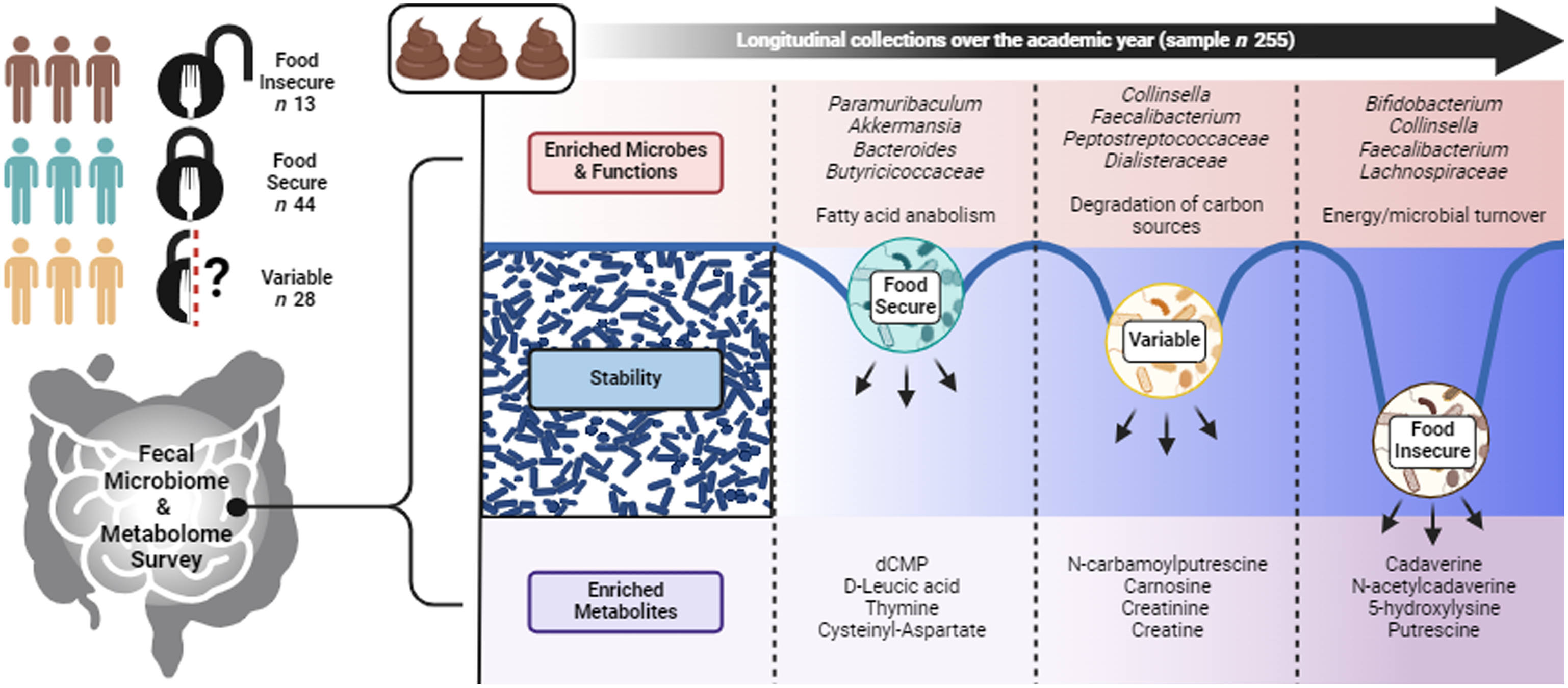
Food insecurity affects the health of college-aged individuals, but its impact on the gut microbiome (GM) over time is poorly understood. This study explored the association between food insecurity and the GM in eighty-five college students, identifying microbial taxa, metabolites and pathways linked to food security status and examining GM stability and microbe–metabolite interactions. Longitudinal GM and metabolomic data were collected from first-year students over an academic year, encompassing periods of variable food security status. Participants were categorised into three groups: food insecure (FI, n 13), food secure (FS, n 44) and variable (VAR, n 28) status. GM composition varied significantly between FS classifications (Bray–Curtis dissimilarity, P ≤ 0·005). Stability analysis revealed correlations between stability scores and microbial features, pathways and metabolites. Specific microbes (e.g. Bifidobacterium species, Faecalibacterium prausnitizii D and Lachnospiraceae), pathways (energy and microbial turnover) and metabolites (cadaverine, N-acetylcadaverine, putrescine, testosterone sulfate and creatine) associated with FI status were identified. Multi-omic integration revealed metabolic pathways influenced by differentially abundant microbial species and co-occurring fecal metabolites in FI participants related to the microbial production of polyamines, detoxification and energy metabolism. The transition from FS to FI showed no significant differences at specific taxonomic, functional or metabolite levels. This study uncovers complex interactions between food security, GM composition and metabolism. Significant differences were found in microbial community variability and metabolic pathways associated with food security status, but the transition from food security to insecurity disrupted the GM without clear taxonomic or functional distinctions, emphasising the need for further research into these mechanisms.
This study aims to assess consumer preferences for fifteen proposed front-of-package ‘Healthy’ label candidates under the Food and Drug Administration’s (FDA) of the US updated guidelines for the ‘Healthy’ label. The goal of this study is to identify which label designs best align with consumer preferences, thereby supporting the FDA’s efforts to promote healthier dietary choices through effective labelling.
Design:
A best-worst scaling (BWS) experiment was conducted using a balanced incomplete block design to assess consumer preferences for the fifteen FDA-proposed ‘Healthy’ labels. Participants completed fifteen best-worst scaling choice tasks where they identified the ‘best’ and ‘worst’ design from three randomly presented options in each task.
Setting:
The experiment was conducted in a controlled laboratory setting in the USA.
Participants:
Three hundred and eight US adult consumers who are primary household shoppers without dietary restrictions.
Results:
Results from the random parameter logit model indicate that labels 12 and 8 emerged as the most preferred designs, with preference shares of 16·7 and 16·1 %, respectively. These two labels featured a prominent ‘Healthy’ display with bold blue font, balanced colour themes and check marks, which likely contributed to their appeal. The Krinsky and Robb bootstrapping method confirmed the statistical significance of the preferences for these labels over others.
Conclusions:
This study identifies two labels as the most preferred FDA-proposed ‘Healthy’ label designs, offering clear guidance to policymakers on effective labelling strategies. By adopting a consumer-preferred design, the FDA’s ‘Healthy’ label may have greater potential to influence healthier food choices.
Interest in probiotics and prebiotics in sports nutrition is growing, but research on Jordanian athletes remains limited. While gut microbiota influences athletic performance, little is known about athletes’ understanding and use of probiotic- and prebiotic-rich foods in this region. This exploratory study investigates the knowledge, dietary habits, and correlations with gastrointestinal (GI) problems among Jordanian athletes to inform future research and interventions. The study provides insights into how awareness and consumption of gut-supportive foods can impact GI health, offering broader nutritional implications for global dietary strategies for athletes. A standardised questionnaire was administered to 324 athletes (ages 18–22) to assess knowledge, dietary practices, and GI symptoms. Descriptive statistics summarised the data, and chi-square tests examined associations among knowledge, diet, and GI symptoms (p < 0.05). Knowledge and diet were scored based on correct responses and reported intake of gut-supporting foods. Results showed that 55.9% of athletes were familiar with probiotics and 32.1% with prebiotics. The majority reported low consumption of probiotic- and prebiotic-rich foods, with 72.2% scoring low on diet intake. Although 60.5% seldom consumed fast food, overall intake of gut-supportive foods was limited. No statistically significant associations were found, but a weak positive trend between dietary habits and GI symptoms was observed, suggesting diet may have a modest influence on GI health. Living arrangements influenced both dietary choices and GI symptoms. This study highlights the need for targeted nutrition education to improve awareness and intake of probiotics and prebiotics, potentially supporting GI health and enhancing athletic performance.