To save content items to your account,
please confirm that you agree to abide by our usage policies.
If this is the first time you use this feature, you will be asked to authorise Cambridge Core to connect with your account.
Find out more about saving content to .
To save content items to your Kindle, first ensure no-reply@cambridge.org
is added to your Approved Personal Document E-mail List under your Personal Document Settings
on the Manage Your Content and Devices page of your Amazon account. Then enter the ‘name’ part
of your Kindle email address below.
Find out more about saving to your Kindle.
Note you can select to save to either the @free.kindle.com or @kindle.com variations.
‘@free.kindle.com’ emails are free but can only be saved to your device when it is connected to wi-fi.
‘@kindle.com’ emails can be delivered even when you are not connected to wi-fi, but note that service fees apply.
The chapter starts by presenting a sketch of the phonology of Irish. This covers first the segmental phonology dealing with consonants and then vowels. The importance of the palatalised–non-palatalised distinction in the consonant system is stressed. The phonotactics of Irish are described and the range of possible consonant clusters outlined. Attention is then turned to prosodic aspects of Irish phonology, with a description of both stress and intonation.
Phonological processes such as allophonic variation and sandhi phenomena are also included, and a description of the initial consonant mutation system is given in phonological terms. In all these sections of the chapter, important dialect differences are noted. Following the description of Irish phonology, a review is presented of studies of the acquisition of Irish as a first (or joint first) language. Two diary studies provided some information on order of acquisition of segments and on patterns of simplification. A longitudinal, group study is also reviewed and the results of this add much more to our knowledge of phonological acquisition in Irish. The chapter concludes with a look at the development of new, urban, forms of Irish, and at the need for more research into phonological acquisition norms in Irish.
This chapter examines the acquisition of Welsh in its social and cultural context, with a particular focus on how Welsh being a minority language influences how children speak it. The primary perspective taken will be sociolinguistic, that is variation in children’s Welsh. We review the literature on the linguistic effects of language contact between English as the dominant language on Welsh in the speech of children as well as adults, including discussions of code-switching and diachronic grammatical change. Next, we turn to examining the social factors that have been found to affect children’s acquisition of Welsh, especially language exposure and how this can vary considerably from child to child. The next section reviews one of the main methodological approaches that has been used to collect data in Welsh linguistics, namely corpus data, and considers some of the benefits and challenges that such a method provides for researching child language as well as directing readers to relevant corpora and making some recommendations on considerations for future corpora of children’s Welsh. The chapter concludes with ideas for research directions in this field that the reader may find useful.
The acquisition of a minority language undergoing revitalisation through education poses unique questions about the individual and environmental factors that modulate language development. Unlike monolingual acquisition, the acquisition of a minority heritage language such as Scottish Gaelic (Gaelic hereafter) always occurs in a bilingual, if not multilingual, context. Gaelic speakers are bilingual speakers whose proficiency in the two languages may differ as a function of exposure to the minority language, the languages spoken in the home and in early childhood, as well as the opportunity to use Gaelic outside the school context. This leads to great variability in the Gaelic language outcomes observed in the acquisition of Gaelic. In this chapter, we provide an overview of existing studies on the acquisition of Gaelic morphosyntax in children. We highlight the gaps in the literature and we identify the areas where research is yet to be carried out. We conclude by reviewing reasons why the study of Gaelic can inform us about (bilingual) language development more broadly.
This chapter provides an up-to-date review of the literature on the phonetic and phonological patterns of Welsh and their development. While typically developing children’s acquisition constitutes a major component, it also discusses socio-phonetic variation and adult second language acquisition, thereby approaching Welsh speech development from a lifespan perspective. The chapter is structured in four major sections. The first section introduces the reader to the segmental and suprasegmental properties of the two main varieties of Welsh: Northern and Southern Welsh. Subsequently, the second section considers methodological aspects of studies on Welsh phonology, while the third section focuses on children’s development of Welsh speech patterns, starting with evidence from studies on early word productions before moving on to a discussion of consonant and consonant cluster acquisition in preschool and school-aged children. The section concludes with an account of developmental error patterns. The final major section then reviews the literature on the speech patterns of different groups of Welsh speakers and the role that extra-linguistic variables, such as sex/gender and language dominance, play in shaping these. Finally, studies on the Welsh accents of second language learners will be discussed. The chapter concludes with suggestions for future research.
This chapter provides a review of the acquisition of the Welsh lexicon. Because Welsh-speaking children are growing up as both Welsh and English speakers, consideration of the acquisition of Welsh in relation to English allows a comprehensive picture of development. The chapter first explores what an examination of the number of lexical items a child knows in the two languages reveals, and this is followed by an examination of other factors central to lexical knowledge. These include children’s acquisition of the collection/unitiser system in Welsh, the acquisition of mutation and its ramifications for the acquisition of grammatical gender, and bilinguals’ processing of semantics in their two languages when these carve up the semantic space differently. Discussion includes ramifications for practitioners.
Kongish Daily, a Facebook page promoting Kongish – a creative, critical, and colloquial form of Hong Kong English with Cantonese inflections – has attracted a following in social media over the past decade. It has also sparked interest among sociolinguists interested in (post-)multilingual developments in East Asia. This study is built on Hansen Edwards’s (2016) premise that Hong Kong English would gain wider acceptance in Hong Kong as the cultural identity of local language users shifted amidst sociocultural transformations. We first provide an overview of the Kongish phenomenon, followed by a qualitative study involving 30 active Kongish users from diverse age groups, genders and occupations. Through semi-structured interviews, we explore users’ perceptions of language and identity. Our findings support Hansen Edwards’s prediction regarding the strengthening of Hong Kongers’ cultural identification, while revealing an evolving, counter-stereotypical Hong Kong culture as well as an opinion divide on the future trajectory of Kongish.
In recent times, there has been a growing interest in how Celtic languages are acquired, due to ongoing efforts for minority language revitalisation through immersion education. With contributions from a team of leading scholars, this is the first volume to bring together state-of-the-art studies on language development in both children and adults learning the three most prominent Celtic languages spoken in the UK and Ireland: Scottish Gaelic, Welsh, and Irish. It focuses on how core language areas – phonology, lexicon, morphology and syntax – are acquired by different groups of learners, providing key insights into theoretical and empirical debates around bilingual language development and linguistic change more generally. The volume also covers the socio-cultural and educational context within which these languages are learnt, highlighting how these factors affect linguistic outcomes in a minority language context. It is essential reading for academic researchers and students in developmental linguistics, sociolinguistics, bilingualism, and Celtic languages.
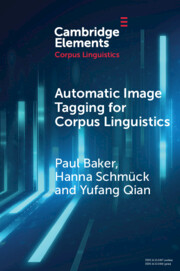
This Element reports on the creation and analysis of a 1.5-million-word corpus consisting of a year's worth of UK national press news articles about Islam and Muslims, published between December 2022 and November 2023. The corpus also contains 8,546 image files which have been automatically tagged using Google's Vertex AI. Analysis was carried out on three levels a) written text only, b) images only, c) interactions between written text and images. Using examples from the analyses, the authors demonstrate the affordances of these three approaches, providing a critical evaluation of Vertex AI's capabilities and the abilities of popular corpus software to work with visually tagged corpora. The Element acts as a practical guide for researchers who want to carry out this form of analysis. This title is also available as Open Access on Cambridge Core.
Unbalanced bilinguals often exhibit reduced emotionality in their non-native language, although the underlying neural mechanisms remain poorly understood. This fMRI (functional magnetic resonance imaging) study investigated neural differences during a silent reading task where late Spanish–English bilinguals read happy, fearful and neutral fiction passages in their first (L1) and second (L2) languages. We observed a significant language-by-emotionality interaction in the left hippocampus while participants read fearful texts, indicating a stronger limbic system response in L1. Functional connectivity analyses revealed lower coupling between semantic (left anterior temporal lobe) and limbic (left amygdala) regions when reading fearful texts in L2, suggesting less integrated emotional processing. Overall, these findings show that emotional reading in unbalanced bilinguals is strongly influenced by language, with a higher emotional response and more integrated connectivity between semantic and affective areas in the native language.
This article explores recent developments in English language education in Taiwan, situating them within broader sociopolitical shifts and demographic changes. It begins by outlining the emergence of English in Taiwan’s education system before presenting the formulation and objectives of the Bilingual 2030 policy. The article then analyzes how this national initiative has reshaped English language education across educational levels. In particular, it highlights the expansion of English–medium instruction (EMI) in higher education as a central feature of Taiwan’s bilingualization agenda. Finally, it discusses two key developments influenced by the policy: the internationalization of higher education as a response to demographic and policy pressures, and the resulting expansion of EMI courses as a central strategy for attracting global talent and sustaining university enrollment.
Against the proliferation of large language model (LLM) based Artificial Intelligence (AI) products such as ChatGPT and Gemini, and their increasing use in professional communication training, researchers, including applied linguists, have cautioned that these products (re)produce cultural stereotypes due to their training data. However, there is a limited understanding of how humans navigate the assumptions and biases present in the responses of these LLM-powered systems and the role humans play in perpetuating stereotypes during interactions with LLMs. In this article, we use Sequential-Categorial Analysis, which combines Conversation Analysis and Membership Categorization Analysis, to analyze simulated interactions between a human physiotherapist and three LLM-powered chatbot patients of Chinese, Australian, and Indian cultural backgrounds. Coupled with analysis of information elicited from LLM chatbots and the human physiotherapist after each interaction, we demonstrate that users of LLM-powered systems are highly susceptible to becoming interactionally entrenched in culturally essentialized narratives. We use the concepts of interactional instinct and interactional entrenchment to argue that whilst human–AI interaction may be instinctively prosocial, LLM users need to develop Critical Interactional Competence for human–AI interaction through appropriate and targeted training and intervention, especially when LLM-powered tools are used in professional communication training programs.
We investigated whether executive functions (EFs) are engaged in bilingual language control in Finnish speakers with different degrees of Swedish language experience and proficiency, including early bilinguals, late high-proficiency bilinguals and low-proficiency learners of Swedish. In an online experiment, language switching was measured with a cued naming (CN) paradigm, and a Simon task was used to assess EF performance. Following the skill-learning (task specificity) hypothesis, we expected that language switching may be automatized and no longer rely on EFs in bilinguals with high language proficiency, but not for those with lower proficiency. Thus, we expected significant associations between the tasks in the lower proficiency participants only. Our results showed no CN switching–EF associations in the more experienced L2 speakers, but a significant association in lower-proficiency participants. This suggests that language switching engages EFs only in participants with lower proficiency in whom these processes are not yet automatized.
The present paper provides a small–scale exploratory analysis of L2 English pronunciation and accent aims among secondary school students in Germany – with a focus on the bath and lot vowels, rhoticity, and T–flapping. The eight learners investigated in the current study show blended use of Standard Southern British English (StSBrE) and Standard American (StAmE) phonological variants with relatively high degrees of variation between learners. StSBrE–oriented productions were dominant overall. Agreement of accent aim and L2 pronunciation was largely feature–dependent and limited overall but varied between learners.