To save content items to your account,
please confirm that you agree to abide by our usage policies.
If this is the first time you use this feature, you will be asked to authorise Cambridge Core to connect with your account.
Find out more about saving content to .
To save content items to your Kindle, first ensure no-reply@cambridge.org
is added to your Approved Personal Document E-mail List under your Personal Document Settings
on the Manage Your Content and Devices page of your Amazon account. Then enter the ‘name’ part
of your Kindle email address below.
Find out more about saving to your Kindle.
Note you can select to save to either the @free.kindle.com or @kindle.com variations.
‘@free.kindle.com’ emails are free but can only be saved to your device when it is connected to wi-fi.
‘@kindle.com’ emails can be delivered even when you are not connected to wi-fi, but note that service fees apply.
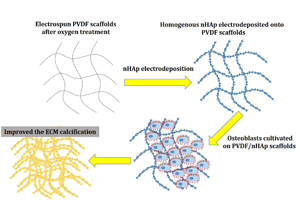
The fibrous scaffolds for bone tissue engineering that mimic the extracellular matrix with bioactive and bactericidal properties could provide adequate conditions for regeneration of damaged bone. Electrospun ultrathin fiber covered with nano-hydroxyapatite is a favorable fibrous scaffold design. We developed a fast and reproducible strategy to produce polyvinylidene fluoride (PVDF)/nano-hydroxyapatite (nHAp) nanofibrous scaffolds with bactericidal and bioactive properties. Fibrous PVDF scaffolds were obtained first by the electrospinning method. Then, their surfaces were modified using oxygen plasma treatment followed by electrodeposition of nHAp. This process formed nanofibrous and superhydrophilic PVDF fibers (133.6 nm, fiber average diameter) covered with homogeneous nHAp (202.6 nm, average particle diameter) crystals. Energy-dispersive X-ray spectrometry demonstrated the presence of calcium phosphate, indicating a Ca/P molar ratio of approximately 1.64. X-ray diffraction, Fourier transform infrared spectroscopy, and Raman spectroscopy spectra identified β-phase of nHAp. Thermal analysis indicated a slight reduction in stability after nHAp electrodeposition. Bactericidal assays showed that nHAp exhibited 99.8% efficiency against Pseudomonas aeruginosa bacteria. The PVDF/Plasma and PVDF/nHAp groups had the highest cell viability, total protein, and alkaline phosphatase activity by 7 days after exposure of the scaffolds to MG63 cell culture. Therefore, the developed scaffolds are an exciting alternative for application in bone regeneration.
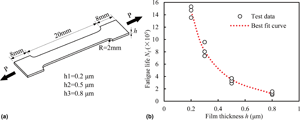
The thickness effect has a significant influence on the fatigue life of micro–nanometer thin films. Due to the increasing application of micro–nanometer thin films in the field of microelectronics, a suitable fatigue prediction model is urgently needed. To reveal the impact of the thickness effect on the fatigue life of a copper wire film, cyclic tension fatigue test of four groups of copper wire films were carried out. Based on the theory of continuous damage mechanics and damage homogenization method, a fatigue damage accumulation model that considered the film thickness was proposed. Based on the proposed fatigue damage prediction model, the damage evolution law and fatigue life of copper wire films with different thickness and strain range were predicted. Furthermore, the size effect of the copper films was analyzed. The results showed that the fatigue life of copper wire films will decrease with the increase of thickness and strain amplitude; the thinner the film, the more significant the thickness effect on the fatigue life is; with the increase of the film thickness, the film thickness effect will gradually decrease.
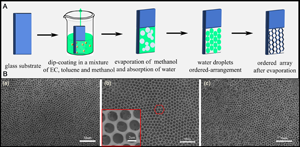
A simple and effective strategy is proposed for fabricating honeycomb-patterned ethyl cellulose (EC) films via a combination of the dip-coating and breath figure methods under a wide humidity range (40–90%). A mixture of toluene and methanol as a volatile solvent/nonsolvent pair was used to effectively control the surface morphology. Additionally, honeycomb patterns were successfully formed via dip-coating under a low humidity (relative humidity less than 40%), when water was directly added into the mixed solution. The important factors that influenced the morphology of EC honeycomb-patterned films were investigated, such as the humidity, solution concentration, and the withdrawal speed during dip-coating. The pore sizes could be controlled by changing the film-formation conditions. Water contact angle enables a transition from hydrophilic to hydrophobic. The possible mechanisms of honeycomb pattern formation are discussed. The fabrication of an ordered honeycomb-patterned film in a cost-effective and convenient manner will have broad application potential in the future.
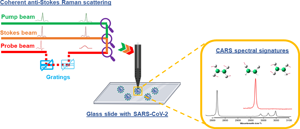
From the 1918 influenza pandemic (H1N1) until the recent 2019 severe acute respiratory syndrome coronavirus 2 (SARS-CoV-2) pandemic, no efficient diagnostic tools have been developed for sensitive identification of viral pathogens. Rigorous, early, and accurate detection of viral pathogens is not only linked to preventing transmission but also to timely treatment and monitoring of drug resistance. Reverse transcription-polymerase chain reaction (RT-PCR), the gold standard method for microbiology and virology testing, suffers from both false-negative and false-positive results arising from the detection limit, contamination of samples/templates, exponential DNA amplification, and variation of viral ribonucleic acid sequences within a single individual during the course of the infection. Rapid, sensitive, and label-free detection of SARS-CoV-2 can provide a first line of defense against the current pandemic. A promising technique is non-linear coherent anti-Stokes Raman scattering (CARS) microscopy, which has the ability to capture rich spatiotemporal structural and functional information at a high acquisition speed in a label-free manner from a biological system. Raman scattering is a process in which the distinctive spectral signatures associated with light-sample interaction provide information on the chemical composition of the sample. In this prospective, we briefly discuss the development and future prospects of CARS for real-time multiplexed label-free detection of SARS-CoV-2 pathogens.
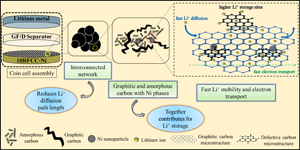
To address the challenges of capacity fading and poor electronic conductivity of hard carbons as anode in Li-ion batteries (LIBs), we report here the catalytic graphitization of resorcinol–formaldehyde xerogel (RFX)-derived hard carbon via a single-step synthesis by incorporating two transition metal catalysts (Co and Ni) with different loadings (5 and 10%) at a modest temperature of 1100 °C. Loading of both the catalysts affects the extent of graphitization and other physiochemical properties that have a direct influence on the anodic performance of as graphitized RFX-derived hard carbon. A 10% Ni catalyst in RFX-derived carbon induces the highest degree of graphitization of 81.4% along with partial amorphous carbon and nickel phases. This improved crystallinity was conducive enough to facilitate rapid electron and Li-ion transfer while the amorphous carbon phase contributed to higher specific capacity, resulting in overall best anodic performance as ever reported for RFX-derived carbon. A specific capacity of 578 mAh/g obtained after 210 cycles at 0.2 C with coulombic efficiency greater than 99% confirms the potential of graphitized RFX-derived carbon as an anode for high-performance LIBs.
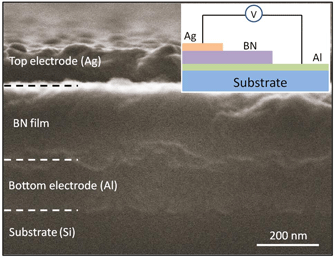
Continuous hBN films have been grown by means of a radio-frequency-sputtering technology, and their material properties have been investigated. The prepared hBN films can achieve good smoothness in a large area. The surface morphologies and compositions of the hBN films on Si substrate and Al film have been characterized, indicating that there is no difference. The 101-phase peak of hBN film is the strongest, and the optical band gap of the fabricated film is 5.84 eV. An attempt on the fabrication of the hBN based resistive switching (RS) device has been made by using an Ag/hBN/Al structure, leading to the observation of a clear and stable RS behavior. The device exhibits a resistance window (high-resistivity state/low-resistivity state) of around 102, and the RS behaviors of hBN film prepared by sputtering were first observed. It has been found that the opening voltage for the device is changed when a different cycle voltage is applied because of the built-in electric field increasing with the increase of applied cycle voltage. The mechanism of the RS behavior has been analyzed, which lay a foundation for the application of hBN as RS material in resistive random access memory to improve the storage density.
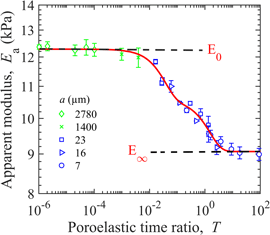
Mechanical properties of hydrogels are of considerable interest for applications including tissue engineering and drug delivery. However, mechanical characterization of hydrogels is inherently challenging due to their multiphasic construction. Under mechanical loading, internal fluid redistribution affects the gel response, leading to a time- and length-scale-dependent material behavior, known as poroelasticity. Traditional mechanical tests are effective for determining instantaneous flow-independent gel response, and they are limited in characterizing poroelastic behavior as a function of loading time- and length-scales. Here, micro- and nanoindentation experiments are combined to characterize the full range of poroelastic behavior of a hydrogel. A master curve is presented to demonstrate that the relative competition of poroelastic relaxation time with ramp loading time determines gel response across different time- and length-scales. The master curve provides a novel mechanism to establish the instantaneous and equilibrium limits on the elastic modulus for a material, useful for designing hydrogel biomaterials.
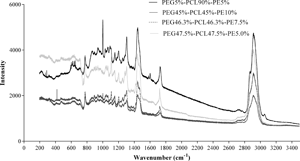
Interactions between smooth muscle cells (SMCs) and biomaterials must not result in phenotype changes as this may generate uncontrolled multiplication processes and occlusions in vascular grafts. The aim of this study was to relate the hydrolytic stability and biocompatibility of polyurethanes (PUs) on SMCs. A higher polycaprolactone (PCL) concentration was found to improve the hydrolytic stability of the material and the adhesion of SMCs. A material with 5% polyethylene glycol, 90% PCL, and 5% pentaerythritol presented high cell viability and adhesion, suggesting a contractile phenotype in SMCs depending on the morphology. Nevertheless, all PUs retained their elastic modulus over 120 days, similar to the collagen of native arteries (~10 MPa). Furthermore, aortic SMCs did not present toxicity (viability over 80%) and demonstrated adherence without any abnormal cell multiplication processes, which is ideal for the function to be fulfiled in situ in the vascular grafts.
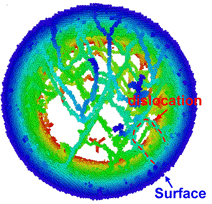
The orientation between twin boundary (TB) and loading direction may play an intriguing role in the deformation behaviors of twinned metallic materials. In this aspect, its essential effect on the high-entropy alloy (HEA) nanocrystals is elusive. Attention herein is focused on the atomic-scaled deformation mechanisms and fracture behaviors of HEA nanocrystals containing twins of even smaller spacings via a combined approach of in situ tensile tests inside a high-resolution transmission electron microscope and molecular dynamics simulations. The results indicate that the deformation mechanisms (especially dislocation activities) of HEA nanocrystals depend on the load orientation with respect to TBs. Because of the low activation energy and uneven local composition of HEA, the surface acts as an effective dislocation source and, together with Schmid factor, dominate the activated dislocation slip system. The load orientation-dependent TB-dislocation interactions may transform the type of fracture from semi-brittle to ductile. Our results indicate that the deformation mechanisms and the types of fracture in HEA nanocrystals can be controlled by changing the orientation.
Structural phase transitions in semiconductors have been utilized for driving technological advancements in switchable electronics and phase-change memory devices. There have been numerous reports on high susceptibility of halide perovskites to phase transitions because of their soft lattice; however, the factors affecting the underlying process are still poorly understood. Insights into the phase transition dynamics of halide perovskites are desirable for precise control of optoelectronic properties and for unlocking their use in novel solid-state applications.
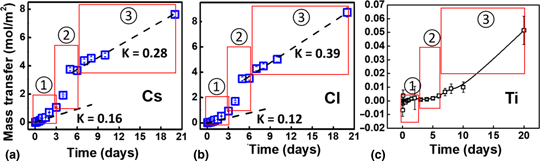
To improve the stability of Cs2SnCl6 under aqueous/moisture environments, we applied a concept of artificial passivation by depositing a protective TiO2 coating of 10 nm on the surface of Cs2SnCl6. Static leaching experiments results indicate that the initial release rates of Cs+ and Cl− are decreased by 20–30 times with TiO2 coating, suggesting its possibility to improve the short-term water/environmental stability of Cs2SnCl6. An amorphous-to-crystalline phase transition in TiO2 film was observed, possibly resulting in degradation of Cs2SnCl6. However, the crystalline TiO2 film still remains after 21 days water exposure and can still act as an effective passivation layer to reduce the release rates of Cs+ and Cl- by as much as about 17 and 7 times, respectively, relative to static leaching without artificial coatings. Therefore, the water/environmental stability of metal halide perovskite Cs2SnCl6, which is a highly soluble molecular salt, can be enhanced by the nanoscale TiO2 coating as an artificial passivation film.
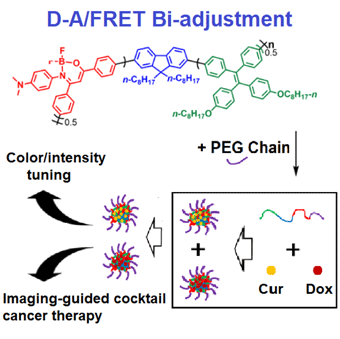
Nowadays, theranostics drug delivery systems (DDSs) with imaging and therapy bi-functions have been regarded as a future orientation for imaging-guided cancer therapy. To achieve high imaging quality, a donor–acceptor (D–A)/Förster resonance energy transfer (FRET) bi-adjustment strategy is carried out for designing dual-colored DDSs with amplified aggregation-induced emission (AIE) behavior for imaging-guided cocktail cancer therapy in this study. In detail, four AIE-active conjugated polymers P-1 to P-4 are synthesized via the Suzuki reaction. Noteworthily, the D–A-type structure is applied in tuning the fluorescence color from orange (P-1) to far-red/near-infrared (P-2), while the intramolecular FRET process further enhanced the fluorescence signal for six times (P-3). Afterwards, P-3-based amphipathic polymer P-4 further acts as a drug carrier in preparing doxorubicin (Dox)- and curcumin (Cur)-loaded polymer dots (Pdots) (Dox-loaded Pdots as PDox and Cur-loaded Pdots as PCur). PDox + PCur DDS is successfully applied in imaging-guided cocktail cancer therapy to give obviously higher in vivo anticancer efficacy compared with single PDox or PCur. In addition, the drug-loaded Pdots also exhibit higher biocompatibility compared with free drugs. This work provides a novel D–A/FRET bi-adjustment strategy for developing high efficiency imaging-guided cocktail DDSs in cancer therapy.
The discovery of artificial electromagnetic materials, called metamaterials, not only redefines the human perception of constitutive parameters in electromagnetic theory, but also brings forward new phenomena, such as negative refraction. We provide a comprehensive introduction to the unique characteristics of metamaterials, starting with Maxwell's equations and the kDB coordinate system, and moving through to theoretical concepts and design principles of negative refraction in metamaterials. For each kind of media, including isotropic, anisotropic and bianisotropic metamaterials, we discuss the characteristic waves and their properties. We show examples of negative refraction both theoretically and experimentally.
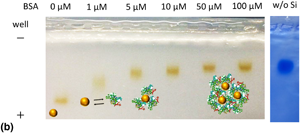
The interaction between negatively charged all-inorganic silicon quantum dots (Si QDs) and bovine serum albumin (BSA) is studied. It is shown that a small difference in the size of Si QDs affects the structure of Si QD–BSA composites significantly. When the diameter of Si QDs is 4 nm, a heterodimer (~20 nm) composed of one Si QD and one BSA molecule is a preferable and stable structure. On the other hand, when the diameter is 7 nm, the size of the composites increases to ~50 nm. The Si QD–BSA composites exhibit stable photoluminescence in the near-infrared range in phosphate-buffered saline.
Intermetallic γ-TiAl-based alloys are commonly used as structural materials for components in high-temperature applications, although they generally suffer from a lack of ductility and crack resistance at ambient temperatures. Within this study, the process-adapted 4th generation TNM+ alloy, exhibiting a fully lamellar microstructure, was examined using notched micro-cantilevers with defined orientations of lamellar interfaces. These configurations were tested in situ using superimposed continuous stiffness measurement methods during loading with simultaneous scanning electron microscopy observations. Subsequently, the video signal was used for visual crack length determination by computer vision and compared to values calculated from in situ changes in stiffness data. Applying this combinatorial approach enabled to determine the J-integral as a measure of the fracture toughness for microstructurally different local crack propagation paths. Thus, distinct differences in conditional fracture toughness could be determined from 3.7 MPa m1/2 for γ/γ-interface to 4.4 MPa m1/2 for α2/γ-interface.
Triiodide perovskites CsPbI3, CsSnI3, and FAPbI3 (where FA is formamidinium) are highly promising materials for a range of optoelectronic applications in energy conversion. However, they are thermodynamically unstable at room temperature, preferring to form low-temperature (low-T) non-perovskite phases with one-dimensional anisotropic crystal structures. While such thermodynamic behavior represents a major obstacle toward realizing high-performance devices based on their high-temperature (high-T) perovskite phases, the underlying phase transition dynamics are still not well understood. Here we use in situ optical micro-spectroscopy to quantitatively study the transition from the low-T to high-T phases in individual CsSnI3 and FAPbI3 nanowires. We reveal a large blueshift in the photoluminescence (PL) peak (~38 meV) at the low-T/high-T two-phase interface of partially transitioned FAPbI3 wire, which may result from the lattice distortion at the phase boundary. Compared to the experimentally derived activation energy of CsSnI3 (~1.93 eV), the activation energy of FAPbI3 is relatively small (~0.84 eV), indicating a lower kinetic energy barrier when transitioning from a face-sharing octahedral configuration to a corner-sharing one. Further, the phase propagation rate in CsSnI3 is observed to be relatively high, which may be attributed to a high concentration of Sn vacancies. Our results could not only facilitate a deeper understanding of phase transition dynamics in halide perovskites with anisotropic crystal structures, but also enable controllable manipulation of optoelectronic properties via local phase engineering.
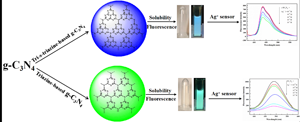
A triazine-based graphite carbon nitride (tri-C3N4) was successfully prepared using a solid and mild method, and modified through concentrated acid and the hydrothermal method. Interestingly, the modified tri-C3N4 (tri-HC3N4) showed good water stability and excellent fluorescence property. Meanwhile, tri-HC3N4 was successfully used to construct a high-sensitive and selective fluorescence sensor to Ag+. The as-prepared fluorescence sensor showed a fast response and a low detection limit as 0.4046 μM. Moreover, the possible quenching mechanisms were discussed based on the photoinduced electron transfer and the formation of new complex between tri-HC3N4 and Ag+ with the help of the related characterizations. This study does not only provide a new tri-HC3N4 for a high efficiency fluorescence sensor, but also show the potential application in biological sciences.
The relationship between zoo animals, particularly nonhuman primates, and visitors is complex and varies by species. Adding complexity to this relationship is the trend for zoos to host events outside of normal operating hours. Here, we explored whether a late-night haunted-house style event influenced the behavior of spider monkeys. We conducted behavioral observations both on event nights and nights without the event. The spider monkeys were active and outside more frequently on event nights compared to the control nights indicating that their typical nighttime behavior was altered. However, it is difficult to definitively conclude whether the behavioral changes were a result of the event being aversive or enriching. Our findings suggest that zoos should conduct behavioral observations of and collect physiological data from their animals, especially if they are sensitive to environmental changes, when implementing new events, including those occurring outside of normal operating hours to ensure high levels of animal welfare.