A collection of out-of-copyright and rare books from the Cambridge University Library and other world-class institutions that have been digitally scanned, made available online, and reprinted in paperback.
To save content items to your account,
please confirm that you agree to abide by our usage policies.
If this is the first time you use this feature, you will be asked to authorise Cambridge Core to connect with your account.
Find out more about saving content to .
To save content items to your Kindle, first ensure no-reply@cambridge.org
is added to your Approved Personal Document E-mail List under your Personal Document Settings
on the Manage Your Content and Devices page of your Amazon account. Then enter the ‘name’ part
of your Kindle email address below.
Find out more about saving to your Kindle.
Note you can select to save to either the @free.kindle.com or @kindle.com variations.
‘@free.kindle.com’ emails are free but can only be saved to your device when it is connected to wi-fi.
‘@kindle.com’ emails can be delivered even when you are not connected to wi-fi, but note that service fees apply.
Thomas Southey (1777–1838) joined the navy at the age of twelve, saw action during the French Revolutionary Wars, and was first posted to the West Indies in early 1804. Promoted to captain in 1811 and later employed as a customs officer, he died on the voyage home from his last posting in Demerara. His only book, published in 1827, is dedicated to his older brother, Robert, a Romantic poet, who also wrote on historical subjects (his books on Nelson, the Duke of Wellington, and Brazil are also available in the Cambridge Library Collection). Thomas's three-volume work draws on extensive reading, with substantial passages quoted verbatim from his sources. He concludes that the history of the West Indies presents 'little more than a melancholy series of calamities and crimes', but commends the British government's efforts to put an end to slavery. Volume 3 covers the period from 1784 to 1816.
John Brand (1744–1806), secretary of the Society of Antiquaries, first published his widely popular Observations on Popular Antiquities in 1777. This fascinating two-volume almanac of British superstitions and customs was in fact a heavily revised and annotated version of Henry Bourne's Antiquitates vulgares (1725). Beginning with New Year's Eve, Volume 1 describes the origins and practices of British calendar festivals including religious holidays, saints' days, seasonal celebrations such as May Day and the Summer Solstice, and obscurer festivities such as the Feast of Sheep Shearing. Following the success of the book's initial reception, Brand continued to research English folklore with the intention of publishing fuller information. This two-volume version, published posthumously in 1813, was edited and expanded by Sir Henry Ellis, Keeper of Manuscripts at the British Museum, and further revisions also appeared in 1841 and 1870. Brand's book is regarded as the foundation for folklore studies in England.
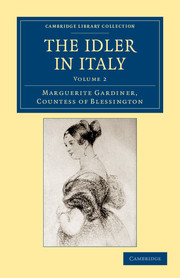
Marguerite Gardiner, Countess of Blessington (1789–1849), was famous for her charm, wit and beauty, the latter reflected in Sir Thomas Lawrence's famous portrait of her in 1822. Blessington had an unhappy childhood, and was forced into her first marriage at the age of fourteen, but had developed a love of reading and story-telling. With her second husband Charles John Gardiner, first Earl of Blessington, she lived for several years in France and Italy. This three-volume work, first published 1839–40, contains Blessington's humorous account of living abroad. In Volume 2 she gives detailed descriptions of her travels in Italy, where she stayed in cities such as Lucca, Siena, Florence, Rome and Naples, but also in smaller seaside towns such as Terracina. She draws attention to 'the odour of the cuisine' and the beautiful surroundings and weather, inspiring encounters with artists and locals, and daily visits to art galleries.
Professor of botany from 1825 until his death, John Stevens Henslow (1796–1861) revived and greatly advanced the study of plants at Cambridge. His influence helped to make the University Botanic Garden an important centre for teaching and research. Originally published over a period of seventeen years, and now reissued here together, these thirteen papers reveal the impressive breadth of Henslow's scientific knowledge. The first two items, from 1821, address the geology of the Isle of Man and Anglesey respectively, preceding his five-year tenure as chair of mineralogy at Cambridge from 1822. The rest of the papers, dating from 1829 to 1838, address botanical topics. Professor John Parker, Director of Cambridge University Botanic Garden, has provided a new introduction that traces Henslow's developing interests and contextualises the items in this collection. Several of Henslow's other publications, including his Catalogue of British Plants (1829), are reissued separately in this series.
Joseph Ennemoser (1787–1854) was born in Tyrol and, after fighting in the Tyrolean rebellion and the Napoleonic wars, qualified as a physician in Berlin. He later became professor at the recently founded University of Bonn, and eventually opened a successful medical practice in Munich. Ennemoser was a leading figure in the then highly fashionable field of 'animal magnetism' (popularised by Mesmer in the later eighteenth century) and hypnosis, and his emphasis on the connection between the mind and physical health foreshadowed Freud's development of psychoanalysis. The holistic views of the mesmerists incorporated ideas both from natural philosophy and from German Romanticism, and Ennemoser and his contemporaries wrestled with the problem of integrating materialist and mystical viewpoints. In this 1842 publication, Ennemoser analyses the relationship between 'animal magnetism', nature and religion, focusing on phenomena including visions, their physiological and psychological explanations, and the application and effects of 'magnetic' treatments.
Cambridge University Library houses a vast and internationally important collection of manuscripts, from early medieval illustrated bibles to personal papers and administrative records of the university. These volumes, first published between 1856 and 1867, contain the first published catalogue of the manuscripts held by the University Library. Edited by Henry Richards Luard (1825–91), Registrary of the University, these volumes provide detailed descriptions of the manuscript collection of the University Library as it was in the mid-nineteenth century. Information on the appearance, condition, age and provenance of the manuscripts is provided, together with accounts of their contents, to provide a practical and highly detailed guide to this fascinating collection. Volume 4 describes classmarks Ll.1-Oo.7, containing ecclesiastical biographies from the thirteenth and fourteenth centuries, collections of legal statutes from the fourteenth century, sixteenth-century magical texts and fourteenth-century Latin translations of Avicenna's Canones.
Bernal Díaz del Castillo (1492–1584) was a foot soldier in the army of Mexico's conqueror Hernán Cortés, and participated in the campaigns that led to the fall of the Aztec empire in 1521. This 1928 translation of his journals derives from the 1904 edition by the Mexican historian Genaro García - the first edition based on the original manuscript. Written as a corrective to accounts that overemphasised Cortés' exploits, Díaz's epic focuses on the experiences of the common soldier. The most complete contemporary chronicle of the Mexican conquest, this important historical document is also a captivating adventure narrative that combines factual accuracy with many dramatic anecdotes. This volume focuses on the complex relationships that developed between the Spaniards and the Aztec emperor Montezuma on the army's arrival in Mexico. It contains chapters 82–136 and a key to the maps that appear at http://www.cambridge.org/catalogue/catalogue.asp?isbn=9781108017060.
A leading German theosophical writer, Karl Kiesewetter (1854–95) published several influential works in the years just before his early death. They included a history of modern esotericism (1891), a biography of Mesmer (1893, also reissued in this series), studies of John Dee and of the Faust legend (both 1893), and this two-volume account of occult beliefs and practices in the ancient world (1895), which was completed by Ludwig Kuhlenbeck (1857–1920), a scholar of ancient philosophy and law. Volume 2 focuses on the civilisations of the Mediterranean (Greece, Alexandria, Rome) and northern Europe (the Germanic and Celtic peoples). Each general description is followed by more detailed investigations of particular aspects of that community, such as individuals (Socrates, Philo and Pythagoras), practices (divination, healing and oracles), and teachings (gnosticism, Manicheanism and creation, the afterlife), together with textual excerpts (in German translation).
Thomas Southey (1777–1838) joined the navy at the age of twelve, saw action during the French Revolutionary Wars, and was first posted to the West Indies in early 1804. Promoted to captain in 1811 and later employed as a customs officer, he died on the voyage home from his last posting in Demerara. His only book, published in 1827, is dedicated to his older brother, Robert, a Romantic poet, who also wrote on historical subjects (his books on Nelson, the Duke of Wellington, and Brazil are also available in the Cambridge Library Collection). Thomas' three-volume work draws on extensive reading, with substantial passages quoted verbatim from his sources. He concludes that the history of the West Indies presents 'little more than a melancholy series of calamities and crimes', but commends the British government's efforts to put an end to slavery. Volume 1 covers the period from 1492 to 1654.
The sisters Agnes Lewis (1843–1926) and Margaret Gibson (1843–1920) were pioneering biblical scholars who became experts in a number of ancient languages. Travelling widely in the Middle East, they made several significant discoveries, including one of the earliest manuscripts of the Four Gospels in Syriac, a dialect of Aramaic, the language probably spoken by Jesus himself. Their chief discoveries were made in the Monastery of St Catherine on Mount Sinai. This work is based on a manuscript discovered in the monastery in 1895 and first published in 1896. Originally published as part of the Studia Sinaitica, this fascicule comprises Arabic and Syriac texts of various apocryphal stories edited and translated by Margaret Gibson. The first part of the text contains the 'Anaphora Pilati', the story of the aftermath of Pontius Pilate's decision to crucify Jesus. Also included are the Clementine Recognitions and the Martyrdom of James and Simon.
A highly influential Czech historian and politician, František Palacký (1798–1876) became in 1825 the first editor of the journal of the Bohemian Museum, a key cultural institution in the development of Czech nationalism. He was actively involved in the nineteenth-century Czech national revival, helping also to found the Czech national theatre. Entering politics in 1848, he served as president of the Prague Slavic Congress, and later became a member of the Austrian senate as a supporter of greater Czech autonomy. In this extensive work, comprising ten separate parts - published in German between 1836 and 1867 - Palacký gives a detailed account of Bohemian history until 1526. It remains an important and ambitious feat of scholarship, still relevant to students of central European history. The first part of Volume 3 (1845) covers the years 1378–1419, the period of King Wenceslaus IV's reign, up to the outbreak of the Hussite Wars.
This is the fourth, revised and expanded 1850 edition of an influential two-volume work originally published in 1830 by the German scientist and philosopher Gotthilf Heinrich von Schubert (1780–1860). Schubert studied theology and medicine, and taught natural history at Erlangen and Munich, specialising in botany, forestry and mineralogy. He also lectured on topics including animal magnetism, clairvoyance and dreams, and attempted to reconcile Enlightenment philosophy with Christian faith. This book presents Schubert's views on human nature as body, soul and spirit, and on humankind's place in the natural order. Volume 1 introduces Schubert's ideal of a harmonious balance between opposing forces, contrasting the animate and the inanimate and describing the mineral, vegetable and animal kingdoms and their interactions. It then focuses on human anatomy and physiology, and discusses the senses, heredity, sleep and death, and the differences between humans and other animals.
A keen student of theology, August Friedrich Gfrörer (1803–61) became professor of history at the University of Freiburg and also sat as a representative in the Frankfurt parliament, agitating for the reunification of Protestantism and Catholicism. This three-volume work, published in 1838, may be regarded as marking the modern period in the Christian study of Judaism. Gfrörer was the first scholar who attempted to recount the history of Palestinian Judaism at the time of Jesus by using primary source material and without pursuing an obvious apologetic or polemic agenda. More than 2,000 pages in length, the work is a formidable scholarly achievement of lasting value in the field of religious studies. Volume 1 accounts for first-century Jewish education and scholarship, and discusses the doctrine of revelation. The author also addresses the Jewish understanding of God and of spirits, angels and demons.
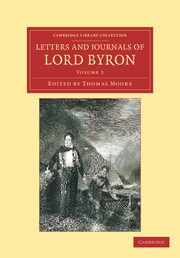
George Gordon Noel Byron, 6th Baron Byron of Rochdale (1788–1824) is one of the central writers of British Romanticism and his 'Byronic' hero - the charming, dashing, rebellious outsider - remains a literary archetype. But to what extent is this character a portrayal of the author himself? Byron was known for his extremely unconventional, eccentric character and his extravagant and flamboyant lifestyle: Lady Caroline Lamb, one of his lovers, famously described him as 'mad, bad and dangerous to know'. This two-volume work, compiled by his friend Thomas Moore, to whom Byron had given his manuscript memoirs (which he later burnt), was published in 1830. Volume 2 gives an account of Byron's life and work from 1816, including his travels abroad in Switzerland and Italy, where close friendships with Lady Blessington and Percy and Mary Shelley developed, to his early death in the Greek War of Independence in 1824.
Friedrich Gottlieb Welcker (1784–1868) championed a comprehensive approach to antiquity, embracing history, literature, art and religion. This, and his openness to contemporary philosophical ideas about aesthetics and mythology, gave his work a visionary quality that inspired later figures as diverse as Usener and Wilamowitz. In this three-volume work on tragedy, his largest, published between 1839 and 1841, he attempts to reconstruct all the lost trilogies and tetralogies of Greek tragic theatre, insisting on their artistic unity, and demonstrating their fundamental debt to the Epic Cycle (which he had investigated in his Der Epische Cyclus, also reissued in this series). Amid much that is fantastic he made many brilliant discoveries, such that he must still be consulted by all serious students of the subject. Volume 2 discusses Euripides, and the Trojan and Theban epic cycles.
Thomas Carlyle (1795–1881) was one of the most influential authors of the nineteenth century. Eagerly studied at the highest level of intellectual society, his satirical essays and perceptive historical biographies caused him to be regarded for much of the Victorian period as a literary genius and eminent social philosopher. After graduating from Edinburgh University in 1814, he published his first scholarly work on German literature in 1824, before finding literary success with his history of the French Revolution in 1837. After falling from favour during the first part of the twentieth century, his work has more recently become the subject of scholarly re-examination. His introduction of German literature and philosophy into the British intellectual milieu profoundly influenced later philosophical ideas and literary studies. These volumes are reproduced from the 1896 Centenary Edition of his collected works. Volume 22 contains the second volume of his translations of German romances.
A keen student of theology, August Friedrich Gfrörer (1803–61) became professor of history at the University of Freiburg and also sat as a representative in the Frankfurt parliament, agitating for the reunification of Protestantism and Catholicism. This three-volume work, published in 1838, may be regarded as marking the modern period in the Christian study of Judaism. Gfrörer was the first scholar who attempted to recount the history of Palestinian Judaism at the time of Jesus by using primary source material and without pursuing an obvious apologetic or polemic agenda. More than 2,000 pages in length, the work is a formidable scholarly achievement of lasting value in the field of religious studies. Volume 2 discusses the authenticity and literary character of the Gospels of Matthew, Mark and Luke. According to Gfrörer, the Gospel of John has a distinct character which sets it apart from the other Gospels.
Henry of Bracton (or Bratton) (c. 1210–1268) was a jurist who worked as a Justice of Assize in the south-west of England, and was the author of the first systematic discussion of English common law. The manuscripts which form Bracton's Note Book were discovered in the British Museum in 1884 by Vinogradoff, and were edited in three volumes in 1887 by Maitland. These volumes contain a collection of over 2,000 lawsuits from the thirteenth century, each with a description of how the law should be applied to the particular circumstances of each case. This is the first example of case law in English legal writing, and its usefulness as a record of legal precedent probably led to the creation of Year Rolls (official records of court cases) from 1268. Volume 3 contains the texts of Pleas in the Bench and before the King from 1224 to 1240.
Best known for his brief marriage to George Eliot, John Cross (1840–1924) compiled this three-volume 'autobiography' of 1885 from his late wife's journals and letters. Eliot was never married to her long-term partner G. H. Lewes, and she courted further scandal when she married Cross, twenty years her junior, in 1880. While these volumes offer a valuable insight into Eliot's private reflections, what is perhaps most telling is the material left out or rewritten in Cross' efforts to lend his wife's unconventional life some respectability, which he does at the expense of what one reviewer described as Eliot's 'salt and spice'. George Eliot's Life will be of particular interest to scholars of nineteenth-century biography and literature. Volume 1 covers Eliot's life from 1819 to 1857, beginning with a brief sketch of her childhood and continuing with her move to Coventry, then to London, and travels to Geneva.
A keen student of theology, August Friedrich Gfrörer (1803–61) became professor of history at the University of Freiburg and also sat as a representative in the Frankfurt parliament, agitating for the reunification of Protestantism and Catholicism. His academic work marked the modern period in the Christian study of Judaism, making full use of primary sources without pursuing an obvious apologetic or polemical agenda. This two-volume work, published in 1831, is a critical study of early Christianity and the influence that Judaism had on the New Testament. Volume 2 is devoted to substantiating the thesis that the core principles of Philo's theology were already discernible among the Alexandrian Jews. Gfrörer traces how Philo's theology and philosophy were transplanted to Palestine via such sects as the Therapeutae and the Essenes as well as through the historian Josephus. The Apocrypha serve as Gfrörer's main primary source.