A collection of out-of-copyright and rare books from the Cambridge University Library and other world-class institutions that have been digitally scanned, made available online, and reprinted in paperback.
To save content items to your account,
please confirm that you agree to abide by our usage policies.
If this is the first time you use this feature, you will be asked to authorise Cambridge Core to connect with your account.
Find out more about saving content to .
To save content items to your Kindle, first ensure no-reply@cambridge.org
is added to your Approved Personal Document E-mail List under your Personal Document Settings
on the Manage Your Content and Devices page of your Amazon account. Then enter the ‘name’ part
of your Kindle email address below.
Find out more about saving to your Kindle.
Note you can select to save to either the @free.kindle.com or @kindle.com variations.
‘@free.kindle.com’ emails are free but can only be saved to your device when it is connected to wi-fi.
‘@kindle.com’ emails can be delivered even when you are not connected to wi-fi, but note that service fees apply.
Michael Kelly (1762–1826) was an Irish singer and composer who studied music in a Naples conservatory before touring Europe and performing for royalty. His voyage to Italy began with a brush with pirates, one of whom was a childhood acquaintance. Kelly also found himself stranded penniless in Venice, spent a night in prison after a fist fight at the theatre, and had a narrow escape from revolutionary France. He is probably best remembered for creating the roles of Don Basilio and Don Curzio in the first performance, in 1786, of Le Nozze di Figaro, of which he describes the rehearsal period and reception. He later joined London's Theatre Royal as both a performer and composer and opened a music shop, which went bankrupt. These memoirs, published in 1826, provide rich first-hand insights into a key period in theatre history. Volume 2 covers Kelly's later musical and theatrical career.
The publications of the Hakluyt Society (founded in 1846) made available edited (and sometimes translated) early accounts of exploration. The first series, which ran from 1847 to 1899, consists of 100 books containing published or previously unpublished works by authors from Christopher Columbus to Sir Francis Drake, and covering voyages to the New World, to China and Japan, to Russia and to Africa and India. Three volumes, published in 1887, are devoted to the diary of William Hedges (1632–1701) who in 1681 became the first Agent of the East India Company at its new base in Bengal. The first volume contains a transcription of the diary itself; Volume 2 contains a collection of documents relevant to Hedges' time in India; and Volume 3 is a documentary history of Thomas Pitt, grandfather of Pitt the Elder and Governor of Fort St George, who appears frequently in Hedges' diary.
This short-lived classical journal (1831–3), edited by Julius Charles Hare (1795–1855) and Connop Newell Thirlwall (1797–1875), both fellows of Trinity College, Cambridge, disseminated the new comparative philology. Developed primarily in Germany - both editors were fluent German speakers - this approach critiqued biblical and classical texts and was associated with a liberal Christianity which brought the editors into conflict with the university's religious conservatism. Hare left Cambridge in 1832 to take up the family living in Herstmonceaux, Sussex, while Thirlwall was dismissed in 1834 for supporting the admission of dissenters. Both editors nevertheless continued with ecclesiastical careers, Thirlwall becoming bishop of St David's and Hare archdeacon of Lewes. This 1832 volume, containing the journal's first three issues, illuminates the tensions between classical scholarship and Anglicanism as well as the development of specialised journals in an age of general literary reviews.
Anna Jameson (1794–1860) was an inspirational figure to a generation of young women writers and artists including Barbara Bodichon and Bessie Rayner Parkes. Her work was reviewed by leading figures such as Mary Shelley and Charles Kingsley, and even Thomas Carlyle, though less complimentary, referred to her as the 'celebrated Mrs Jamieson'. This book, first published in 1838, secured her growing reputation as a writer of history, literary criticism and travel literature, and has been popular ever since. Inspired by a journey made to support the career of her estranged husband, one of its key themes is the condition of women, which recurs regularly in Jameson's writing. In Volume 1, Jameson describes her difficulty adapting to the winter cold, her impressions of Ontario's landscape, peoples, and political system, and her reflections on literature, especially Goethe. For more information on this author, see http://orlando.cambridge.org/public/svPeople?person_id=jamean
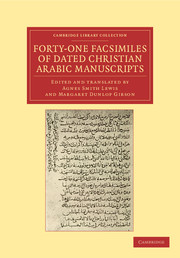
The twin sisters Agnes Lewis (1843–1926) and Margaret Gibson (1843–1920) were pioneering biblical scholars who became experts in a number of ancient languages. Travelling widely in the Middle East, they made several significant discoveries, including one of the earliest manuscripts of the Four Gospels in Syriac, a dialect of Aramaic, the language probably spoken by Jesus himself. Their chief discoveries were made in the Monastery of St Catherine on Mount Sinai. This fascicule, originally published in 1907 as part of the Studia Sinaitica series, is a collection of Arabic Christian documents from various sources, including St Catherine's Monastery and the British Museum. Translated and edited by Lewis and Gibson, the texts, of great value to scholars of Arabic Christianity, include portions of theological treatises, sections of the Gospels and tales from the lives of the saints; of particular interest are the pages of biblical commentary and lectionaries.
Aeschylus' Tragedies are here presented in the original Greek, with Latin translations, notes, scholia, and readings assembled by one of the eminent classical scholars of the nineteenth century, Samuel Butler (1774–1839). Based upon the monumental seventeenth-century commentary edition by Thomas Stanley, and drawing upon scholarship published in the intervening century, Butler's four volumes of the complete plays represent an important synthesis of early critical responses to Aeschylus. The history of Greek scholarship in England – from the labours of one its first and most influential interpreters, Stanley, to the efforts of one of its most respected teachers, Butler – is amply demonstrated in this set of works. This second part of the fourth volume contains Aeschylus' vita and fragments, together with a complete index to the edition. Headmaster of Shrewsbury School and later bishop of Lichfield, Butler is central to histories of classical scholarship and education in England.
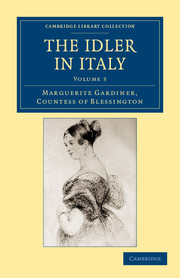
Marguerite Gardiner, Countess of Blessington (1789–1849) was famous for her charm, wit and beauty, the latter reflected in Sir Thomas Lawrence's famous portrait of her in 1822. Blessington had an unhappy childhood, and was forced into her first marriage at the age of fourteen, but had developed a love of reading and story-telling. With her second husband Charles John Gardiner, first Earl of Blessington, she lived for several years in France and Italy. This three-volume work, first published 1839–40, contains Blessington's humorous account of living abroad. Volume 3 includes her lively narrative of her travels in Northern Italy: she spends time in Padua, Venice, Bologna, Milan and the Italian lakes. The volume concludes with a return to Genoa, where Blessington remembers her good friend Lord Byron, who had died in 1824, and her departure for England.
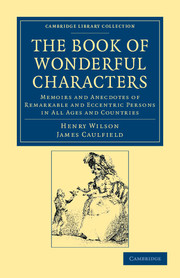
Printmaker James Caulfield (1764–1826) spent much of his career publishing illustrated books about 'remarkable persons'. He began his first series around 1788 and continued it sporadically from 1790 to 1795, with books on a similar theme continuing to appear in the first decades of the nineteenth century. More than forty years after his death, this collection of biographies (produced in collaboration with Henry Wilson (fl. 1820–30)) was republished in 1869. The edition's introduction explains that the renewed interest in these characters comes from the fact that 'we have nearly lost all, and are daily losing what little remains of, our individuality'. The vignettes, accompanied by engravings of each individual, describe a wide-ranging group - from the man who died aged 152 to a 'remarkable glutton' to a woman who lived on the smell of flowers - their only common factor being that they were in some way 'wonderful'.
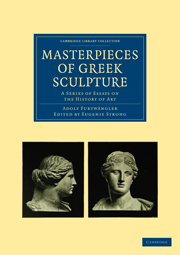
Adolf Furtwängler (1853–1907) was a prominent German archaeologist and art historian specialising in classical art. He was appointed assistant Director of the Königliche Museen zu Berlin in 1880, a position he held until 1894 when he was appointed professor of Classical Archaeology in Munich. He is best known for developing the Kopienkritik approach to studying Roman sculpture, which he introduces in this volume first published in 1885 and translated into English by Eugenie Strong in 1895. Kopienkritik is a methodology which assumes that Roman sculptures are copies of Greek originals, and that by studying the Roman copies the original Greek sculpture can be reconstructed. This approach dominated the study of classical sculpture in the twentieth century and remains influential despite repeated criticism. Furtwängler compares the styles of known classical Greek sculptors with Roman statues to uncover the original sculptor in this defining example of the Kopienkritic approach.
A highly influential Czech historian and politician, František Palacký (1798–1876) became in 1825 the first editor of the journal of the Bohemian Museum, a key cultural institution in the development of Czech nationalism. He was actively involved in the nineteenth-century Czech national revival, helping also to found the Czech national theatre. Entering politics in 1848, he served as president of the Prague Slavic Congress, and later became a member of the Austrian senate as a supporter of greater Czech autonomy. In this extensive work, comprising ten separate parts - published in German between 1836 and 1867 - Palacký gives a detailed account of Bohemian history until 1526. It remains an important and ambitious feat of scholarship, still relevant to students of central European history. The second part of Volume 2 (this is the 1850 printing) covers the years 1306–78, the time of the Luxembourgian dynasty.
The Venns (father and son) published this ten-part work, containing over 125,000 entries, between 1922 and 1954. It is a comprehensive directory of all known alumni of the University of Cambridge, listed in two alphabetical sequences, from the university's foundation in the thirteenth century to 1751 and from 1752 to 1900. John Venn senior (1834–1923) is best known for his work as a philosopher and logician, but contributed to his university in many other ways. His keen interests in genealogy and antiquarian studies inspired this study, researched from sources including episcopal registers. His son, John Archibald Venn (1883–1958) brought the work to completion after his father's death. Thorough and reliable, it is recognised for its extraordinary value to historians and genealogists. Volume 1, Part 4 (1927) covers 'Saal to Zuinglius', and includes figures such as the statesman, poet and playwright Thomas Sackville, 1st Earl of Dorset.
The novels of Charles Dickens (1812–70), with their inimitable energy and their comic, tragic and grotesque characters, are still widely read, and reworked for film and television. Great Expectations was (like most of Dickens' works) first published in serial form, in his periodical All the Year Round, shortly before the first book edition of 1861. The serial version is now reissued in the Cambridge Library Collection simultaneously with the three-volume book edition and a volume of newly photographed actual-size colour images of the entire original manuscript. Dickens himself had the manuscript bound and presented to his friend Chauncy Hare Townshend, with whom he shared an interest in mesmerism and the occult, and in 1868 Townshend bequeathed his library (including the manuscript) to the Wisbech and Fenland Museum. Dickens scholars and enthusiasts will now be able easily to study the two-column serialisation alongside the work-in-progress and the first book edition.
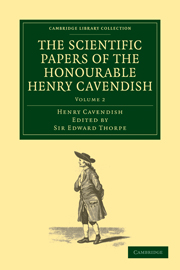
Henry Cavendish (1731–1810) was an English scientist whose published work was mostly concerned with electricity. He was elected a Fellow of the Royal Society in 1760. Cavendish was a prolific scientific investigator, performing experiments on not only electricity but also magnetism, thermometry, gases, heat potential and the chemical composition of water. Although he published some of his research, including his discovery of hydrogen, the majority of his work remained unpublished until 1879, when James Clerk Maxwell published a collection of Cavendish's electrical experiments. These papers showed that Cavendish had discovered many important electrical concepts which had since been credited to other researchers, including the concept of electric potential. First published in 1921, these volumes are a collection of Cavendish's results from his many experiments. Volume 2 contains previously unpublished papers showing the results of Cavendish's chemical, magnetic and thermometry experiments.
The German linguist and mythologist Heymann Steinthal (1823–99) taught at the University of Berlin (today Humboldt-University Berlin) and was especially engaged with Wilhelm von Humboldt and his linguistic works. He was a co-founder of the Berliner Gesellschaft für Anthropologie, Ethnologie und Urgeschichte (Berlin Society for Anthropology, Ethnology and Prehistory). This innovatory volume, published in 1855, draws a connection between the disciplines of linguistics and psychology, and further relates them to the issue of logic. The three parts of the book deal with the nature of grammar, its relation to logic and the connection of grammar and linguistics to cognitive behaviour. Finally Steinthal discusses the idea of linguistics as ethnopsychology. Pursuing this concept, he, with his brother-in-law Moritz Lazarus, co-founded the journal Zeitschrift für Völkerpsychologie und Sprachwissenschaft (Journal for Ethnopsychology and Linguistics) in 1860, thus laying the foundations for a promising new area of research.
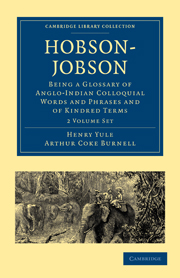
This dictionary of Anglo-Indian terms gives the definition and etymology of over two thousand words in common use in colonial India in the late nineteenth century. First published in 1886, it was written by the Scottish orientalist Sir Henry Yule (1820–1889) and Arthur C. Burnell (1840–1882), an English scholar of Sanskrit and author of a Handbook of South Indian Palaeography. Whereas previous glossaries focused on technical terms used by the Indian administration, this work aims at dealing with words that recur in the daily English of India: 'either as expressing ideas really not provided for' by English, or wrongly 'supposed by the speakers to express something not capable of just denotation by any English term'. Tracing the literary sources and Indian origins of words such as cooly or curry, but also - more surprisingly - tank or veranda, this dictionary is a fascinating resource for the modern reader.
Often described as the father of the Scottish Enlightenment, Francis Hutcheson (1694–1746) was born in the north of Ireland to an Ulster-Scottish Presbyterian family. Organised into three 'books' that were divided between two volumes, A System of Moral Philosophy was his most comprehensive work. It synthesised ideas that he had formulated as a minister and as the Chair of Moral Philosophy at the University of Glasgow (1729–46). Published posthumously by his son in 1755, prefaced by an account of his life, it is the only treatise by Hutcheson for which a manuscript is known to have survived. Asserting that individual natural rights derive from an innate understanding of moral behaviour, Hutcheson offers a model that mediates between individual interests and communal ideals. Containing Book 1 and part of Book 2, Volume 1 describes the role and perception of 'perfect' and 'imperfect' natural rights.
Anna Jameson (1794–1860) was an inspirational figure to a generation of young women writers and artists including Barbara Bodichon and Bessie Rayner Parkes. Her work was reviewed by leading figures such as Mary Shelley and Charles Kingsley, and even Thomas Carlyle, though less complimentary, referred to her as the 'celebrated Mrs Jamieson'. This book, first published in 1838, secured her already growing reputation as a writer of history, literary criticism and travel literature, and has been popular ever since. Inspired by a journey made to support the career of her estranged husband, one of its key themes is the condition of women, which recurs regularly in Jameson's writing. Volume 3 centres on a journey up Lake Huron and describes Native American settlements, languages, customs, and beliefs, revealing her ambivalent feelings of both curiosity and revulsion. For more information on this author, see http://orlando.cambridge.org/public/svPeople?person_id=jamean
This four-volume collection was issued by the Paris publisher Furne in the mid-nineteenth century to showcase the work of recent French explorers for a readership avid for accounts of exotic foreign lands. Volume 4 was prepared by Alfred Jacobs (1802–62), an archivist and palaeographer, drawing heavily on an 1839 publication by Jean-Baptiste Benoit Eyriès (1767–1846). Eyriès was a founder member of the French Geographical Society and a member of the Asiatic Society, trained in botany and mineralogy, an accomplished linguist and seasoned traveller, who wrote, edited and translated a substantial number of works on geography, travel and exploration. Like earlier volumes in Furne's collection, this account of Asia and Africa takes the form of a fictionalised journey, making use of a wide range of additional sources to give readers as complete a picture as possible. This 1859 edition is illustrated with twenty-two engravings.
A naval officer from a generation that could spend an average of between 250 and 300 days a year at sea, Sir Cyprian Bridge (1839–1924) used this extensive experience and the knowledge he gained from wide reading to become a highly respected commander, firm in his beliefs and unafraid to voice them. In retirement he became a vocal critic of the drive to build bigger ships, believing that hardware should be subordinate to tactics. A regular contributor to newspapers, he wrote articles on naval history, tactics and strategy. This collection of articles was published in 1910, and includes his well-known paper, first delivered in 1902, setting out the difficulties in maintaining supplies and communications with a fleet based far from home. This work remains relevant to naval historians, and to those interested in how Britain maintained her maritime supremacy into the twentieth century.
James Catnach (1792–1841) became famous for publishing satirical ballads and sensational accounts of famous murders in his daily broadsheets, first printed in his own home in Seven Dials, London. Capitalising on the turbulent times, Catnach grew rich on producing lurid descriptions of crimes and the trials and executions that followed them. His imagination occasionally over-stepped the mark; he was once jailed for libel after claiming that a local butcher made his sausages from human flesh. This sympathetic and entertaining biography of Catnach, first published in 1878 by London raconteur Charles Hindley (d. 1893), describes Catnach's rise to prominence and features numerous reproductions of his ballads and stories. It is a fascinating tale encompassing the development of early forms of mass media and the wider political and social currents of the time, and provides invaluable insights into popular culture in nineteenth-century London.