A collection of out-of-copyright and rare books from the Cambridge University Library and other world-class institutions that have been digitally scanned, made available online, and reprinted in paperback.
To save content items to your account,
please confirm that you agree to abide by our usage policies.
If this is the first time you use this feature, you will be asked to authorise Cambridge Core to connect with your account.
Find out more about saving content to .
To save content items to your Kindle, first ensure no-reply@cambridge.org
is added to your Approved Personal Document E-mail List under your Personal Document Settings
on the Manage Your Content and Devices page of your Amazon account. Then enter the ‘name’ part
of your Kindle email address below.
Find out more about saving to your Kindle.
Note you can select to save to either the @free.kindle.com or @kindle.com variations.
‘@free.kindle.com’ emails are free but can only be saved to your device when it is connected to wi-fi.
‘@kindle.com’ emails can be delivered even when you are not connected to wi-fi, but note that service fees apply.
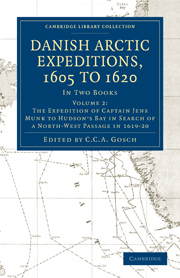
The publications of the Hakluyt Society (founded in 1846) made available edited (and sometimes translated) early accounts of exploration. The first series, which ran from 1847 to 1899, consists of 100 books containing published or previously unpublished works by authors from Christopher Columbus to Sir Francis Drake, and covering voyages to the New World, to China and Japan, to Russia and to Africa and India. This 1897 volume contains the first English translation of Jens Munk's Navigatio Septentrionalis, his account of the Danish expedition of 1619–1620 in search of a North-West Passage to Asia. They reached Hudson's Bay and explored it, producing the first map to show the whole area. However, they were poorly prepared for the conditions there, and almost all the crew died from cold, hunger or disease. They returned to Denmark the following year, and although another expedition was planned, it did not take place.
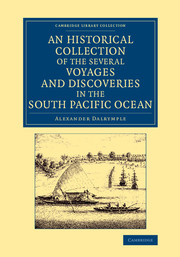
This important collection, published in two volumes in 1770–1 and reissued here in one, contains accounts of notable Iberian and Dutch voyages in the southern hemisphere, translated and edited by Alexander Dalrymple (1737–1808). Hydrographer to the Admiralty from 1795, Dalrymple produced this work as part of his research into the belief at the time that there existed an undiscovered continent in the South Pacific. These volumes were intended to demonstrate the knowledge of the region to date. The first volume covers sixteenth-century Spanish and Portuguese voyages, beginning with Ferdinand Magellan and including those of Juan Fernández, Álvaro de Mendaña y Neira and Pedro Fernandes de Queirós. The second volume contains the seventeenth- and eighteenth-century Dutch voyages of Jacob Le Mair and Willem Schouten, Abel Tasman and Jacob Roggeveen. This volume also contains a chronological table of discoveries in the southern hemisphere since 1501.
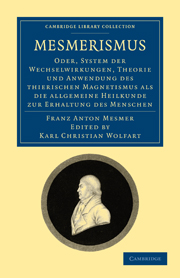
Early in his career, the German doctor Franz Mesmer (1734–1815) became fascinated by the concept that the invisible natural forces or 'magnetism' exerted by planets, minerals and animals (or humans) could produce physical effects including healing. His influential 'discoveries' were highly controversial, and Mesmer tried persistently but unsuccessfully to obtain scientific recognition for his theory of 'animal magnetism'. This book, published in 1814, was edited by Mesmer's friend J. C. Wolfart, also a medical doctor and a former sceptic. Its scope goes far beyond the mere question of healing individuals. Mesmer proposes a system that he claims would both improve the physical and mental health of individuals and promote the ethical ordering of society. Mesmer appeals to future leaders to develop his blueprint of a more 'natural' and balanced world order, based on his understanding of Enlightenment science and his observations of human physiology, psychology, education, government and justice.
This enormously influential work by Swiss diplomat and jurist Emmerich de Vattel (1714–76) was first published in 1758, and is credited with shaping modern international law by applying natural law to international relations. Its argument for liberty and equality proved influential upon the American Declaration of Independence, with Benjamin Franklin commenting on its usefulness to the drafters. The book was translated into English in 1760, 1787, and 1797: the latter version was revised by Joseph Chitty the elder (1775–1841), a barrister and one of the most prolific legal writers of his day, who published more than twenty books on law in his lifetime, and also served as tutor or mentor to some of the most influential lawyers of nineteenth-century England. First published in 1834, Chitty's version amends the errors of the anonymous 1797 translation, as well as revising and expanding the explanatory notes.
Novelist Emily Gerard (1849–1905) went with her husband, an officer in the Austrian army, to Transylvania for two years in 1883. Then part of the Austro-Hungarian Empire, today a region of western Romania, Transylvania was little known to readers back in England. In the years following, she wrote this full-length account (published in 1888) as well as several articles on the region, which Bram Stoker used when researching the setting for Dracula. She describes her encounters with the different nationalities that made up the Transylvanian people: Romanians, Saxons and gypsies. Full of startling anecdotes and written in a novelistic style, her work combines her personal recollections with a detailed account of the landscape and people. The first volume recounts her first impressions and the superstitions and customs of the Romanian and Saxon populations. For more information on this author, see http://orlando.cambridge.org/public/svPeople?person_id=geraem
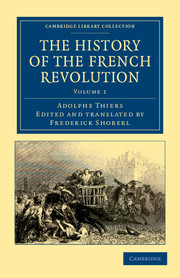
Marie-Louis-Adolphe Thiers (1797–1877) was a prominent figure in a turbulent period in French history. Described by Karl Marx as a 'monstrous gnome' and condemned by the left for suppressing the Paris Commune of 1871, he enjoyed a controversial political career, but it is for his epic Histoire de la Révolution Française that he is chiefly remembered today. It was first published in French in ten volumes between 1823 and 1827, and in 1838 Frederic Shoberl's English translation made it a staple of British bookshelves. Consolidated into five volumes and illustrated with an array of engravings, this edition presents readers with a history of events spanning more than a decade of revolution and war, and remains one of the most comprehensive accounts of the French Revolution. Volume 1 leads readers from the 'cringing assemblies' of Louis XIV to the storming of the Tuileries in August 1792.
Thomas Hill Green (1836–82) was one of the most influential English thinkers of his time, and he made significant contributions to the development of political liberalism. Much of his career was spent at Balliol College, Oxford: having begun as a student of Benjamin Jowett, he later acted effectively as his second-in-command at the college. Interested for his whole career in social questions, Green supported the temperance movement, the extension of the franchise, and the admission of women to university education. He became Whyte's professor of moral philosophy at Oxford in 1878, and his lectures had a lasting influence on a generation of students. Volume 3, published in 1888, contains a memoir by Nettleship, Green's pupil and editor, drawing on Green's recollections, as well as the memories of friends and family. The rest of the volume consists of essays on topics ranging from Aristotle to Christian dogma.
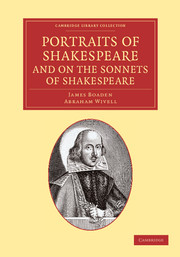
From his funerary monument in Stratford-upon-Avon to the engraving by Droeshout in the First Folio, the depictions of William Shakespeare (1564–1616) have long been the subject of scrutiny. Equally, the mystery surrounding the identity of 'W. H.', the dedicatee of Shakespeare's sonnets, continues to capture the imagination. This volume brings together three works that were originally published separately: two pieces on the portraits and one on the sonnets. A playwright turned theatrical biographer, James Boaden (1762–1839) cultivated a lifelong interest in Shakespeare. His illustrated 1824 analysis of the portraits examines the evidence concerning their authenticity. This is followed by an 1827 investigation by the portrait painter Abraham Wivell (1786–1849), who engages critically with Boaden's findings and those of others. Finally, Boaden's 1837 essay on the sonnets presents the case for naming William Herbert, Earl of Pembroke, as their dedicatee - a claim taken up by many later scholars.
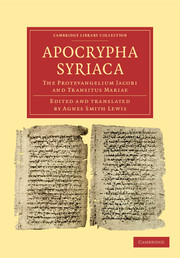
The twin sisters Agnes Lewis (1843–1926) and Margaret Gibson (1843–1920) were pioneering biblical scholars who became experts in a number of ancient languages. Travelling widely in the Middle East, they made several significant discoveries, including one of the earliest manuscripts of the Four Gospels in Syriac, a dialect of Aramaic, the language probably spoken by Jesus himself. First published in 1902 as part of the Studia Sinaitica, this text is transcribed and translated by Lewis from a Syriac manuscript she acquired in Suez in 1895. As well as featuring pages of the Septaguint and the Peshitta Gospels, the palimpsest includes some Arabic pages including a very early version of the Qur'an (estimated by Lewis as seventh-century). Illustrated with reproductions of the leaves of the various texts, this is a valuable resource for scholars of Syriac, but also of interest for historians of Christianity and Early Islam.
The nineteenth century saw the paradoxes and obscurities of eighteenth-century calculus gradually replaced by the exact theorems and statements of rigorous analysis. It became clear that all analysis could be deduced from the properties of the real numbers. But what are the real numbers and why do they have the properties we claim they do? In this charming and influential book, Richard Dedekind (1831–1916), Professor at the Technische Hochschule in Braunschweig, showed how to resolve this problem starting from elementary ideas. His method of constructing the reals from the rationals (the Dedekind cut) remains central to this day and was generalised by Conway in his construction of the 'surreal numbers'. This reissue of Dedekind's 1888 classic is of the 'second, unaltered' 1893 edition.
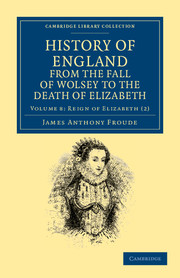
James Anthony Froude (1818–94), historian and disciple of Carlyle, published this twelve-volume history of the English Reformation between 1858 and 1870. The work is shaped by Froude's firm belief that the Reformation enabled the development of modernity and the rise of 'progressive intelligence' in England. His polemical stance was criticised by some historians, but his engaging narrative style and elegant prose made his work extremely popular with the general public, and the books were highly influential. The first six volumes consider the course of the Reformation from the break with Rome until the accession of Elizabeth I in 1558, and the remaining six recount the reign of Elizabeth I, ending with the defeat of the Spanish Armada. Volume 8 goes back to consider the condition of Ireland during Mary I's reign, the rise of the English navy, and the significance of Mary Stuart.
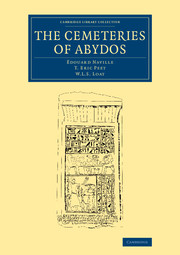
Originally published between 1913 and 1914 for the Egypt Exploration Fund, these three excavation reports relating to the necropolis at Abydos are now reissued together in one volume. Following the important work carried out by Flinders Petrie - his two reports on The Royal Tombs (1900–1) and the three-part Abydos (1902–4) are also reissued in this series - Édouard Naville (1844–1926) began further excavation and recording of the site's cemeteries with Thomas Eric Peet (1882–1934) and others. Each report contains a section of valuable illustrative material, such as photographs and drawings of the discovered artefacts. Part 1, covering the 1909–10 season, includes chapters on pottery and mummified dogs. Part 2, written up by Peet, covers all the tomb work carried out between 1909 and 1912. Part 3, co-authored with W. L. S. Loat, covers the 1912–13 season, notably the discovery of an ibis cemetery.
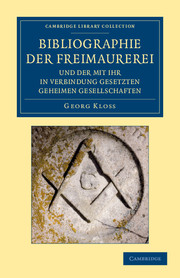
The Frankfurt physician Georg Kloss (1787–1854) was an avid bibliophile and a Freemason. In 1835 his large collection of early printed books was sold by Sotheby's in London, as his extra-curricular interests had shifted from incunabula to the history of freemasonry. He went on to publish several scholarly books on the subject, of which this bibliography (Frankfurt, 1844) was the first. Mentioned by Frederick Leigh Gardner in 1911 as 'excellent though exceedingly scarce', it records over 5,000 books, documents and references relating to freemasonry. These date from 1723 to 1835, and many are very rare, having been printed in tiny quantities. Kloss's bibliography is organised thematically, with sections devoted to topics including Masonic history, ritual, rules and regional jurisdictions (notably France), and related movements including theosophy, kabbalah, the Templars and the Rosicrucians. It also contains indexes of lodges and of authors, translators and composers.
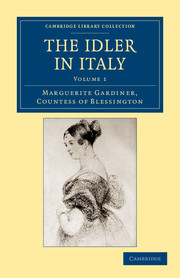
Marguerite Gardiner, countess of Blessington (1789–1849), was famous for her charm, wit and beauty, the latter reflected in Sir Thomas Lawrence's famous portrait of her in 1822. Blessington had an unhappy childhood, and was forced into her first marriage at the age of fourteen, but had developed a love of reading and story-telling. With her second husband Charles John Gardiner, first Earl of Blessington, she lived for several years in France and Italy. This three-volume work, first published 1839–40, contains Blessington's humorous account of living abroad. She gives detailed descriptions of her time in Italian cities such as Florence, Rome and Naples, drawing attention to 'the odour of the cuisine', the beautiful surroundings and weather, inspiring encounters with artists, and daily visits to art galleries. Volume 1 describes travelling around Switzerland and France, and ends with the author's encounter with Lord Byron in Genoa in 1823.
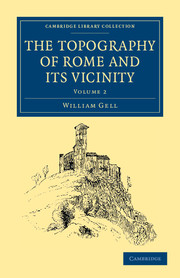
The antiquary Sir William Gell (1777–1836) was most famous for his two books on the archaeological discoveries at Pompeii (also reissued in this series) but his interest in the topography of classical sites resulted in several other publications, including this two-volume work, first published in 1834. The work was intended to accompany a map (available to download at http://www.cambridge.org/9781108042109) of the territory of ancient Rome, for which the field research and surveying activities were carried out in 1822. It provides alphabetical entries (from Abbatone to Zagarolo) on all the sites in Rome and its environs, with their modern names and populations, and their significance in ancient history and literature. Volume 2 also contains essays on the history and languages of ancient Italy, and supplements to various entries, where new discoveries had been made during the course of the work's preparation.
This famous pamphlet - published anonymously in 1776 because of its seditious content - by the British political radical Thomas Paine (1737–1809) laid out his pioneering ideas for American independence, and earned him the title of 'Father of the American Revolution'. The Declaration of Independence, written chiefly by Thomas Jefferson and famously promulgated later that year, was influenced by Paine's arguments in this work: that America was too large to be governed by a country as small as Britain - which, he claimed, was ruling America only for its own financial gain - and that the colonies had now achieved the financial and military capacity to break free. Criticising the British monarchical system, with a single figure at its pinnacle, Paine called instead for a government that promoted security, liberty and equality for its people. Over half a million copies of this highly influential document were sold in America in its first year.
Bernal Díaz del Castillo (1492–1584) was a foot soldier in the army of Mexico's conqueror Hernán Cortés. The first edition of his True History of the Conquest of New Spain (as it was entitled in a later English translation) was published in Madrid in 1632 from a manuscript copy sent to Spain shortly after the author's death. Written in a highly accessible style, and describing the experiences of the troops themselves rather than seeing events from an officer's perspective, the work became even more successful than the official accounts and went through many editions and translations. The two-volume edition reissued here was first published in 1904 and is considered a more reliable text, as it was based on the original manuscript preserved in Guatemala City. Volume 2 contains chapters 140–214 and the index to both volumes.
The twin sisters Agnes Lewis (1843–1926) and Margaret Gibson (1843–1920) were pioneering biblical scholars who became experts in a number of ancient languages. Travelling widely in the Middle East, they made several significant discoveries, including one of the earliest manuscripts of the four gospels in Syriac, a dialect of Aramaic, the language probably spoken by Jesus himself. Originally published in the Horae Semitica series, this fascicule is a collection of palimpsest fragments acquired and translated by Agnes Lewis. Discovered in Sinai and dating from the sixth to eighth centuries, the documents include parts of the four gospels and the epistles. Most important of the texts are an Aramaic lectionary on the gospels and a number of homilies including unique stories from the lives of Jesus and the apostles. Originally published in 1909 and featuring translations of the Aramaic texts, this is a vital resource for the biblical scholar.
Hausa is an African language originating in Niger and northern Nigeria and spoken widely in West and Central Africa as a lingua franca. Charles Henry Robinson (1861–1925) was the first student of the short-lived Hausa Association, formed in 1891 to promote the study of the Hausa Language and people. The Association sponsored Robinson to stay in northern Nigeria from 1894 to 1895 to gain more experience in the language. On his return Robinson published an anthology of Hausa texts in 1896 and a Hausa grammar in 1897 as well as this two-volume dictionary in 1899. His efforts contributed greatly to Western knowledge of the language despite criticisms of his relatively short experience of Hausa-speaking communities. Volume 1 is a Hausa–English dictionary. The version reissued here is the 1925 fourth edition, for which the Hausa–English dictionary was re-written and expanded.
A pioneering Egyptologist, Sir William Matthew Flinders Petrie (1853–1942) excavated over fifty sites and trained a generation of archaeologists. Ernest A. Gardner (1862–1939) was to become a leading classical archaeologist, but his first major project was carrying on the work of Petrie at Naukratis, the ancient Greek colony in the Nile Delta that Petrie had discovered in 1884. Reissued here together are Petrie's initial excavation report of 1886 and Gardner's 1888 continuation, each with many illustrations and material contributed by specialists on certain topics. Notably, the finds of inscribed pottery yielded significant insights into how the Greek alphabet developed. The final component included here is Petrie's 1889 report covering recent digs, particularly his discovery of a Roman necropolis and dozens of remarkable mummy portraits at Hawara. He wrote prolifically throughout his long career, and a great many of his other publications are also reissued in this series.