A collection of out-of-copyright and rare books from the Cambridge University Library and other world-class institutions that have been digitally scanned, made available online, and reprinted in paperback.
To save content items to your account,
please confirm that you agree to abide by our usage policies.
If this is the first time you use this feature, you will be asked to authorise Cambridge Core to connect with your account.
Find out more about saving content to .
To save content items to your Kindle, first ensure no-reply@cambridge.org
is added to your Approved Personal Document E-mail List under your Personal Document Settings
on the Manage Your Content and Devices page of your Amazon account. Then enter the ‘name’ part
of your Kindle email address below.
Find out more about saving to your Kindle.
Note you can select to save to either the @free.kindle.com or @kindle.com variations.
‘@free.kindle.com’ emails are free but can only be saved to your device when it is connected to wi-fi.
‘@kindle.com’ emails can be delivered even when you are not connected to wi-fi, but note that service fees apply.
A leading German theosophical writer, Karl Kiesewetter (1854–95) produced a number of works on esotericism and occult beliefs and practices. This book, first published in 1891, remains one of the most extensive histories of modern esotericism. In his account of its development, Kiesewetter focuses on a number of historical figures who were, in his opinion, highly influential in the field. He discusses the Renaissance esotericism of Heinrich Cornelius Agrippa (1486–1535) and devotes much consideration to Paracelsus (1493–1541), whom he considers to be 'the Luther of medicine'. He also engages with the system of pneumatology developed by Emanuel Swedenborg (1688–1772) and quotes extensively from the works of Jacob Böhme (1575–1624) and other German writers on pneumatology. Also included in this historical overview of modern occultism is the work of Andrew Jackson Davis (1826–1910), who was a leading figure within nineteenth-century American spiritualism.
Critic, poet and essayist Friedrich von Schlegel (1772–1829) was a leading figure of German Romanticism. Believed to be autobiographical, his unfinished novel Lucinde caused a scandal in 1799 because of its portrayal of a sexual liaison. After exploring the development of philosophy, Schlegel increasingly turned his attention to the study of Sanskrit and Hindu religious writings. This work on the connections between Sanskrit and Indo-European languages, first published in German in 1808, is regarded as an important early contribution to comparative grammar – it was Schlegel himself who introduced this term into linguistics. He was inspired by the example of comparative anatomy, and he also promoted the idea of family trees for languages. The Aesthetic and Miscellaneous Works of Frederick von Schlegel (1849), in English translation, is also reissued in this series.
Archivist and historian James Gairdner, C.B. (1828–1912) began his career in the Public Record Office at 18 and retired as assistant keeper forty-seven years later. The author of numerous historical works, Gairdner is best-known for his archival and editorial work, which forms his most significant contributions to historical scholarship. He oversaw almost entirely the publication of Letters and Papers, Foreign and Domestic, of the Reign of Henry VIII. The Paston Letters represent a similarly important work. The Letters reveal the fortunes of the Norfolk Paston family and of their tumultuous time. Beginning in the reign of Henry V and continuing through the reigns of Edward IV, Richard III, and Henry VII, the Letters are of great interest to early modern historians and literary critics. In Volume 2 (1424–1454), Gairdner includes some documents from the reign of Henry V before turning to letters written during Henry VI's reign.
The most lasting achievement of the German Egyptologist Heinrich Karl Brugsch (1827–94) is perhaps his work on the Egyptian demotic script, which had been relatively neglected since Champollion's death. This two-volume illustrated history of Egypt, 'derived entirely from the monuments', was first published in an English translation (by H. D. Seymour, from the 1876 first German edition, and edited by Philip Smith) in 1879. Brugsch brings to bear his wide experience of the archaeological sites together with his linguistic expertise, and deliberately eschews later Greek and Roman accounts of Egypt. Volume 2 covers the period from the Nineteenth Dynasty, the time of the empire's widest extent under Seti I and Rameses II, through the later decline and disintegration, with ruling dynasties from Nubia and Assyria, to the Persian conquest in 525 BCE. An appendix discusses the biblical account of Exodus in the context of Egyptian material remains.
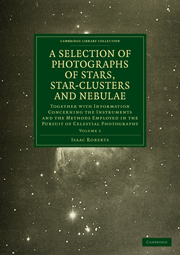
A geologist and fellow of the Royal Astronomical Society, Isaac Roberts (1829–1904) made significant contributions to the photography of star-clusters and nebulae. By championing reflecting rather than refracting telescopes, Roberts was able to perceive previously unnoticed star-clusters, and was the first to identify the spiral shape of the Great Andromeda Nebula. Roberts' use of a telescope for photographing stars, and a long exposure time, provided greater definition of stellar phenomena than previously used hand-drawings. Although Roberts' conclusions about the nature of the nebulae he photographed were not always correct, the book is significant for the possibilities it suggests for nebular photography. Published in London in 1893 and 1899, the two-volume Photographs of Stars represents the summation of his work with his assistant W. S. Franks at his observatory in Crowborough, Sussex. Volume 1 contains 51 collotype plates of stars, and descriptions of his instruments and methods.
Cambridge University Library houses a vast and internationally important collection of manuscripts, from early medieval illustrated bibles to personal papers and administrative records of the university. These volumes, first published between 1856 and 1867, contain the first published catalogue of the manuscripts held by the University Library. Edited by Henry Richards Luard (1825–91), Registrary of the University, these volumes provide detailed descriptions of the manuscript collection of the University Library as it was in the mid-nineteenth century. Information on the appearance, condition, age and provenance of the manuscripts is provided, together with accounts of their contents, to provide a practical and highly detailed guide to this fascinating collection. Volume 1 describes classmarks Dd.1-Dd.15, containing a wide variety of ecclesiastical manuscripts in English and Latin, sixteenth-century English and Latin medical texts and seventeenth-century commonplace books.
This book contains the Greek text of eight plays of Euripides edited by Johann Gottfried Hermann (1772–1848): Hecuba (1831), Iphigenia in Aulide (1831), Iphigenia Taurica (1833), Helena (1837), Andromacha (1838), Cyclops (1838), Phoenissae (1811), and Orestes (1841). The plays were published individually by Hermann and collected together at a later date. The Greek text of each play is supported by a critical apparatus containing a selection of variant readings between manuscripts and between printed editions. Each play is introduced by a Latin preface, discussing interpretative and text-critical issues and Hermann's theories on Greek poetic metre. Hermann's metrical theories had a significant impact on his editorial decisions and on the choices he made between variant readings in each play, and they influenced the direction of later Euripidean scholarship. Hermann's critical texts and prefaces therefore continue to be read by successive generations of scholars and students.
The biographer and writer on philosophy, ethics and literature Leslie Stephen (1832–1904) was educated at Eton, King's College, London, and then Trinity College, Cambridge, where he remained as a fellow and a tutor for his entire career. He served as the first editor (1885–91) of the Dictionary of National Biography and in 1871 he became editor of the Cornhill Magazine. In this short piece, published in 1865, Stephen takes issue with the portrayal of the American Civil War (1861–5) by The Times. Having travelled to the United States himself in 1863, Stephen argues that the newspaper's depiction of the events in America is inaccurate, and both misinforms the public in Britain and damages Britain's reputation abroad. Also included in this reissue is a short article on the poet John Byrom (1692–1763), and an obituary of Henry Sidgwick (1838–1900), Stephen's personal friend.
The antiquary Sir William Gell (1777–1836) was most famous for his two books on the archaeological discoveries at Pompeii (also reissued in this series) but his interest in the topography of classical sites is also reflected in this work, first published in 1823. Gell describes his experiences of many visits to the Peloponnese over a period of twenty years, during which the Greek movement for independence from the Ottoman Empire was gathering momentum and widespread support in Europe. Written partly in response to a request to 'give us anything but your dull maps and measures', the book does not discuss archaeological sites in detail but rather records impressions of the lives of the Greek and Turkish inhabitants in the period immediately before the outbreak of war. Gell's own conclusions about the prospects for 'Grecian liberty' are gloomy: he holds it to be 'quite unattainable at the present day'.
This work marks a significant and tragic moment in the history of medieval Jewish–Christian relations, as it promulgates one of Europe's first allegations of Jewish ritual murder of a Christian child. Composed in stages between 1150 and 1173 by Thomas, a monk at the Benedictine priory of Norwich, the Life narrates in seven books the murder (in 1144), discovery, miracles and canonisation (though he was deprived of sainthood at the Reformation) of a local boy, William. Offering an invaluable window into daily life in twelfth-century East Anglia, the work also stands at the origins of a myth with profound consequences for medieval Jewish communities. Edited by Augustus Jessop (1823–1914) and M. R. James (1862–1936) from a unique manuscript, this 1896 edition offers the original Latin text and a modern English translation, supplemented by detailed considerations of the textual, historical and political contexts shaping this remarkable document.
Karl Wilhelm Ludwig Müller (1813–94), who wrote in Latin under the name Carolus Müllerus, was a German classicist whose monumental five-volume Fragmenta historicorum graecorum (also reissued in the Cambridge Library Collection) remains an important resource today. Between 1855 and 1861, he also produced this valuable two-volume collection of the works of lesser-known Greek geographers. Volume 2 (1861) contains texts from the Roman imperial period, including Dionysius of Byzantium's Anaplus Bospori ('Voyage through the Bosphorus') and the work of Dionysius Periegetes, which is accompanied by Latin paraphrases from antiquity by Rufus Festus Avienus and Priscian, as well as the commentary on it by Eustathius of Thessalonica. The surviving Greek texts have parallel Latin translations, and Müller's extensive prolegomena (also in Latin) discusses what is known about the authors, their works and the manuscript sources.
Broadsheet papers were a popular forerunner of the tabloid newspaper, providing sensational descriptions of current events, especially violent crimes, executions and political scandal. Illustrated with satirical cartoons and often recounting stories in verse, the legacy of broadsheets can be seen in later publications such as Private Eye. This book, first published in 1871 by Charles Hindley (d. 1893), is a collection of notable and popular extracts from broadsheets, such as those produced by James Catnach. Although a wide variety of subjects were covered, including natural disasters, elopements, Parliamentary business and royal events, broadsheets were at their most profitable and lurid when reporting crime stories. Included in this text are accounts of famous cases such as Burke and Hare, child-killer Constance Kent and the Red Barn Murder. The book is an invaluable resource for social historians and provides fascinating insights into the Victorian media and the origins of today's mass media.
Published in 1812, this study of Malay in its written form was begun during William Marsden's service with the East India Company in Sumatra (1771–9). He continued his textual work in England upon his return, thus putting his practical knowledge into a solid scholarly frame. An expert in Asian languages and an outstanding Malay scholar in the English-speaking world, Marsden (1754–1836) was a fellow of the Royal Society from 1783 and later its vice-president and treasurer. This work is distinctive for its substantial Malay–English section, and for the use of examples from original Malay texts collected by the author. Despite being superseded by subsequent dictionaries, it is still a highly regarded and valuable source of information, especially about older, specialised and regional terms. The introduction provides the reader with a history of the Malayan language, including its spread, usage and regional variations.
Once the political centre of Lower Egypt, the city of Tanis was in ruins by the time pioneering archaeologist W. M. Flinders Petrie (1853–1942) arrived in the late nineteenth century. He recruited more than a hundred workers from nearby settlements to help with his excavations there. Now reissued together, these two reports of Petrie's discoveries were originally published separately in 1885 and 1888. His colleague Francis Llewellyn Griffith (1862–1934) contributes epigraphic analysis and translations. Each report contains much illustrative content, such as maps and photographs of the sites as well as drawings of the finds and hieroglyphic inscriptions. The 1888 publication also covers work carried out at Nebesheh and Defenneh, neither of which had been previously studied by archaeologists. Alexander Stuart Murray (1841–1904) discusses the important discoveries of painted vases at the latter site. Many of Petrie's other Egyptological publications are also reissued in this series.
Basil L. Gildersleeve (1831–1924) was an American classicist who spent much of his career at Johns Hopkins University. This is his influential 1895 edition of Pindar's Olympian and Pythian Odes, a body of work notable for its insights into lyric poetry and modes of self-understanding. Gildersleeve's remarkable introductory essay outlines Pindar's lineage, patriotism, and poetic development, as well as his poetic themes and structures. It focuses particularly on Pindar's new approach to old themes, his view of government and the human condition, and his role as a conveyer of Greek ethics. The poems are presented in the original Greek, followed by extensive notes that gloss the historical specificities and grammatical structures. Gildersleeve's index highlights major characters, battles, forms and metaphors. Although the scholarly analysis later in the book is very thorough, Gilderdale's introduction itself is accessible to anybody interested in ancient Greek poetry.
Henry Morton Stanley (1841–1904), the Welsh-born explorer famous for his 1871 meeting with the missionary David Livingstone, published this intimate autobiography in 1909. Through his recollections we learn how his troubled early life - an impoverished childhood in a workhouse and some harrowing experiences as a young soldier - were what drove him to succeed as an explorer, and gave him the strength to deal with the sometimes vehement opposition he encountered. Although Stanley died before finishing this book, his wife Dorothy brought it to completion by compiling and editing the letters and memoirs he wrote during his travels, so that his avowed aim - to encourage impoverished young people to realise their ambitions - was met. This is the story of a man who, in the context of his own time, achieved 'greatness' against the odds, though his imperialist and allegedly racist views later caused the eclipse of his reputation.
These letters to Gilbert White (1720–93), the author of The Natural History and Antiquities of Selborne (1789; also reissued in this series) were published in 1907. They were written between 1744 and 1790 by John Mulso (1721–91); brother of the bluestocking Mrs Chapone, to White, whom he had met when both were undergraduates at Oxford. White's letters to Mulso were unfortunately destroyed, frustrating plans to publish a 'most interesting and amusing series of letters' between intimate friends, but the remaining half of the correspondence, 'containing almost the only contemporary illustration of Gilbert White's character and career', and then in the possession of the earl of Stamford, was edited by Rashleigh Holt-White, a great-great-nephew and enthusiast of his ancestor's life. These fascinating letters give insights into not only White's character but also the lives of the gentry of the period, and the intellectual milieu in which both men moved.
A pioneering Australian reference work, this dictionary was published in 1879 by John Henniker Heaton (1848–1914), who in his youth spent twenty years as a journalist in Australia before returning to England and campaigning in Parliament for postal reform. Published amid a bitter dispute with the government printer, it is still acknowledged to contain much useful information despite some inaccuracies. The first part, 'Men of the Time', focuses on notable men and women with Australian connections, from 1542 to the date of publication, including explorers, governors, leading colonists, writers and scientists. The second part, 'The Australian Dictionary of Dates', provides an alphabetical listing of the most remarkable Australian historical events and topics, from Aboriginal cricketers to the Zig Zag railway line, particularly noting political and legal landmarks. Heaton's book is an important document of Victorian colonial historiography and a valuable resource for the history of European settlement in Australia.
The editor and forger John Payne Collier (1789–1883) claimed to have discovered a Second Folio of Shakespeare which had been 'corrected' in a mid-seventeenth-century hand. He published this catalogue of the emendations, including his commentary on them, in 1852. Collier then presented the so-called 'Perkins Folio' to the Duke of Devonshire, whose successor allowed it to be loaned in 1859 to the British Museum, where a thorough examination exposed it as a forgery. A storm of controversy followed and three of the key documents in the debate, all published in 1860, are also reissued here: 'An Inquiry into the Genuineness of the Manuscript Corrections in Mr. J. Payne Collier's Annotated Shakspere Folio, 1632' by Nicholas Hamilton (d.1915), assistant keeper of manuscripts at the British Museum; Collier's attempt to refute Hamilton's findings; and 'A Review of the Present State of the Shakespearian Controversy' by Thomas Duffus Hardy (1804–78).
F. H. A. Scrivener (1813–1891) was educated at Trinity College, Cambridge, and published a variety of works of New Testament scholarship while working as a clergyman and headmaster. In an age when previously unknown manuscript fragments of New Testament texts were being discovered, his skills as a transcriber and collator of these texts were greatly respected. This volume, first published in 1881, is an edition of the Greek text underlying the Revised Version of the New Testament, also published in 1881. It seeks to provide scholars with both a faithful version of the text as it was used by the translators of the Authorised Version (1611), and also extensive notes listing the changes in readings made for the Revised Version, giving the reader a fuller picture of the evolution of the translation. A valuable resource for understanding the version of the Bible used for four centuries in the English-speaking world.