A collection of out-of-copyright and rare books from the Cambridge University Library and other world-class institutions that have been digitally scanned, made available online, and reprinted in paperback.
To save content items to your account,
please confirm that you agree to abide by our usage policies.
If this is the first time you use this feature, you will be asked to authorise Cambridge Core to connect with your account.
Find out more about saving content to .
To save content items to your Kindle, first ensure no-reply@cambridge.org
is added to your Approved Personal Document E-mail List under your Personal Document Settings
on the Manage Your Content and Devices page of your Amazon account. Then enter the ‘name’ part
of your Kindle email address below.
Find out more about saving to your Kindle.
Note you can select to save to either the @free.kindle.com or @kindle.com variations.
‘@free.kindle.com’ emails are free but can only be saved to your device when it is connected to wi-fi.
‘@kindle.com’ emails can be delivered even when you are not connected to wi-fi, but note that service fees apply.
Robert Walpole (1781–1856), great-nephew and namesake of Britain's first prime minister, was a classical scholar and clergyman. After graduating from Trinity College, Cambridge, he visited Greece and the Middle East. In 1817 he published Memoirs Relating to European and Asiatic Turkey (also reissued in this series), extracts from the unpublished papers of various travellers and antiquaries, and it was so well received that he produced this continuation in 1820. It consists of extracts from the unpublished papers of, among others, W. M. Leake and John Sibthorp, with descriptions of antiquities, and notes by the editor. The topics covered vary considerably and reflect the wide interests of contemporary educated gentlemen: they include travel journals, observations on natural history, inscriptions from Egyptian monuments discovered by Belzoni, and C. R. Cockerell's views on the Labyrinth of Minos. The book remains a rich source for scholars from a wide range of disciplines.
This 1817 book by 'A. M. Philalethes' traces the history of Ceylon (now Sri Lanka) from the classical period to 1815, providing details of the religion, laws and manners of the people. An appendix contains an account, originally published in 1681, by Robert Knox (1641–1720) of his nearly twenty-year captivity on the island. The identity of the pseudonymous 'Philalethes' is not certain: he may have been Robert Fellowes (1770–1847), who, however, never visited Ceylon, or the Revd G. Bissett, who did. The book, which includes topographical notes and a collection of moral maxims and ancient proverbs, begins with classical accounts of the Island of Ceylon by Ptolemy, among others, and moves from this 'imperfect acquaintance with this remote region' to Knox's 'lively picture of the state of the country and manners of the people' which, according to 'Philalethes', was among the most important possessions of Great Britain.
The History of the Condemnation of the Patriarch Nicon, composed by the Greek prelate Paisius Ligarides of Scio (1612–1678), is an account of the bitter struggle between the leaders of the Russian church and state during the reign of Tsar Alexis Michaelovich (1629–1676) and the patriarchate of Nicon (1605–1681). The conflict resulted in the exile and deposition of the Patriarch in 1666, decreed by an ecclesiastical council headed by Ligarides. Ligarides' History, a theological and legal essay on the powers of the tsar, is one of the most important polemics produced during the period. The arguments and ideas it contains represented important advances in the developing ideological tradition of the absolute authority of the tsar. This 1873 translation, the third of six volumes on the subject compiled by William Palmer, made this key historical source accessible to English-speaking scholars of Russian ecclesiastical history and political thought.
Archivist and historian James Gairdner, C.B. (1828–1912) began his career in the Public Record Office at 18 and retired as assistant keeper forty-seven years later. The author of numerous historical works, Gairdner is best-known for his archival and editorial work, which forms his most significant contributions to historical scholarship. He oversaw almost entirely the publication of Letters and Papers, Foreign and Domestic, of the Reign of Henry VIII. The Paston Letters represent a similarly important work. The Letters reveal the fortunes of the Norfolk Paston family and of their tumultuous time. Beginning in the reign of Henry V and continuing through the reigns of Edward IV, Richard III, and Henry VII, the Letters are of great interest to early modern historians and literary critics. Volume 4 (1461–1468) continues with the reign of Edward IV and the War of the Roses.
A pioneering Egyptologist, Sir William Matthew Flinders Petrie (1853–1942) excavated over fifty sites and trained a generation of archaeologists. This single-volume reissue brings together two of his well-illustrated excavation reports. The first, originally published in 1897, describes work on six of the temples at Thebes, including the discovery of the famous Merneptah Stele, which contains the first non-biblical reference to Israel. A chapter on this inscription and others found in the temples is provided by the German scholar Wilhelm Spiegelberg (1870–1930). The second report, first published in 1896, discusses the archaeological work carried out at Naqada and Ballas by Petrie and James Edward Quibell (1867–1935), with a chapter by F. C. J. Spurrell (1842–1915) on the flint implements found at Naqada. Petrie wrote prolifically throughout his long career, and a great many of his other publications - for both specialists and non-specialists - are also reissued in this series.
William Hoey (1849–1919) was a magistrate in Lucknow, India when this book was published by the American Missionary Press in 1880. At the time, Lucknow was the seventh largest city in the British Empire, and it was the capital of the province that had most recently come under British rule. Hoey's monograph captures the details of trade in the city and surrounding regions at this time of change. Part 1 outlines the prominent features of trade in the area and includes tables of imports and exports. Part 2 focuses on Lucknow specifically, and contains the author's discussion of the impact of British rule on the city. The third part is a detailed A-Z of every trade, including information on production, prices and profit, and the work concludes with an extensive glossary of Indian terms. The level of detail in this work makes it an invaluable historical document.
The most lasting achievement of the German Egyptologist Heinrich Karl Brugsch (1827–94) is perhaps his work on the Egyptian demotic script, which had been relatively neglected since Champollion's death. This illustrated two-volume history of Egypt, 'derived entirely from the monuments', was first published in an English translation (by H. D. Seymour, from the 1876 first German edition, and edited by Philip Smith) in 1879. Brugsch brings to bear his wide experience of the archaeological sites together with his linguistic expertise, and deliberately eschews later Greek and Roman accounts of Egypt. Volume 1 gives a detailed survey of the physical environment of Egypt before considering the pre-dynastic period, and the emergence of Menes, the first known pharaoh. He then takes the narrative through the Old and Middle Kingdoms, and the intermediate period, to the emergence of the New Kingdom and the flowering and end of the Eighteenth Dynasty.
Friedrich Gottlieb Welcker (1784–1868) championed a comprehensive approach to antiquity, embracing history, literature, art and religion. This, and his openness to contemporary philosophical ideas about aesthetics and mythology, gave his work a visionary quality that inspired later figures as diverse as Usener and Wilamowitz. In this three-volume work on tragedy, his largest, published between 1839 and 1841, he attempts to reconstruct all the lost trilogies and tetralogies of Greek tragic theatre, insisting on their artistic unity, and demonstrating their fundamental debt to the Epic Cycle (which he had investigated in his Der Epische Cyclus, also reissued in this series). Amid much that is fantastic he made many brilliant discoveries, such that he must still be consulted by all serious students of the subject. Volume 1 deals with the period and plays of Aeschylus and Sophocles.
Michael Kelly (1762–1826) was an Irish singer and composer who studied music in a Naples conservatory before touring Europe and performing for royalty. His voyage to Italy began with a brush with pirates, one of whom was a childhood acquaintance. Kelly also found himself stranded penniless in Venice, spent a night in prison after a fist fight at the theatre, and had a narrow escape from revolutionary France. He is probably best remembered for creating the roles of Don Basilio and Don Curzio in the first performance, in 1786, of Le Nozze di Figaro, of which he describes the rehearsal period and reception. He later joined London's Theatre Royal as both a performer and composer and opened a music shop, which went bankrupt. These memoirs, published in 1826, provide rich first hand insights into a key period in theatre history. Volume 1 covers Kelly's early life and musical training.
This four-volume collection was issued by the Paris publisher Furne in the mid-nineteenth century to showcase the adventures and discoveries of recent French explorers. In Volumes 1 and 2 the naval officer Jules Dumont d'Urville (1790–1842) presents a lightly fictionalised account based on his first two voyages to the Pacific on board the Coquille (renamed L'Astrolabe for the second voyage). This was intended for a wider audience and offered at a more affordable price than the large-format scientific expedition reports produced for the French government. The work, illustrated with engravings, was originally published in 1832, but the printings by Furne reissued here date from 1863 and 1859 respectively. Volume 2 describes the voyage from French Polynesia back to France via Australia, New Zealand and Cape Horn. It includes d'Urville's discovery of the location in the Solomon Islands where the explorer Jean-Francois La Pérouse's ships had mysteriously disappeared in 1788.
Cambridge University Library houses a vast and internationally important collection of manuscripts, from early medieval illustrated bibles to personal papers and administrative records of the university. These volumes, first published between 1856 and 1867, contain the first published catalogue of the manuscripts held by the University Library. Edited by Henry Richards Luard (1825–91), Registrary of the University, these volumes provide detailed descriptions of the manuscript collection of the University Library as it was in the mid-nineteenth century. Information on the appearance, condition, age and provenance of the manuscripts is provided, together with accounts of their contents, to provide a practical and highly detailed guide to this fascinating collection. Volume 3 describes classmarks Gg.1-Kk.4, containing collections of French and Italian poetry, Latin and English theological tracts and legal year-books for the reigns of Henry IV, Henry VI and Edward III.
The son of a printer and bookshop owner, Auguste Bernard (1811–1868) quit his studies at the age of seventeen to become a typographer at the Parisian printing house of Firmin Didot, before becoming an editor with the royal printer. Bernard spent his leisure time collecting documents on the history of the people and customs of the ancient province of Forez (roughly, the area of the Loire valley). He is best known for his histories of typography and printing in France and Europe, his most celebrated work being his biography of Geoffroy Tory, the first French royal printer. He published in 1853 this collection in two volumes, containing the first printed transcriptions of the medieval charters of the Abbey of Savigny in northern France and the Abbey of Ainay in Lyon. Volume 1 contains the charters of the Abbey of Savigny, founded in the twelfth century.
Leonard Horner (1785–1864) was a prominent geologist, educator and, later, a factory inspector. In 1833 he was appointed to the Royal Commission on the employment of children in factories, and he inspected sites around the north of England. His earlier scientific work saw him elected a fellow of the Royal Society in 1813, and he was twice president of the Geological Society. The two-volume Memoir of Leonard Horner, edited by his daughter, Katharine Lyell, and published in 1890, is a selection of letters to and from his family and friends. The correspondence gives vivid insights into the world of this influential reformer. Volume 1 focuses on Horner's life from his childhood until 1838, taking in many of the key events of his professional career, including his election to the Royal Society, his attempts at improving higher education in Edinburgh and his involvement with the inspection of factories.
Cambridge University Library houses a vast and internationally important collection of manuscripts, from early medieval illustrated bibles to personal papers and administrative records of the university. These volumes, first published between 1856 and 1867, contain the first published catalogue of the manuscripts held by the University Library. Edited by Henry Richards Luard (1825–91), Registrary of the University, these volumes provide detailed descriptions of the manuscript collection of the University Library as it was in the mid-nineteenth century. Information on the appearance, condition, age and provenance of the manuscripts is provided, together with accounts of their contents, to provide a practical and highly detailed guide to this fascinating collection. Volume 2 describes classmarks Ee.1-Ff.4, containing legal and historical treatises from the thirteenth and fourteenth centuries, collections of secular English verse and medical catalogues of herbs from the fifteenth century.
The Bohemian scholar Joseph Dobrowsky (1753–1829) played a key role in the Czech national revival of the nineteenth century. Born in Hungary, he went to a German school there and also acquired the Czech language. At Prague, he studied philosophy and theology. In the 1780s, Dobrowsky pursued philological interests and helped to establish the Royal Czech Society of Sciences. His linguistic research encompasses work on literary terms, orthography and historically comparative aspects of the Slavic languages. Reissued here is the revised and expanded 1818 edition of a work first published in 1792. In black-letter German, it deals with the origins and development of the Czech language, locating it within the Slavic language family. Dobrowsky also provides a full list of the most important Bohemian theological and literary writings from the sixth to the sixteenth century.
The mining industry was a fundamental part of the economy of South Africa in the late nineteenth century, and control of the region's gold mines was a significant factor in the tension between Dutch and English settlers that led to the Second Boer War in 1899. In 1889 the Witwatersrand Chamber of Mines had been formed to promote the industry's development. Economic problems in the region led the Volksraad of the South African Republic to set up a Commission of Enquiry in 1897 to investigate high tariffs, labour and transport costs which were adversely affecting the mining industry. The 1897 report reissued here was not that of the commission itself, but contains much of the evidence and statistical material presented to it, in the hope that the mining industry would adopt its recommendations. As such, this detailed resource remains relevant to economic historians of South Africa and the British Empire.
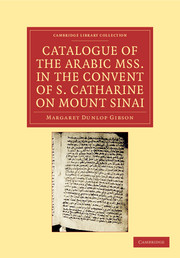
The twin sisters Agnes Lewis (1843–1926) and Margaret Gibson (1843–1920) were pioneering biblical scholars who became experts in a number of ancient languages. Travelling widely in the Middle East, they made several significant discoveries, including one of the earliest manuscripts of the Four Gospels in Syriac, a dialect of Aramaic, the language probably spoken by Jesus himself. Their chief discoveries were made in the Monastery of St Catherine on Mount Sinai. This work is a list of the monastery's manuscripts in Arabic compiled by Margaret Gibson in 1893 and first published in 1894. Written in Greek for use by scholars and for the monks themselves, this fascicule provides a careful document of the monastery's Arabic pages, their physical state and content. Illustrated with photographs of the catalogued works, this text will be of interest to scholars in Arabic Christianity and Middle East monastic history.
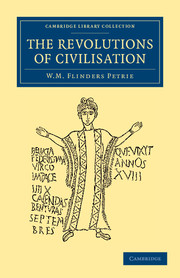
Among the leading Egyptologists of his day, Sir William Matthew Flinders Petrie (1853–1942) excavated over fifty sites and trained a generation of archaeologists. This short yet well-illustrated work, first published in 1911, sketches humankind's achievements over 10,000 years, establishing patterns in the rise and fall of civilisations. Drawing on his extensive knowledge of ancient Egypt, and looking also at Greece, Rome and beyond, Petrie defines each civilisation as having a summer of growth and a winter of decline, revealing his controversial eugenic view that while migration can initially reinvigorate a society, the mixing of peoples over time leads ultimately to that society's deterioration. Correlating developments in the production of art and material culture in different places, Petrie argues that civilisation is not a continuous state, but intermittent and recurrent. Many of his other publications - for both Egyptologists and non-specialists - are also reissued in this series.
A keen student of theology, August Friedrich Gfrörer (1803–61) became professor of history at the University of Freiburg and also sat as a representative in the Frankfurt parliament, agitating for the reunification of Protestantism and Catholicism. This three-volume work, published in 1838, may be regarded as marking the modern period in the Christian study of Judaism. Gfrörer was the first scholar who attempted to recount the history of Palestinian Judaism at the time of Jesus by using primary source material and without pursuing an obvious apologetic or polemic agenda. More than 2,000 pages in length, the work is a formidable scholarly achievement of lasting value in the field of religious studies. Volume 3 is dedicated to an exploration of the Gospel of John. According to Gfrörer, the dogma of God's transcendence is fundamental to both Judaism and Christianity, as told in the Gospel of John.
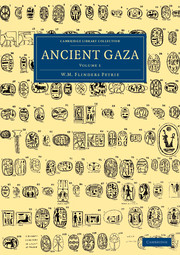
A pioneering Egyptologist, Sir William Matthew Flinders Petrie (1853–1942) excavated over fifty sites and trained a generation of archaeologists. Now reissued in two volumes are the four excavation reports, published between 1931 and 1934, covering his extensive dig at Tell el-Ajjul in Palestine. The reports scrupulously record the finds of artefacts dating from the Copper Age and extending to the Hyksos period. Descriptions of the working party's struggles against malaria and the elements highlight Petrie's devotion to his work. Volume 1 combines the first two reports, first published in 1931 and 1932, and includes descriptions of various cemeteries, tombs, palaces and horse burials. Each report features a section of photographs and sketches of tombs, pottery, weapons and jewellery. Petrie wrote prolifically throughout his long career, and a great many of his Egyptological publications - for both specialists and non-specialists - are also reissued in this series.