A collection of out-of-copyright and rare books from the Cambridge University Library and other world-class institutions that have been digitally scanned, made available online, and reprinted in paperback.
To save content items to your account,
please confirm that you agree to abide by our usage policies.
If this is the first time you use this feature, you will be asked to authorise Cambridge Core to connect with your account.
Find out more about saving content to .
To save content items to your Kindle, first ensure no-reply@cambridge.org
is added to your Approved Personal Document E-mail List under your Personal Document Settings
on the Manage Your Content and Devices page of your Amazon account. Then enter the ‘name’ part
of your Kindle email address below.
Find out more about saving to your Kindle.
Note you can select to save to either the @free.kindle.com or @kindle.com variations.
‘@free.kindle.com’ emails are free but can only be saved to your device when it is connected to wi-fi.
‘@kindle.com’ emails can be delivered even when you are not connected to wi-fi, but note that service fees apply.
The ecclesiastical historian John Strype (1643–1737) published the third volume of his monumental Elizabethan religious history Annals of the Reformation in 1728. For over two and a half centuries it remained one of the most important Protestant histories of the period and has been reprinted in numerous editions. Volume 3 Part 1 covers the years 1581 to 1587. It focuses on diplomacy with Spain and the build up to the attack of the Spanish Armada; relations with Scotland and the trial and execution of Mary Queen of Scots; friendship with the Low Countries and other Protestant allies in Europe; and works of religious polemic and the death of John Fox in 1587. Strype's thorough use of sources and the enormous scope and detail of his history has ensured its place as an outstanding work of eighteenth-century scholarship. It should be read by every student of Elizabethan religious history.
In the summer of 1861 the German-born geologist, zoologist and politician Carl Vogt (1817–95), Professor at Geneva, accompanied the wealthy landowner Georg Berna on a privately financed voyage to the Norwegian coast, the North Cape and Iceland. His role was to explain the natural history of the places they visited; also in the party was the artist Heinrich Hasselhorst, whose drawings illustrate this account of their journey. Vogt's book, published in 1863, is a travel narrative rather than a scientific report. It describes life on board the Joachim Hinrich, and his impressions of places including Bergen, Tromsø and Reykjavik, which he compares to a 'white desert' without trees or bushes. Vogt praises the hospitality, athletic physique and good looks of the Icelandic people, but expresses surprise that the natural resources of the island remain largely unexploited. The book includes appendices on Norwegian geology and Icelandic volcanoes.
Henry of Bracton (or Bratton) (c. 1210–1268) was a jurist who worked as a Justice of Assize in the south-west of England, and was the author of the first systematic discussion of English common law. The manuscripts which form Bracton's Note Book were discovered in the British Museum in 1884 by Vinogradoff, and were edited in three volumes in 1887 by Maitland. These volumes contain a collection of over 2,000 law cases from the thirteenth century, each with a description of how the law should be applied to the particular circumstances of each case. This is the first example of case law in English legal writing, and its usefulness as a record of legal precedent probably led to the creation of Year Rolls (official records of court cases) from 1268. Volume 2 contains the texts of Pleas in the Bench from 1218 to 1234.
A highly influential Czech historian and politician, František Palacký (1798–1876) became in 1825 the first editor of the journal of the Bohemian Museum, a key cultural institution in the development of Czech nationalism. He was actively involved in the nineteenth-century Czech national revival, helping also to found the Czech national theatre. Entering politics in 1848, he served as president of the Prague Slavic Congress, and later became a member of the Austrian senate as a supporter of greater Czech autonomy. In this extensive work, comprising ten separate parts - published in German between 1836 and 1867 - Palacký gives a detailed account of Bohemian history until 1526. It remains an important and ambitious feat of scholarship, still relevant to students of central European history. Volume 1 (revised in 1844) deals with the region's earliest history, tracing the rule of the Bohemian dukes up to the end of the twelfth century.
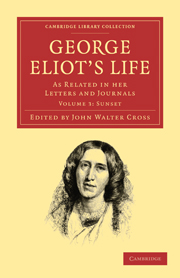
Best known for his brief marriage to George Eliot, John Walter Cross (1840-1924) compiled this three-volume 'autobiography' of 1885 from his late wife's journals and letters. Eliot was never married to her long-term partner G. H. Lewes, and she courted further scandal when she married Cross, twenty years her junior, in the spring of 1880. While these volumes offer a valuable insight into Eliot's private reflections, what is perhaps most telling is the material left out or rewritten in Cross' efforts to lend his wife's unconventional life some respectability, which he does at the expense of what one reviewer described as Eliot's 'salt and spice'. George Eliot's Life will be of particular interest to scholars of nineteenth-century biography and literature. Volume 3 focuses on Eliot's final years, including her later literary success, travels in Spain, the death of G. H. Lewes, and her marriage to Cross.
French zoologist and naturalist Georges Cuvier (1769–1832), one of the most eminent scientific figures of the early nineteenth century, is best known for laying the foundations of comparative anatomy and palaeontology. He spent his lifetime studying the anatomy of animals, and broke new ground by comparing living and fossil specimens - many he uncovered himself. However, Cuvier always opposed evolutionary theories and was during his day the foremost proponent of catastrophism, a doctrine contending that geological changes were caused by sudden cataclysms. He received universal acclaim when he published his monumental Le règne animal, which made significant advances over the Linnaean taxonomic system of classification and arranged animals into four large groups. The sixteen-volume English translation and expansion, The Animal Kingdom (1827–35), is also reissued in the Cambridge Library Collection. First published in 1817, Volume 4 of the original version covers zoophytes and concludes with several beautiful plates.
The twin sisters Agnes Lewis (1843–1926) and Margaret Gibson (1843–1920) were pioneering biblical scholars who became experts in a number of ancient languages. Travelling widely in the Middle East, they made several significant discoveries, including one of the earliest manuscripts of the four gospels in Syriac, the language believed to have been spoken by Jesus himself. Previously published as part of the Horae Semitica series, this first fascicule contains the third-century Syriac text of the Didascalia Apostolorum, edited by Gibson. Traditionally attributed to the apostles, the text is a treatise on Church law and doctrine, covering topics including church organisation, charity and forgiveness. Gibson described it as a 'potent instrument' used to gain the 'unquestioning obedience of the Christian people'. An important resource for the Syriac scholar, the edition also includes additional material from a variety of sources, and is of considerable significance to ecclesiastical history.
Archivist and historian James Gairdner, C.B. (1828–1912) began his career in the Public Record Office at 18 and retired as assistant keeper forty-seven years later. The author of numerous historical works, Gairdner is best-known for his archival and editorial work, which forms his most significant contributions to historical scholarship. He oversaw almost entirely the publication of Letters and Papers, Foreign and Domestic, of the Reign of Henry VIII. The Paston Letters represent a similarly important work. The Letters reveal the fortunes of the Norfolk Paston family and of their tumultuous time. Beginning in the reign of Henry V and continuing through the reigns of Edward IV, Richard III, and Henry VII, the Letters are of great interest to early modern historians and literary critics. Volume 5 (1469–1478) continues to cover the War of the Roses, with letters from Edward's reign, Henry VI's restoration, and Edward IV's own restoration.
Born Alphonse Louis Constant, French magician Éliphas Lévi (1810–75) wrote prolifically on the occult sciences. His hugely popular Dogme et rituel de la haute magie, published in French in 1854, was translated into English by Arthur Edward Waite (1857–1942) in 1896. In the present work, Waite condenses Lévi's two volumes into one. The first part outlines Lévi's theory of the doctrine of transcendent magic and discusses a wide range of magical phenomena, including bewitchment, Kabbalah and alchemy. The second part focuses on the practical aspects of ritual and ceremony in Western occult philosophy. Waite, a mystic and occult historian, edited several alchemical and magical texts for publication in the wake of the mid-nineteenth century occult revival. His translation is accompanied by a preface outlining Lévi's colourful career. The original two-volume French edition is also reissued in the Cambridge Library Collection.
Although he had never set foot in Africa, Scottish poet and linguist John Leyden (1775–1811) decided to publish in 1799 this compilation on 'discoveries and settlements' there, drawing from the published works of explorers. His aim was 'to exhibit the progress of discoveries at this period in North and West Africa', giving descriptions of places such as Guinea, the Gold Coast, and Sierra Leone, as well as accounts of their people. He begins the work by discussing a meeting of the African Association on 9 June 1788, where a map depicted the interior of the continent as 'an extended blank'. Leyden attempts to provide information on those unknown areas by using the travel accounts of writers - including the Scots explorer Mungo Park - who had ventured into the African interior, to put together a narrative which makes this work a valuable collection of eighteenth-century accounts by European explorers in Africa.
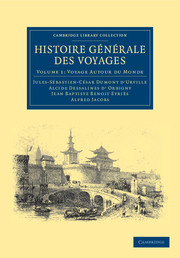
This four-volume collection was issued by the Paris publisher Furne in the mid-nineteenth century to showcase the adventures and discoveries of recent French explorers. In Volumes 1 and 2 the naval officer Jules Dumont d'Urville (1790–1842) presents a lightly fictionalised account based on his first two voyages to the Pacific on board the Coquille (renamed L'Astrolabe for the second voyage). This was intended for a wider audience and offered at a more affordable price than the large-format scientific expedition reports produced for the French government. The work, illustrated with engravings, was originally published in 1832, but the printings by Furne reissued here date from 1863 and 1859 respectively. Volume 1 describes the voyage through the Atlantic to the Cape of Good Hope, and focuses on South and South-East Asia, China and Hawaii, covering natural history, indigenous culture, and colonial commerce. It ends with the ship's arrival in French Polynesia.
Archivist and historian James Gairdner, C.B. (1828–1912) began his career in the Public Record Office at 18 and retired as assistant keeper forty-seven years later. The author of numerous historical works, Gairdner is best-known for his archival and editorial work, which forms his most significant contributions to historical scholarship. He oversaw almost entirely the publication of Letters and Papers, Foreign and Domestic, of the Reign of Henry VIII. The Paston Letters represent a similarly important work. The Letters reveal the fortunes of the Norfolk Paston family and of their tumultuous time. Beginning in the reign of Henry V and continuing through the reigns of Edward IV, Richard III, and Henry VII, the Letters are of great interest to early modern historians and literary critics. Volume 3 (1454–1461) contains letters from Henry VI's reign and the War of the Roses, closing with the accession of Edward IV.
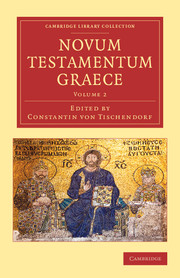
Ad antiquissimos testes denuo recensuit apparatum criticum omni studio perfectum apposuit commentationem isagogicam praetexuit Constantinus Tischendorf
The German biblical scholar Constantin von Tischendorf (1815–74) published his monumental eighth edition of the Greek New Testament between 1869 and 1872. Following his death, the prolegomena was compiled by colleagues and appeared between 1884 and 1894. Influenced by the pioneering scholarship of Karl Lachmann (1793–1851), who had first moved away from relying on the Textus Receptus, Tischendorf placed key emphasis on the witness of older uncial manuscripts, most notably the Codex Sinaiticus (which he rediscovered) and the Codex Vaticanus. His painstaking work laid the foundations for the creation of modern critical texts, and the vast amount of manuscript evidence he collated has ensured that this edition remains a standard work of reference for biblical scholars and textual critics. Volume 2 (1872) contains the text and critical apparatus for the Acts, Epistles and Book of Revelation.
Vincent Eyre (1811–81) was an English officer in the East India Company from 1827 and took part in the First Anglo-Afghan War (1839–42), which ended in disaster for the British. He would later become a major-general and a Knight Commander of the Star of India, but in this work Eyre lucidly describes his experiences as a lieutenant in the war, during which he was severely wounded. In addition to providing a wealth of military detail, he also includes an account of how he was captured with his family by Akbar Khan in January 1842 and held hostage for nearly nine months. Eyre kept a diary throughout, and the manuscript was smuggled to a friend in India prior to publication in England in 1843. This updated third edition offers insights into both military and personal misfortune.
This work, first published in 1822, was edited by Peter Paul Dobree (1782–1825) who had been entrusted with the literary remains of the eminent classical scholar Richard Porson (1759–1808). It contains the text of a ninth-century Greek lexicon compiled by Photius, Patriarch of Constantinople. The lexicon was a tool for Byzantine Greeks studying the works of ancient authors, whose language and vocabulary differed significantly from the day-to-day language spoken in the Byzantine Empire. The lexicon offers the modern scholar a wealth of information regarding ancient works that Photius had access to but are no longer extant. The edition is based on a transcription, made by Porson, of the only remaining manuscript of the lexicon: Codex Galeanus, in Trinity College Library, Cambridge. Volume 1 contains entries for the letters alpha to omicron. The edition has served as an important source for the study of Byzantine lexicography.
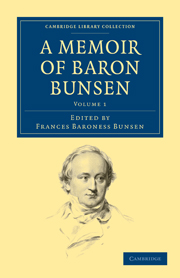
Frances Bunsen (1791–1876) published this account of the life of her husband, the Prussian diplomat and scholar Christian Karl Josias, Baron von Bunsen (1791–1860) in two volumes in 1868. Bunsen served as Prussian ambassador to Great Britain for thirteen years between 1841 and 1854, a critical period in European politics that culminated in the 1848 revolutions and the political turmoil that ensued. The memoir is based on Bunsen's family papers and private correspondence and was prepared at his request. It is illustrated with woodcuts and lithographs. Volume 1 covers Bunsen's early life in Waldeck; his education in Marburg and Göttingen; his marriage; his relationship with the scholar and statesman Barthold Georg Niebuhr (1776–1831); his time in Rome as envoy to the papal court; his first trip to England; and his acceptance by Queen Victoria as Prussian ambassador to Great Britain.
A highly influential Czech historian and politician, František Palacký (1798–1876) became in 1825 the first editor of the journal of the Bohemian Museum, a key cultural institution in the development of Czech nationalism. He was actively involved in the nineteenth-century Czech national revival, helping also to found the Czech national theatre. Entering politics in 1848, he served as president of the Prague Slavic Congress, and later became a member of the Austrian senate as a supporter of greater Czech autonomy. In this extensive work, comprising ten separate parts - published in German between 1836 and 1867 - Palacký gives a detailed account of Bohemian history until 1526. It remains an important and ambitious feat of scholarship, still relevant to students of central European history. The third part of Volume 3 (1854) deals with the first years of the Council of Basel from 1431 to 1439.
With this 1881 publication, Heinrich Klutschak (1847–90), a German native of Prague, produced one of the first comprehensive accounts of Inuit life. In the years 1878–80 the artist and writer was part of an expedition, led by the American soldier Frederick Schwatka, which travelled in the Canadian Arctic. This undertaking was but one of many that sought to discover what had happened during the last expedition of the British explorer Sir John Franklin in the 1840s. As the title of the work indicates, Klutschak and his fellow expedition members attempted to live as fully as possible in the manner of the Inuit and in close proximity to them. Although Klutschak dwells on the antipathy between some of the Inuit bands, the general tone of the book is one of respect for their survival skills and way of life.
Anna Jameson (1794–1860) was an inspirational figure to a generation of young women writers and artists including Barbara Bodichon and Bessie Rayner Parkes. Her work was reviewed by leading figures such as Mary Shelley and Charles Kingsley, and even Carlyle, though less complimentary, referred to her as the 'celebrated Mrs Jamieson'. This book, first published in 1838, secured her growing reputation as a writer of history, literary criticism and travel literature, and has been popular ever since. Inspired by a journey made to support the career of her estranged husband, one of its key themes is the condition of women, which recurs regularly in Jameson's writing. Volume 2 describes the arrival of summer, and Jameson's experiences of landscapes, towns and people from Niagara to Detroit. It includes reflections on Schiller, emigration, and the Canadian infrastructure. For more information on this author, see http://orlando.cambridge.org/public/svPeople?person_id=jamean
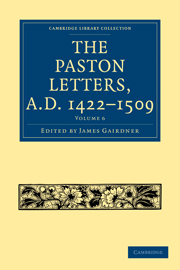
Archivist and historian James Gairdner, C.B. (1828–1912) began his career in the Public Record Office at 18 and retired as assistant keeper forty-seven years later. The author of numerous historical works, Gairdner is best-known for his archival and editorial work, which forms his most significant contributions to historical scholarship. He oversaw almost entirely the publication of Letters and Papers, Foreign and Domestic, of the Reign of Henry VIII The Paston Letters represent a similarly important work. The Letters reveal the fortunes of the Norfolk Paston family and of their tumultuous time. Beginning in the reign of Henry V and continuing through the reigns of Edward IV, Richard III, and Henry VII, the Letters are of great interest to early modern historians and literary critics. Volume 6 (1478–1506) covers the reigns of Edward IV, Edward V, Richard III, and Henry VII, concluding with an Appendix of the family's wills.