A collection of out-of-copyright and rare books from the Cambridge University Library and other world-class institutions that have been digitally scanned, made available online, and reprinted in paperback.
To save content items to your account,
please confirm that you agree to abide by our usage policies.
If this is the first time you use this feature, you will be asked to authorise Cambridge Core to connect with your account.
Find out more about saving content to .
To save content items to your Kindle, first ensure no-reply@cambridge.org
is added to your Approved Personal Document E-mail List under your Personal Document Settings
on the Manage Your Content and Devices page of your Amazon account. Then enter the ‘name’ part
of your Kindle email address below.
Find out more about saving to your Kindle.
Note you can select to save to either the @free.kindle.com or @kindle.com variations.
‘@free.kindle.com’ emails are free but can only be saved to your device when it is connected to wi-fi.
‘@kindle.com’ emails can be delivered even when you are not connected to wi-fi, but note that service fees apply.
Sir Julian Corbett (1854–1922) was an eminent British naval historian who focused on the analysis of historic naval strategy. After graduating from Trinity College, Cambridge, in 1876 Corbett practised as a barrister until 1882, when he turned to historical writing. He was appointed Lecturer in History to the Royal Naval College, Greenwich, in 1903, and was consulted on naval reforms during the First World War. These volumes, first published in 1907, contain Corbett's detailed analysis of naval warfare during the Seven Years' War (1756–1763). Focusing on the strategy of the British navy, Corbett recounts chronologically the major actions of the war, analysing in detail fleet movements and naval tactics in their political and diplomatic context. These volumes were the first scholarly work on this subject, and provide valuable information concerning the development of English naval strategy during this formative period. Volume 1 covers 1754–1759.
The historian John Strype (1643–1737) published the fourth and final volume of his monumental Elizabethan religious history Annals of the Reformation in 1731. For over two and a half centuries it remained one of the most important Protestant histories of the period and has been reprinted in numerous editions. Volume 4 is a rich collection of primary sources, covering the final years of Elizabeth I's reign and the first years of the reign of James I. The sources concern the continued threats from Spain; religious dissidence in England; episcopal organisation and the transference of power to James I. The sources, transcribed by Strype, include state papers, official proclamations, royal records, and letters. Strype's thorough use of sources and the enormous scope and detail of his history has ensured its place as an outstanding work of eighteenth-century scholarship. It should be read by every student of Elizabethan religious history.
A pioneering Egyptologist, Sir William Matthew Flinders Petrie (1853–1942) excavated over fifty sites and trained a generation of archaeologists. Now reissued in two volumes are the four excavation reports, published between 1931 and 1934, covering his extensive dig at Tell el-Ajjul in Palestine. The reports scrupulously record the finds of artefacts dating from the Copper Age and extending to the Hyksos period. Descriptions of the working party's struggles against malaria and the elements highlight Petrie's devotion to his work. Volume 2 combines the final two excavation reports, first published in 1933 and 1934, and includes the significant discovery of the large tomb of the governor under Tutankhamun. Each report features a section of photographs and sketches of tombs, pottery, weapons and jewellery. Petrie wrote prolifically throughout his long career, and a great many of his Egyptological publications - for both specialists and non-specialists - are also reissued in this series.
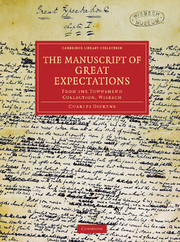
The novels of Charles Dickens (1812–70), with their inimitable energy and their comic, tragic and grotesque characters, are still widely read, and reworked for film and television. Dickens himself had the original manuscripts of his works bound and presented them to his friends. That of Great Expectations was given to Chauncy Hare Townshend, with whom Dickens shared an interest in mesmerism and the occult. Townshend bequeathed his library (including the manuscript), together with collections of paintings and objects, to the Wisbech and Fenland Museum in 1868. The manuscript has been newly photographed and is here reproduced in colour and at actual size. The Cambridge Library Collection is also reissuing the serialised version of Great Expectations (1860–1) and the first book edition (1861, in three volumes). Dickens scholars and enthusiasts can now study the work-in-progress, with all its deletions and revisions, alongside the first two published versions.
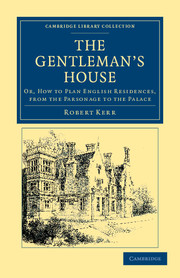
After Scottish architect Robert Kerr (1823–1904) published this book in 1864, he was given a commission to build what would become his best-known work, Bearwood House, in Berkshire, for the then proprietor of The Times of London, John Walter. Kerr gives a thorough explanation of the elements involved in the planning and building of a 'comfortable English Residence of the better sort' in this book, which is divided into five parts. The first gives a detailed historical account of the 'domestic plan' from the eleventh century to the present day. The subsequent sections leave no corner of a manor house unexamined, as Kerr discusses every room of such houses, their grounds, the possible types of architectural styles, and the matter of cost. There is also an extensive appendix of plates of architectural and garden plans, accompanied by explanations, giving a comprehensive guide to mid-Victorian stately-home building.
A keen student of theology, August Friedrich Gfrörer (1803–61) became professor of history at the University of Freiburg and also sat as a representative in the Frankfurt parliament, agitating for the reunification of Protestantism and Catholicism. His academic work marked the modern period in the Christian study of Judaism, making full use of primary sources without pursuing an obvious apologetic or polemical agenda. This two-volume work, published in 1831, is a critical study of early Christianity and the influence that Judaism had on the New Testament. Volume 1 provides a thorough exposition of Philo of Alexandria's philosophy and theology. Gfrörer also offers a biographical sketch of Philo and gives an informative overview of his writings and his time.
A highly influential Czech historian and politician, František Palacký (1798–1876) became in 1825 the first editor of the journal of the Bohemian Museum, a key cultural institution in the development of Czech nationalism. He was actively involved in the nineteenth-century Czech national revival, helping also to found the Czech national theatre. Entering politics in 1848, he served as president of the Prague Slavic Congress, and later became a member of the Austrian senate as a supporter of greater Czech autonomy. In this extensive work, comprising ten separate parts - published in German between 1836 and 1867 - Palacký gives a detailed account of Bohemian history until 1526. It remains an important and ambitious feat of scholarship, still relevant to students of central European history. The first part of Volume 2 (this is the 1847 printing) covers the rule of the Přemyslid dynasty in the thirteenth century.
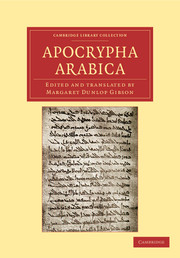
The twin sisters Agnes Lewis (1843–1926) and Margaret Gibson (1843–1920) were pioneering biblical scholars who became experts in a number of ancient languages. Travelling widely in the Middle East, they made several significant discoveries, including one of the earliest manuscripts of the Four Gospels in Syriac, a dialect of Aramaic, the language probably spoken by Jesus himself. Their chief discoveries were made in the Monastery of St Catherine on Mount Sinai. This text is a transcription and translation of an Arabic Christian manuscript discovered by Margaret Gibson in 1893 and first published in 1901. The text includes 'The Book of the Rolls', a retelling of early Biblical events; stories of Aphikia, a virtuous woman from the time of King Solomon; and the tale of Cyprian and Justa (recounted in Arabic and Greek). A useful resource for linguists and for scholars in the history of Arabic Christianity.
This four-volume collection was issued by the Paris publisher Furne in the mid-nineteenth century to showcase the work of recent French explorers for a readership avid for accounts of exotic foreign lands. Volume 3 is an updated version of an 1841 publication by the influential French palaeontologist Alcide d'Orbigny (1802–57), who between 1826 and 1833 travelled around South America collecting natural history specimens for the Paris Museum. The scientific publications resulting from this fieldwork were greatly admired by Charles Darwin. This lightly fictionalised account of d'Orbigny's travels, illustrated with engravings, was supplemented by information on North America derived from other sources. It went through several editions; this posthumous 1859 printing was further expanded by Alfred Jacobs (1827–62). It begins by describing the Caribbean, focuses in detail on South America, and continues with accounts of the history, landscapes and peoples of Mexico, the United States, Canada, Greenland and Iceland.
First published in 1842, this extensive reference work was edited and written in large part by the eminent lexicographer and classicist Sir William Smith (1813–93). Knighted in 1892, Smith was one of the major figures responsible for the revival of classical teaching and scholarship in Britain. He also made contributions to biblical study, editing a series of reference works on the subject. His three-volume Dictionary of Greek and Roman Biography and Mythology is also reissued in six parts in the Cambridge Library Collection. The present work is a massive achievement, running to well over a million words and copiously illustrated throughout with line drawings. It proved enduringly popular and was frequently reprinted throughout the nineteenth century. It is reissued now in two parts. The first part contains entries from abacus to lodix (a small shaggy blanket). The second part contains entries from logistai (Athenian officials) to zona (a girdle).
The English naturalist Philip Henry Gosse (1810–88) spent nine months in 1838–9 in a small town in Alabama where he was the teacher at the local school. His time there was unhappy because of the widespread abuse of slaves he witnessed, the support of the practice by his fellow Methodists being particularly distressing. However, he loved the beauty of his surroundings, and the abundant wildlife, and in 1859 he published this account in the form of nineteen letters. Gosse recounts in detail his voyage from Philadelphia to Mobile, Alabama, and the environment around his new home in the hills, with vivid descriptions of the plants, animals and insects he observed there. He rarely mentions slavery specifically, but the arrogance of the masters and the plight of their 'possessions' is a recurring theme in the work. Other books on natural history by Gosse are also reissued in this series.
Born in Hamburg, Henry (Heinrich) Barth (1821–1865) studied history, archaeology, geography and Arabic. He joined James Richardson's 1849 expedition to Africa, which aimed to open the interior to trade and to study slavery. Following the deaths of Richardson (1851) and his colleague Overweg (1852), Barth led the expedition alone. His travels extended to Lake Chad in the east, Cameroon in the south and Timbuktu in the west. He was the first European to use the oral traditions of the local tribes for historical research, learning several African languages, and studying the history, resources and civilisations of the people he encountered. Barth's five-volume account includes plates, engravings and detailed annotated maps. Published in both English and German in 1857–1858, it is still regarded as a major source on African culture. Volume 2 describes the settlements and peoples found on the journey from Kano to the shore of Lake Chad.
One of the foremost scholars of his day, the German classicist August Böckh (1785–1867) was chosen by the Berlin Academy of Sciences as the first editor of the monumental Corpus inscriptionum graecarum. Before that he had published this groundbreaking edition of the extant works of the Greek poet Pindar (c.522–c.443 BCE) in two volumes, the second being split into two parts. In the first volume Böckh had presented Pindar's victory odes (Epinikia), the only complete surviving works by the poet, alongside his own Latin treatise on metrics and extensive critical notes. In this first part of the second volume, published in 1819, the editor includes a lengthy Latin preface followed by the ancient Greek - primarily Alexandrian - scholia taken from the Codex Vratislaviensis. These commentaries on Pindar's works, by such writers as Aristarchus, Chrysippus, Aristodemus and Didymus, are also accompanied by the editor's notes.
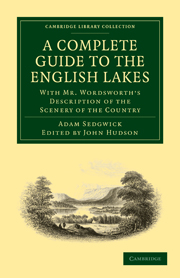
First published in 1853, this is a comprehensive guide to the British Lake District. It features contributions from William Wordsworth and the geologist Adam Sedgwick, as well as a number of shorter sections by local experts on subjects such as botany and toponymy. The first part comprises detailed descriptions of the major towns and villages of the area, providing recommended routes and excursions for tourists. This is followed by Wordsworth's description of the scenery of the Lake District, offering fascinating observations on the natural formation of the landscape and the influence of human settlement. The latter part consists of a series of five letters on the geological structure of the area, written by Sedgwick between 1842 and 1853. Illustrated with detailed maps of the area, this is a key text for those interested in the history of tourism in the Lake District and its development in the Victorian period.
This short-lived classical journal (1831–3), edited by Julius Charles Hare (1795–1855) and Connop Newell Thirlwall (1797–1875), both fellows of Trinity College, Cambridge, disseminated the new comparative philology. Developed primarily in Germany - both editors were fluent German speakers - this approach critiqued biblical and classical texts and was associated with a liberal Christianity which brought the editors into conflict with the university's religious conservatism. Hare left Cambridge in 1832 to take up the family living in Herstmonceaux, Sussex, while Thirlwall was dismissed in 1834 for supporting the admission of dissenters. Both editors nevertheless continued with ecclesiastical careers, Thirlwall becoming bishop of St David's and Hare archdeacon of Lewes. This 1833 volume, containing the journal's last three issues, illuminates the tensions between classical scholarship and Anglicanism as well as the development of specialised journals in an age of general literary reviews.
Alphonse Aulard (1849–1928) was the first French historian to use nineteenth-century historicist methods in the study of the French Revolution. Pioneered by German historians such as Leopold van Ranke, this approach emphasised empiricism, objectivity and the scientific pursuit of facts. Aulard's commitment to archival investigation is evidenced by the many edited collections of primary sources that appear in his extensive publication record. In these eight volumes of papers analysing the French Revolution (published 1893–1921), Aulard sought to apply the principles of historicism to reveal the truth and dispel myths. The work draws on earlier journal articles and lectures which Aulard delivered as Professor of the History of the French Revolution at the Sorbonne, a post he had held since 1885. Volume 3 (1902) surveys the history of the French provinces, the role of the Committee of Public Safety during the Terror, and the unification of Monaco with France in 1793.
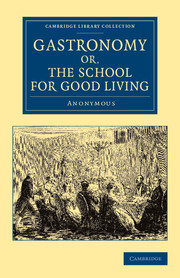
A Literary and Historical Essay on the European Kitchen, Beginning with Cadmus the Cook and King, and Concluding with the Union of Cookery and Chymistry
The art of the chef and the appreciation of good food have been with us since time immemorial, as this work delightfully demonstrates. Dedicating the book to 'professors of culinary science in the United Kingdom', the anonymous author sets out to trace developments 'from the age of pounded acorns to the refinements of modern luxury'. The style is irresistibly extravagant, with vocabulary to match, introducing the reader to the concept of the 'theogastrophilist': one who makes his belly his god. This vividly enjoyable exploration of the pleasures of eating begins its account in ancient Greece, and then embarks on a culinary journey through European history, featuring the fourteenth-century French cook Taillevent, the recipe collection Le viandier that was credited to him, and John Evelyn's 1699 vegetarian treatise Acetaria. Of universal appeal, the work was first published in 1814, and ran to a second edition in 1822, which is reissued here.
This two-volume English translation of part of a longer travel narrative by the Ottoman aristocrat Evliya Çelebi (1611–c.1680) was translated by the Austrian scholar Joseph von Hammer (1774–1856) and published in 1834 by the Oriental Translation Fund of Great Britain and Ireland, set up to make 'Eastern' texts more widely available in English. Çelebi was highly educated, had served the Ottoman court both as a diplomat and as a soldier, and as he says, had in his travels 'seen the countries of eighteen monarchs and heard 147 different languages'. His lifetime encompassed the highest point of Ottoman expansion into Europe, and his indefatigable curiosity about everything he saw makes this work a fascinating assemblage of topics varying from the fountains of Istanbul to a journey to Georgia. Volume 1 includes a short biography of Çelebi and accounts of the history and architecture of his native city.
During the eighteenth century, Spain relaxed its stringent export restrictions on Merino sheep, whose notably fine fleeces had long ensured the reputation of the Spanish woollen industry. Merinos were introduced around Europe and in 1792 Sir Joseph Banks, President of the Royal Society, established the first British flock in George III's gardens at Kew. This book, describing the qualities and adaptability of the Merino, was originally published in Paris in 1802 by the French agriculturalist and aristocrat C. P. Lasteyrie (1759–1849). It appeared in 1810 in this English translation by Benjamin Thompson (1775/6–1816), a professional playwright and translator, who was also an unsuccessful agricultural speculator and, briefly, secretary to the Merino Society. Documenting the spread of the Merino, regional variations in breeding regulations and husbandry practices, and wool yields, prices and taxation, this promotional treatise sheds light on the history of both agriculture and commodity trading.
Henry Cavendish (1731–1810) was an English scientist whose published work was mostly concerned with electricity. He was elected a Fellow of the Royal Society in 1760. Cavendish was a prolific scientific investigator, performing experiments on not only electricity but also magnetism, thermometry, gases, heat potential and the chemical composition of water. Although he published some of his research, including his discovery of hydrogen, the majority of his work remained unpublished until 1879, when James Clerk Maxwell published a collection of Cavendish's electrical experiments. These papers showed that Cavendish had discovered many important electrical concepts which had since been credited to other researchers, including the concept of electric potential. First published in 1921, these volumes are a collection of Cavendish's results from his many experiments. Volume 1 is a revised edition of James Clerk Maxwell's 1879 volume Electrical Researches of Henry Cavendish, also reissued in this series.