A collection of out-of-copyright and rare books from the Cambridge University Library and other world-class institutions that have been digitally scanned, made available online, and reprinted in paperback.
To save content items to your account,
please confirm that you agree to abide by our usage policies.
If this is the first time you use this feature, you will be asked to authorise Cambridge Core to connect with your account.
Find out more about saving content to .
To save content items to your Kindle, first ensure no-reply@cambridge.org
is added to your Approved Personal Document E-mail List under your Personal Document Settings
on the Manage Your Content and Devices page of your Amazon account. Then enter the ‘name’ part
of your Kindle email address below.
Find out more about saving to your Kindle.
Note you can select to save to either the @free.kindle.com or @kindle.com variations.
‘@free.kindle.com’ emails are free but can only be saved to your device when it is connected to wi-fi.
‘@kindle.com’ emails can be delivered even when you are not connected to wi-fi, but note that service fees apply.
This biography of the Champollion brothers was published in Grenoble in 1887. Jean-François (1790–1832) was a child prodigy who had taught himself numerous ancient languages in his teenage years, despite not having received any formal education. Having become an assistant professor of history at Grenoble in his nineteenth year, Jean-François published a decipherment of the trilingual Rosetta Stone in 1824, thus offering the key to an understanding of Egyptian hieroglyphics and consequently of the civilisation of ancient Egypt. His older brother, Jacques-Joseph (1778–1867), although a less gifted scholar, supported Jean-François and kept his name and achievement before the public after his early death. Jacques-Joseph's son Aimé-Louis (1813–94), the author of this biographical account, followed in his father's footsteps, becoming the librarian of the Bibliothèque Royale and publishing works on palaeography. Based on original letters, this is the only near-contemporary biography of the pioneering Egyptologist.
Upon the restoration of Charles II, theatre burst back into popularity across the stages of England. For the first time since the rise of Cromwell, it was possible to make a living from writing verse, and the theatres attracted poets in their dozens. One of them was the young John Dryden (1631–1700). In this sprightly 1826 biography, reissued here in one volume, Walter Scott (1771–1832) brings Dryden's work, philosophy and historical context vividly to life. He begins with Dryden's literary origins in the Restoration theatre, exploring the flops and then the successes that earned the poet his laurels, and continues with a detailed analysis of his later work, including the unstaged opera The State of Innocence as well as Mac Flecknoe, the cornerstone of Restoration satire. A lively critic, Scott is unafraid to write off Anglo-Saxon poetry, insult grammarians and illuminate Dryden's less admirable qualities.
David Steel was one of the most respected and prolific naval publishers of the early nineteenth century. His published volumes focused on naval strategy and shipbuilding techniques, and he was the first to publish regular Navy Lists. This volume, first published in 1801, contains information concerning British naval battles and losses which occurred during the early part of the French Revolutionary Wars, 1793–1800. This volume lists all ships belonging to the major European powers involved in the war which had been destroyed, describes settlements and colonies which had been captured by the British Navy, lists ships with details concerning their crew which were captured by the British Navy, and provides a list of commanding officers who were killed during this period. This volume presents a valuable summary of the major actions and prizes the British Navy fought and captured during this early period of the Revolutionary Wars.
Henry of Bracton (or Bratton) (c. 1210–1268) was a jurist who worked as a Justice of Assize in the south-west of England, and was the author of the first systematic discussion of English common law. The manuscripts which form Bracton's Note Book were discovered in the British Museum in 1884 by Vinogradoff, and were edited in three volumes in 1887 by Maitland. These volumes contain a collection of over 2,000 lawsuits from the thirteenth century, each with a description of how the law should be applied to the particular circumstances of each case. This is the first example of case law in English legal writing, and its usefulness as a record of legal precedent probably led to the creation of Year Rolls (official records of court cases) from 1268. Volume 1, 'Apparatus', introduces the texts and gives an account of Bracton's life.
Beiträge zur Ethnographie (1867) is Carl von Martius' colourful and personal memoir of his travels to Brazil in the years 1817–1820. Although better known as a botanist, Martius here ventures into the territory of ethnographic and linguistic studies, writing about the indigenous peoples of the Americas and Brazil. Volume 2 is a dictionary of different dialects of the Tupi language as well as various other South American dialects, as encountered by Martius himself, with Portuguese and German equivalents. A dictionary of the Tupi language was first compiled by the Jesuits who wished to establish a common language for various groups of the native population. As a botanist Martius was particularly interested in collecting the names of various animals and plants, and these were included by him together with the names of the locations in which the Tupi Indians settled.
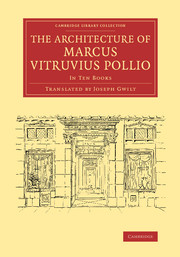
Active in the first century BCE, Marcus Vitruvius Pollio wrote his influential architectural treatise in ten books. It remained the standard manual for architects into the medieval period. The topics which Vitruvius considered essential are diverse, including aspects of design as well as geometry and engineering. In the nineteenth century, the English architect and author Joseph Gwilt (1784–1863) won greater acclaim for the books he published than for the buildings he designed. His most celebrated achievement, The Encyclopaedia of Architecture (1842), is also reissued in this series. Gwilt's one-volume translation of Vitruvius's Latin text was first published in 1826. Supplanting previous versions, this work was long regarded as the standard edition in English. It contains a brief life of Vitruvius as well as an annotated list of previous editions since the fifteenth century. A number of detailed illustrative plates accompany the text.
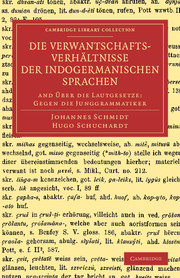
The German linguists Johannes Schmidt (1843–1901) and Hugo Schuchardt (1842–1927) sought to answer many questions relating to the development of Indo-European languages, which are all believed to be descended from a single common ancestor. Schmidt's Verwantschaftsverhältnisse was originally published in 1872 and Schuchardt's Über die Lautgesetze followed in 1885; here they are reissued together in one volume. Schmidt's work developed the 'wave model' of language change, to which Schuchardt also subscribed. According to this theory, linguistic innovations spread outwards concentrically like waves, which become progressively weaker as time elapses and the distance from their point of origin increases. Since later changes may not cover the same area, there may be no sharp boundaries between neighbouring languages or dialects. This theory stood in opposition to the tree model and the doctrine of sound laws propounded by the Neogrammarian school of linguists, which is roundly critiqued in Schuchardt's contribution.
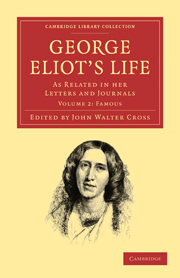
Best known for his brief marriage to George Eliot, John Walter Cross (1840–1924) compiled this three-volume 'autobiography' of 1885 from his late wife's journals and letters. Eliot was never married to her long-term partner G. H. Lewes, and she courted further scandal when she married Cross, twenty years her junior, in the spring of 1880. While these volumes offer a valuable insight into Eliot's private reflections, what is perhaps most telling is the material left out or rewritten in Cross' efforts to lend his wife's unconventional life some respectability, which he does at the expense of what one reviewer described as Eliot's 'salt and spice'. George Eliot's Life will be of particular interest to scholars of nineteenth-century biography and literature. Volume 2 covers the years 1858–1866, including Eliot's initial success in fiction and her travels in Italy, Holland, and along the Rhine.
Often described as the father of the Scottish Enlightenment, Francis Hutcheson (1694–1746) was born in the north of Ireland to an Ulster-Scottish Presbyterian family. Organised into three 'books' that were divided between two volumes, A System of Moral Philosophy was his most comprehensive work. It synthesised ideas that he had formulated as a minister and as the Chair of Moral Philosophy at the University of Glasgow (1729–46). Published posthumously by his son in 1755, prefaced by an account of his life, it is the only treatise by Hutcheson for which a manuscript is known to have survived. Asserting that individual natural rights derive from an innate understanding of moral behaviour, Hutcheson offers a model that mediates between individual interests and communal ideals. Containing the concluding chapters of Book 2 and Book 3, Volume 2 explores the role of familial and political governance in relation to communal happiness.
Henry Grey, 3rd Earl Grey (1802–1894) served as Great Britain's Secretary of State for War and the Colonies during the 1846–1852 administration of Prime Minister Lord John Russell. Following his time in office, Grey composed the two-volume Colonial Policy (1853) as a means of illuminating the actions and policies of the government he helped lead. Written in the form of letters addressed to Lord John himself, its goal was to give readers curious about colonial policy 'the means of knowing the real character and scope of those measures, and the grounds upon which they were adopted'. In this first volume, Grey offers some preliminary remarks before focusing on the Caribbean, British North America, and Australia. Seen in its entirety, this 'insider' work remains an important resource for students of colonial policy during this period of the expansion of British rule.
Between 1839 and 1851 Ernest Ludwig von Leutsch (1808–1887) and Friedrich Wilhelm Schneidewin (1810–1856), classics professors at the University of Göttingen, published this collection of ancient paroimia or proverbs written or collected by ancient Greek authors. Volume 2 (reissued here in two parts) contains writings by Diogenianus, Gregorius Cyprianus, Marcarius, Aesop, Apostolius and Arsenius. A critical apparatus for each text cites the variant readings between the most important manuscripts and a running Latin commentary is given below the critical apparatus. The Corpus has long been considered the definitive collection of Greek paroemiography and the editorial methods underlying it are still followed by editors today. Unsurpassed in breath and scope, the Corpus remains an indispensable tool for students and scholars of the Greek proverbial tradition. It ranks as one of the outstanding achievements of nineteenth-century classical scholarship.
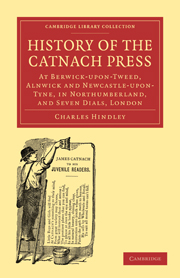
Charles Hindley (d.1893) wrote several books on British popular literature including Curiosities of Street Literature and a history of the cries of London. This book, first published in a limited edition in 1869 but here reprinted from the 1886 edition, tells the colourful story of John (1769–1813) and James (1792–1842) Catnach, the father-and-son printers who were leaders in the expanding market for cheap publications for the masses. John's contribution was to start using real paper and printer's ink instead of the cheap substitutes current at the time. He was also noted for embellishing his work with great technical skill. James later developed a successful business printing cheap song-sheets, ballads and sensationalist accounts of crimes, conspiracies and scandals, and was able to support his widowed mother and his sisters on the proceeds. This lively biography is illustrated with numerous woodcuts, many from Catnach's publications.
Henry Grey, 3rd Earl Grey (1802–1894) served as Great Britain's Secretary of State for War and the Colonies during the 1846 to 1852 administration of Prime Minister Lord John Russell. Following his time in office, Grey composed the two-volume Colonial Policy (1853) as a means of illuminating the actions and policies of the government he helped lead. Written in the form of letters addressed to Lord John himself, its goal was to give readers curious about colonial policy 'the means of knowing the real character and scope of those measures, and the grounds upon which they were adopted'. In this second volume, Grey focuses on Australia, New Zealand, Hong Kong, and Africa before offering some concluding observations. Seen in its entirety, this 'insider' work remains an important resource for students of colonial policy during this period of the expansion of British rule.
This slim volume, published anonymously in 1771 within months of the Endeavour's return from Captain Cook's first voyage, predates Hawkesworth's publication of Cook's own journal in his Voyages (1773, also reissued). It has been attributed variously to two of the ship's petty officers (Orton and Perry); Sydney Parkinson, draughtsman; his employer Joseph Banks; or the Swedish botanist Solander. The story moves rapidly, with well-chosen detail: mines that 'destroy two thousand slaves yearly', or the brown granite of a communal laundry. The author describes marine animals, Tahitian and New Zealand society, and foodstuffs including a 'large milky farinaceous fruit, which when baked resembles bread' - the breadfruit that Joseph Banks later decided to introduce to the Caribbean, leading to the ill-fated Bounty voyage (Bligh's account of which is also reissued). The author reports making 'considerable progress in learning the language of the country', and concludes with a short list of Tahitian words.
To mark the fiftieth anniversary of the foundation of Newnham College, the second Cambridge college to offer university education to women, its Council asked Alice Gardner to write this short history, published in 1921. Gardner (1854–1927) had gone up to Newnham in 1876: she had achieved the highest history degree in her year (though she was not allowed to graduate), and went on to a distinguished teaching career in Cambridge and Bristol. The book describes 'the idea of Newnham', which arose from supporters of female education in the mid-nineteenth century, the parallel trajectory of the founders of Girton College, and the small beginning of what became Newnham, with five students in a house overlooking Parker's Piece in 1871. Gardner takes the story up to 1914 (with a short epilogue), ending with the hypothesis, 'If Newnham ever becomes a College of the University …', a status eventually achieved in 1948.
American philologist Edward Robinson (1794–1863) is considered a founding figure in the field of biblical geography and archaeology. In 1838 he explored Palestine with Eli Smith (1801–57), a Yale graduate and Protestant missionary, and co-author of Missionary Researches in Armenia (also reissued in this series). Smith had settled in Beirut and was proficient in Arabic. The authors succeeded in identifying many biblical locations, and the original edition of their book, structured as a travel journal, was published in 1841. It was awarded the gold medal of the Royal Geographical Society the following year. Robinson and Smith returned to Palestine in 1852 and published an enlarged edition in 1856. This reissue is of the 1857 third edition, which was slightly abridged but contained new maps and plans. Volume 3 covers Robinson's 1852 itinerary through Beirut, Galilee, Samaria, Jerusalem and Damascus, again with detailed accounts of topography, history and architecture.
Charles Roach Smith (1806–90) had a prosperous career as a druggist. His shop was in the City of London, then undergoing major excavation and redevelopment, and he began to collect the artefacts being uncovered around him. With a widening interest in all aspects of the past, Smith began to publish notes on his collection as well as antiquarian observations. (His Illustrations of Roman London is also reissued in this series.) This three-volume work, published 1883–91, reviews his activities as an excavator, collector, and co-founder of the British Archaeological Association. Pen-portraits of fellow enthusiasts and descriptions of ancient buildings and ruins are interspersed with accounts of infighting in the Association, and biting criticism of local and national authorities who refused to take on responsibility for Britain's archaeological heritage. Volume 1 includes essays on the Saxon Shore forts, of which Roach Smith was a pioneering investigator.
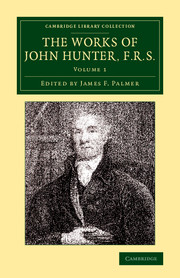
The surgeon and anatomist John Hunter (1728–93) left a famous legacy in the Hunterian Museum of medical specimens now in the Royal College of Surgeons, and in this collection of his writings, edited by James Palmer, with a biography by Drewry Ottley, published between 1835 and 1837. The first four volumes are of text, and the larger Volume 5 contains plates. Hunter had begun his career as a demonstrator in the anatomy classes of his brother William, before qualifying as a surgeon. He regarded surgery as evidence of failure - the mutilation of a patient who could not be cured by other means - and his studies of anatomy and natural history were driven by his belief that it was necessary to understand the normal physiological processes before attempting to cure the abnormal ones. Volume 1 contains Ottley's biography, a list of Hunter's published works, and his lectures on surgery.
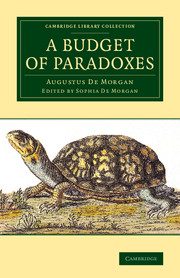
An important figure in the development of modern mathematical logic and abstract algebra, Augustus De Morgan (1806–71) was also a witty writer who made a hobby of collecting evidence of paradoxical and illogical thinking from historical sources as well as contemporary pamphlets and periodicals. Based on articles that had appeared in The Athenaeum during his lifetime, this work was edited by his widow and published in book form in 1872. It parades all varieties of crackpot, from circle-squarers to inventors of perpetual motion machines, all for the reader's entertainment and education. Filled with anecdotes, personal opinions and 'squibs' of every kind, the book remains enjoyable reading for those who are amused rather than appalled by the human condition. Also reissued in the Cambridge Library Collection are the Memoir of Augustus De Morgan (1882), prepared by his wife, and his ambitious Formal Logic (1847).
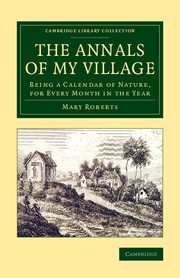
The writer Mary Roberts (1788–1864) developed an interest in natural history while growing up in the Gloucestershire countryside. This work of observations on wildlife, plants and the weather, though written while she was living in the village of Sheepscombe, near Painswick, was not published until 1831, some time after she had moved to London with her widowed mother and was a published author. Each chapter is devoted to a month of the year, and Roberts' acute observation of nature is enhanced by her considerable knowledge: she cites Withering and Cuvier (both also reissued in the Cambridge Library Collection) as her reference sources for plants and animals respectively. Her motive is 'a sincere desire to interest the dwellers among rural scenes in the … natural objects that surround them', and there is plenty to interest the modern reader in this charming account of the ecology of a remote rural hamlet.