A collection of out-of-copyright and rare books from the Cambridge University Library and other world-class institutions that have been digitally scanned, made available online, and reprinted in paperback.
To save content items to your account,
please confirm that you agree to abide by our usage policies.
If this is the first time you use this feature, you will be asked to authorise Cambridge Core to connect with your account.
Find out more about saving content to .
To save content items to your Kindle, first ensure no-reply@cambridge.org
is added to your Approved Personal Document E-mail List under your Personal Document Settings
on the Manage Your Content and Devices page of your Amazon account. Then enter the ‘name’ part
of your Kindle email address below.
Find out more about saving to your Kindle.
Note you can select to save to either the @free.kindle.com or @kindle.com variations.
‘@free.kindle.com’ emails are free but can only be saved to your device when it is connected to wi-fi.
‘@kindle.com’ emails can be delivered even when you are not connected to wi-fi, but note that service fees apply.
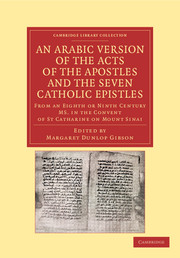
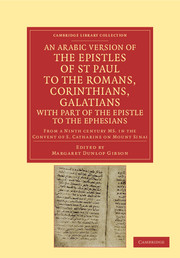
The twin sisters Agnes Lewis (1843–1926) and Margaret Gibson (1843–1920) were pioneering biblical scholars who became experts in a number of ancient languages. Travelling widely in the Middle East, they made several significant discoveries, including one of the earliest manuscripts of the Four Gospels in Syriac, a dialect of Aramaic, the language probably spoken by Jesus himself. Their chief discoveries were made in the Monastery of St Catherine on Mount Sinai. This text is a transcription of an Arabic manuscript discovered at the monastery and translated by Margaret Gibson. First published in 1899, the text includes sections of the New Testament as well as a short moral parable, some religious aphorisms and an essay on the nature of God. Illustrated with reproductions of the manuscript pages, this book is a useful text in the study of Arabic Christianity as well as an interesting resource for theological scholars.
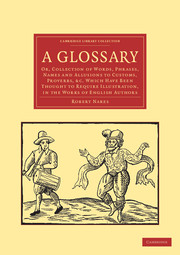
Or, Collection of Words, Phrases, Names and Allusions to Customs, Proverbs, etc. Which Have Been Thought to Require Illustration, in the Works of English Authors
Originally published in 1822, Robert Nares' glossary of antiquated Elizabethan terms is the result of a personal interest in and love of Elizabethan literature. Nares (1753–1829), well known as a scholar and clergyman, was also a keen philologist and antiquary. This glossary was undertaken in his spare time, and compiled over forty years as he was often occupied with various academic and clerical duties, including founding the British Critic and editing it for twenty years (1793–1813), and becoming Keeper of Manuscripts at the British Museum (1799–1807). It has long been a useful guide for the 'average reader' (in his own words), as its several reprintings during the nineteenth century demonstrate. His love of the English language was reflected in his previous work, Elements of Orthoepy (1784), which concerned itself with ascertaining correct pronunciation from Shakespeare's time onwards and exploring contemporary variations in the language.
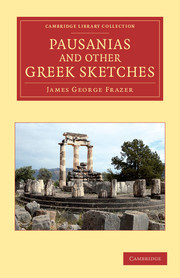
Sir James Frazer (1854–1941) is best remembered for his monumental study of ancient religion, The Golden Bough (of which the first and third editions are both reissued in this series). He also produced a translation of and commentary on the Description of Greece of Pausanias, the second-century CE traveller and antiquarian, and the first piece in this 1900 compilation of Frazer's 'sketches' is the introductory essay to that work. Short descriptions then follow of the present-day appearance of over ninety places visited by Pausanias, and the work ends with an essay on Pericles and the effect of the period of his rule on the art and architecture of Athens. This fascinating work is imbued with Frazer's enthusiasm for, and knowledge of, the topography of ancient Greece, and will be of interest not only to scholars but also to visitors to the country.
A highly influential Czech historian and politician, František Palacký (1798–1876) became in 1825 the first editor of the journal of the Bohemian Museum, a key cultural institution in the development of Czech nationalism. He was actively involved in the nineteenth-century Czech national revival, helping also to found the Czech national theatre. Entering politics in 1848, he served as president of the Prague Slavic Congress, and later became a member of the Austrian senate as a supporter of greater Czech autonomy. In this extensive work, comprising ten separate parts - published in German between 1836 and 1867 - Palacký gives a detailed account of Bohemian history until 1526. It remains an important and ambitious feat of scholarship, still relevant to students of central European history. In the second part of Volume 3 (1851) Palacký addresses the Hussite Wars from 1419 to 1431.
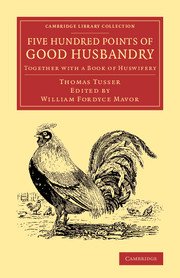
A singer and poet as well as a farmer, Thomas Tusser (c.1524–80) first produced his verse manual on farming in the mid-sixteenth century. Since then, it has gone through more than a dozen editions. This 1812 version is a collation of three of the poem's early editions. Editor William Mavor (1758–1837) provides a biographical sketch of Tusser, modernises the work's orthography and punctuation, and includes page-by-page annotations on subject matter and difficult points of language. The work divides into two: the first half, structured around the farming calendar, deals with the cultivation of open and enclosed land, while the second contains 'points of huswifery', arranged loosely around the working day. Tusser writes from the perspective of a tenant farmer, notably placing emphasis on the often overlooked benefits of land enclosure as well as on the role of women in farm labour.
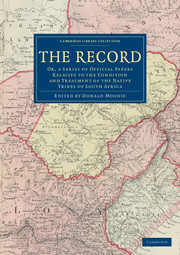
Originally published in 1838, this text draws upon official documents such as council resolutions and official journals, as well as statistics and local people's oral accounts, in order to explore the history of the treatment of the indigenous population of South Africa between 1649 and 1819. It was compiled, edited and translated by Scottish colonial official Donald Moodie (1794–1861), a 'liberal-minded British Colonist', who had emigrated to South Africa in 1820, originally as a farmer, and rose to the position of magistrate, and later 'Protector of the Slaves'. He was often critical of colonists' behaviour towards the indigenous tribes; he conducted interviews with the local populace during his investigations, earning himself the title of 'South Africa's pioneer oral historian'. This reissue includes only Parts 1, 3 and 5 of Moodie's investigation, as Parts 2 and 4 were never published.
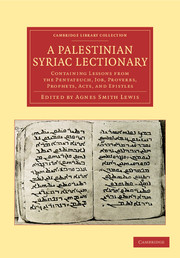
The twin sisters Agnes Lewis (1843–1926) and Margaret Gibson (1843–1920) were pioneering biblical scholars who became experts in a number of ancient languages. Travelling widely in the Middle East, they made several significant discoveries, including one of the earliest manuscripts of the Four Gospels in Syriac, a dialect of Aramaic, the language probably spoken by Jesus himself. This text, first published in 1897 as part of the Studia Sinaitica, contains a collection of Syriac scriptural lessons from a manuscript acquired in Cairo by Lewis in 1895. She believed the manuscript might have been used by the Syrian Church, although the date of the pages is uncertain. Included with the edited and annotated text is a glossary by Margaret Gibson and critical notes by distinguished theologian Eberhard Nestle, providing a useful resource for Syriac scholars which also casts light on the development of Christianity across the Middle East.
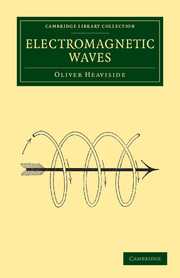
Oliver Heaviside (1850–1925), the self-taught physicist and electrical engineer, began his career as an operator on the newly laid Anglo-Danish telegraph cable in 1868. The most advanced electrical technology of the time, the cable system inspired several of his early mathematical papers. This monograph, first published as a paper in the Philosophical Magazine in 1888, then as a book in 1889, draws on his established work on telegraphic propagation and self-inductance, and on Maxwell's field theory. In a fascinating insight into the contemporary scientific community, he complains that these subjects are still often misunderstood, and explains his formulae afresh from several angles. Also covered - and frequently questioned - are contemporary theories of permittivity, the speed of electromagnetic waves, and the dielectric properties of conductors. Heaviside's Electrical Papers (2 volumes, 1892) and his Electromagnetic Theory (3 volumes, 1893–1912) have also been reissued in this series.
The twin sisters Agnes Lewis (1843–1926) and Margaret Gibson (1843–1920) were pioneering biblical scholars who became experts in a number of ancient languages. Travelling widely in the Middle East, they made several significant discoveries, including one of the earliest manuscripts of the Four Gospels in Syriac, a dialect of Aramaic, the language probably spoken by Jesus himself. Their chief discoveries were made in the Monastery of St Catherine on Mount Sinai. This work is a transcription by Gibson of a manuscript discovered by Lewis in the monastery in 1892 and published in 1894. The manuscript is an Arabic translation, believed to date from the ninth century, of part of St Paul's epistles. Included with the text are Gibson's notes on both the translation of the Arabic and the adaptations made to the text by the original translator, making the work a useful resource for scholars of Arabic Christianity.
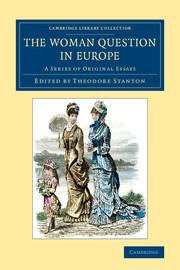
The American journalist Theodore Stanton (1851–1925), son of the leading feminist and suffragist Elizabeth Cady Stanton, published this remarkable collection of essays in 1884. His intention had been to get from each European country 'the collaboration of one or more women, who … had participated, either actively or in spirit, in some phase of the women's movement'. In seventeen chapters, all but two written by women, the progress of 'the woman question' - the debate on the rights of women to financial independence, higher education and the franchise - across Europe (and in the Ottoman empire) is described, largely for an American and British readership. The work, introduced by the veteran feminist Frances Power Cobbe, has among the contributors (each given a short biography) many famous names in the struggle for women's rights at the end of the nineteenth century, including (from Britain) Millicent Garrett Fawcett, Jessie Boucherett and Maria Grey.
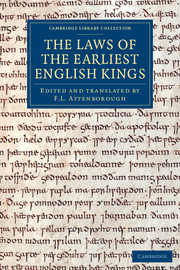
Frederick Levi Attenborough (1887–1973) studied at Cambridge and was a Fellow of Emmanuel College between 1920 and 1925. He later became the Principal of University College, Leicester. In 1922 Cambridge University Press published his edition of the early Anglo-Saxon laws, with a facing-page modern English translation. A few years earlier, Felix Lieberman had published his monumental three-volume Die Gesetze der Angelsachsen, which is still the definitive specialist edition of the laws (as Attenborough rightly predicted), and which is also reissued in the Cambridge Library Collection. Attenborough explains that his work is for social and legal historians who do not read German, or do not require the full critical apparatus and contextual material provided by Lieberman. Attenborough's book covers the laws from Aethelbert to Aethelstan; in 1925 Cambridge published a continuation by Agnes Robertson, The Laws of the Kings of England from Edmund to Henry I, which is also available.
Alexander von Humboldt (1769–1859) was an internationally respected scientist and explorer whose meticulous approach to scientific observation greatly influenced later research. He travelled the world, once staying at the White House as a guest of Thomas Jefferson, and is commemorated in the many species and places which bear his name. This two volume work, published in French in 1810 as Vue des Cordillères, and in this English translation in 1814, was one of the many publications that resulted from Humboldt's expedition to Latin America in 1799–1804. It describes geographical features such as volcanoes and waterfalls, and aspects of the indigenous cultures including architecture, sculpture, art, languages and writing systems, religions, costumes and artefacts. This approachable, closely observed travelogue vividly recounts a huge variety of impressions and experiences, and reveals Humboldt's boundless curiosity as well as his scientific and cultural knowledge.
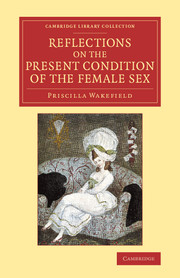
Coming from a prosperous London Quaker family, the author Priscilla Wakefield (1751–1832) wrote educational books for children, including an introduction to botany (also reissued in this series), and this 1798 work for adults, a fascinating piece of social and feminist history. Wakefield argues for better education for women, and suggests ways for those without the support of a husband or family to earn a living. Her ideas are not radical: she divides women into four social classes, with recommendations on appropriate work for each, and she believes that marriage rather than independence is the best outcome for any woman. Her concern for social norms is illustrated by her belief that field labour and any manufacturing job 'where both sexes are promiscuously assembled' are detrimental to female virtue. There are, however, many occupations which do not destroy 'the peculiar characteristic of their sex', or exceed 'the most exact limits of modesty and decorum'.
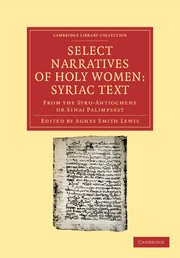
The sisters Agnes Lewis (1843–1926) and Margaret Gibson (1843–1920) were pioneering biblical scholars who became experts in a number of ancient languages. Travelling widely in the Middle East, they made several significant discoveries, including one of the earliest manuscripts of the Four Gospels in Syriac, a dialect of Aramaic, the language probably spoken by Jesus himself. Their chief discoveries were made in the Monastery of St Catherine on Mount Sinai. This fascicule, a useful resource for scholars of Syriac, and originally published as part of the Studia Sinaitica series, is the text of a Syriac manuscript from the monastic library at St Catherine's. Transcribed by Lewis and first published in 1900, the manuscript recounts the tales of a number of saintly women including Pelagia, a rich courtesan who converted to Christianity, and Eugenia, a holy woman who lived as a man and became the abbot of a monastery.
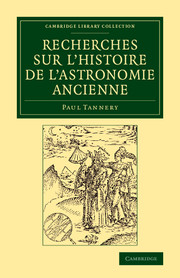
The French mathematician and historian of science Paul Tannery (1843–1904) worked as an administrator in the state tobacco industry while researching and publishing on a wide variety of topics, including editions of Fermat and Descartes as well as of the Greek mathematician Diophantus of Alexandria. This 1893 work reviews the history of ancient Greek astronomy, beginning with a survey of what the Greeks actually meant by the use of the terms 'astronomy' and 'astrology', and going on to consider the work of Pythagoras and the other pre-Socratics, Aristotle and the Alexandrian mathematicians. At its core is a detailed analysis of Claudius Ptolemy's Almagest, which attempts to trace each of the Greek master's theories - on the sphericity and circumference of the earth, on the sun, moon and planets, and on the prediction of eclipses - back to its historical origins in Greek mathematical and philosophical thought.
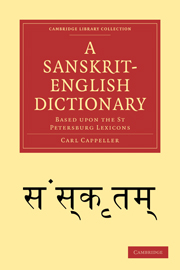
This one-volume Sanskrit–English dictionary, first published in 1891, is an English version of the seven-volume Sanskrit-Worterbuch, published at St Petersburg between 1852 and 1875, and contains about 50,000 entries. The aim of the editor, Carl Cappeller, was to provide a glossary for Sanskrit texts which were at the time becoming available in printed editions in Europe, particularly 'such works as are most appreciated and studied by every friend of Sanskrit literature'. He hoped that it would provide 'not only a handbook for the beginner in Sanskrit, who wants to have as many words as possible explained to him, but also to serve the purposes of the linguistic student, whose interest is limited to the old stock of words and their relations to other languages'. The dictionary has stood the test of time and is still consulted by students of Sanskrit.
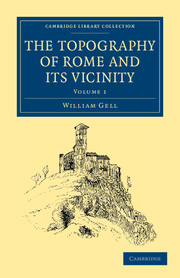
The antiquary Sir William Gell (1777–1836) was most famous for his two books on the archaeological discoveries at Pompeii (also reissued in this series) but his interest in the topography of classical sites resulted in several other publications, including this two-volume work, first published in 1834. The work was intended to accompany a map (available to download at http://www.cambridge.org/9781108042109) of the territory of Ancient Rome, for which the field research and surveying activities were carried out in 1822. It provides alphabetical entries (from Abbatone to Zagarolo) on all the sites in Rome and its environs, with their modern names and populations, and their significance in ancient history and literature. Volume 2 also contains essays on the history and languages of Ancient Italy, and supplements to various entries, where new discoveries had been made during the course of the work's preparation.
Or, An Account of the Mansion, Books, and Pictures, at Althorp, the Residence of George John Earl Spencer, K.G., to which is Added a Supplement to the Bibliotheca Spenceriana
The bibliophile aristocrat George Spencer (1758–1834) employed Thomas Frognall Dibdin (1776–1847) as his librarian for life. The second earl had amassed the greatest private library in Europe, housed at Althorp, and Dibdin was tasked with cataloguing the vast collection and sourcing suitable editions to add to it. In 1814, Dibdin began publishing his four-volume catalogue, Bibliotheca Spenceriana (also reissued in this series). Aedes Althorpianae was published in two volumes in 1822, and although it is to a great extent devoted to further details of the great library and its contents, it is also illuminating for its detailed history of Althorp and the Spencers. Its descriptions of the internal decoration of Althorp, particularly its art, are accompanied by numerous illustrations. Volume 1 includes descriptions of the various illustrated works in the library, such as a volume of original drawings by Pieter Bruegel the Elder and a sumptuous illuminated Magna Carta.
The writings of Ælfric of Eynsham (c.950–c.1010) are among the most important to survive from Anglo-Saxon England. He was shaped by tenth-century monastic reform, and his promotion of Old English was highly influential. His earliest known works, the Sermones Catholici (c.990–5), are adaptations of Latin texts rendered in Old English. The homilies draw on the gospels, saints' lives and other doctrinal themes. They were intended to be delivered over two years. This two-volume collection, first published between 1844 and 1846, contains transcriptions of the Old English texts with facing-page translations by Benjamin Thorpe (1781/2–1870). A well-respected scholar with a strong interest in promoting the study of Old English, Thorpe produced an important edition of the Anglo-Saxon Chronicle for the Rolls Series (also reissued in this series). Volume 1 of the present work contains the sermons for the first year, focusing on important events in the church calendar.
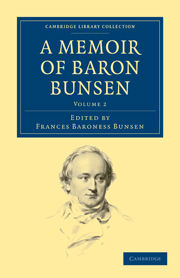
Frances Bunsen (1791–1876) published this account of the life of her husband, the Prussian diplomat and scholar Christian Karl Josias, Baron von Bunsen (1791–1860) in two volumes in 1868. Bunsen served as Prussian ambassador to Great Britain for thirteen years between 1841 and 1854, a critical period in European politics that culminated in the 1848 revolutions and the political turmoil that ensued. The memoir is based on Bunsen's family papers and private correspondence and was prepared at his request. It is illustrated with woodcuts and lithographs. Volume 2, opening in the year 1842, covers Bunsen's time as Prussian ambassador; his literary work, publications and biblical scholarship; his retirement in Heidelberg and Bonn; and his final illness and death. It is a key source for nineteenth-century British and Prussian diplomacy, and a fascinating account of an accomplished scholar and statesman.