Refine search
Actions for selected content:
26203 results in Theoretical Physics and Mathematical Physics
Some investigations of gas discharges by means of an exploring electrode
-
- Journal:
- Mathematical Proceedings of the Cambridge Philosophical Society / Volume 23 / Issue 5 / January 1927
- Published online by Cambridge University Press:
- 24 October 2008, pp. 531-541
- Print publication:
- January 1927
-
- Article
- Export citation
Note on the velocity of gas-reactions
-
- Journal:
- Mathematical Proceedings of the Cambridge Philosophical Society / Volume 23 / Issue 4 / October 1926
- Published online by Cambridge University Press:
- 24 October 2008, pp. 438-449
- Print publication:
- October 1926
-
- Article
- Export citation
A mathematical theory of natural and artificial selection
-
- Journal:
- Mathematical Proceedings of the Cambridge Philosophical Society / Volume 23 / Issue 4 / October 1926
- Published online by Cambridge University Press:
- 24 October 2008, pp. 363-372
- Print publication:
- October 1926
-
- Article
- Export citation
On Quantum Algebra
-
- Journal:
- Mathematical Proceedings of the Cambridge Philosophical Society / Volume 23 / Issue 4 / October 1926
- Published online by Cambridge University Press:
- 24 October 2008, pp. 412-418
- Print publication:
- October 1926
-
- Article
- Export citation
Proceedings at the Meetings Held During the Session 1925–1926: Annual General Meeting
-
- Journal:
- Mathematical Proceedings of the Cambridge Philosophical Society / Volume 23 / Issue 4 / October 1926
- Published online by Cambridge University Press:
- 24 October 2008, pp. 482-489
- Print publication:
- October 1926
-
- Article
- Export citation
An optical illusion due to contrast
-
- Journal:
- Mathematical Proceedings of the Cambridge Philosophical Society / Volume 23 / Issue 4 / October 1926
- Published online by Cambridge University Press:
- 24 October 2008, pp. 419-421
- Print publication:
- October 1926
-
- Article
- Export citation
On the stability of copper catalysts produced by thermal decomposition
-
- Journal:
- Mathematical Proceedings of the Cambridge Philosophical Society / Volume 23 / Issue 4 / October 1926
- Published online by Cambridge University Press:
- 24 October 2008, pp. 432-437
- Print publication:
- October 1926
-
- Article
- Export citation
On some resistance properties of a certain network containing inductances and capacities and their analogies in a vibrating mechanical system
-
- Journal:
- Mathematical Proceedings of the Cambridge Philosophical Society / Volume 23 / Issue 4 / October 1926
- Published online by Cambridge University Press:
- 24 October 2008, pp. 391-402
- Print publication:
- October 1926
-
- Article
- Export citation
Note on the extension to higher space of a theorem of Wallace
-
- Journal:
- Mathematical Proceedings of the Cambridge Philosophical Society / Volume 23 / Issue 4 / October 1926
- Published online by Cambridge University Press:
- 24 October 2008, pp. 361-362
- Print publication:
- October 1926
-
- Article
- Export citation
Note on the Petzval optical condition
-
- Journal:
- Mathematical Proceedings of the Cambridge Philosophical Society / Volume 23 / Issue 4 / October 1926
- Published online by Cambridge University Press:
- 24 October 2008, pp. 461-464
- Print publication:
- October 1926
-
- Article
- Export citation
The elliptic products of Jacobi and the theory of linear congruences
-
- Journal:
- Mathematical Proceedings of the Cambridge Philosophical Society / Volume 23 / Issue 4 / October 1926
- Published online by Cambridge University Press:
- 24 October 2008, pp. 337-355
- Print publication:
- October 1926
-
- Article
- Export citation
-
In the application of Elliptic Functions to the Theory of Numbers the two formulae of Jacobi

are of great importance.
On compressional waves in two superposed layers
-
- Journal:
- Mathematical Proceedings of the Cambridge Philosophical Society / Volume 23 / Issue 4 / October 1926
- Published online by Cambridge University Press:
- 24 October 2008, pp. 472-481
- Print publication:
- October 1926
-
- Article
- Export citation
On the Quantum Theory of the Problem of the Two Bodies
-
- Journal:
- Mathematical Proceedings of the Cambridge Philosophical Society / Volume 23 / Issue 4 / October 1926
- Published online by Cambridge University Press:
- 24 October 2008, pp. 422-431
- Print publication:
- October 1926
-
- Article
- Export citation
The Polarisabilities of Atomic Cores
-
- Journal:
- Mathematical Proceedings of the Cambridge Philosophical Society / Volume 23 / Issue 4 / October 1926
- Published online by Cambridge University Press:
- 24 October 2008, pp. 403-411
- Print publication:
- October 1926
-
- Article
- Export citation
-
If it is assumed that the series electron of an atom polarises the core, then it has been shown by Born and Heisenberg that the polarisability α of the core in a given state may be calculated from the corresponding term value by means of the approximate formulae,
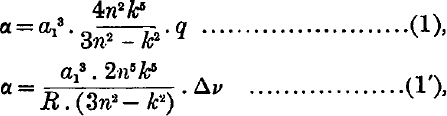 where q is the quantum defect, δν is the difference between the term and the corresponding hydrogen term, R is the Rydberg constant in cm.−1, α1 is the radius of first hydrogen orbit, n is the principal quantum number, k is the azimuthal quantum number, For terms with small quantum defect either of the formulae (1) and
  may be used, but for terms with large quantum defect (1) gives a higher degree of accuracy.
 may be used, but for terms with large quantum defect (1) gives a higher degree of accuracy.
PSP volume 23 issue 4 Cover and Front matter
-
- Journal:
- Mathematical Proceedings of the Cambridge Philosophical Society / Volume 23 / Issue 4 / October 1926
- Published online by Cambridge University Press:
- 24 October 2008, pp. f1-f2
- Print publication:
- October 1926
-
- Article
-
- You have access
- Export citation
Statement of Accounts of the Cambridge Philosophical Society, from January 1, 1925, to December 31, 1925
-
- Journal:
- Mathematical Proceedings of the Cambridge Philosophical Society / Volume 23 / Issue 4 / October 1926
- Published online by Cambridge University Press:
- 24 October 2008, pp. 490-491
- Print publication:
- October 1926
-
- Article
- Export citation
Improvements in the apparatus for measuring the velocity of very rapid chemical reactions
-
- Journal:
- Mathematical Proceedings of the Cambridge Philosophical Society / Volume 23 / Issue 4 / October 1926
- Published online by Cambridge University Press:
- 24 October 2008, pp. 450-460
- Print publication:
- October 1926
-
- Article
- Export citation
On the descriptive form of Taylor's theorem
-
- Journal:
- Mathematical Proceedings of the Cambridge Philosophical Society / Volume 23 / Issue 4 / October 1926
- Published online by Cambridge University Press:
- 24 October 2008, pp. 383-385
- Print publication:
- October 1926
-
- Article
- Export citation
-
The particular form of Taylor's theorem considered states that: If ƒ(x)is n times differentiable at a then
 where
where .
.

The correspondence between lines in threefold space and points of a quadric fourfold in fivefold space, established by a geometrical construction
-
- Journal:
- Mathematical Proceedings of the Cambridge Philosophical Society / Volume 23 / Issue 4 / October 1926
- Published online by Cambridge University Press:
- 24 October 2008, pp. 386-390
- Print publication:
- October 1926
-
- Article
- Export citation
Maxwell's Law, and the Absorption and Emission of Radiation
-
- Journal:
- Mathematical Proceedings of the Cambridge Philosophical Society / Volume 23 / Issue 4 / October 1926
- Published online by Cambridge University Press:
- 24 October 2008, pp. 465-471
- Print publication:
- October 1926
-
- Article
- Export citation
-
In the famous paper in which he developed his theory of radiation, Einstein investigated two problems. He investigated first the problem of what distribution of radiant energy in the steady state would be set up by an enclosed assembly of atoms in thermodynamic equilibrium radiating and absorbing according to the assumptions of his theory; he showed that the distribution so set up was given by Planck's law. He investigated secondly the velocities set up amongst the atoms in consequence of the random variations in direction of the emissions and absorptions; provided that emissions are assumed to be directed, so giving rise to recoil momentum, he showed that the mean square velocity-component in a given direction,
 , is equal to its equipartition value, given by
 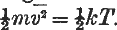 .
.
 , is equal to its equipartition value, given by
  .
.