Refine search
Actions for selected content:
26203 results in Theoretical Physics and Mathematical Physics
Index to the Proceedings Vol. XXIII
-
- Journal:
- Mathematical Proceedings of the Cambridge Philosophical Society / Volume 23 / Issue 8 / October 1927
- Published online by Cambridge University Press:
- 24 October 2008, pp. 996-1004
- Print publication:
- October 1927
-
- Article
- Export citation
PSP volume 23 issue 8 Cover and Back matter
-
- Journal:
- Mathematical Proceedings of the Cambridge Philosophical Society / Volume 23 / Issue 8 / October 1927
- Published online by Cambridge University Press:
- 24 October 2008, pp. b1-b2
- Print publication:
- October 1927
-
- Article
-
- You have access
- Export citation
On the Distribution of the Error of an Interpolated Value, and on the Construction of Tables
-
- Journal:
- Mathematical Proceedings of the Cambridge Philosophical Society / Volume 23 / Issue 8 / October 1927
- Published online by Cambridge University Press:
- 24 October 2008, pp. 912-921
- Print publication:
- October 1927
-
- Article
- Export citation
An Illustration of the Space Representation of Circles
-
- Journal:
- Mathematical Proceedings of the Cambridge Philosophical Society / Volume 23 / Issue 8 / October 1927
- Published online by Cambridge University Press:
- 24 October 2008, pp. 859-864
- Print publication:
- October 1927
-
- Article
- Export citation
Simplexes and other configurations upon a rational normal curve
-
- Journal:
- Mathematical Proceedings of the Cambridge Philosophical Society / Volume 23 / Issue 8 / October 1927
- Published online by Cambridge University Press:
- 24 October 2008, pp. 882-889
- Print publication:
- October 1927
-
- Article
- Export citation
PSP volume 23 issue 8 Cover and Front matter
-
- Journal:
- Mathematical Proceedings of the Cambridge Philosophical Society / Volume 23 / Issue 8 / October 1927
- Published online by Cambridge University Press:
- 24 October 2008, pp. f1-f11
- Print publication:
- October 1927
-
- Article
-
- You have access
- Export citation
Proceedings at the meetings held during the session 1926–1927: Annual general meeting
-
- Journal:
- Mathematical Proceedings of the Cambridge Philosophical Society / Volume 23 / Issue 8 / October 1927
- Published online by Cambridge University Press:
- 24 October 2008, pp. 985-992
- Print publication:
- October 1927
-
- Article
- Export citation
The specific heat of water vapour and the theory of the dissociation of water vapour at high temperatures
-
- Journal:
- Mathematical Proceedings of the Cambridge Philosophical Society / Volume 23 / Issue 8 / October 1927
- Published online by Cambridge University Press:
- 24 October 2008, pp. 942-950
- Print publication:
- October 1927
-
- Article
- Export citation
The Relation between Refractive Index and Density
-
- Journal:
- Mathematical Proceedings of the Cambridge Philosophical Society / Volume 23 / Issue 8 / October 1927
- Published online by Cambridge University Press:
- 24 October 2008, pp. 907-911
- Print publication:
- October 1927
-
- Article
- Export citation
-
Varying ideas of the mechanism of the propagation of light and of the constitution of matter have led at different times to different formulae for the dependence of the refractive index n of a medium on its density ρ, notably those of Laplace,
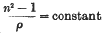 , and of Lorenz and Lorentz,
 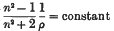 . Recently Macdonald has given a theory which seems more in accord with the modern concept of atomic structure and finds a formula
 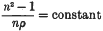 for a non-magnetic medium. It has therefore seemed worth while to examine a number of experimental results to see whether this new formula gives as satisfactory agreement as that of Lorenz and Lorentz; it is found that it does in most cases, and is occasionally the better.
 , and of Lorenz and Lorentz,
  . Recently Macdonald has given a theory which seems more in accord with the modern concept of atomic structure and finds a formula
  for a non-magnetic medium. It has therefore seemed worth while to examine a number of experimental results to see whether this new formula gives as satisfactory agreement as that of Lorenz and Lorentz; it is found that it does in most cases, and is occasionally the better.
A theorem of Dr P. Zeeman
-
- Journal:
- Mathematical Proceedings of the Cambridge Philosophical Society / Volume 23 / Issue 8 / October 1927
- Published online by Cambridge University Press:
- 24 October 2008, pp. 845-852
- Print publication:
- October 1927
-
- Article
- Export citation
Eddy currents in thin circular cylinders of uniform conductivity, due to periodically changing magnetic fields, in two dimensions
-
- Journal:
- Mathematical Proceedings of the Cambridge Philosophical Society / Volume 23 / Issue 8 / October 1927
- Published online by Cambridge University Press:
- 24 October 2008, pp. 901-906
- Print publication:
- October 1927
-
- Article
- Export citation
The Absorption and Reduction in Velocity of β-rays on their passage through matter
-
- Journal:
- Mathematical Proceedings of the Cambridge Philosophical Society / Volume 23 / Issue 8 / October 1927
- Published online by Cambridge University Press:
- 24 October 2008, pp. 970-981
- Print publication:
- October 1927
-
- Article
- Export citation
A differential retarding potential method for the study of the energy distribution of slow electron emissions
-
- Journal:
- Mathematical Proceedings of the Cambridge Philosophical Society / Volume 23 / Issue 8 / October 1927
- Published online by Cambridge University Press:
- 24 October 2008, pp. 922-929
- Print publication:
- October 1927
-
- Article
- Export citation
The pedal planes of a tetrahedron
-
- Journal:
- Mathematical Proceedings of the Cambridge Philosophical Society / Volume 23 / Issue 8 / October 1927
- Published online by Cambridge University Press:
- 24 October 2008, pp. 853-858
- Print publication:
- October 1927
-
- Article
- Export citation
A Case of Double Reflexion
-
- Journal:
- Mathematical Proceedings of the Cambridge Philosophical Society / Volume 23 / Issue 8 / October 1927
- Published online by Cambridge University Press:
- 24 October 2008, pp. 951-952
- Print publication:
- October 1927
-
- Article
- Export citation
Statement of Accounts
-
- Journal:
- Mathematical Proceedings of the Cambridge Philosophical Society / Volume 23 / Issue 8 / October 1927
- Published online by Cambridge University Press:
- 24 October 2008, pp. 993-995
- Print publication:
- October 1927
-
- Article
- Export citation
On the Effect of Continued Small Additions of Poisonous Substances on the Velocity of Gaseous Catalytic Reaction in Closed Vessels
-
- Journal:
- Mathematical Proceedings of the Cambridge Philosophical Society / Volume 23 / Issue 7 / July 1927
- Published online by Cambridge University Press:
- 24 October 2008, pp. 832-837
- Print publication:
- July 1927
-
- Article
- Export citation
Excitation by High Velocity Electrons
-
- Journal:
- Mathematical Proceedings of the Cambridge Philosophical Society / Volume 23 / Issue 7 / July 1927
- Published online by Cambridge University Press:
- 24 October 2008, pp. 804-810
- Print publication:
- July 1927
-
- Article
- Export citation
Wave Propagation in Strings with Continuous and Concentrated Loads
-
- Journal:
- Mathematical Proceedings of the Cambridge Philosophical Society / Volume 23 / Issue 7 / July 1927
- Published online by Cambridge University Press:
- 24 October 2008, pp. 768-778
- Print publication:
- July 1927
-
- Article
- Export citation
A Valve Amplifier for Ionisation Currents
-
- Journal:
- Mathematical Proceedings of the Cambridge Philosophical Society / Volume 23 / Issue 7 / July 1927
- Published online by Cambridge University Press:
- 24 October 2008, pp. 811-828
- Print publication:
- July 1927
-
- Article
- Export citation
