Refine search
Actions for selected content:
26203 results in Theoretical Physics and Mathematical Physics
Two sets of conditions for expansion in a Laurent's series
-
- Journal:
- Mathematical Proceedings of the Cambridge Philosophical Society / Volume 24 / Issue 1 / January 1928
- Published online by Cambridge University Press:
- 24 October 2008, pp. 38-47
- Print publication:
- January 1928
-
- Article
- Export citation
-
Let f(z) be a single-valued function of z, defined in the domain D given by
 ; suppose that f(z) is integrable in the general Denjoy sense round all circles with centre ζ lying in D, and along all portions of radial lines intercepted between two such circles.
 ; suppose that
 On the Lens Interferometer
-
- Journal:
- Mathematical Proceedings of the Cambridge Philosophical Society / Volume 24 / Issue 1 / January 1928
- Published online by Cambridge University Press:
- 24 October 2008, pp. 166-170
- Print publication:
- January 1928
-
- Article
- Export citation
A manometer for use with small Pitot tubes
-
- Journal:
- Mathematical Proceedings of the Cambridge Philosophical Society / Volume 24 / Issue 1 / January 1928
- Published online by Cambridge University Press:
- 24 October 2008, pp. 74-75
- Print publication:
- January 1928
-
- Article
- Export citation
PSP volume 24 issue 1 Cover and Front matter
-
- Journal:
- Mathematical Proceedings of the Cambridge Philosophical Society / Volume 24 / Issue 1 / January 1928
- Published online by Cambridge University Press:
- 24 October 2008, p. f1
- Print publication:
- January 1928
-
- Article
-
- You have access
- Export citation
The Pure Archimedean Polytopes in Six and Seven Dimensions
-
- Journal:
- Mathematical Proceedings of the Cambridge Philosophical Society / Volume 24 / Issue 1 / January 1928
- Published online by Cambridge University Press:
- 24 October 2008, pp. 1-9
- Print publication:
- January 1928
-
- Article
- Export citation
-
An Archimedean solid (in three dimensions) may be defined as a polyhedron whose faces are regular polygons of two or more kinds and whose vertices are all surrounded in the same way. For example, the “great rhombicosidodecahedron” is bounded by squares, hexagons and decagons, one of each occurring at each vertex. Thus any Archimedean solid is determined by the faces which meet at one vertex, and therefore by the shape and size of the “vertex figure,” which may be defined as follows. Suppose, for simplicity, that the length of each edge of the solid is unity. The further extremities of all the edges which meet at a particular vertex lie on a sphere of unit radius, and also on the circumscribing sphere of the solid, and therefore on a circle. These points form a polygon, called the “vertex figure,” whose sides correspond to the faces at a vertex and are of length 2 cos π/n for an n-gonal face. Thus the vertex figure of the great rhombicosi-dodecahedron is a scalene triangle of sides
 .
.
 .
.The Wave Mechanics of an Atom with a Non-Coulomb Central Field. Part II. Some Results and Discussion
-
- Journal:
- Mathematical Proceedings of the Cambridge Philosophical Society / Volume 24 / Issue 1 / January 1928
- Published online by Cambridge University Press:
- 24 October 2008, pp. 111-132
- Print publication:
- January 1928
-
- Article
- Export citation
The number of α-particles emitted by thorium C + C′
-
- Journal:
- Mathematical Proceedings of the Cambridge Philosophical Society / Volume 24 / Issue 1 / January 1928
- Published online by Cambridge University Press:
- 24 October 2008, pp. 133-138
- Print publication:
- January 1928
-
- Article
- Export citation
A condition for inverting the order of integration in a repeated integral
-
- Journal:
- Mathematical Proceedings of the Cambridge Philosophical Society / Volume 24 / Issue 1 / January 1928
- Published online by Cambridge University Press:
- 24 October 2008, pp. 35-37
- Print publication:
- January 1928
-
- Article
- Export citation
Note on the law that light-rays are the null geodesics of a gravitational field
-
- Journal:
- Mathematical Proceedings of the Cambridge Philosophical Society / Volume 24 / Issue 1 / January 1928
- Published online by Cambridge University Press:
- 24 October 2008, pp. 32-34
- Print publication:
- January 1928
-
- Article
- Export citation
-
In the “special” or “restricted” theory of relativity, for which the line-element ds of the “world” of space-time is given by
 , the geodesics of the world are straight lines, and the null geodesics (i.e. the geodesics for which ds vanishes) are the tracks of rays of light. When Einstein discovered the “general“ theory of relativity, in which the effects of gravitation are taken into account, he carried over this principle by analogy, and asserted its truth for gravitational fields; it was, in fact, the basis of his famous calculation of the deviation of light at the sun. The law was, however, not proved at the time: and indeed there is the obvious difficulty in proving it, that strictly speaking there are no “rays” of light—that is, electromagnetic disturbances which are filiform, or drawn out like a thread—except in the limit when the frequency of the light is infinitely great: in all other cases, diffraction causes the “ray” to spread out over a three-dimensional region.
 , the geodesics of the world are straight lines, and the null geodesics (i.e. the geodesics for which
 The ionisation curve of an average α particle
-
- Journal:
- Mathematical Proceedings of the Cambridge Philosophical Society / Volume 24 / Issue 1 / January 1928
- Published online by Cambridge University Press:
- 24 October 2008, pp. 139-149
- Print publication:
- January 1928
-
- Article
- Export citation
The Classical limit of the space distribution law of a gas in a field of force
-
- Journal:
- Mathematical Proceedings of the Cambridge Philosophical Society / Volume 24 / Issue 1 / January 1928
- Published online by Cambridge University Press:
- 24 October 2008, pp. 76-79
- Print publication:
- January 1928
-
- Article
- Export citation
Notes on Spectrophotometry
-
- Journal:
- Mathematical Proceedings of the Cambridge Philosophical Society / Volume 23 / Issue 8 / October 1927
- Published online by Cambridge University Press:
- 24 October 2008, pp. 959-969
- Print publication:
- October 1927
-
- Article
- Export citation
A Rapid Mercury Still
-
- Journal:
- Mathematical Proceedings of the Cambridge Philosophical Society / Volume 23 / Issue 8 / October 1927
- Published online by Cambridge University Press:
- 24 October 2008, pp. 956-958
- Print publication:
- October 1927
-
- Article
- Export citation
The specific heat of carbon dioxide and the form of the CO2 molecule
-
- Journal:
- Mathematical Proceedings of the Cambridge Philosophical Society / Volume 23 / Issue 8 / October 1927
- Published online by Cambridge University Press:
- 24 October 2008, pp. 890-900
- Print publication:
- October 1927
-
- Article
- Export citation
A Convenient Method of Distillation of the Alkali Metals
-
- Journal:
- Mathematical Proceedings of the Cambridge Philosophical Society / Volume 23 / Issue 8 / October 1927
- Published online by Cambridge University Press:
- 24 October 2008, pp. 953-955
- Print publication:
- October 1927
-
- Article
- Export citation
The β-ray spectrum of Ra E
-
- Journal:
- Mathematical Proceedings of the Cambridge Philosophical Society / Volume 23 / Issue 8 / October 1927
- Published online by Cambridge University Press:
- 24 October 2008, pp. 982-984
- Print publication:
- October 1927
-
- Article
- Export citation
The emission of radiation by a quadripole electric moment on the Quantum Mechanics
-
- Journal:
- Mathematical Proceedings of the Cambridge Philosophical Society / Volume 23 / Issue 8 / October 1927
- Published online by Cambridge University Press:
- 24 October 2008, pp. 930-934
- Print publication:
- October 1927
-
- Article
- Export citation
On the generalizations of the theorems of Parseval and Riesz-Fischer
-
- Journal:
- Mathematical Proceedings of the Cambridge Philosophical Society / Volume 23 / Issue 8 / October 1927
- Published online by Cambridge University Press:
- 24 October 2008, pp. 865-870
- Print publication:
- October 1927
-
- Article
- Export citation
-
Any two real numbers p and q will be called conjugate if


Summation of the integral conjugate to the Fourier integral of finite type
-
- Journal:
- Mathematical Proceedings of the Cambridge Philosophical Society / Volume 23 / Issue 8 / October 1927
- Published online by Cambridge University Press:
- 24 October 2008, pp. 871-881
- Print publication:
- October 1927
-
- Article
- Export citation
-
1. The complete Denjoy-Fourier integral is of the form
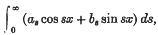
where

the generating function ƒ(t) being integrable in the general Denjoy sense in every finite interval, and the integrals (1·2) being interpreted as principal values or in some other suitable way.
The Amount of Energy Emitted in the γ-Ray Form by Radium E
-
- Journal:
- Mathematical Proceedings of the Cambridge Philosophical Society / Volume 23 / Issue 8 / October 1927
- Published online by Cambridge University Press:
- 24 October 2008, pp. 935-941
- Print publication:
- October 1927
-
- Article
- Export citation
