To save content items to your account,
please confirm that you agree to abide by our usage policies.
If this is the first time you use this feature, you will be asked to authorise Cambridge Core to connect with your account.
Find out more about saving content to .
To save content items to your Kindle, first ensure no-reply@cambridge.org
is added to your Approved Personal Document E-mail List under your Personal Document Settings
on the Manage Your Content and Devices page of your Amazon account. Then enter the ‘name’ part
of your Kindle email address below.
Find out more about saving to your Kindle.
Note you can select to save to either the @free.kindle.com or @kindle.com variations.
‘@free.kindle.com’ emails are free but can only be saved to your device when it is connected to wi-fi.
‘@kindle.com’ emails can be delivered even when you are not connected to wi-fi, but note that service fees apply.
In the recent experiments on the Zeeman effect in strong magnetic fields made by Mr H. W. B. Skinner and myself for obtaining an intense source of light for a small fraction of a second, we have been discharging a condenser battery consisting of 32 Leyden jars connected in parallel with a capacity of one-tenth of a microfarad. The discharge was made through a small spark gap by means of an oil immersed switch (the details of this arrangement are to be found in the above-mentioned paper). When the discharge was produced a curious phenomenon was sometimes observed. After the battery had been charged to its maximum tension, and the switch had been put into operation, only a small spark occurred in the spark gap, and the main part of the discharge went over the top of the insulators of one of the Leyden jars.
For a strut under thrust when buckling is resisted by a force proportional to the displacement, it is shown that for both a clamped and a pinned strut there is stability for any length when the thrust is less than a certain critical value; and the relation is found between the length and the first value of the thrust above this that will give buckling. A notion of the wave-length and number of nodes after buckling is obtained.
The results are applied to the theory of the formation of mountains by horizontal compression, and it is shown that the crust of the earth would be able to transmit, without buckling, stresses right up to the breaking stress across regions of continental extent, unless the depth down to the level of no strain were less than 16 metres.
An attempt is made to employ the results also to consider the stability of solid surface films under compression, and it is seen that other factors, making for stability, must enter besides rigidity and gravity. This is supplied by surface tension, and it then appears that collapse due to a weakness in the film must precede buckling.
A rough calculation is given of the frequency of vibration of an atom in a solid film.
A century ago geodetic and gravitational universal surveys were mainly concerned with determining the effective (gravitational) ellipticity of the Earth, after due allowance had been made for local anomalies, with especial view to the exact purposes of physical astronomy. One of the chief of these anomalies was exhibited by a remark of Airy, after scrutiny of the available data in his treatise (1830) on “Figure of the Earth” in the Encyclopedia metropolitana, that the observations show gravity to be abnormally in excess on island stations. It appeared, for instance, that this cause might make the mass of the Moon uncertain up to 2 per cent. A very refined explanation of this anomaly of island stations (which will be seen presently to be only partially effective) was offered by Sir George Stokes, from whom this last remark is quoted, in the course of a memoir, fundamental for theoretical geodesy, in which he demonstrated that no outside survey could lead to any certain knowledge of the distribution of mass inside the Earth, even in its outer crust, except as a matter of probability when backed up by geological knowledge.
It has been found that illumination of a mercury surface by ultraviolet light strong in the line λ=2536·7 Å., exerts a marked influence on the photochemical union of hydrogen andgases such as oxygen, ethylene, and carbon monoxide. The rate of reaction is proportional to the first order to the area of surface exposed.
The formation of a mercuric oxide film has been shown to occur only in the presence of a mixture of hydrogen and oxygen, and alternative mechanisms for its formation are suggested.
In the case of nitrogen-hydrogen mixtures, hydrazine and ammonia have been identified in the reaction products, and in the case of hydrogen and oxygen, hydrogen peroxide and water have been found, and it is suggested that the reactions proceed in steps.
The catalytic efficiency of the surface depends on its cleanness and is cut down by poisons, such as the reaction products in the case of the combination of hydrogen and carbon monoxide.
An interpretation of ultra-short wave wireless phenomena is given which indicates that the maximum number of electrons per c.c. in the atmospheric ionized layer is of the order 105 to 106.
Measurements of the saturation currents produced between two parallel plates by a source of radium C of carefully tested purity have been performed by an accurate galvanometer method. From the results a transformation constant

has been assigned to radium C corresponding to a half-value period of 19·72±·04 minutes.
Similar measurements with radium active deposit have enabled a value to be estimated for the period of radium B between 26·7 and 26·8 minutes, which is the limit of accuracy of the experimental data.
The existence of complex compounds of metallic salts with ammonia was recognised in the early years of last century. Platinum in particular readily unites with ammonia, and the early chemists, when studying the general chemistry of ammonium platino-and platini-chlorides, soon discovered highly crystalline ammonia derivatives of platinum which contained an unusually high proportion of the metal. In the formulation of such compounds difficulties at once arose. Thus Peyrone in 1844 knew three distinct compounds of the composition PtCl2N2H6, a pale lemoncoloured compound known as the second chloride of Reiset, an orange-coloured compound discovered by Peyrone himself, and finally a dark green insoluble substance known as Magnus' green salt, discovered by the latter in 1828. The existence of these three compounds, now known as trans and cis dichloro-diaminoplatinum [Pt(NH3)2Cl2], and as tetramino-platinous platinochloride [Pt(NH3)4]PtCl4 respectively, could not be satisfactorily explained on current theories of salt formation. Similar compounds in which aliphatic and cyclic mono-amines replaced the ammonia groups were discovered later, but it was not until 1889 that Jörgensen introduced the use of the simplest stable aliphatic diamine, viz. ethylene diamine.
The lines of a double-six will here be represented by the usual notation
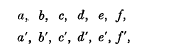
where two lines whose symbols are in the same line or same column of this scheme are non-intersectors and all other pairs of lines intersect. Any six of the lines, no two of whose symbols are in the same column, and just three are in the same row, are generators of a quadric, and the actual position in space of each of the other six is determined by the two points in which it intersects this quadric.
The following gives a brief summary of a paper, which it is hoped to publish in extenso later. It is a contribution to the theory of ferromagnetic crystals, and contains in particular a theoretical explanation of Webster's experimental results.
The following is an alternative to Proposition II of the former paper. It does not assume the second of the initial assumptions in Art. 2, nor does it assume that the angles supplementary to equal angles are equal, which Hilbert regards as a proposition (Foundations of Geometry, p. 18 of the English translation).
Engel and Stäckel in their Theorie der Parallellinien von Euklid bis auf Gauss (1895) call attention to the fact that Saccheri and Lambert have used in their argument the property of the triangle that the external angle is greater than either of the interior and opposite angles (Euc. I. 16), which is not true for triangles of all magnitudes when the hypothesis of the obtuse angle holds good. They do not show how starting from the point of view of Saccheri and Lambert the proofs should be amended so that they would be valid in the Elliptic Plane. Bonola (Non-Euclidean Geometry, translated by Carslaw, 1912, p. 31) in his account of the subject also uses Euc. I. 16. It is the object of this paper to obtain the main results proved by Saccheri and Lambert when the hypothesis of the obtuse angle holds without using Euc. I. 16. It is not suggested that this is a convenient method of procedure but it may perhaps have some historical interest. The key to the procedure here adopted is found in the reversal of the Euclidean order in a certain group of propositions, viz. I. 16, 18, 19, 20.
While the paper “On the pedal locus in non-euclidean hyperspace” was in the press, Professor H. F. Baker kindly directed the writer's attention to a reference from which it appeared that the euclidean case had first been studied by Beltrami. After publication, it was discovered that the main subject of Beltrami's paper was the non-euclidean case. He proves, by analytical methods, theorems which may be stated as follows: Let A0, A1,…, An denote the vertices of a simplex, [A], in non-euclidean space of n dimensions, and P a point such that the orthogonal projections of P on the walls of [A] lie in a flat, p; then the locus of P is an (n − 1)- fold, W, of order n + 1, which is anallagmatic for the isogonal transformation q. [A]; the isogonal conjugate of P is the absolute pole of p, and the envelope, w, of p is therefore the absolute reciprocal of W. Beltrami does not note the theorem, fundamental for the geometrical treatment of the subject, that W is the Jacobian of a certain group of n + 1 point-hyperspheres. He goes on to show that in the euclidean case the locus W breaks up into an n-ic (n − 1)-fold and the flat at infinity, while the envelope w does not, in general, break up. Finally, he notes that in two dimensions there is also a special non-euclidean case, in which W breaks up into an order-conic and a line, and w into a class-conic and a point; and that the appropriate condition is fundamentally that which is necessary for the degeneration of a certain class-conic into a pair of points. “But what are the points? And what is the corresponding condition satisfied by the absolute conic? This is a question which it would be interesting to resolve.” It does not appear that the subject has been pursued further; and in the present note an attempt is made to discuss fully the analogous case qi degeneracy in n dimensions.
In these Proceedings, Vol. xx (1920), pp. 198–204, the writer ventured (l.c. p. 203) on some remarks as to the reason why Sir G. Darwin and Mr Jeans had obtained discordant results for the stability of the pear-shaped figure of equilibrium, suggesting that this was due to a different mode of expansion of the functions involved. Sir G. Darwin used an infinite series of Lamé functions; Mr Jeans' method was equivalent to using the early parts from an expansion, of which every term, when expressed as an integral series of Lamé functions, would be an infinite series. At that time there was difficulty in obtaining Liapounoff's papers; since then, by the kindness of M. Belopolsky, of Pulkova, the whole of the four parts of Liapounoff's publication “Sur les figures d'équilibre peu différentes des ellipsoïdes d'une masse liquide homogène douèe d'un mouvement de rotation,” in all over 750 large folio pages, have become available; and these are now in the market. It is particularly interesting to see that the fourth part (1914) is devoted precisely to that change in the method of development which would arise in passing from Sir G. Darwin's expansion to the other expansion referred to above. And it is only by this change that Liapounoff is able to give the general proof of a form of expression of his results—in terms of polynomials and not infinite series—upon which his theorem of instability is made to depend. The careful consideration of the convergence of his expansions, which adds so greatly to the length of Liapounoff's papers, supplies materials for the proof that the expansion used in Mr Jeans' paper can be placed on a sure foundation, while Sir G. Darwin's expansion requires an estimation of the remainder.
It is a familiar fact that if two quadric forms, in (n + 1) homogeneous variables, be each expressible as a sum of squares, of (n + 1) independent linear functions of the variables, then they are polar reciprocals of one another, in regard to any one of 2n quadrics. The question arises whether this is true for any two quadrics. Segre states that this is an unsettled question. A solution is given, however, by Terracini for any two non-degenerate quadrics, supposed to have been reduced to the Weierstrass canonical form. The present note has the purpose of pointing out that a solution is derivable from a remark made by Frobenius; this requires a knowledge of the roots of the equation satisfied by the matrix of the two quadrics.
The usual proof of the adiabatic invariance of the quantum integrals of a multiply periodic dynamical system rests on the assumption that the Hamiltonian equations remain valid for the adiabatically changing system, with the same Hamiltonian function H, or at any rate with a new Hamiltonian function differing from the old one only by terms that vanish with ȧ, (a) being the varying parameter.
The constructs in question are represented by the vanishing of all determinants of two rows and columns drawn from a matrix of r + 1 rows and s + 1 columns, where r can be taken less than or equal to s. They are thus the multiple constructs of highest dimension on the well-known family of constructs generated by projective systems of linear spaces. In the present note the constructs are considered from a somewhat different point of view, the principal applications being to the determination of directrix loci of minimum order for the systems of spaces which they contain, and to the re-proof and extension of a known theorem.
Prof. W. P. Milne has recently been investigating, in connection with the general cubic surface, the Equianharmonic Envelope S4 and the Harmonic Envelope T6, denned as the envelopes of planes cutting the surface in equianharmonic and harmonic cubic curves respectively: he suggested to me that I should consider the particular case of the quadrinodal cubic surface.
The object of these notes is twofold. First, to connect the theory of the possible shapes of Jacobi's ellipsoidal equilibrium figure, for a given mass of homogeneous rotating liquid, with the theory of its stability and other properties given by Prof. H. F. Baker in his paper “On the stability of rotating liquid ellipsoids” in Proc. Camb. Phil. Soc. vol. 20, pp. 190–97. And secondly, to indicate two inconclusive reasonings on the subject in Thomson and Tait's Natural Philosophy (2nd edition), arts. 778 and 778′, and to complete the proofs of the results in question.
