Refine search
Actions for selected content:
26203 results in Theoretical Physics and Mathematical Physics
Statement of Accounts of the Cambridge Philosophical Society, from January 1, 1924 to December 31, 1924
-
- Journal:
- Mathematical Proceedings of the Cambridge Philosophical Society / Volume 22 / Issue 5 / July 1925
- Published online by Cambridge University Press:
- 24 October 2008, pp. 814-815
- Print publication:
- July 1925
-
- Article
- Export citation
A note on wireless signal strength measurements made during the Solar Eclipse of 24 January, 1925
-
- Journal:
- Mathematical Proceedings of the Cambridge Philosophical Society / Volume 22 / Issue 5 / July 1925
- Published online by Cambridge University Press:
- 24 October 2008, pp. 672-675
- Print publication:
- July 1925
-
- Article
- Export citation
Theory of Statistical Estimation
-
- Journal:
- Mathematical Proceedings of the Cambridge Philosophical Society / Volume 22 / Issue 5 / July 1925
- Published online by Cambridge University Press:
- 24 October 2008, pp. 700-725
- Print publication:
- July 1925
-
- Article
- Export citation
On Hausdorff's proof of the extended Riesz-Fischer theorem
-
- Journal:
- Mathematical Proceedings of the Cambridge Philosophical Society / Volume 22 / Issue 5 / July 1925
- Published online by Cambridge University Press:
- 24 October 2008, pp. 777-778
- Print publication:
- July 1925
-
- Article
- Export citation
-
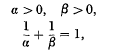
1. The extended Riesz-Fischer theorem, in the special case of the trigonometrical orthogonal system, states that, if a and β are real numbers such that
then

implies, whenever α ≤ 2, the existence of a solution of the system of integral equations,

such that

and further

When a = 2, this reduces to the original Riesz-Fischer theorem.
On the representation of the modular group of order ½p (p2 – 1) as a group of linear substitutions on ½ (p – 1) symbols, ichen p is a prime of the form 4n + 3
-
- Journal:
- Mathematical Proceedings of the Cambridge Philosophical Society / Volume 22 / Issue 5 / July 1925
- Published online by Cambridge University Press:
- 24 October 2008, pp. 779-787
- Print publication:
- July 1925
-
- Article
- Export citation
A Generalization of Feuerbach's Theorem
-
- Journal:
- Mathematical Proceedings of the Cambridge Philosophical Society / Volume 22 / Issue 5 / July 1925
- Published online by Cambridge University Press:
- 24 October 2008, pp. 601-620
- Print publication:
- July 1925
-
- Article
- Export citation
A theoretical study of the stopping power of hydrogen atoms for α-particles
-
- Journal:
- Mathematical Proceedings of the Cambridge Philosophical Society / Volume 22 / Issue 5 / July 1925
- Published online by Cambridge University Press:
- 24 October 2008, pp. 793-803
- Print publication:
- July 1925
-
- Article
- Export citation
On groups of linear substitutions which contain irreducible metacyclical subgroups
-
- Journal:
- Mathematical Proceedings of the Cambridge Philosophical Society / Volume 22 / Issue 5 / July 1925
- Published online by Cambridge University Press:
- 24 October 2008, pp. 788-792
- Print publication:
- July 1925
-
- Article
- Export citation
-
If G is a group of finite order which contains an operation P of prime order p, permutable only with its own powers, the order of G must, by Sylow's theorem, be of the form (1 + kp) pś, where s is a factor of p – 1. The greatest subgroup of G, which contains self-conjugately {P};, the subgroup generated by P, must be a metacyclical subgroup {S, P}, where

while g is a primitive root of the congruence gs = 1 (mod. p).
On Pedal Quadrics in Non-Euclidean Hyperspace
-
- Journal:
- Mathematical Proceedings of the Cambridge Philosophical Society / Volume 22 / Issue 5 / July 1925
- Published online by Cambridge University Press:
- 24 October 2008, pp. 751-758
- Print publication:
- July 1925
-
- Article
- Export citation
On the idea of frequency
-
- Journal:
- Mathematical Proceedings of the Cambridge Philosophical Society / Volume 22 / Issue 5 / July 1925
- Published online by Cambridge University Press:
- 24 October 2008, pp. 726-727
- Print publication:
- July 1925
-
- Article
- Export citation
PSP volume 22 issue 5 Cover and Back matter
-
- Journal:
- Mathematical Proceedings of the Cambridge Philosophical Society / Volume 22 / Issue 5 / July 1925
- Published online by Cambridge University Press:
- 24 October 2008, pp. b1-b2
- Print publication:
- July 1925
-
- Article
-
- You have access
- Export citation
On simplexes doubly incident with a quadric
-
- Journal:
- Mathematical Proceedings of the Cambridge Philosophical Society / Volume 22 / Issue 5 / July 1925
- Published online by Cambridge University Press:
- 24 October 2008, pp. 655-668
- Print publication:
- July 1925
-
- Article
- Export citation
-
(1) The simplex in a space Sn of order n (or n − 1 dimensions) is a set of n points a1 a2 …an which do not all lie in a subspace of Sn.
The elements of the simplex a1 a2 …an are the n points a1 a2 …an whieh are elements of order one, the
 lines ar as which are elements or faces of order two, etc., etc., and finally the n primesa1 a2 … ar−1 ar+1 … an which are elements or faces of order n – 1.
 lines
lines The Symmetric Functions of which the General Determinant is a particular case
-
- Journal:
- Mathematical Proceedings of the Cambridge Philosophical Society / Volume 22 / Issue 5 / July 1925
- Published online by Cambridge University Press:
- 24 October 2008, pp. 633-654
- Print publication:
- July 1925
-
- Article
- Export citation
PSP volume 22 issue 4 Cover and Back matter
-
- Journal:
- Mathematical Proceedings of the Cambridge Philosophical Society / Volume 22 / Issue 4 / March 1925
- Published online by Cambridge University Press:
- 24 October 2008, pp. b1-b2
- Print publication:
- March 1925
-
- Article
-
- You have access
- Export citation
Integrals developable about a singular point of a Hamiltonian system of differential equations. Part II
-
- Journal:
- Mathematical Proceedings of the Cambridge Philosophical Society / Volume 22 / Issue 4 / March 1925
- Published online by Cambridge University Press:
- 24 October 2008, pp. 510-533
- Print publication:
- March 1925
-
- Article
- Export citation
-
This paper completes an investigation, of which the first part has already been published, into the integrals of a Hamiltonian system which are formally developable about a singular point of the system. Let

be a system of differential equations of which the origin is a singular point of the first type, i.e. a point at which H is developable in a convergent Taylor series, but at which its first derivatives all vanish. We suppose that H does not involve t, and we consider only integrals not involving t. Let the exponents of this singular point be ± λ1, ± λ2,…±λn. In Part I, I considered the case in which the constants λ1,…λn are connected by no relation of commensurability, i.e. a relation of the form

where A1…An are integers (positive, negative or zero) not all zero, and showed that the equations (1) possess n, and only n, integrals not involving t which are formally developable as power series in the xk, yk. In this paper I consider the case in which λ1 … λn are connected by one or more relations of commensur-ability. Suppose that there are p, and only p, such relations linearly independent (p > 0): it will be shown that the equations (1) possess (n − p) independent integrals not involving t, formally developable about the origin and independent of H.
On the Vector Algebra of Eight Associated Points of Three Quadric Surfaces
-
- Journal:
- Mathematical Proceedings of the Cambridge Philosophical Society / Volume 22 / Issue 4 / March 1925
- Published online by Cambridge University Press:
- 24 October 2008, pp. 481-487
- Print publication:
- March 1925
-
- Article
- Export citation
On the positive flash in vacuum discharge tubes
-
- Journal:
- Mathematical Proceedings of the Cambridge Philosophical Society / Volume 22 / Issue 4 / March 1925
- Published online by Cambridge University Press:
- 24 October 2008, pp. 574-576
- Print publication:
- March 1925
-
- Article
- Export citation
The decay constant of radium emanation
-
- Journal:
- Mathematical Proceedings of the Cambridge Philosophical Society / Volume 22 / Issue 4 / March 1925
- Published online by Cambridge University Press:
- 24 October 2008, pp. 562-566
- Print publication:
- March 1925
-
- Article
- Export citation
The Determination of the Frequency of an Alternating Current Supply by the Vibrations of Rods
-
- Journal:
- Mathematical Proceedings of the Cambridge Philosophical Society / Volume 22 / Issue 4 / March 1925
- Published online by Cambridge University Press:
- 24 October 2008, pp. 539-547
- Print publication:
- March 1925
-
- Article
- Export citation
-
One method of measuring frequency depends upon resonance. If a body of unit mass, subject to elastic constraints and experiencing a damping resistance proportional to its speed, be acted on by a periodic force F sin pt, the equation of motion may be written

The amplitude of the steady vibration ultimately set up is

the maximum value occurring when p2 = q2 − 2s2. If the motion, in the absence of the dri ving force F sin pt, be only slightly damped, s2 is very small compared with q2, and little error will be made if the value of p giving maximum amplitude be taken as equal to q. When s/q is small, the resonance is “sharp,” i.e. a small discrepancy between p and q, or, more strictly, between p and (q2 − 2s2)½, causes the amphtude to fall far below its maxìmum value. Thus, when the damping is small, maximum amplitude, f or variation of p, indicates that p is very nearly equal to q.
Dissociative Equilibrium in an External Field of Force
-
- Journal:
- Mathematical Proceedings of the Cambridge Philosophical Society / Volume 22 / Issue 4 / March 1925
- Published online by Cambridge University Press:
- 24 October 2008, pp. 493-509
- Print publication:
- March 1925
-
- Article
- Export citation
