Refine search
Actions for selected content:
26203 results in Theoretical Physics and Mathematical Physics
The second solution of the Mathieu equation
-
- Journal:
- Mathematical Proceedings of the Cambridge Philosophical Society / Volume 23 / Issue 1 / February 1926
- Published online by Cambridge University Press:
- 24 October 2008, pp. 47-49
- Print publication:
- February 1926
-
- Article
- Export citation
PSP volume 23 issue 1 Cover and Back matter
-
- Journal:
- Mathematical Proceedings of the Cambridge Philosophical Society / Volume 23 / Issue 1 / February 1926
- Published online by Cambridge University Press:
- 24 October 2008, pp. b1-b2
- Print publication:
- February 1926
-
- Article
-
- You have access
- Export citation
Periodic solutions of a linear differential equation of the second order with periodic coefficients
-
- Journal:
- Mathematical Proceedings of the Cambridge Philosophical Society / Volume 23 / Issue 1 / February 1926
- Published online by Cambridge University Press:
- 24 October 2008, pp. 44-46
- Print publication:
- February 1926
-
- Article
- Export citation
-
The equation to be considered is of the type

where p (x) is continuous for all real values of x, even, and periodic. It is no restriction to suppose that the period is π, and this assumption will be made, so that the equation is virtually Hill's equation.

On chains of two-two relations and the theory of elliptic functions
-
- Journal:
- Mathematical Proceedings of the Cambridge Philosophical Society / Volume 23 / Issue 1 / February 1926
- Published online by Cambridge University Press:
- 24 October 2008, pp. 92-102
- Print publication:
- February 1926
-
- Article
- Export citation
-
1. The relation

in which we suppose each of a, b, c, a2 − c2 to be different from zero, leads, from a value θ, to two values of φ, which we may denote by θ1 and θ−1. Each of these, put in place of θ, leads, beside the value θ of φ, to another value of φ, say, respectively, θ2 and θ−2. If θ2 or θ−2 be put for θ, the same relation leads to two values of φ, say, θ1 and θ3 or θ−1 and θ−3, respectively. And so on. It may happen that θn is the same as θ, in which case also θ−n is the same as θ; this we may express by saying that the relation is closed, or that there is closure, after n links. It is the object of the present note to express in reduced form, in terms of a, b, c, the condition that this may be so. Evidently, if n = pq, the condition of closure after n links is satisfied when the condition for closure after p links (or also after q links) is satisfied. But there is a condition for closure after n links which is not satisfied for any less number of links; this is the condition which we call the reduced or proper condition for closure after n links, and it is this which we seek to express.

PSP volume 23 issue 1 Cover and Front matter
-
- Journal:
- Mathematical Proceedings of the Cambridge Philosophical Society / Volume 23 / Issue 1 / February 1926
- Published online by Cambridge University Press:
- 24 October 2008, pp. f1-f11
- Print publication:
- February 1926
-
- Article
-
- You have access
- Export citation
The quenching of resonance radiation and the breadths of absorption-lines
-
- Journal:
- Mathematical Proceedings of the Cambridge Philosophical Society / Volume 23 / Issue 1 / February 1926
- Published online by Cambridge University Press:
- 24 October 2008, pp. 78-84
- Print publication:
- February 1926
-
- Article
- Export citation
A photographic method of determining the mobility of recoil atoms
-
- Journal:
- Mathematical Proceedings of the Cambridge Philosophical Society / Volume 23 / Issue 1 / February 1926
- Published online by Cambridge University Press:
- 24 October 2008, pp. 73-77
- Print publication:
- February 1926
-
- Article
- Export citation
On the substitution of Wallis's Postulate of Similarity for Euclid's Postulate of Parallels
-
- Journal:
- Mathematical Proceedings of the Cambridge Philosophical Society / Volume 22 / Issue 6 / November 1925
- Published online by Cambridge University Press:
- 24 October 2008, pp. 964-969
- Print publication:
- November 1925
-
- Article
- Export citation
On Differentiation with respect to a Function
-
- Journal:
- Mathematical Proceedings of the Cambridge Philosophical Society / Volume 22 / Issue 6 / November 1925
- Published online by Cambridge University Press:
- 24 October 2008, pp. 924-934
- Print publication:
- November 1925
-
- Article
- Export citation
On the Theorem of Pappus
-
- Journal:
- Mathematical Proceedings of the Cambridge Philosophical Society / Volume 22 / Issue 6 / November 1925
- Published online by Cambridge University Press:
- 24 October 2008, pp. 919-923
- Print publication:
- November 1925
-
- Article
- Export citation
Doublet and Triplet Separations in Optical Spectra as Evidence whether Orbits penetrate into the Core
-
- Journal:
- Mathematical Proceedings of the Cambridge Philosophical Society / Volume 22 / Issue 6 / November 1925
- Published online by Cambridge University Press:
- 24 October 2008, pp. 904-918
- Print publication:
- November 1925
-
- Article
- Export citation
Notes on Optical Constants
-
- Journal:
- Mathematical Proceedings of the Cambridge Philosophical Society / Volume 22 / Issue 6 / November 1925
- Published online by Cambridge University Press:
- 24 October 2008, pp. 817-823
- Print publication:
- November 1925
-
- Article
- Export citation
Assemblies of Imperfect Gases by the method of Partition Functions
-
- Journal:
- Mathematical Proceedings of the Cambridge Philosophical Society / Volume 22 / Issue 6 / November 1925
- Published online by Cambridge University Press:
- 24 October 2008, pp. 861-885
- Print publication:
- November 1925
-
- Article
- Export citation
The Analysis of the β-Ray Spectrum due to the Natural L Radiation of Radium B
-
- Journal:
- Mathematical Proceedings of the Cambridge Philosophical Society / Volume 22 / Issue 6 / November 1925
- Published online by Cambridge University Press:
- 24 October 2008, pp. 838-843
- Print publication:
- November 1925
-
- Article
- Export citation
The Atomic Number of a Radioactive Element at the moment of emission of the γ-rays
-
- Journal:
- Mathematical Proceedings of the Cambridge Philosophical Society / Volume 22 / Issue 6 / November 1925
- Published online by Cambridge University Press:
- 24 October 2008, pp. 844-848
- Print publication:
- November 1925
-
- Article
- Export citation
The β-Ray Spectrum of the Natural L-Radiation from Radium B
-
- Journal:
- Mathematical Proceedings of the Cambridge Philosophical Society / Volume 22 / Issue 6 / November 1925
- Published online by Cambridge University Press:
- 24 October 2008, pp. 832-833
- Print publication:
- November 1925
-
- Article
- Export citation
The Lebesgue-Stieltjes Integral
-
- Journal:
- Mathematical Proceedings of the Cambridge Philosophical Society / Volume 22 / Issue 6 / November 1925
- Published online by Cambridge University Press:
- 24 October 2008, pp. 935-950
- Print publication:
- November 1925
-
- Article
- Export citation
-
It has long been realized that a Stieltjes integral can be defined and developed on the same lines as a Lebesgue integral, using in place of the measure of a set E the variation of an increasing function ø (x) upon E; but only the more obvious—and less useful—properties of such an integral seem to have been stated. The original integral defined by Stieltjes possesses the remarkable Integration by Parts property that if either of
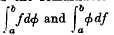 exists, so does the other, and their sum is equal to
 exists, so does the other, and their sum is equal to
PSP volume 22 issue 6 Cover and Back matter
-
- Journal:
- Mathematical Proceedings of the Cambridge Philosophical Society / Volume 22 / Issue 6 / November 1925
- Published online by Cambridge University Press:
- 24 October 2008, pp. b1-b2
- Print publication:
- November 1925
-
- Article
-
- You have access
- Export citation
Index to the Proceedings vol. XXII
-
- Journal:
- Mathematical Proceedings of the Cambridge Philosophical Society / Volume 22 / Issue 6 / November 1925
- Published online by Cambridge University Press:
- 24 October 2008, pp. 979-987
- Print publication:
- November 1925
-
- Article
- Export citation
An extended form of Kronecker's theorem with an application which shows that Burgers' theorem on adiabatic invariants is statistically true for an assembly
-
- Journal:
- Mathematical Proceedings of the Cambridge Philosophical Society / Volume 22 / Issue 6 / November 1925
- Published online by Cambridge University Press:
- 24 October 2008, pp. 886-903
- Print publication:
- November 1925
-
- Article
- Export citation
-
The following paper is in two parts.
In Part 1 it is shown that Kronecker's theorem can be extended in the form
If
 is greater than ηfor all sets of integers l1, l2, … l3 less in absolute value than K/σ and not all zero, l also being an integer, then, for any x1, x2 … x3, an integer q less than l/(ησ8) can be found such that qv1–x1, qv2–x2…qv3–x4 all differ from integers by less than σ;. K, L depend only on s.
It is an immediate corollary that if

is greator than
for all sets of integers l1, l2… l3, l less in absolute value than K/σ and not all zero while F(v1, v2… v3), l less in absolute value than K/σ and not all zero while F(v1, v2… v3, v) is periodic period 1, in v1, v2 … v3,v, then T can be found between 0 and  such that
Where K, L depend on s, and N on s and the bounds of

 is greater than ηfor all sets of integers l
 such that

