Refine search
Actions for selected content:
26203 results in Theoretical Physics and Mathematical Physics
PSP volume 23 issue 4 Cover and Back matter
-
- Journal:
- Mathematical Proceedings of the Cambridge Philosophical Society / Volume 23 / Issue 4 / October 1926
- Published online by Cambridge University Press:
- 24 October 2008, p. b1
- Print publication:
- October 1926
-
- Article
-
- You have access
- Export citation
On Mellin's inversion formula
-
- Journal:
- Mathematical Proceedings of the Cambridge Philosophical Society / Volume 23 / Issue 4 / October 1926
- Published online by Cambridge University Press:
- 24 October 2008, pp. 356-360
- Print publication:
- October 1926
-
- Article
- Export citation
-
The extension of Mellin's inversion formula expressed by the equations
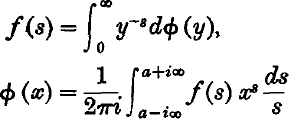 has been considered by Fowler who shows that some form of Stieltjes integral is essential to Poincaré's proof of the necessity of the quantum hypothesis. Fowler confines his discussion to a restricted type of function φ (y) which is sufficient for the physical problem. It will be proved here that the formulae hold with a general Stieltjes integral in the first equation.
The Summation of a Fourier Integral of Finite Type
-
- Journal:
- Mathematical Proceedings of the Cambridge Philosophical Society / Volume 23 / Issue 4 / October 1926
- Published online by Cambridge University Press:
- 24 October 2008, pp. 373-382
- Print publication:
- October 1926
-
- Article
- Export citation
-
A Fourier integral will be described as of finite type if the range of integration of the integrals by means of which the coefficients in the Fourier integral are defined is a finite interval instead of the usual (−∞ ∞). Thus
 is of finite type (p, q), such that
  where ƒ(x) is the generating function of the series.
The Problem of Relativity in reference to several bodies
-
- Journal:
- Mathematical Proceedings of the Cambridge Philosophical Society / Volume 23 / Issue 3 / July 1926
- Published online by Cambridge University Press:
- 24 October 2008, pp. 191-197
- Print publication:
- July 1926
-
- Article
- Export citation
-
§ 1. If the kinetic potential for the relative motion of two masses is written with an added constant as

a close connexion with the relativity quadratic appears. The latter is in fact

where

a modification of the primary form

which shows an unaltered determinant. The condition in respect to the determinant, suggested, I believe, by Schwarzschild, is one which to me appears to give the most significant form to the results. From the dynamical standpoint we may regard it as imposing a counterpoise in the inertia coefficients to the modification introduced by the potential; or from a geometrical point of view we may regard it as minimizing the departure from the normal use of coordinates. An illuminating example of the loss of meaning that accompanies transformation in which this condition is disregarded is furnished by the isotropic form which is sometimes given to Einstein's quadratic.
On the higher singularities of plane algebraic curves
-
- Journal:
- Mathematical Proceedings of the Cambridge Philosophical Society / Volume 23 / Issue 3 / July 1926
- Published online by Cambridge University Press:
- 24 October 2008, pp. 206-232
- Print publication:
- July 1926
-
- Article
- Export citation
A Theory of the Action of X-rays on living Cells
-
- Journal:
- Mathematical Proceedings of the Cambridge Philosophical Society / Volume 23 / Issue 3 / July 1926
- Published online by Cambridge University Press:
- 24 October 2008, pp. 284-287
- Print publication:
- July 1926
-
- Article
- Export citation
An approximation to the motion of two rotating electrical doublets in a plane
-
- Journal:
- Mathematical Proceedings of the Cambridge Philosophical Society / Volume 23 / Issue 3 / July 1926
- Published online by Cambridge University Press:
- 24 October 2008, pp. 269-283
- Print publication:
- July 1926
-
- Article
- Export citation
-
We may summarize our conclusions as follows. If the rotating doublets have quite different angular velocitiesinitially, then they repel each other with a force (R) given by

where

and

ø1 and ψ1 being the (constant) angular velocities of the two doublets.
If the doublets have the same angular velocities initially, and the same moments of inertia, then over a certain range of r we have

where

and ω is the common value of the angular velocities of the doublets. When the doublets correspond to hydrogen atoms in their principal quantum orbits, the range of distance becomes 5 Å. to 50 Å. and the formula for R reduces to

This is a law of force of the type found empirically by Lennard-Jones for helium, neon, and argon. The attractive term in this formula is larger than the attractive terms found by Lennard-Jones. The repulsive term, however, which leads to a “diameter” of 3·31 Å., is in very satisfactory agreement with the repulsive terms found by Lennard-Jones.
The (2, 1) Correspondence
-
- Journal:
- Mathematical Proceedings of the Cambridge Philosophical Society / Volume 23 / Issue 3 / July 1926
- Published online by Cambridge University Press:
- 24 October 2008, pp. 233-261
- Print publication:
- July 1926
-
- Article
- Export citation
Integral Invariants of the Affine Field
-
- Journal:
- Mathematical Proceedings of the Cambridge Philosophical Society / Volume 23 / Issue 3 / July 1926
- Published online by Cambridge University Press:
- 24 October 2008, pp. 262-268
- Print publication:
- July 1926
-
- Article
- Export citation
-
In this paper the method of infinitesimal transformations of coordinates, used by Weyl to determine conditions that a function of the tensors gik and φi, and certain of their derivatives, should be a scalar density, is applied (with certain modifications so as to give tensor relations) to functions of
 and
and  . It is known that in order that such a function should be a scalar density it must be a homogeneous function, of degree ½n, of
  , and this must of course be deducible from the equations found by the infinitesimal transformations. In view of the part which these equations may play, as “equations of energy,” etc., in purely affine field theories, it seems desirable that the connection should be explicitly shown, and this is done in § 3.
 and
and  . It is known that in order that such a function should be a scalar density it must be a homogeneous function, of degree ½
 , and this must of course be deducible from the equations found by the infinitesimal transformations. In view of the part which these equations may play, as “equations of energy,” etc., in purely affine field theories, it seems desirable that the connection should be explicitly shown, and this is done in § 3.
Some Relations between the Optical Spectra of Different Atoms of the same Electronic Structure. II. Aluminium-like and Copper-like Atoms
-
- Journal:
- Mathematical Proceedings of the Cambridge Philosophical Society / Volume 23 / Issue 3 / July 1926
- Published online by Cambridge University Press:
- 24 October 2008, pp. 304-326
- Print publication:
- July 1926
-
- Article
- Export citation
On the Quantum Theory of Vibration-Rotation Bands
-
- Journal:
- Mathematical Proceedings of the Cambridge Philosophical Society / Volume 23 / Issue 3 / July 1926
- Published online by Cambridge University Press:
- 24 October 2008, pp. 327-335
- Print publication:
- July 1926
-
- Article
- Export citation
-
The dynamical problem of the “diatomic molecule” is solved on the new mechanics. The terms of the rotational energy are
 , where
  ; the weights of the corresponding states are 2m; the frequencies differ a little from the classical ones. Finally the intensities are slightly different from those computed by Kemble; the main term agrees with that of Fowler, but the positive branch is only slightly stronger than the negative. The central line vanishes. The intensities are valid only for the fundamental band.
 , where
  ; the weights of the corresponding states are 2
Relativity in Connexion with Axial Rotation
-
- Journal:
- Mathematical Proceedings of the Cambridge Philosophical Society / Volume 23 / Issue 3 / July 1926
- Published online by Cambridge University Press:
- 24 October 2008, pp. 198-202
- Print publication:
- July 1926
-
- Article
- Export citation
PSP volume 23 issue 3 Cover and Front matter
-
- Journal:
- Mathematical Proceedings of the Cambridge Philosophical Society / Volume 23 / Issue 3 / July 1926
- Published online by Cambridge University Press:
- 24 October 2008, p. f1
- Print publication:
- July 1926
-
- Article
-
- You have access
- Export citation
PSP volume 23 issue 3 Cover and Back matter
-
- Journal:
- Mathematical Proceedings of the Cambridge Philosophical Society / Volume 23 / Issue 3 / July 1926
- Published online by Cambridge University Press:
- 24 October 2008, p. b1
- Print publication:
- July 1926
-
- Article
-
- You have access
- Export citation
Sur la non-existence simultanée de deux fonctions de Mathieu
-
- Journal:
- Mathematical Proceedings of the Cambridge Philosophical Society / Volume 23 / Issue 3 / July 1926
- Published online by Cambridge University Press:
- 24 October 2008, pp. 203-205
- Print publication:
- July 1926
-
- Article
- Export citation
-
1. Soit donnée l'équation de Mathieu

a et q étant des paramètres réels.
On the Attenuation of Wireless Signals in Short Distance Overland Transmission
-
- Journal:
- Mathematical Proceedings of the Cambridge Philosophical Society / Volume 23 / Issue 3 / July 1926
- Published online by Cambridge University Press:
- 24 October 2008, pp. 288-303
- Print publication:
- July 1926
-
- Article
- Export citation
PSP volume 23 issue 2 Cover and Back matter
-
- Journal:
- Mathematical Proceedings of the Cambridge Philosophical Society / Volume 23 / Issue 2 / April 1926
- Published online by Cambridge University Press:
- 24 October 2008, pp. b1-b2
- Print publication:
- April 1926
-
- Article
-
- You have access
- Export citation
The General (m, n) Correspondence
-
- Journal:
- Mathematical Proceedings of the Cambridge Philosophical Society / Volume 23 / Issue 2 / April 1926
- Published online by Cambridge University Press:
- 24 October 2008, pp. 109-119
- Print publication:
- April 1926
-
- Article
- Export citation
Oxidations on Charcoal
-
- Journal:
- Mathematical Proceedings of the Cambridge Philosophical Society / Volume 23 / Issue 2 / April 1926
- Published online by Cambridge University Press:
- 24 October 2008, pp. 187-190
- Print publication:
- April 1926
-
- Article
- Export citation
The Behaviour of the Centres of Activity of Saturated Surfaces during the initial stages of Unimolecular Reactions
-
- Journal:
- Mathematical Proceedings of the Cambridge Philosophical Society / Volume 23 / Issue 2 / April 1926
- Published online by Cambridge University Press:
- 24 October 2008, pp. 172-182
- Print publication:
- April 1926
-
- Article
- Export citation
