Refine search
Actions for selected content:
26203 results in Theoretical Physics and Mathematical Physics
On the Applicability and Deformation of Surfaces
-
- Journal:
- Mathematical Proceedings of the Cambridge Philosophical Society / Volume 22 / Issue 3 / 20 September 1924
- Published online by Cambridge University Press:
- 24 October 2008, pp. 243-247
- Print publication:
- 20 September 1924
-
- Article
- Export citation
Note on the Doppler principle and Bohr's frequency condition
-
- Journal:
- Mathematical Proceedings of the Cambridge Philosophical Society / Volume 22 / Issue 3 / 20 September 1924
- Published online by Cambridge University Press:
- 24 October 2008, pp. 432-433
- Print publication:
- 20 September 1924
-
- Article
- Export citation
The Statistical Theory of Dissociation and Ionization by Collision, with applications to the capture and loss of electrons by α-particles
-
- Journal:
- Mathematical Proceedings of the Cambridge Philosophical Society / Volume 22 / Issue 3 / 20 September 1924
- Published online by Cambridge University Press:
- 24 October 2008, pp. 253-272
- Print publication:
- 20 September 1924
-
- Article
- Export citation
PSP volume 22 issue 3 Cover and Back matter
-
- Journal:
- Mathematical Proceedings of the Cambridge Philosophical Society / Volume 22 / Issue 3 / 20 September 1924
- Published online by Cambridge University Press:
- 24 October 2008, pp. b1-b2
- Print publication:
- 20 September 1924
-
- Article
-
- You have access
- Export citation
Two notes on the Riemann Zeta-function*
-
- Journal:
- Mathematical Proceedings of the Cambridge Philosophical Society / Volume 22 / Issue 3 / 20 September 1924
- Published online by Cambridge University Press:
- 24 October 2008, pp. 234-242
- Print publication:
- 20 September 1924
-
- Article
- Export citation
-
Let Λ (n) be the arithmetic function usually so denoted, which is zero unless n is a prime power pm (m ≥ 1), when it is log p. We write as usual
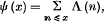
and
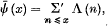
where the dash denotes that if x is an integer the last term Λ (x) of the sum is to be taken with a factor ½. We wrute further

Some electrical properties of liquid sulphur
-
- Journal:
- Mathematical Proceedings of the Cambridge Philosophical Society / Volume 22 / Issue 3 / 20 September 1924
- Published online by Cambridge University Press:
- 24 October 2008, pp. 393-399
- Print publication:
- 20 September 1924
-
- Article
- Export citation
On loci which have two systems of generating spaces
-
- Journal:
- Mathematical Proceedings of the Cambridge Philosophical Society / Volume 22 / Issue 3 / 20 September 1924
- Published online by Cambridge University Press:
- 24 October 2008, pp. 319-324
- Print publication:
- 20 September 1924
-
- Article
- Export citation
-
In hypergeometry loci defined by parametric equations

have been frequently discussed from various points of view. Among other properties these loci possess two systems of generating spaces obtained by keeping the α's (or β's) fixed while the β's (or α's) vary, the simplest example being the generators of a quadric in S3. Another method of obtaining loci having these properties is by taking the flat spaces through the sets of a linear series of sets of points on an elliptic curve and the flat spaces through the sets of the residual series (the curve being supposed normal. In this way we shall obtain a configuration of ∞PSP's and ∞qSq's, the dual of which gives a locus included among those represented by (1).
The Spectra of some Lithium-like and Sodium-like Atoms
-
- Journal:
- Mathematical Proceedings of the Cambridge Philosophical Society / Volume 22 / Issue 3 / 20 September 1924
- Published online by Cambridge University Press:
- 24 October 2008, pp. 409-425
- Print publication:
- 20 September 1924
-
- Article
- Export citation
On the zeros of the Riemann zeta-function*
-
- Journal:
- Mathematical Proceedings of the Cambridge Philosophical Society / Volume 22 / Issue 3 / 20 September 1924
- Published online by Cambridge University Press:
- 24 October 2008, pp. 295-318
- Print publication:
- 20 September 1924
-
- Article
- Export citation
-
Let N (T) denote, as usual, the number of zeros of ζ (s) whose imaginary part γ satisfies 0 < γ < T, and N (σ, T) the number of these for which, in addition, the real part is greater than σ. In this definition we suppose, in the first place, that no zero actually lies on the line t = T: if the line contains zeros we define


On the measurement of the critical potentials of gases
-
- Journal:
- Mathematical Proceedings of the Cambridge Philosophical Society / Volume 22 / Issue 3 / 20 September 1924
- Published online by Cambridge University Press:
- 24 October 2008, pp. 405-408
- Print publication:
- 20 September 1924
-
- Article
- Export citation
The Thallous Thallic Halides
-
- Journal:
- Mathematical Proceedings of the Cambridge Philosophical Society / Volume 22 / Issue 3 / 20 September 1924
- Published online by Cambridge University Press:
- 24 October 2008, pp. 363-368
- Print publication:
- 20 September 1924
-
- Article
- Export citation
Trajectories of small horizontal velocity in a resisting medium
-
- Journal:
- Mathematical Proceedings of the Cambridge Philosophical Society / Volume 22 / Issue 3 / 20 September 1924
- Published online by Cambridge University Press:
- 24 October 2008, pp. 217-233
- Print publication:
- 20 September 1924
-
- Article
- Export citation
On a Case of steady flow of a Gas in Two Dimensions
-
- Journal:
- Mathematical Proceedings of the Cambridge Philosophical Society / Volume 22 / Issue 3 / 20 September 1924
- Published online by Cambridge University Press:
- 24 October 2008, pp. 350-362
- Print publication:
- 20 September 1924
-
- Article
- Export citation
The Quadratic form for Radial Acceleration, in the Theory of Relativity
-
- Journal:
- Mathematical Proceedings of the Cambridge Philosophical Society / Volume 22 / Issue 3 / 20 September 1924
- Published online by Cambridge University Press:
- 24 October 2008, pp. 248-252
- Print publication:
- 20 September 1924
-
- Article
- Export citation
The relative absorbing powers of the L-levels for radiation of varying wave-length
-
- Journal:
- Mathematical Proceedings of the Cambridge Philosophical Society / Volume 22 / Issue 3 / 20 September 1924
- Published online by Cambridge University Press:
- 24 October 2008, pp. 379-392
- Print publication:
- 20 September 1924
-
- Article
- Export citation
PSP volume 22 issue 3 Cover and Front matter
-
- Journal:
- Mathematical Proceedings of the Cambridge Philosophical Society / Volume 22 / Issue 3 / 20 September 1924
- Published online by Cambridge University Press:
- 24 October 2008, pp. f1-f2
- Print publication:
- 20 September 1924
-
- Article
-
- You have access
- Export citation
Some Methods of Estimating the Successive Ionisation Potentials of any Element
-
- Journal:
- Mathematical Proceedings of the Cambridge Philosophical Society / Volume 22 / Issue 3 / 20 September 1924
- Published online by Cambridge University Press:
- 24 October 2008, pp. 464-474
- Print publication:
- 20 September 1924
-
- Article
- Export citation
Complexes of Conics and the Weddle Surface
-
- Journal:
- Mathematical Proceedings of the Cambridge Philosophical Society / Volume 22 / Issue 3 / 20 September 1924
- Published online by Cambridge University Press:
- 24 October 2008, pp. 201-216
- Print publication:
- 20 September 1924
-
- Article
- Export citation
-
A complex or system ∞3 of conics in space of four dimensions is such that a finite number of conics pass through an arbitrary point. Linear complexes are those for which this number is unity, and are such that their curves are defined by conditions of incidence with fixed surfaces, curves and points. In this paper are discussed briefly the linear complexes defined by the condition that their curves meet an irreducible curve in four points. Denoting by
 a curve of order m and genus p it is found that the curves in question are
  The complex associated with
  is considered in greater detail, since it is found to have an interesting connection with the well-known Weddle quartic surface of ordinary space. In fact the conics of the system touching a space (of three dimensions) do so in the points of such a surface. The main properties of this surface can be thence deduced. In addition we discuss certain results in connection with this curve . The paper closes with certain enumerative results which were obtained in the course of the researches giving the results recorded and which we believe are worth record.
 a curve of order
  The complex associated with
  is considered in greater detail, since it is found to have an interesting connection with the well-known Weddle quartic surface of ordinary space. In fact the conics of the system touching a space (of three dimensions) do so in the points of such a surface. The main properties of this surface can be thence deduced. In addition we discuss certain results in connection with this curve
 On the Problem of Four Particles
-
- Journal:
- Mathematical Proceedings of the Cambridge Philosophical Society / Volume 22 / Issue 2 / May 1924
- Published online by Cambridge University Press:
- 24 October 2008, pp. 88-91
- Print publication:
- May 1924
-
- Article
- Export citation
On Five Lines, in Space of Four Dimensions, which lie upon a, Quadric Threefold and the Normal Quartic Curves of which they are Chords
-
- Journal:
- Mathematical Proceedings of the Cambridge Philosophical Society / Volume 22 / Issue 2 / May 1924
- Published online by Cambridge University Press:
- 24 October 2008, pp. 189-199
- Print publication:
- May 1924
-
- Article
- Export citation
