Refine search
Actions for selected content:
26203 results in Theoretical Physics and Mathematical Physics
The Propagation of Electromagnetic Waves in a Refracting Medium in a Magnetic Field
-
- Journal:
- Mathematical Proceedings of the Cambridge Philosophical Society / Volume 27 / Issue 1 / January 1931
- Published online by Cambridge University Press:
- 24 October 2008, pp. 143-162
- Print publication:
- January 1931
-
- Article
- Export citation
The Diamagnetism of the Free Electron
-
- Journal:
- Mathematical Proceedings of the Cambridge Philosophical Society / Volume 27 / Issue 1 / January 1931
- Published online by Cambridge University Press:
- 24 October 2008, pp. 86-90
- Print publication:
- January 1931
-
- Article
- Export citation
On the Orthogonal Groups in Four Dimensions
-
- Journal:
- Mathematical Proceedings of the Cambridge Philosophical Society / Volume 27 / Issue 1 / January 1931
- Published online by Cambridge University Press:
- 24 October 2008, pp. 37-48
- Print publication:
- January 1931
-
- Article
- Export citation
In memory of the Rev. William Cecil, M.A., sometime Fellow of Magdalene College and Fellow of the Cambridge Philosophical Society
-
- Journal:
- Mathematical Proceedings of the Cambridge Philosophical Society / Volume 27 / Issue 1 / January 1931
- Published online by Cambridge University Press:
- 24 October 2008, pp. 1-14
- Print publication:
- January 1931
-
- Article
- Export citation
PSP volume 27 issue 1 Cover and Back matter
-
- Journal:
- Mathematical Proceedings of the Cambridge Philosophical Society / Volume 27 / Issue 1 / January 1931
- Published online by Cambridge University Press:
- 24 October 2008, pp. b1-b2
- Print publication:
- January 1931
-
- Article
- Export citation
Note on Continuous Functionals
-
- Journal:
- Mathematical Proceedings of the Cambridge Philosophical Society / Volume 27 / Issue 1 / January 1931
- Published online by Cambridge University Press:
- 24 October 2008, pp. 49-56
- Print publication:
- January 1931
-
- Article
- Export citation
A Mathematical Theory of Natural Selection. Part VIII. Metastable Populations
-
- Journal:
- Mathematical Proceedings of the Cambridge Philosophical Society / Volume 27 / Issue 1 / January 1931
- Published online by Cambridge University Press:
- 24 October 2008, pp. 137-142
- Print publication:
- January 1931
-
- Article
- Export citation
The calculation of the van der Waal forces for hydrogen and helium at large inter-atomic distances
-
- Journal:
- Mathematical Proceedings of the Cambridge Philosophical Society / Volume 27 / Issue 1 / January 1931
- Published online by Cambridge University Press:
- 24 October 2008, pp. 66-72
- Print publication:
- January 1931
-
- Article
- Export citation
The Photoelectric Absorption of Gamma Rays
-
- Journal:
- Mathematical Proceedings of the Cambridge Philosophical Society / Volume 27 / Issue 1 / January 1931
- Published online by Cambridge University Press:
- 24 October 2008, pp. 103-112
- Print publication:
- January 1931
-
- Article
- Export citation
-
No satisfactory formula has so far been derived theoretically for the photoelectric absorption of X-rays and γ-rays. The empirical law

has hitherto been generally accepted as giving approximately the variation of the photoelectric absorption coefficient per electron, with atomic number Z and wave length λ for X-rays of wave length greater than 100 X.U., and the validity of this law has often been assumed for γ-rays also.
Note on some linear Diophantine inequalities
-
- Journal:
- Mathematical Proceedings of the Cambridge Philosophical Society / Volume 27 / Issue 1 / January 1931
- Published online by Cambridge University Press:
- 24 October 2008, pp. 24-25
- Print publication:
- January 1931
-
- Article
- Export citation
-
1. Mordell has recently proved that if A, B, C, D, P, Q are any real constants such that Δ = AD − BC ≠ 0, and if ΔBC ≠ 0, then the inequalities

are satisfied by integer values of x and y.
The Theory of the Scattering of Short X-rays by Molecular Hydrogen
-
- Journal:
- Mathematical Proceedings of the Cambridge Philosophical Society / Volume 27 / Issue 1 / January 1931
- Published online by Cambridge University Press:
- 24 October 2008, pp. 77-85
- Print publication:
- January 1931
-
- Article
- Export citation
The packing of certain sets of cubes
-
- Journal:
- Mathematical Proceedings of the Cambridge Philosophical Society / Volume 27 / Issue 1 / January 1931
- Published online by Cambridge University Press:
- 24 October 2008, pp. 57-65
- Print publication:
- January 1931
-
- Article
- Export citation
-
Let (X1, …, Xn) be the coordinates of the centre of a unit cube C, in n-dimensional space, whose (n − 1)-dimensional faces are parallel to the axes of coordinates. Further let the X's be integers. Let εi = ± 1 for r (≤ n) values of i, 1 ≤ i ≤ n, and let εi = 0 for the remaining n − r values of i. Then (X1 + ε1, …, Xn + εn) gives the centre of a cube C′, which touches the cube C along an (n − r)-dimensional edge or face. The cube C and the cubes C′, for all possible arrangements of the ε's, which are subject to the above conditions, form a symmetrical arrangement of
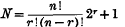 cubes. This paper discusses the possibility of completely filling space by means of the packing together of such sets of cubes.
 cubes. This paper discusses the possibility of completely filling space by means of the packing together of such sets of cubes.
Note on the use of a thyratron with a Geiger counter
-
- Journal:
- Mathematical Proceedings of the Cambridge Philosophical Society / Volume 27 / Issue 1 / January 1931
- Published online by Cambridge University Press:
- 24 October 2008, pp. 113-115
- Print publication:
- January 1931
-
- Article
- Export citation
Note on the Angular Scattering of Electrons in Gases
-
- Journal:
- Mathematical Proceedings of the Cambridge Philosophical Society / Volume 27 / Issue 1 / January 1931
- Published online by Cambridge University Press:
- 24 October 2008, pp. 73-76
- Print publication:
- January 1931
-
- Article
- Export citation
Preliminary Note on the Masses of the Electron, the Proton, and the Universe
-
- Journal:
- Mathematical Proceedings of the Cambridge Philosophical Society / Volume 27 / Issue 1 / January 1931
- Published online by Cambridge University Press:
- 24 October 2008, pp. 15-19
- Print publication:
- January 1931
-
- Article
- Export citation
Corrigenda
-
- Journal:
- Mathematical Proceedings of the Cambridge Philosophical Society / Volume 27 / Issue 1 / January 1931
- Published online by Cambridge University Press:
- 24 October 2008, p. 25
- Print publication:
- January 1931
-
- Article
-
- You have access
- Export citation
-
Some applications of Fourier series in the analytic theory of numbers.
Page 589, equation (3–10), after “k>0” insert “and 0<R(s)< 1,” and for “2nπi/k” read “2nπix/k.”
Page 589, equation (3·11), for
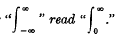
Add also ‘The evaluation of the integrals given in (3·11) is obvious when 0 < R (s) < 1, and then holds also for 0 < R (s) < 2 by the theory of analytic continuation.”
On the demonstration of electric lines of force, and a new method of measuring the electric moment of tourmaline
-
- Journal:
- Mathematical Proceedings of the Cambridge Philosophical Society / Volume 26 / Issue 4 / October 1930
- Published online by Cambridge University Press:
- 24 October 2008, pp. 491-495
- Print publication:
- October 1930
-
- Article
- Export citation
The number of contact primes of the canonical curve of genus p
-
- Journal:
- Mathematical Proceedings of the Cambridge Philosophical Society / Volume 26 / Issue 4 / October 1930
- Published online by Cambridge University Press:
- 24 October 2008, pp. 453-457
- Print publication:
- October 1930
-
- Article
- Export citation
On some series of functions
-
- Journal:
- Mathematical Proceedings of the Cambridge Philosophical Society / Volume 26 / Issue 4 / October 1930
- Published online by Cambridge University Press:
- 24 October 2008, pp. 458-474
- Print publication:
- October 1930
-
- Article
- Export citation
-
We now consider some properties of “almost all” series

where the numbers
 vary independently in the interval (0, 1). What we need is a definition of measure in the space of sequences
  or, what is the same thing, in the space
of infinitely many dimensions. Such a definition has been given by Steinhaus. He defines a correspondence between the cube (7.2) and the interval (0,1) in the following way:
 vary independently in the interval (0, 1). What we need is a definition of measure in the space of sequences
  or, what is the same thing, in the space
The Matrix Mechanics of the Spinning Electron
-
- Journal:
- Mathematical Proceedings of the Cambridge Philosophical Society / Volume 26 / Issue 4 / October 1930
- Published online by Cambridge University Press:
- 24 October 2008, pp. 496-506
- Print publication:
- October 1930
-
- Article
- Export citation
