Refine search
Actions for selected content:
26203 results in Theoretical Physics and Mathematical Physics
The theory of the extraction of electrons from metals by positive ions and metastable atoms
-
- Journal:
- Mathematical Proceedings of the Cambridge Philosophical Society / Volume 26 / Issue 3 / July 1930
- Published online by Cambridge University Press:
- 24 October 2008, pp. 386-401
- Print publication:
- July 1930
-
- Article
- Export citation
The Convergence of Singular Integrals
-
- Journal:
- Mathematical Proceedings of the Cambridge Philosophical Society / Volume 26 / Issue 3 / July 1930
- Published online by Cambridge University Press:
- 24 October 2008, pp. 312-322
- Print publication:
- July 1930
-
- Article
- Export citation
Note on the modified Heine-Borel Theorem
-
- Journal:
- Mathematical Proceedings of the Cambridge Philosophical Society / Volume 26 / Issue 3 / July 1930
- Published online by Cambridge University Press:
- 24 October 2008, pp. 334-336
- Print publication:
- July 1930
-
- Article
- Export citation
On some series of functions, (1)
-
- Journal:
- Mathematical Proceedings of the Cambridge Philosophical Society / Volume 26 / Issue 3 / July 1930
- Published online by Cambridge University Press:
- 24 October 2008, pp. 337-357
- Print publication:
- July 1930
-
- Article
- Export citation
-
Let c0, c1,…, cn,…be a sequence of real constants, and ƒ0(x), ƒ1(x),…, ƒn(x),… a sequence of functions defined, for example, in the interval (0, 1). In this paper we shall investigate some of the properties of the series

which may be obtained from the standard series

by interchanging the signs of the terms in a quite arbitrary way.
Note on Exchange Phenomena in the Thomas Atom
-
- Journal:
- Mathematical Proceedings of the Cambridge Philosophical Society / Volume 26 / Issue 3 / July 1930
- Published online by Cambridge University Press:
- 24 October 2008, pp. 376-385
- Print publication:
- July 1930
-
- Article
-
- You have access
- Export citation
Multiple tangents to forms in four dimensions
-
- Journal:
- Mathematical Proceedings of the Cambridge Philosophical Society / Volume 26 / Issue 3 / July 1930
- Published online by Cambridge University Press:
- 24 October 2008, pp. 285-304
- Print publication:
- July 1930
-
- Article
- Export citation
A Phase Diagram for Unimolecular Films
-
- Journal:
- Mathematical Proceedings of the Cambridge Philosophical Society / Volume 26 / Issue 3 / July 1930
- Published online by Cambridge University Press:
- 24 October 2008, pp. 419-420
- Print publication:
- July 1930
-
- Article
- Export citation
The quarto-quartic transformation of four-dimensional space associated, with certain protectively generated loci
-
- Journal:
- Mathematical Proceedings of the Cambridge Philosophical Society / Volume 26 / Issue 3 / July 1930
- Published online by Cambridge University Press:
- 24 October 2008, pp. 323-333
- Print publication:
- July 1930
-
- Article
- Export citation
-
The principal object of the present paper is to give a geometrical account of a certain Cremona transformation of four-dimensional space ([4]) into itself. The transformation in question is analogous to the cubo-cubic transformation of [3] which is obtained by drawing cubic surfaces through a twisted sextic curve of genus three,
 . A similar transformation, in space of any number of dimensions, has been described analytically in a note by Godeaux; and most of our work in the present paper extends to the general case. The case of four dimensions is studied here as being less abstract, and more easily susceptible of geometrical treatment; in the general case it is less simple to dispense completely with algebraical methods. We shall see that the various loci which arise in the course of the work are already well known.
 . A similar transformation, in space of any number of dimensions, has been described analytically in a note by Godeaux; and most of our work in the present paper extends to the general case. The case of four dimensions is studied here as being less abstract, and more easily susceptible of geometrical treatment; in the general case it is less simple to dispense completely with algebraical methods. We shall see that the various loci which arise in the course of the work are already well known.
The Real Representation of the Commutator S−1 T−1 ST in Four Dimensions
-
- Journal:
- Mathematical Proceedings of the Cambridge Philosophical Society / Volume 26 / Issue 3 / July 1930
- Published online by Cambridge University Press:
- 24 October 2008, pp. 305-311
- Print publication:
- July 1930
-
- Article
- Export citation
-
It has been remarked in a former paper that perhaps a fuller understanding of the theory of linear groups may be arrived at by considering the real representations. It is sufficient that these be irreducible in the real field. In the present paper we continue this investigation and deal with the angles of rotation; in particular we find the form of the commutator

where S and T are substitutions of order p1 and p2 and have angles of rotation θ, θ′, θ″, … and φ, φ′, φ″, …. If certain conclusions regarding the orders of S, T, and C may be drawn we shall then be able to attack a very important problem—;that of Primitivity. This is in essence very similar to the method of Blichfeldt, since the commutator is the product of

which are both of order p2.

Two Formulae for Space Curves
-
- Journal:
- Mathematical Proceedings of the Cambridge Philosophical Society / Volume 26 / Issue 3 / July 1930
- Published online by Cambridge University Press:
- 24 October 2008, pp. 358-360
- Print publication:
- July 1930
-
- Article
- Export citation
PSP volume 26 issue 3 Cover and Back matter
-
- Journal:
- Mathematical Proceedings of the Cambridge Philosophical Society / Volume 26 / Issue 3 / July 1930
- Published online by Cambridge University Press:
- 24 October 2008, pp. b1-b2
- Print publication:
- July 1930
-
- Article
-
- You have access
- Export citation
Rotational Specific Heat and Rotational Entropy of Simple Gases at Moderate Temperatures
-
- Journal:
- Mathematical Proceedings of the Cambridge Philosophical Society / Volume 26 / Issue 3 / July 1930
- Published online by Cambridge University Press:
- 24 October 2008, pp. 402-418
- Print publication:
- July 1930
-
- Article
- Export citation
-
It is well known that the rotational specific heat of a diatomic gas is given by

where R is the gas constant, σ = h2/8π2AKT, h is Planck's constant, T is the absolute temperature, K is Boltzmann's constant, and A is the moment of inertia of the molecule.
On the Cesàro summability of Fourier series and Allied series
-
- Journal:
- Mathematical Proceedings of the Cambridge Philosophical Society / Volume 26 / Issue 2 / April 1930
- Published online by Cambridge University Press:
- 24 October 2008, pp. 173-203
- Print publication:
- April 1930
-
- Article
- Export citation
-
For r>-1, let
 denote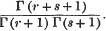
If

we say that the series a0 + a1 + a2 +…+an+… is summable by Cesàro mean of order r, or more shortly summable (C, r) to sum s. If r >−1, and

we say that the series is summable by Rieszian mean of order r to the sum s. It has been shown that these two methods of summation are equivalent. Throughout this paper I shall deal with the Rieszian mean, but I shall retain the symbol (C, r). It is known† that if a series is summable (C, r), it is also summable (C, r′) to the same sum for all numbers r′ greater than r.
 denote
Note on the Gibbs Phenomenon
-
- Journal:
- Mathematical Proceedings of the Cambridge Philosophical Society / Volume 26 / Issue 2 / April 1930
- Published online by Cambridge University Press:
- 24 October 2008, pp. 158-169
- Print publication:
- April 1930
-
- Article
- Export citation
-
The Fourier series of the function defined by

is

and if
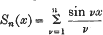
then

while

The expression (1) exceeds (2); this is the Gibbs phenomenon.

The law of stifling of sound by curtains or cushions
-
- Journal:
- Mathematical Proceedings of the Cambridge Philosophical Society / Volume 26 / Issue 2 / April 1930
- Published online by Cambridge University Press:
- 24 October 2008, pp. 231-235
- Print publication:
- April 1930
-
- Article
- Export citation
The Draining of a Vertical Plate
-
- Journal:
- Mathematical Proceedings of the Cambridge Philosophical Society / Volume 26 / Issue 2 / April 1930
- Published online by Cambridge University Press:
- 24 October 2008, pp. 204-205
- Print publication:
- April 1930
-
- Article
- Export citation
PSP volume 26 issue 2 Cover and Front matter
-
- Journal:
- Mathematical Proceedings of the Cambridge Philosophical Society / Volume 26 / Issue 2 / April 1930
- Published online by Cambridge University Press:
- 24 October 2008, pp. f1-f2
- Print publication:
- April 1930
-
- Article
-
- You have access
- Export citation
Continued Fractions in Several Dimensions
-
- Journal:
- Mathematical Proceedings of the Cambridge Philosophical Society / Volume 26 / Issue 2 / April 1930
- Published online by Cambridge University Press:
- 24 October 2008, pp. 127-144
- Print publication:
- April 1930
-
- Article
- Export citation
The Absorption of β-Rays
-
- Journal:
- Mathematical Proceedings of the Cambridge Philosophical Society / Volume 26 / Issue 2 / April 1930
- Published online by Cambridge University Press:
- 24 October 2008, pp. 252-257
- Print publication:
- April 1930
-
- Article
- Export citation
A mathematical theory of natural and artificial selection. (Part VI, Isolation.)
-
- Journal:
- Mathematical Proceedings of the Cambridge Philosophical Society / Volume 26 / Issue 2 / April 1930
- Published online by Cambridge University Press:
- 24 October 2008, pp. 220-230
- Print publication:
- April 1930
-
- Article
- Export citation
