Refine search
Actions for selected content:
26203 results in Theoretical Physics and Mathematical Physics
A transformation of a formula of Sommerfeld
-
- Journal:
- Mathematical Proceedings of the Cambridge Philosophical Society / Volume 26 / Issue 2 / April 1930
- Published online by Cambridge University Press:
- 24 October 2008, pp. 123-126
- Print publication:
- April 1930
-
- Article
- Export citation
-
Sommerfeld has shown that the electromagnetic field set up by a Hertzian oscillator placed on the infinite plane surface separating two media normal to that surface may be obtained from the Hertzian function of cylindrical coordinates r, z,
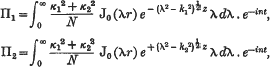
where the suffixes 1, 2 refer to the two media occupying the regions z>0, z<0,

and

where ɛ1, μ1, σ1 are the dielectric constant, permeability, and conductivity (in Heaviside units) of the first medium, k2, k2 like expressions for the second, c is the velocity of light, and n the frequency in radians per second; +(λ2−k2)½ is taken to have its real part positive.
On the remarkable quadrics of a space cubic curve
-
- Journal:
- Mathematical Proceedings of the Cambridge Philosophical Society / Volume 26 / Issue 2 / April 1930
- Published online by Cambridge University Press:
- 24 October 2008, pp. 206-219
- Print publication:
- April 1930
-
- Article
- Export citation
The Instability of a Compressible Fluid heated below
-
- Journal:
- Mathematical Proceedings of the Cambridge Philosophical Society / Volume 26 / Issue 2 / April 1930
- Published online by Cambridge University Press:
- 24 October 2008, pp. 170-172
- Print publication:
- April 1930
-
- Article
- Export citation
On a Type of Automatically Interrupted Triode Oscillations
-
- Journal:
- Mathematical Proceedings of the Cambridge Philosophical Society / Volume 26 / Issue 2 / April 1930
- Published online by Cambridge University Press:
- 24 October 2008, pp. 236-251
- Print publication:
- April 1930
-
- Article
- Export citation
Note on the sum of an oscillating series
-
- Journal:
- Mathematical Proceedings of the Cambridge Philosophical Society / Volume 26 / Issue 2 / April 1930
- Published online by Cambridge University Press:
- 24 October 2008, pp. 152-157
- Print publication:
- April 1930
-
- Article
- Export citation
-
Consider the series

and let

The series

is not necessarily convergent. Suppose that its Poisson sum exists. This we denote by

The expression
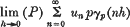
when existent will be said to be the sum (
 , p) of the series (1).
 , p) of the series (1).
PSP volume 26 issue 2 Cover and Back matter
-
- Journal:
- Mathematical Proceedings of the Cambridge Philosophical Society / Volume 26 / Issue 2 / April 1930
- Published online by Cambridge University Press:
- 24 October 2008, pp. b1-b2
- Print publication:
- April 1930
-
- Article
-
- You have access
- Export citation
A New Method of Examination of Surface Films
-
- Journal:
- Mathematical Proceedings of the Cambridge Philosophical Society / Volume 26 / Issue 2 / April 1930
- Published online by Cambridge University Press:
- 24 October 2008, pp. 273-277
- Print publication:
- April 1930
-
- Article
- Export citation
The Remainders in the Asymptotic Expansions of Certain Bessel Functions
-
- Journal:
- Mathematical Proceedings of the Cambridge Philosophical Society / Volume 26 / Issue 2 / April 1930
- Published online by Cambridge University Press:
- 24 October 2008, pp. 145-151
- Print publication:
- April 1930
-
- Article
- Export citation
A Microcalorimeter
-
- Journal:
- Mathematical Proceedings of the Cambridge Philosophical Society / Volume 26 / Issue 2 / April 1930
- Published online by Cambridge University Press:
- 24 October 2008, pp. 278-284
- Print publication:
- April 1930
-
- Article
- Export citation
The Added Mass of Prisms Floating in Water
-
- Journal:
- Mathematical Proceedings of the Cambridge Philosophical Society / Volume 26 / Issue 2 / April 1930
- Published online by Cambridge University Press:
- 24 October 2008, pp. 258-272
- Print publication:
- April 1930
-
- Article
- Export citation
Enumerative Formulae for Surfaces
-
- Journal:
- Mathematical Proceedings of the Cambridge Philosophical Society / Volume 26 / Issue 1 / January 1930
- Published online by Cambridge University Press:
- 24 October 2008, pp. 43-71
- Print publication:
- January 1930
-
- Article
- Export citation
An attempt to detect an Electric Moment in a Light Quantum
-
- Journal:
- Mathematical Proceedings of the Cambridge Philosophical Society / Volume 26 / Issue 1 / January 1930
- Published online by Cambridge University Press:
- 24 October 2008, pp. 117-121
- Print publication:
- January 1930
-
- Article
- Export citation
-
If a light quantum has an electric moment, we should expect its axis to coincide with the direction of the electric vector, and therefore to be perpendicular to the plane of polarisation. Now an electric doublet of moment μ on entering a uniform electric field E with its doubletaxis parallel or antiparallel to the field will have its energy changed by an amount ∓ μE. For a light quantum this is equivalent to a change in wave-length
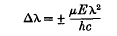
when in the field. The method adopted to detect this change was to set up a grating with a strong electric field normal to its surface, and then have a plane polarised parallel beam of light fall on the ruled surface with the electric vector parallel to the direction of the field. The spectra formed near the normal to the grating were then examined both in the presence and absence of the field.
The Thermodynamics of an Elastic Solid
-
- Journal:
- Mathematical Proceedings of the Cambridge Philosophical Society / Volume 26 / Issue 1 / January 1930
- Published online by Cambridge University Press:
- 24 October 2008, pp. 101-106
- Print publication:
- January 1930
-
- Article
- Export citation
-
1. We consider a small cube of the solid, of edge l, in the actual strained position. If the stresses were removed and the cube cooled to the absolute zero, the displacements of its particles would be (−u, −v, −w). Then the particles may be considered to have displacements (u, v, w) from a standard position; and the cube has strain components of the usual forms



Some series of squares of Bessel functions
-
- Journal:
- Mathematical Proceedings of the Cambridge Philosophical Society / Volume 26 / Issue 1 / January 1930
- Published online by Cambridge University Press:
- 24 October 2008, pp. 82-87
- Print publication:
- January 1930
-
- Article
- Export citation
PSP volume 26 issue 1 Cover and Back matter
-
- Journal:
- Mathematical Proceedings of the Cambridge Philosophical Society / Volume 26 / Issue 1 / January 1930
- Published online by Cambridge University Press:
- 24 October 2008, pp. b1-b2
- Print publication:
- January 1930
-
- Article
-
- You have access
- Export citation
PSP volume 26 issue 1 Cover and Front matter
-
- Journal:
- Mathematical Proceedings of the Cambridge Philosophical Society / Volume 26 / Issue 1 / January 1930
- Published online by Cambridge University Press:
- 24 October 2008, pp. f1-f2
- Print publication:
- January 1930
-
- Article
-
- You have access
- Export citation
On the Equation of State of an Ionised Gas
-
- Journal:
- Mathematical Proceedings of the Cambridge Philosophical Society / Volume 26 / Issue 1 / January 1930
- Published online by Cambridge University Press:
- 24 October 2008, pp. 107-114
- Print publication:
- January 1930
-
- Article
- Export citation
On the existence of non-combining groups of wave-functions, and on the uniqueness of the solutions of certain wave equations
-
- Journal:
- Mathematical Proceedings of the Cambridge Philosophical Society / Volume 26 / Issue 1 / January 1930
- Published online by Cambridge University Press:
- 24 October 2008, pp. 99-100
- Print publication:
- January 1930
-
- Article
- Export citation
Representation of the planes of five-dimensional space
-
- Journal:
- Mathematical Proceedings of the Cambridge Philosophical Society / Volume 26 / Issue 1 / January 1930
- Published online by Cambridge University Press:
- 24 October 2008, pp. 72-81
- Print publication:
- January 1930
-
- Article
- Export citation
Concerning some Solutions of the Boundary Layer Equations in Hydrodynamics
-
- Journal:
- Mathematical Proceedings of the Cambridge Philosophical Society / Volume 26 / Issue 1 / January 1930
- Published online by Cambridge University Press:
- 24 October 2008, pp. 1-30
- Print publication:
- January 1930
-
- Article
- Export citation
