Refine search
Actions for selected content:
26203 results in Theoretical Physics and Mathematical Physics
On the Phragmén-Lindelöf Principle
-
- Journal:
- Mathematical Proceedings of the Cambridge Philosophical Society / Volume 25 / Issue 3 / July 1929
- Published online by Cambridge University Press:
- 24 October 2008, pp. 265-267
- Print publication:
- July 1929
-
- Article
- Export citation
-
In this short note my chief object is to prove the following theorem:
If
(1) f(z) is a regular function of z(= ρeiψ) in the angle |ψ| ≤ α, where
 ;
;(2) f(z)= 0(eαρ), where K is a positive constant, throughout this angle;
(3) f(z) is not identically zero;
then
(4)
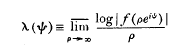
is a continuous function of ψ for |ψ| < α.
 ;
;
On Ramanujan's Arithmetical Function Σr, s(n)
-
- Journal:
- Mathematical Proceedings of the Cambridge Philosophical Society / Volume 25 / Issue 3 / July 1929
- Published online by Cambridge University Press:
- 24 October 2008, pp. 255-264
- Print publication:
- July 1929
-
- Article
- Export citation
-
Let σs(n) denote the sum of the sth powers of the divisors of n,
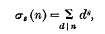
and let
 , where ζ(s) is the Riemann ζfunction. Ramanujan, in his paper “On certain arithmetical functions*”, proves that, if
and

then
 , whenever r and s are odd positive integers. He conjectures that the error term on the right of (1·1) is of the form
for every ε > 0, and that it is not of the form
 . He further conjectures that
for all positive values of r and s; and this conjecture has recently been proved to be correct.
 , where ζ(

 , whenever
 . He further conjectures that
An Analysis of Triode Valve Rectification
-
- Journal:
- Mathematical Proceedings of the Cambridge Philosophical Society / Volume 25 / Issue 3 / July 1929
- Published online by Cambridge University Press:
- 24 October 2008, pp. 355-367
- Print publication:
- July 1929
-
- Article
- Export citation
On the Transport of Sediments by Streams
-
- Journal:
- Mathematical Proceedings of the Cambridge Philosophical Society / Volume 25 / Issue 3 / July 1929
- Published online by Cambridge University Press:
- 24 October 2008, pp. 272-276
- Print publication:
- July 1929
-
- Article
- Export citation
An Approximate Method of Determining the High-Velocity Limits of Continuous β-ray Spectra
-
- Journal:
- Mathematical Proceedings of the Cambridge Philosophical Society / Volume 25 / Issue 3 / July 1929
- Published online by Cambridge University Press:
- 24 October 2008, pp. 331-339
- Print publication:
- July 1929
-
- Article
- Export citation
PSP volume 25 issue 3 Cover and Front matter
-
- Journal:
- Mathematical Proceedings of the Cambridge Philosophical Society / Volume 25 / Issue 3 / July 1929
- Published online by Cambridge University Press:
- 24 October 2008, p. f1
- Print publication:
- July 1929
-
- Article
-
- You have access
- Export citation
Double Row of Vortices with Arbitrary Stagger
-
- Journal:
- Mathematical Proceedings of the Cambridge Philosophical Society / Volume 25 / Issue 2 / April 1929
- Published online by Cambridge University Press:
- 24 October 2008, pp. 132-138
- Print publication:
- April 1929
-
- Article
- Export citation
-
The investigations of von Karman dealing with the unsymmetrical double row of vortices in an infinite sea of liquid are well known. He found that the unsymmetrical double row is stable when, and only when, cosh2πa/b = 2, where 2a is the distance between the two rows and 2b is the distance between consecutive vortices on the same row. A detailed account of the stability of the Karman street and of the symmetrical double row has been given by Lamb, and it has been shown that the symmetrical double row is unstable for all values of the ratio a/b. The object of this paper is to investigate the stability of a double row of vortices of arbitrary stagger. We define a double row of stagger 2l to be the system formed by positive vortices at the points (2nb + l, a) and negative vortices at (2mb − l, − a), where m and n assume all integral values from − ∞ to + ∞. The vortices are thus neither exactly “in step” nor exactly “out of step.” When l = 0 the system reduces to the symmetrical double row and when
 the system is the unsymmetrical double row.
 the system is the unsymmetrical double row.
Secondary Electron Emission from Solid Metal Surfaces
-
- Journal:
- Mathematical Proceedings of the Cambridge Philosophical Society / Volume 25 / Issue 2 / April 1929
- Published online by Cambridge University Press:
- 24 October 2008, pp. 237-254
- Print publication:
- April 1929
-
- Article
- Export citation
Configuration of Quadrivalent Atoms
-
- Journal:
- Mathematical Proceedings of the Cambridge Philosophical Society / Volume 25 / Issue 2 / April 1929
- Published online by Cambridge University Press:
- 24 October 2008, pp. 219-221
- Print publication:
- April 1929
-
- Article
- Export citation
-
Two alternative views have been expressed in regard to the configuration of quadrivalent atoms. On the one hand le Bel and van't Hoff assigned to quadrivalent carbon a tetrahedral configuration, which has since been confirmed by the X-ray analysis of the diamond. On the other hand, Werner in 1893 adopted an octahedral configuration for radicals of the type MA6, e.g. in

and then suggested that “the molecules [MA4]X2 are incomplete molecules [MA6]X2. The radicals [MA4] result from the octahedrally-conceived radicals [MA6] by loss of two groups A, but with no function-change of the acid residue…. They behave as if the bivalent metallic atom in the centre of the octahedron could no longer bind all six of the groups A and lost two of them leaving behind the fragment [MA4]” (p. 303).
Thermionic Emission through double layers
-
- Journal:
- Mathematical Proceedings of the Cambridge Philosophical Society / Volume 25 / Issue 2 / April 1929
- Published online by Cambridge University Press:
- 24 October 2008, pp. 175-185
- Print publication:
- April 1929
-
- Article
- Export citation
The Mobility Distribution and Rate of Formation of Negative Ions in Air
-
- Journal:
- Mathematical Proceedings of the Cambridge Philosophical Society / Volume 25 / Issue 2 / April 1929
- Published online by Cambridge University Press:
- 24 October 2008, pp. 205-218
- Print publication:
- April 1929
-
- Article
- Export citation
The Distribution of Charge and Current in an Atom consisting of many Electrons obeying Dirac's equations
-
- Journal:
- Mathematical Proceedings of the Cambridge Philosophical Society / Volume 25 / Issue 2 / April 1929
- Published online by Cambridge University Press:
- 24 October 2008, pp. 225-236
- Print publication:
- April 1929
-
- Article
- Export citation
Some further results concerning the integrals of moduli of regular functions along curves of certain types
-
- Journal:
- Mathematical Proceedings of the Cambridge Philosophical Society / Volume 25 / Issue 2 / April 1929
- Published online by Cambridge University Press:
- 24 October 2008, pp. 139-144
- Print publication:
- April 1929
-
- Article
- Export citation
-
In a paper* of some time back I gave the following theorem:
If f(z) is a regular function of z for z inside and on a circle Τ, and C is any convex curve inside Τ, and λ>0, then

A Geometrical Study of the Alternating and Symmetric Groups
-
- Journal:
- Mathematical Proceedings of the Cambridge Philosophical Society / Volume 25 / Issue 2 / April 1929
- Published online by Cambridge University Press:
- 24 October 2008, pp. 168-174
- Print publication:
- April 1929
-
- Article
- Export citation
-
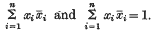
Let a finite group Τ be represented as an irreducible group of order N of linear substitutions on n variables,

The variables may be chosen so that the substitutions of the group leave invariant the Hermitian form
A note on Ramanujan's arithmetical function τ(n)
-
- Journal:
- Mathematical Proceedings of the Cambridge Philosophical Society / Volume 25 / Issue 2 / April 1929
- Published online by Cambridge University Press:
- 24 October 2008, pp. 121-129
- Print publication:
- April 1929
-
- Article
- Export citation
-
The function τ (n), defined by the equation

is considered by Ramanujan* in his memoir “On certain arithmetical functions”
The associated Diriċhlet series

converges when σ = > σ0, for a sufficiently large positive σ0.
Energy Relations in Artificial Disintegration
-
- Journal:
- Mathematical Proceedings of the Cambridge Philosophical Society / Volume 25 / Issue 2 / April 1929
- Published online by Cambridge University Press:
- 24 October 2008, pp. 186-192
- Print publication:
- April 1929
-
- Article
- Export citation
PSP volume 25 issue 2 Cover and Back matter
-
- Journal:
- Mathematical Proceedings of the Cambridge Philosophical Society / Volume 25 / Issue 2 / April 1929
- Published online by Cambridge University Press:
- 24 October 2008, p. b1
- Print publication:
- April 1929
-
- Article
-
- You have access
- Export citation
On Certain Loci of Three Dimensions Representable on Ordinary Space by means of Cubic Surfaces, and the Cremona Transformations for Ordinary Space obtained by Projection of such Loci
-
- Journal:
- Mathematical Proceedings of the Cambridge Philosophical Society / Volume 25 / Issue 2 / April 1929
- Published online by Cambridge University Press:
- 24 October 2008, pp. 145-167
- Print publication:
- April 1929
-
- Article
- Export citation
Note on the Number of High Velocity β-rays
-
- Journal:
- Mathematical Proceedings of the Cambridge Philosophical Society / Volume 25 / Issue 2 / April 1929
- Published online by Cambridge University Press:
- 24 October 2008, pp. 222-224
- Print publication:
- April 1929
-
- Article
- Export citation
An analogy for beams of particles of a reciprocal optical theorem due to Helmholtz
-
- Journal:
- Mathematical Proceedings of the Cambridge Philosophical Society / Volume 25 / Issue 2 / April 1929
- Published online by Cambridge University Press:
- 24 October 2008, pp. 193-197
- Print publication:
- April 1929
-
- Article
- Export citation
-
There is a theorem in geometrical optics due to Helmholtz which states that if a ray of light (1) after any number of refractions and reflections at plane or nearly plane surfaces gives rise (among others) to a ray (2) whose intensity is a certain fraction f12 of the intensity of the ray (1), then on reversing the path of the light an incident ray (2)′ will give rise, among others, to a ray (1)′ whose intensity is a fraction f21 of the ray (2)′, such that

The surfaces if not plane must be such that their radius of curvature is large compared with the lateral extent of the ray and this lateral extent must itself be large compared with the wave-lengths in the ray. In view of the many recent studies of reflection and transmission (refraction) of beams of electrons at potential walls, it seems worth while to ask whether there exists an analogy of the optical theorem for beams of electrons (or other particles). It is easy to see that the analogy must exist by using the principle of detailed balancing required by an assembly in statistical equilibrium. But a direct “dynamical” proof is also easy and may prove of sufficient practical interest to put on record here.
