Refine search
Actions for selected content:
26203 results in Theoretical Physics and Mathematical Physics
On the theory of the recombination of ions in gases at high pressures
-
- Journal:
- Mathematical Proceedings of the Cambridge Philosophical Society / Volume 28 / Issue 2 / April 1932
- Published online by Cambridge University Press:
- 24 October 2008, pp. 219-233
- Print publication:
- April 1932
-
- Article
- Export citation
On some series of functions, (3)
-
- Journal:
- Mathematical Proceedings of the Cambridge Philosophical Society / Volume 28 / Issue 2 / April 1932
- Published online by Cambridge University Press:
- 24 October 2008, pp. 190-205
- Print publication:
- April 1932
-
- Article
- Export citation
Photo-electric absorption in hydrogen-like atoms
-
- Journal:
- Mathematical Proceedings of the Cambridge Philosophical Society / Volume 28 / Issue 2 / April 1932
- Published online by Cambridge University Press:
- 24 October 2008, pp. 209-218
- Print publication:
- April 1932
-
- Article
- Export citation
PSP volume 28 issue 1 Cover and Front matter
-
- Journal:
- Mathematical Proceedings of the Cambridge Philosophical Society / Volume 28 / Issue 1 / January 1932
- Published online by Cambridge University Press:
- 24 October 2008, pp. f1-f2
- Print publication:
- January 1932
-
- Article
-
- You have access
- Export citation
The upper limit of energy in the β-ray spectrum of thorium C″
-
- Journal:
- Mathematical Proceedings of the Cambridge Philosophical Society / Volume 28 / Issue 1 / January 1932
- Published online by Cambridge University Press:
- 24 October 2008, pp. 115-120
- Print publication:
- January 1932
-
- Article
- Export citation
PSP volume 28 issue 1 Cover and Back matter
-
- Journal:
- Mathematical Proceedings of the Cambridge Philosophical Society / Volume 28 / Issue 1 / January 1932
- Published online by Cambridge University Press:
- 24 October 2008, pp. b1-b2
- Print publication:
- January 1932
-
- Article
-
- You have access
- Export citation
Explicit formulae connecting Hölder's, Cesàro's and another mean value
-
- Journal:
- Mathematical Proceedings of the Cambridge Philosophical Society / Volume 28 / Issue 1 / January 1932
- Published online by Cambridge University Press:
- 24 October 2008, pp. 1-17
- Print publication:
- January 1932
-
- Article
- Export citation
-
1. Having given the terms sn of a sequence

then Hölder's means
 are defined by
Cesàro's means
 are defined by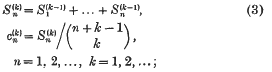
and a third kind, σ, of mean which will be used in this paper is defined by

 are defined by
 are defined by
On the determination of the horizontal component of the earth's magnetic field by a coupled oscillations method
-
- Journal:
- Mathematical Proceedings of the Cambridge Philosophical Society / Volume 28 / Issue 1 / January 1932
- Published online by Cambridge University Press:
- 24 October 2008, pp. 109-114
- Print publication:
- January 1932
-
- Article
- Export citation
The ‘relaxation’ term in Debye and Hückel's theory of ionic mobility
-
- Journal:
- Mathematical Proceedings of the Cambridge Philosophical Society / Volume 28 / Issue 1 / January 1932
- Published online by Cambridge University Press:
- 24 October 2008, pp. 83-92
- Print publication:
- January 1932
-
- Article
- Export citation
An attempt to detect the spontaneous transformation of helium into penetrating radiation
-
- Journal:
- Mathematical Proceedings of the Cambridge Philosophical Society / Volume 28 / Issue 1 / January 1932
- Published online by Cambridge University Press:
- 24 October 2008, pp. 124-127
- Print publication:
- January 1932
-
- Article
- Export citation
A quantum mechanical theory of energy exchanges between inert gas atoms and a solid surface
-
- Journal:
- Mathematical Proceedings of the Cambridge Philosophical Society / Volume 28 / Issue 1 / January 1932
- Published online by Cambridge University Press:
- 24 October 2008, pp. 136-164
- Print publication:
- January 1932
-
- Article
- Export citation
The interval between the departure of the disintegration particle and the emission of the gamma radiation
-
- Journal:
- Mathematical Proceedings of the Cambridge Philosophical Society / Volume 28 / Issue 1 / January 1932
- Published online by Cambridge University Press:
- 24 October 2008, pp. 128-135
- Print publication:
- January 1932
-
- Article
- Export citation
The general surfaces in four dimensions with one or two apparent triple points
-
- Journal:
- Mathematical Proceedings of the Cambridge Philosophical Society / Volume 28 / Issue 1 / January 1932
- Published online by Cambridge University Press:
- 24 October 2008, pp. 51-54
- Print publication:
- January 1932
-
- Article
- Export citation
Note on the instability of a surface of discontinuity
-
- Journal:
- Mathematical Proceedings of the Cambridge Philosophical Society / Volume 28 / Issue 1 / January 1932
- Published online by Cambridge University Press:
- 24 October 2008, pp. 35-44
- Print publication:
- January 1932
-
- Article
- Export citation
-
In a paper recently published I found it necessary to extend those investigations of Lord Rayleigh which deal with the instability of the surface common to two streams of fluid. The Rayleigh investigation is equivalent to a first order approximation to the flow and concludes that the initial form of the disturbance of the common surface is maintained but that its amplitude increases exponentially with the time, the form of the surface at time t being, with particular values inserted,

where a is the initial amplitude, 2π/k the wave-length, U the velocity of the upper stream, – U the velocity of the lower stream, and ρ the density of both fluids. A second order approximation to the flow for the above particular case shows that the original disturbance does not grow symmetrically, the ordinate of the common surface being given by

(A slightly amended form of this solution is given byequation III(8).) The solution suggests the initial stages in the formation of vortices. The problem was further discussed by a numerical step-by-step method and showed the formation of vortices quite clearly.

Note on a high-tension supply for Geiger counters operated from A.C. mains
-
- Journal:
- Mathematical Proceedings of the Cambridge Philosophical Society / Volume 28 / Issue 1 / January 1932
- Published online by Cambridge University Press:
- 24 October 2008, pp. 121-123
- Print publication:
- January 1932
-
- Article
- Export citation
Note in regard to surfaces in space of four dimensions, in particular rational surfaces*
-
- Journal:
- Mathematical Proceedings of the Cambridge Philosophical Society / Volume 28 / Issue 1 / January 1932
- Published online by Cambridge University Press:
- 24 October 2008, pp. 62-82
- Print publication:
- January 1932
-
- Article
- Export citation
The tangent planes to a degenerate surface
-
- Journal:
- Mathematical Proceedings of the Cambridge Philosophical Society / Volume 28 / Issue 1 / January 1932
- Published online by Cambridge University Press:
- 24 October 2008, pp. 45-50
- Print publication:
- January 1932
-
- Article
- Export citation
-
1. In the Lehrbuch der abzählenden Methoden Zeuthen considers the problem of determining the nature and multiplicity of the tangent lines and planes to a degenerate surface in ordinary space. The surface φ in question consists of n arbitrary planes; these meet in pairs, forming
 double lines, and in threes, forming
  triple points. The tangent cone to φ from an arbitrary point consists of plane pencils, each counted twice, as follows from the known theory of degenerate plane curves. According to Zeuthen the tangent planes are of two types:
(i) those passing through one of the triple points; there are thus
such systems, and each is to be counted six times;(ii) those passing through certain points S lying on the double lines; these depend upon the passage to the limit, it being assumed that φ is obtained as the limiting form of some nondegenerate surface. Two such points lie on each double line, so that there are n(n−1) such systems of planes.
 double lines, and in threes, forming
  triple points. The tangent cone to φ from an arbitrary point consists of
 The collision of electrons with rotating dipoles
-
- Journal:
- Mathematical Proceedings of the Cambridge Philosophical Society / Volume 28 / Issue 1 / January 1932
- Published online by Cambridge University Press:
- 24 October 2008, pp. 99-105
- Print publication:
- January 1932
-
- Article
- Export citation
Note on a new power-angle diagram for alternators
-
- Journal:
- Mathematical Proceedings of the Cambridge Philosophical Society / Volume 28 / Issue 1 / January 1932
- Published online by Cambridge University Press:
- 24 October 2008, pp. 106-108
- Print publication:
- January 1932
-
- Article
- Export citation
-
In an alternating current motor (of simplest type) the internal E.M.F. e, the terminal tension e, the useful electrical power transformed p and the rotor phase angle φ are connected by the known formula

in which
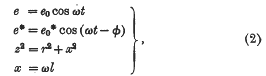
where r is the resistance and l the self-inductance of the armature and ω the angular velocity of the rotor.
The application of quadratic forms in an infinity of variables to boundary problems in partial differential equations
-
- Journal:
- Mathematical Proceedings of the Cambridge Philosophical Society / Volume 28 / Issue 1 / January 1932
- Published online by Cambridge University Press:
- 24 October 2008, pp. 23-34
- Print publication:
- January 1932
-
- Article
- Export citation
-
The object of this paper is to find the characteristic functions and the characteristic numbers of the partial differential equation

valid in a domain G, and where
 on Γ, the boundary of G. The method employed is to transform two quadratic forms to their common self-conjugate “triangle“ of reference. The solution to the problem is given by this method in a simple manner, without the use of the integral equation theory, or the use of minimal sequences.
 on Γ, the boundary of