Refine search
Actions for selected content:
26203 results in Theoretical Physics and Mathematical Physics
PSP volume 28 issue 4 Cover and Front matter
-
- Journal:
- Mathematical Proceedings of the Cambridge Philosophical Society / Volume 28 / Issue 4 / October 1932
- Published online by Cambridge University Press:
- 24 October 2008, pp. f1-f2
- Print publication:
- October 1932
-
- Article
-
- You have access
- Export citation
Proceedings at the Meetings held during the Session 1931—1932: Annual General Meeting
-
- Journal:
- Mathematical Proceedings of the Cambridge Philosophical Society / Volume 28 / Issue 4 / October 1932
- Published online by Cambridge University Press:
- 24 October 2008, pp. 554-562
- Print publication:
- October 1932
-
- Article
- Export citation
The numerical calculation of the scattering correction in γ ray absorption measurements
-
- Journal:
- Mathematical Proceedings of the Cambridge Philosophical Society / Volume 28 / Issue 4 / October 1932
- Published online by Cambridge University Press:
- 24 October 2008, pp. 475-489
- Print publication:
- October 1932
-
- Article
- Export citation
The distribution of second order moment statistics in a normal system
-
- Journal:
- Mathematical Proceedings of the Cambridge Philosophical Society / Volume 28 / Issue 4 / October 1932
- Published online by Cambridge University Press:
- 24 October 2008, pp. 455-459
- Print publication:
- October 1932
-
- Article
- Export citation
-
Let x be a normally distributed variable, which may without loss of generality be measured from the mean of the distribution, so that E(x) = 0, E denoting mathematical expectation. Then x satisfies the differential relation

where k2 (otherwise σ2 or (2h2)−1) is the semi-invariant of order 2. Also k1 = 0, and we know that kr = 0 for r > 2.
PSP volume 28 issue 4 Cover and Back matter
-
- Journal:
- Mathematical Proceedings of the Cambridge Philosophical Society / Volume 28 / Issue 4 / October 1932
- Published online by Cambridge University Press:
- 24 October 2008, pp. b1-b10
- Print publication:
- October 1932
-
- Article
-
- You have access
- Export citation
Modified ionic states in crystals
-
- Journal:
- Mathematical Proceedings of the Cambridge Philosophical Society / Volume 28 / Issue 4 / October 1932
- Published online by Cambridge University Press:
- 24 October 2008, pp. 522-530
- Print publication:
- October 1932
-
- Article
- Export citation
Statement of Accounts of the Cambridge Philosophical Society, from January 1, 1931, to December 31, 1931
-
- Journal:
- Mathematical Proceedings of the Cambridge Philosophical Society / Volume 28 / Issue 4 / October 1932
- Published online by Cambridge University Press:
- 24 October 2008, pp. 564-565
- Print publication:
- October 1932
-
- Article
- Export citation
Energy distribution curves of the disintegration electrons
-
- Journal:
- Mathematical Proceedings of the Cambridge Philosophical Society / Volume 28 / Issue 4 / October 1932
- Published online by Cambridge University Press:
- 24 October 2008, pp. 538-553
- Print publication:
- October 1932
-
- Article
- Export citation
The densities of the regular polytopes, Part 2*
-
- Journal:
- Mathematical Proceedings of the Cambridge Philosophical Society / Volume 28 / Issue 4 / October 1932
- Published online by Cambridge University Press:
- 24 October 2008, pp. 509-521
- Print publication:
- October 1932
-
- Article
- Export citation
On Nicod's reduction in the number of primitives of logic†
-
- Journal:
- Mathematical Proceedings of the Cambridge Philosophical Society / Volume 28 / Issue 4 / October 1932
- Published online by Cambridge University Press:
- 24 October 2008, pp. 427-432
- Print publication:
- October 1932
-
- Article
- Export citation
The significance of the sign of a mutual inductance
-
- Journal:
- Mathematical Proceedings of the Cambridge Philosophical Society / Volume 28 / Issue 4 / October 1932
- Published online by Cambridge University Press:
- 24 October 2008, pp. 531-537
- Print publication:
- October 1932
-
- Article
- Export citation
Asymptotic dipole expansions for small horizontal angles
-
- Journal:
- Mathematical Proceedings of the Cambridge Philosophical Society / Volume 28 / Issue 4 / October 1932
- Published online by Cambridge University Press:
- 24 October 2008, pp. 433-441
- Print publication:
- October 1932
-
- Article
- Export citation
On the operational solution of linear difference equations whose coefficients are expressible by factorial series
-
- Journal:
- Mathematical Proceedings of the Cambridge Philosophical Society / Volume 28 / Issue 4 / October 1932
- Published online by Cambridge University Press:
- 24 October 2008, pp. 463-474
- Print publication:
- October 1932
-
- Article
- Export citation
The restriction to linearity of the Lorentz transformation
-
- Journal:
- Mathematical Proceedings of the Cambridge Philosophical Society / Volume 28 / Issue 4 / October 1932
- Published online by Cambridge University Press:
- 24 October 2008, pp. 460-462
- Print publication:
- October 1932
-
- Article
- Export citation
Energy problems in the continuous spectra of β-rays
-
- Journal:
- Mathematical Proceedings of the Cambridge Philosophical Society / Volume 28 / Issue 3 / July 1932
- Published online by Cambridge University Press:
- 24 October 2008, pp. 328-337
- Print publication:
- July 1932
-
- Article
- Export citation
-
By their measurements on the heating effect of the β-rays of Radium E, Ellis and Wooster(1) have proved that the continuous spectra of β-rays represent the actual β-rays of disintegration. Since the β-rays in the continuous spectrum have a wide range of energies, there arise problems which can best be understood by considering a particular series of disintegrations, which we may regard as typical; the most suitable series to consider is the following:
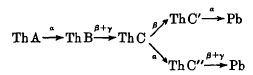
The main problem that arises is to reconcile the facts that the β-rays from Thorium B and Thorium C are emitted with a wide range of energies, while before, in Thorium A, and after, in Thorium C and Thorium C′, we have bodies which emit α-rays which are homogeneous, or, at most, consist of a few homogeneous groups [Rosenblum(2)].
PSP volume 28 issue 3 Cover and Back matter
-
- Journal:
- Mathematical Proceedings of the Cambridge Philosophical Society / Volume 28 / Issue 3 / July 1932
- Published online by Cambridge University Press:
- 24 October 2008, pp. b1-b2
- Print publication:
- July 1932
-
- Article
- Export citation
On the possibility of a thermal effect accompanying sudden changes in the magneton-numbers in CuCl2 and NiSO47 H2O
-
- Journal:
- Mathematical Proceedings of the Cambridge Philosophical Society / Volume 28 / Issue 3 / July 1932
- Published online by Cambridge University Press:
- 24 October 2008, pp. 338-340
- Print publication:
- July 1932
-
- Article
- Export citation
-
1. The temperature variation of the paramagnetic susceptibility of most of the solids follows the generalised Curie law

as found first by Kamerlingh Onnes and Weiss. This gives a linear relation between 1/ψ and T. The value of C is a measure of the atomic magnetic moment, and if this moment is expressed in terms of the Weiss magneton-number p, then
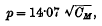
where CM is the value of C when ψ refers to a gram-molecule. The experimental results for a paramagnetic substance are usually expressed in terms of p and θ. Weiss (1), Foex (2), Cabrera and others have found that in some substances there are discontinuities in the slope of the 1/ψ, T curve. Thus Weiss (3) finds that magnetite above its Curie point shows several sudden changes in the 1/ψ, T curve, which he has interpreted as corresponding to the magneton-numbers p = 4, 5, 6, 8,10. Similarly, for cupric chloride (anhydride) Weiss (4) gives p= 9.2 and 10, for the temperature ranges — 140° to 20° and 20° to 500° respectively. Nickel sulphate (5) has also been found to possess a transition point at about — 113°, where the p value on cooling changes from 14.6 to 18.2.

Secondary electron emission from a nickel surface produced by positive ions of mercury
-
- Journal:
- Mathematical Proceedings of the Cambridge Philosophical Society / Volume 28 / Issue 3 / July 1932
- Published online by Cambridge University Press:
- 24 October 2008, pp. 349-355
- Print publication:
- July 1932
-
- Article
- Export citation
Plane congruences of the second order in space of four dimensions and fifth incidence theorems
-
- Journal:
- Mathematical Proceedings of the Cambridge Philosophical Society / Volume 28 / Issue 3 / July 1932
- Published online by Cambridge University Press:
- 24 October 2008, pp. 275-284
- Print publication:
- July 1932
-
- Article
- Export citation
The propagation of radio frequency currents along a wire of finite length
-
- Journal:
- Mathematical Proceedings of the Cambridge Philosophical Society / Volume 28 / Issue 3 / July 1932
- Published online by Cambridge University Press:
- 24 October 2008, pp. 356-366
- Print publication:
- July 1932
-
- Article
- Export citation
