Refine search
Actions for selected content:
26203 results in Theoretical Physics and Mathematical Physics
On surfaces of sectional genus four
-
- Journal:
- Mathematical Proceedings of the Cambridge Philosophical Society / Volume 29 / Issue 2 / May 1933
- Published online by Cambridge University Press:
- 24 October 2008, pp. 184-194
- Print publication:
- May 1933
-
- Article
- Export citation
The generalised product moment distribution in a normal system
-
- Journal:
- Mathematical Proceedings of the Cambridge Philosophical Society / Volume 29 / Issue 2 / May 1933
- Published online by Cambridge University Press:
- 24 October 2008, pp. 260-270
- Print publication:
- May 1933
-
- Article
- Export citation
An integral which occurs in statistics
-
- Journal:
- Mathematical Proceedings of the Cambridge Philosophical Society / Volume 29 / Issue 2 / May 1933
- Published online by Cambridge University Press:
- 24 October 2008, pp. 271-276
- Print publication:
- May 1933
-
- Article
- Export citation
-
1. In this note we give a direct evaluation of the integral

whose value has been inferred from the theory of statistics. Here A = Ap = (αμν) and C = Cp = (Cμν) are real symmetrical matrices, of which A is positive definite; there are ½ p (p + 1) independent variables of integration tμν (1 ≤ μ ≤ ν ≤ p), and tμν is written also as tνμ for symmetry of notation; in the summation ∑ the variables μ, ν run independently from 1 to p; k is a real number. A word of explanation is necessary with regard to the determination of the power |A − iT|−k. Since A is positive definite and T real and symmetric, the roots of the equation
The effect of a magnetic field on relative gravity determinations with invar pendulums
-
- Journal:
- Mathematical Proceedings of the Cambridge Philosophical Society / Volume 29 / Issue 2 / May 1933
- Published online by Cambridge University Press:
- 24 October 2008, pp. 288-296
- Print publication:
- May 1933
-
- Article
- Export citation
Incidence scrolls
-
- Journal:
- Mathematical Proceedings of the Cambridge Philosophical Society / Volume 29 / Issue 2 / May 1933
- Published online by Cambridge University Press:
- 24 October 2008, pp. 235-244
- Print publication:
- May 1933
-
- Article
- Export citation
Slow rotation of a circular cylinder in a viscous fluid bounded by parallel walls
-
- Journal:
- Mathematical Proceedings of the Cambridge Philosophical Society / Volume 29 / Issue 2 / May 1933
- Published online by Cambridge University Press:
- 24 October 2008, pp. 277-287
- Print publication:
- May 1933
-
- Article
- Export citation
A theorem on transitive groups
-
- Journal:
- Mathematical Proceedings of the Cambridge Philosophical Society / Volume 29 / Issue 2 / May 1933
- Published online by Cambridge University Press:
- 24 October 2008, pp. 257-259
- Print publication:
- May 1933
-
- Article
- Export citation
-
Let
 be any transitive permutation group on the n symbols 1, …, n. Let
  be the subgroup of whose elements leave i fixed. Let ′ be the normalizer of , i.e., the subgroup of the symmetric group
  on 1, …, n transforming into itself. Let G′, G′1, G′2, etc., denote elements of ′. Finally, let ″ be the centralizer of , i.e., the subgroup in transforming every element of into itself.
 be any transitive permutation group on the
  be the subgroup of
  on 1, …,
 A study of the intensity variations of downcoming wireless waves
-
- Journal:
- Mathematical Proceedings of the Cambridge Philosophical Society / Volume 29 / Issue 2 / May 1933
- Published online by Cambridge University Press:
- 24 October 2008, pp. 301-318
- Print publication:
- May 1933
-
- Article
- Export citation
PSP volume 29 issue 2 Cover and Front matter
-
- Journal:
- Mathematical Proceedings of the Cambridge Philosophical Society / Volume 29 / Issue 2 / May 1933
- Published online by Cambridge University Press:
- 24 October 2008, pp. f1-f2
- Print publication:
- May 1933
-
- Article
-
- You have access
- Export citation
An extension of Morley's chain of theorems on circles*
-
- Journal:
- Mathematical Proceedings of the Cambridge Philosophical Society / Volume 29 / Issue 2 / May 1933
- Published online by Cambridge University Press:
- 24 October 2008, pp. 165-172
- Print publication:
- May 1933
-
- Article
- Export citation
The reflection of electrons from standing light waves
-
- Journal:
- Mathematical Proceedings of the Cambridge Philosophical Society / Volume 29 / Issue 2 / May 1933
- Published online by Cambridge University Press:
- 24 October 2008, pp. 297-300
- Print publication:
- May 1933
-
- Article
- Export citation
Some surfaces containing triple curves, II
-
- Journal:
- Mathematical Proceedings of the Cambridge Philosophical Society / Volume 29 / Issue 2 / May 1933
- Published online by Cambridge University Press:
- 24 October 2008, pp. 178-183
- Print publication:
- May 1933
-
- Article
- Export citation
Isolated singular points in the theory of algebraic surfaces
-
- Journal:
- Mathematical Proceedings of the Cambridge Philosophical Society / Volume 29 / Issue 2 / May 1933
- Published online by Cambridge University Press:
- 24 October 2008, pp. 212-230
- Print publication:
- May 1933
-
- Article
- Export citation
-
If F(x0, x1, x2, x3) = 0 is the equation of a surface in space of three dimensions which has an ordinary isolated s-ple point O, then by means of the substitutions

where Φ0 = 0, Φ1 = 0, …, Φr = 0 are the equations of r + 1 linearly independent surfaces passing simply through O, F is transformed into a surface F′ in [r], on which to the point O of F there corresponds a simple curve γ. The points of γ arise from the points of F in the first neighbourhood of O, and in this simple case the genus of γ is ½ (s − 1) (s − 2). In the study of properties which are common to all members of an infinite family of birationally equivalent surfaces no distinction is made between O and γ, O being regarded as a curve which has become infinitesimal on the particular surface of the family in question.
On the product of two Legendre polynomials
-
- Journal:
- Mathematical Proceedings of the Cambridge Philosophical Society / Volume 29 / Issue 2 / May 1933
- Published online by Cambridge University Press:
- 24 October 2008, pp. 173-177
- Print publication:
- May 1933
-
- Article
- Export citation
-
1. As long ago as 1878 Neumann gave a formula expressing the product of two Legendre polynomials as a sum of such polynomials. In the same year Adams gave an inductive proof, and obtained the result in the form

The sums of powers as simultaneous canonical expressions
-
- Journal:
- Mathematical Proceedings of the Cambridge Philosophical Society / Volume 29 / Issue 2 / May 1933
- Published online by Cambridge University Press:
- 24 October 2008, pp. 245-256
- Print publication:
- May 1933
-
- Article
- Export citation
-
1. In this paper I discuss the expression of m + 1 general forms F, F′, …, F(m), each of order n and homogeneous in r + 1 variables z0, z1, …, zl, …, zr, as the sums each of the nth powers of (the same) h + H linear forms in these variables. I take h > 0 of these linear forms to be undetermined, namely the forms
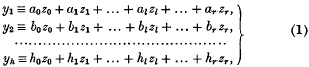
whose coefficients are undetermined; and I take the remaining H ≥ 0 linear forms to be assigned, namely the forms
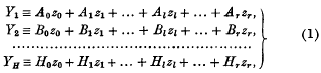
whose coefficients are assigned.
PSP volume 29 issue 2 Cover and Back matter
-
- Journal:
- Mathematical Proceedings of the Cambridge Philosophical Society / Volume 29 / Issue 2 / May 1933
- Published online by Cambridge University Press:
- 24 October 2008, pp. b1-b2
- Print publication:
- May 1933
-
- Article
-
- You have access
- Export citation
The densities of the regular polytopes, Part 3*
-
- Journal:
- Mathematical Proceedings of the Cambridge Philosophical Society / Volume 29 / Issue 1 / January 1933
- Published online by Cambridge University Press:
- 24 October 2008, pp. 1-22
- Print publication:
- January 1933
-
- Article
- Export citation
Planar threefolds in space of four dimensions
-
- Journal:
- Mathematical Proceedings of the Cambridge Philosophical Society / Volume 29 / Issue 1 / January 1933
- Published online by Cambridge University Press:
- 24 October 2008, pp. 103-115
- Print publication:
- January 1933
-
- Article
- Export citation
-
1. It is known that, in [3], a ruled surface of order n and genus p has in general a double curve of order ½ (n − 1) (n − 2) − p and genus ½ (n − 5) (n + 2p − 2) + 1, 2(n + 2p − 2) torsal generators, 2(n − 2)(n − 3) − 2(n − 6)p generators which touch the double curve, and
 triple points.
 triple points.
Surface motion of sputtered particles
-
- Journal:
- Mathematical Proceedings of the Cambridge Philosophical Society / Volume 29 / Issue 1 / January 1933
- Published online by Cambridge University Press:
- 24 October 2008, pp. 131-135
- Print publication:
- January 1933
-
- Article
- Export citation
Asymptotic expansions of the expressions for the partition function and the rotational specific heat of a rigid polyatomic molecule for high temperatures
-
- Journal:
- Mathematical Proceedings of the Cambridge Philosophical Society / Volume 29 / Issue 1 / January 1933
- Published online by Cambridge University Press:
- 24 October 2008, pp. 142-148
- Print publication:
- January 1933
-
- Article
- Export citation
-
The partition function F(θ) is of fundamental importance in the theory of the specific heat of gases. Once it is known, the rotational specific heat of a perfect gas is given by

where R is the gram-molecular gas constant, and θ bears the relation

to the absolute temperature T, k being Boltzmann's constant.


