Refine search
Actions for selected content:
26203 results in Theoretical Physics and Mathematical Physics
The algebraic surfaces contained by a cubic primal in four dimensions
-
- Journal:
- Mathematical Proceedings of the Cambridge Philosophical Society / Volume 29 / Issue 4 / 30 October 1933
- Published online by Cambridge University Press:
- 24 October 2008, pp. 484-486
- Print publication:
- 30 October 1933
-
- Article
- Export citation
PSP volume 29 issue 4 Cover and Back matter
-
- Journal:
- Mathematical Proceedings of the Cambridge Philosophical Society / Volume 29 / Issue 4 / 30 October 1933
- Published online by Cambridge University Press:
- 24 October 2008, pp. b1-b10
- Print publication:
- 30 October 1933
-
- Article
-
- You have access
- Export citation
Non-continuous interaction between hosts and parasites
-
- Journal:
- Mathematical Proceedings of the Cambridge Philosophical Society / Volume 29 / Issue 4 / 30 October 1933
- Published online by Cambridge University Press:
- 24 October 2008, pp. 487-491
- Print publication:
- 30 October 1933
-
- Article
- Export citation
Homogeneous variables in classical dynamics
-
- Journal:
- Mathematical Proceedings of the Cambridge Philosophical Society / Volume 29 / Issue 3 / 30 July 1933
- Published online by Cambridge University Press:
- 24 October 2008, pp. 389-400
- Print publication:
- 30 July 1933
-
- Article
- Export citation
PSP volume 29 issue 3 Cover and Back matter
-
- Journal:
- Mathematical Proceedings of the Cambridge Philosophical Society / Volume 29 / Issue 3 / 30 July 1933
- Published online by Cambridge University Press:
- 24 October 2008, pp. b1-b2
- Print publication:
- 30 July 1933
-
- Article
-
- You have access
- Export citation
The exact difference equation of the first order
-
- Journal:
- Mathematical Proceedings of the Cambridge Philosophical Society / Volume 29 / Issue 3 / 30 July 1933
- Published online by Cambridge University Press:
- 24 October 2008, pp. 373-381
- Print publication:
- 30 July 1933
-
- Article
- Export citation
On the transformation of certain singular surfaces
-
- Journal:
- Mathematical Proceedings of the Cambridge Philosophical Society / Volume 29 / Issue 3 / 30 July 1933
- Published online by Cambridge University Press:
- 24 October 2008, pp. 319-330
- Print publication:
- 30 July 1933
-
- Article
- Export citation
Bisecant curves of ruled surfaces
-
- Journal:
- Mathematical Proceedings of the Cambridge Philosophical Society / Volume 29 / Issue 3 / 30 July 1933
- Published online by Cambridge University Press:
- 24 October 2008, pp. 382-388
- Print publication:
- 30 July 1933
-
- Article
- Export citation
-
The bisecant curves of a ruled surface, that is to say the curves on the surface which meet each generator in two points, are fundamental in the consideration of the normal space of the ruled surface. It is well known that if
 is a bisecant curve of order ν and genus π on a ruled surface of order N and genus P, then
provided that the curve
has no double points which count twice as intersections of a generator of the ruled surface.
 is a bisecant curve of order
The deflection of a cantilever bar rotated under end load
-
- Journal:
- Mathematical Proceedings of the Cambridge Philosophical Society / Volume 29 / Issue 3 / 30 July 1933
- Published online by Cambridge University Press:
- 24 October 2008, pp. 423-439
- Print publication:
- 30 July 1933
-
- Article
- Export citation
Rational normal octavic surfaces with a double line, in space of five dimensions: Addition
-
- Journal:
- Mathematical Proceedings of the Cambridge Philosophical Society / Volume 29 / Issue 3 / 30 July 1933
- Published online by Cambridge University Press:
- 24 October 2008, pp. 405-406
- Print publication:
- 30 July 1933
-
- Article
- Export citation
-
In a recent paper in these Proceedings on the rational normal octavic surfaces with a double line in [5] I found four such surfaces,
 , and
, and  representable on a plane respectively by the systems of curves C5 (22, 19), C6(26, 14), and C7 (3, 28), with the base points in each case lying on an elliptic cubic. Inadvertently I overlooked a solution of certain indeterminate equations which leads to a fifth type
  represented by the plane system C9(38, 1).
 , and
, and  representable on a plane respectively by the systems of curves
  represented by the plane system
 Diagonal matrices
-
- Journal:
- Mathematical Proceedings of the Cambridge Philosophical Society / Volume 29 / Issue 3 / 30 July 1933
- Published online by Cambridge University Press:
- 24 October 2008, pp. 347-372
- Print publication:
- 30 July 1933
-
- Article
- Export citation
The rotational specific heat of a polyatomic molecule for high temperatures—correction
-
- Journal:
- Mathematical Proceedings of the Cambridge Philosophical Society / Volume 29 / Issue 3 / 30 July 1933
- Published online by Cambridge University Press:
- 24 October 2008, p. 407
- Print publication:
- 30 July 1933
-
- Article
- Export citation
-
I am indebted to Mr L. Kassel of the Department of Commerce, U.S.A., for pointing out an error of computation in a recent paper in these Proceedings.
The asymptotic expansion for the partition function should read

where

A constant deviation X-ray vacuum monochromator
-
- Journal:
- Mathematical Proceedings of the Cambridge Philosophical Society / Volume 29 / Issue 3 / 30 July 1933
- Published online by Cambridge University Press:
- 24 October 2008, pp. 408-416
- Print publication:
- 30 July 1933
-
- Article
- Export citation
Note on thermal instability in cylindrical condensers due to dielectric losses
-
- Journal:
- Mathematical Proceedings of the Cambridge Philosophical Society / Volume 29 / Issue 3 / 30 July 1933
- Published online by Cambridge University Press:
- 24 October 2008, pp. 401-404
- Print publication:
- 30 July 1933
-
- Article
- Export citation
A representation of [k]'s of [m] by points of [(m − k) (k + 1)]
-
- Journal:
- Mathematical Proceedings of the Cambridge Philosophical Society / Volume 29 / Issue 3 / 30 July 1933
- Published online by Cambridge University Press:
- 24 October 2008, pp. 331-346
- Print publication:
- 30 July 1933
-
- Article
- Export citation
-
The algebraical foundation of this representation is very simple: it depends on the theorem
If a coordinate system in [m] is given, then in a general [k] of the [m] a unique set of k + 1 points can be found whose coordinates form the scheme
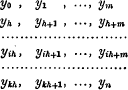
where h = m − k − 1, and n = (m − k)(k + 1) = kh + m.
PSP volume 29 issue 3 Cover and Front matter
-
- Journal:
- Mathematical Proceedings of the Cambridge Philosophical Society / Volume 29 / Issue 3 / 30 July 1933
- Published online by Cambridge University Press:
- 24 October 2008, pp. f1-f2
- Print publication:
- 30 July 1933
-
- Article
-
- You have access
- Export citation
An experiment on dispersion
-
- Journal:
- Mathematical Proceedings of the Cambridge Philosophical Society / Volume 29 / Issue 3 / 30 July 1933
- Published online by Cambridge University Press:
- 24 October 2008, pp. 417-422
- Print publication:
- 30 July 1933
-
- Article
- Export citation
The general double integral problem in the calculus of variations
-
- Journal:
- Mathematical Proceedings of the Cambridge Philosophical Society / Volume 29 / Issue 2 / May 1933
- Published online by Cambridge University Press:
- 24 October 2008, pp. 207-211
- Print publication:
- May 1933
-
- Article
- Export citation
-
In a previous paper in these Proceedings the problem of the double integral

was discussed when the function F had the form

where

It is proposed in the present paper to extend the method to the general problem, where F may have any form provided only that it satisfies the necessary condition of being homogeneous of the first degree in A, B, C.
On Gauss's proof of the normal law of errors
-
- Journal:
- Mathematical Proceedings of the Cambridge Philosophical Society / Volume 29 / Issue 2 / May 1933
- Published online by Cambridge University Press:
- 24 October 2008, pp. 231-234
- Print publication:
- May 1933
-
- Article
- Export citation
Related quadrics and systems of a rational quartic curve
-
- Journal:
- Mathematical Proceedings of the Cambridge Philosophical Society / Volume 29 / Issue 2 / May 1933
- Published online by Cambridge University Press:
- 24 October 2008, pp. 195-206
- Print publication:
- May 1933
-
- Article
- Export citation
