Refine search
Actions for selected content:
26203 results in Theoretical Physics and Mathematical Physics
PSP volume 30 issue 1 Cover and Front matter
-
- Journal:
- Mathematical Proceedings of the Cambridge Philosophical Society / Volume 30 / Issue 1 / January 1934
- Published online by Cambridge University Press:
- 24 October 2008, pp. f1-f2
- Print publication:
- January 1934
-
- Article
-
- You have access
- Export citation
On the regularity of surfaces
-
- Journal:
- Mathematical Proceedings of the Cambridge Philosophical Society / Volume 30 / Issue 1 / January 1934
- Published online by Cambridge University Press:
- 24 October 2008, pp. 4-14
- Print publication:
- January 1934
-
- Article
- Export citation
Some calculations on the range-velocity relation for alpha particles and protons
-
- Journal:
- Mathematical Proceedings of the Cambridge Philosophical Society / Volume 30 / Issue 1 / January 1934
- Published online by Cambridge University Press:
- 24 October 2008, pp. 102-113
- Print publication:
- January 1934
-
- Article
- Export citation
The adsorption of hydrogen on tungsten
-
- Journal:
- Mathematical Proceedings of the Cambridge Philosophical Society / Volume 30 / Issue 1 / January 1934
- Published online by Cambridge University Press:
- 24 October 2008, pp. 74-79
- Print publication:
- January 1934
-
- Article
- Export citation
The Cauchy property of the generalised Perron intergrals
-
- Journal:
- Mathematical Proceedings of the Cambridge Philosophical Society / Volume 30 / Issue 1 / January 1934
- Published online by Cambridge University Press:
- 24 October 2008, pp. 15-18
- Print publication:
- January 1934
-
- Article
- Export citation
-
1. Saks calls an integral complete if it satisfies two conditions, of which one, the condition (C), is as follows.
If f(x) is defined in (a, b) and is integrable in each interval (a + ε, b − η), where a < a + ε < b − η < b, and
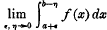
exists, then f(x) is integrable in (a, b) and the integral over (a, b) is equal to the above limit.
A note on the theory of the photo-electric current across a metal semi-conductor contact
-
- Journal:
- Mathematical Proceedings of the Cambridge Philosophical Society / Volume 30 / Issue 1 / January 1934
- Published online by Cambridge University Press:
- 24 October 2008, pp. 55-58
- Print publication:
- January 1934
-
- Article
- Export citation
An attempt to detect radiation in thunder clouds
-
- Journal:
- Mathematical Proceedings of the Cambridge Philosophical Society / Volume 30 / Issue 1 / January 1934
- Published online by Cambridge University Press:
- 24 October 2008, pp. 70-73
- Print publication:
- January 1934
-
- Article
- Export citation
On the projection of irregular linearly measurable plane sets of points
-
- Journal:
- Mathematical Proceedings of the Cambridge Philosophical Society / Volume 30 / Issue 1 / January 1934
- Published online by Cambridge University Press:
- 24 October 2008, pp. 47-54
- Print publication:
- January 1934
-
- Article
- Export citation
Modern algebra and polynomial ideals
-
- Journal:
- Mathematical Proceedings of the Cambridge Philosophical Society / Volume 30 / Issue 1 / January 1934
- Published online by Cambridge University Press:
- 24 October 2008, pp. 27-46
- Print publication:
- January 1934
-
- Article
- Export citation
A general canonical expression
-
- Journal:
- Mathematical Proceedings of the Cambridge Philosophical Society / Volume 29 / Issue 4 / 30 October 1933
- Published online by Cambridge University Press:
- 24 October 2008, pp. 465-469
- Print publication:
- 30 October 1933
-
- Article
- Export citation
The scattering of electrons by nitrogen molecules
-
- Journal:
- Mathematical Proceedings of the Cambridge Philosophical Society / Volume 29 / Issue 4 / 30 October 1933
- Published online by Cambridge University Press:
- 24 October 2008, pp. 511-521
- Print publication:
- 30 October 1933
-
- Article
- Export citation
Statement of Accounts of the Cambridge Philosophical Society, from January 1, 1932, to December 31, 1932
-
- Journal:
- Mathematical Proceedings of the Cambridge Philosophical Society / Volume 29 / Issue 4 / 30 October 1933
- Published online by Cambridge University Press:
- 24 October 2008, pp. 545-546
- Print publication:
- 30 October 1933
-
- Article
- Export citation
On the combination of subalgebras
-
- Journal:
- Mathematical Proceedings of the Cambridge Philosophical Society / Volume 29 / Issue 4 / 30 October 1933
- Published online by Cambridge University Press:
- 24 October 2008, pp. 441-464
- Print publication:
- 30 October 1933
-
- Article
- Export citation
The testing of statistical hypotheses in relation to probabilities a priori
-
- Journal:
- Mathematical Proceedings of the Cambridge Philosophical Society / Volume 29 / Issue 4 / 30 October 1933
- Published online by Cambridge University Press:
- 24 October 2008, pp. 492-510
- Print publication:
- 30 October 1933
-
- Article
- Export citation
On the stability of the three-phase synchronous motor
-
- Journal:
- Mathematical Proceedings of the Cambridge Philosophical Society / Volume 29 / Issue 4 / 30 October 1933
- Published online by Cambridge University Press:
- 24 October 2008, pp. 528-535
- Print publication:
- 30 October 1933
-
- Article
- Export citation
-
A three-phase star-connected alternating-current motor of simplest type, connected to busbars maintained at sinusoidal potentials e1, e2 and e3 with respect to the star-point and connected to a shaft load which exerts a reactive torque f on the rotor, is dynamically specified by the following functions:
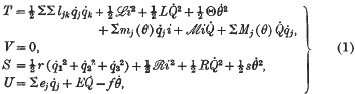
where the
 are the armature currents in the three phases, i is the current in the amortisseur circuit, Q the current in the field circuit, θ the rotor position angle, T the kinetic energy, V the potential energy, S the Rayleigh dissipation and U the activity of the external forces on the machine. The self-inductances of the armature circuits and the mutual inductances between them are assumed to be constant.
 are the armature currents in the three phases,
 Reality distinctions for the rational twisted quartic
-
- Journal:
- Mathematical Proceedings of the Cambridge Philosophical Society / Volume 29 / Issue 4 / 30 October 1933
- Published online by Cambridge University Press:
- 24 October 2008, pp. 470-477
- Print publication:
- 30 October 1933
-
- Article
- Export citation
Proceedings at the Meetings held during the Session 1932—1933: Annual General Meeting
-
- Journal:
- Mathematical Proceedings of the Cambridge Philosophical Society / Volume 29 / Issue 4 / 30 October 1933
- Published online by Cambridge University Press:
- 24 October 2008, pp. 536-545
- Print publication:
- 30 October 1933
-
- Article
- Export citation
The surface ionisation of potassium on molybdenum
-
- Journal:
- Mathematical Proceedings of the Cambridge Philosophical Society / Volume 29 / Issue 4 / 30 October 1933
- Published online by Cambridge University Press:
- 24 October 2008, pp. 522-527
- Print publication:
- 30 October 1933
-
- Article
- Export citation
The normal rational septimic surface with two skew double lines in space of four dimensions
-
- Journal:
- Mathematical Proceedings of the Cambridge Philosophical Society / Volume 29 / Issue 4 / 30 October 1933
- Published online by Cambridge University Press:
- 24 October 2008, pp. 478-483
- Print publication:
- 30 October 1933
-
- Article
- Export citation
PSP volume 29 issue 4 Cover and Front matter
-
- Journal:
- Mathematical Proceedings of the Cambridge Philosophical Society / Volume 29 / Issue 4 / 30 October 1933
- Published online by Cambridge University Press:
- 24 October 2008, pp. f1-f2
- Print publication:
- 30 October 1933
-
- Article
-
- You have access
- Export citation
