Refine search
Actions for selected content:
26203 results in Theoretical Physics and Mathematical Physics
Some chains of theorems derived by successive projection
-
- Journal:
- Mathematical Proceedings of the Cambridge Philosophical Society / Volume 29 / Issue 1 / January 1933
- Published online by Cambridge University Press:
- 24 October 2008, pp. 45-51
- Print publication:
- January 1933
-
- Article
- Export citation
The equilibrium of atoms and ions adsorbed on a metal surface
-
- Journal:
- Mathematical Proceedings of the Cambridge Philosophical Society / Volume 29 / Issue 1 / January 1933
- Published online by Cambridge University Press:
- 24 October 2008, pp. 161-164
- Print publication:
- January 1933
-
- Article
- Export citation
Configurations defined by six lines in space of three dimensions
-
- Journal:
- Mathematical Proceedings of the Cambridge Philosophical Society / Volume 29 / Issue 1 / January 1933
- Published online by Cambridge University Press:
- 24 October 2008, pp. 52-68
- Print publication:
- January 1933
-
- Article
- Export citation
The upper limit of energy in the β-ray spectrum of actinium B
-
- Journal:
- Mathematical Proceedings of the Cambridge Philosophical Society / Volume 29 / Issue 1 / January 1933
- Published online by Cambridge University Press:
- 24 October 2008, pp. 156-160
- Print publication:
- January 1933
-
- Article
- Export citation
The reflexion of light at a surface covered by a monomolecular film
-
- Journal:
- Mathematical Proceedings of the Cambridge Philosophical Society / Volume 29 / Issue 1 / January 1933
- Published online by Cambridge University Press:
- 24 October 2008, pp. 116-130
- Print publication:
- January 1933
-
- Article
- Export citation
On the prior probability in the theory of sampling
-
- Journal:
- Mathematical Proceedings of the Cambridge Philosophical Society / Volume 29 / Issue 1 / January 1933
- Published online by Cambridge University Press:
- 24 October 2008, pp. 83-87
- Print publication:
- January 1933
-
- Article
- Export citation
PSP volume 29 issue 1 Cover and Back matter
-
- Journal:
- Mathematical Proceedings of the Cambridge Philosophical Society / Volume 29 / Issue 1 / January 1933
- Published online by Cambridge University Press:
- 24 October 2008, pp. b1-b2
- Print publication:
- January 1933
-
- Article
-
- You have access
- Export citation
Rational normal octavic surfaces with a double line, in space of five dimensions
-
- Journal:
- Mathematical Proceedings of the Cambridge Philosophical Society / Volume 29 / Issue 1 / January 1933
- Published online by Cambridge University Press:
- 24 October 2008, pp. 95-102
- Print publication:
- January 1933
-
- Article
- Export citation
-
The following paper arises from a remark in a recent paper by Professor Baker. In that paper he gives a simple rule, under which a rational surface has a multiple line, expressed in terms of the system of plane curves which represent the prime sections of the surface. The rule is that, if one system of representing curves is given by an equation of the form

the surface being given, in space (x0, x1,…, xr), by the equations

then the surface contains the line

corresponding to the curve φ = 0; and if the curve φ = 0 has genus q, this line is of multiplicity q + 1.
PSP volume 29 issue 1 Cover and Front matter
-
- Journal:
- Mathematical Proceedings of the Cambridge Philosophical Society / Volume 29 / Issue 1 / January 1933
- Published online by Cambridge University Press:
- 24 October 2008, pp. f1-f2
- Print publication:
- January 1933
-
- Article
-
- You have access
- Export citation
Degenerate surfaces in higher space
-
- Journal:
- Mathematical Proceedings of the Cambridge Philosophical Society / Volume 29 / Issue 1 / January 1933
- Published online by Cambridge University Press:
- 24 October 2008, pp. 88-94
- Print publication:
- January 1933
-
- Article
- Export citation
The spectrum of the self-adjoint partial differential equation in any domain
-
- Journal:
- Mathematical Proceedings of the Cambridge Philosophical Society / Volume 29 / Issue 1 / January 1933
- Published online by Cambridge University Press:
- 24 October 2008, pp. 23-44
- Print publication:
- January 1933
-
- Article
- Export citation
-
The object of this paper is to obtain the general solution to the self-adjoint partial differential equation in n dimensions

where pij, q and ρ and bounded, continuous functions of (x1,…, xn) in a domain D and on its boundary, and where ∑pijXiXj≥0 for all (x1,…, xn) of D and all X1,…, Xn. The domain D is an n-dimensional domain and may be either the whole or part of a Riemann surface space of n dimensions. Its boundary is to consist of any number, zero, finite or enumerable, of continuous continua of n − 1 dimensions. These terms will be explained in paragraph II. The solution u = u(x1,…, xn; t) will be valid for (x1,…, xn) in D and t ≥ 0, and will satisfy boundary conditions of the type
 or similar, these conditions becoming identical at any part of the boundary of D that lies at infinity.

 or similar, these conditions becoming identical at any part of the boundary of
 Some comments on the relation between ionisation and ionisation current in gases at high pressures
-
- Journal:
- Mathematical Proceedings of the Cambridge Philosophical Society / Volume 29 / Issue 1 / January 1933
- Published online by Cambridge University Press:
- 24 October 2008, pp. 149-155
- Print publication:
- January 1933
-
- Article
- Export citation
The sum of powers as canonical expression
-
- Journal:
- Mathematical Proceedings of the Cambridge Philosophical Society / Volume 29 / Issue 1 / January 1933
- Published online by Cambridge University Press:
- 24 October 2008, pp. 69-82
- Print publication:
- January 1933
-
- Article
- Export citation
-
1. In this paper I discuss the expression of the general form F of order n, homogeneous in r + 1 variables z0, z1,…, zl,…, zr, as the sum of the nth powers of h + H linear forms in these variables. I take h (> 0) of these linear forms to be undetermined, namely the forms
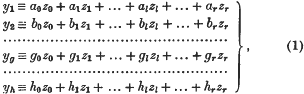
whose coefficients are undetermined; and I take the remaining H(≥0) linear forms to be assigned, namely the forms

whose coefficients are assigned.

Some observations on the theory of interchange of vibrational and translational energy
-
- Journal:
- Mathematical Proceedings of the Cambridge Philosophical Society / Volume 29 / Issue 1 / January 1933
- Published online by Cambridge University Press:
- 24 October 2008, pp. 136-141
- Print publication:
- January 1933
-
- Article
- Export citation
Three related quartic curves in four dimensions
-
- Journal:
- Mathematical Proceedings of the Cambridge Philosophical Society / Volume 28 / Issue 4 / October 1932
- Published online by Cambridge University Press:
- 24 October 2008, pp. 403-415
- Print publication:
- October 1932
-
- Article
- Export citation
Some factors in the design of hot cathode X-ray tubes for steady running
-
- Journal:
- Mathematical Proceedings of the Cambridge Philosophical Society / Volume 28 / Issue 4 / October 1932
- Published online by Cambridge University Press:
- 24 October 2008, pp. 497-508
- Print publication:
- October 1932
-
- Article
- Export citation
The emission of positive ions from hot tungsten
-
- Journal:
- Mathematical Proceedings of the Cambridge Philosophical Society / Volume 28 / Issue 4 / October 1932
- Published online by Cambridge University Press:
- 24 October 2008, pp. 490-496
- Print publication:
- October 1932
-
- Article
- Export citation
Extension of a theorem of C. G. F. James
-
- Journal:
- Mathematical Proceedings of the Cambridge Philosophical Society / Volume 28 / Issue 4 / October 1932
- Published online by Cambridge University Press:
- 24 October 2008, pp. 421-426
- Print publication:
- October 1932
-
- Article
- Export citation
-
The linear subspaces [k] of a space [n] have been represented by Grassmann by the points of a rational locus V(n−k)(k+1), of dimension (n−k)(k+1), in
 ; the representation is effected by taking as independent homogeneous coordinates of a [k] in [n] the
  determinants of order k+1 which belong to the matrix, of k+1 rows and n+1 columns, formed by the co-ordinates of any k+1 linearly independent points of the [k].
 ; the representation is effected by taking as independent homogeneous coordinates of a [
 determinants of order
 On double integrals in the calculus of variations
-
- Journal:
- Mathematical Proceedings of the Cambridge Philosophical Society / Volume 28 / Issue 4 / October 1932
- Published online by Cambridge University Press:
- 24 October 2008, pp. 442-454
- Print publication:
- October 1932
-
- Article
- Export citation
-
The problem of the double integral in the calculus of variations, when expressed in the parametric notation, was first fully discussed by Kobb. In this paper Kobb finds conditions for the minimising of the double integral

taken over the surface

Additional note on plane congruences and fifth incidence theorems
-
- Journal:
- Mathematical Proceedings of the Cambridge Philosophical Society / Volume 28 / Issue 4 / October 1932
- Published online by Cambridge University Press:
- 24 October 2008, pp. 416-420
- Print publication:
- October 1932
-
- Article
- Export citation
