Refine search
Actions for selected content:
26203 results in Theoretical Physics and Mathematical Physics
PSP volume 28 issue 3 Cover and Front matter
-
- Journal:
- Mathematical Proceedings of the Cambridge Philosophical Society / Volume 28 / Issue 3 / July 1932
- Published online by Cambridge University Press:
- 24 October 2008, pp. f1-f2
- Print publication:
- July 1932
-
- Article
- Export citation
Inverse probability and the use of Likelihood
-
- Journal:
- Mathematical Proceedings of the Cambridge Philosophical Society / Volume 28 / Issue 3 / July 1932
- Published online by Cambridge University Press:
- 24 October 2008, pp. 257-261
- Print publication:
- July 1932
-
- Article
- Export citation
The motion of electrons in the field of excited, helium
-
- Journal:
- Mathematical Proceedings of the Cambridge Philosophical Society / Volume 28 / Issue 3 / July 1932
- Published online by Cambridge University Press:
- 24 October 2008, pp. 341-348
- Print publication:
- July 1932
-
- Article
- Export citation
The number of apparent double points of certain loci
-
- Journal:
- Mathematical Proceedings of the Cambridge Philosophical Society / Volume 28 / Issue 3 / July 1932
- Published online by Cambridge University Press:
- 24 October 2008, pp. 285-299
- Print publication:
- July 1932
-
- Article
- Export citation
-
1. A sketch of the first part of this paper, together with some of the second part, was first written out in October last, shortly after the publication of Mr Babbage's paper, A series of rational loci with one apparent double point. It is well known that the Del Pezzo quintic surface
 the only non-ruled quintic surface in [5], has one apparent double point; Babbage shows that this surface is a member of a series of loci
  in [2n + 1], each of which has one apparent double point; he establishes the existence of these loci from their representations on flat spaces ∑n, these representations being analogous to the plane representation of
  by means of cubic curves through four fixed points.
 the only non-ruled quintic surface in [5], has one apparent double point; Babbage shows that this surface is a member of a series of loci
  in [2
in [2 by means of cubic curves through four fixed points.
The interaction of lattice vibrations and free electrons in metals
-
- Journal:
- Mathematical Proceedings of the Cambridge Philosophical Society / Volume 28 / Issue 3 / July 1932
- Published online by Cambridge University Press:
- 24 October 2008, pp. 367-385
- Print publication:
- July 1932
-
- Article
- Export citation
A measurement of Boltzmann's constant by means of the fluctuations of electron pressure in a conductor
-
- Journal:
- Mathematical Proceedings of the Cambridge Philosophical Society / Volume 28 / Issue 3 / July 1932
- Published online by Cambridge University Press:
- 24 October 2008, pp. 386-402
- Print publication:
- July 1932
-
- Article
- Export citation
On the Riemann zeta-function
-
- Journal:
- Mathematical Proceedings of the Cambridge Philosophical Society / Volume 28 / Issue 3 / July 1932
- Published online by Cambridge University Press:
- 24 October 2008, pp. 273-274
- Print publication:
- July 1932
-
- Article
- Export citation
-
It was proved by Littlewood that, for every large positive T, ζ (s) has a zero β + iγ satisfying
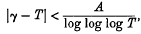
where A is an absolute constant.
On Boole's operational solution of linear finite difference equations with rational coefficients
-
- Journal:
- Mathematical Proceedings of the Cambridge Philosophical Society / Volume 28 / Issue 3 / July 1932
- Published online by Cambridge University Press:
- 24 October 2008, pp. 311-318
- Print publication:
- July 1932
-
- Article
- Export citation
A note on integral functions
-
- Journal:
- Mathematical Proceedings of the Cambridge Philosophical Society / Volume 28 / Issue 3 / July 1932
- Published online by Cambridge University Press:
- 24 October 2008, pp. 262-265
- Print publication:
- July 1932
-
- Article
- Export citation
-
1. Let f(z) denote an integral function of finite order ρ. We write
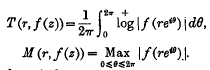
It has been shown that

where hρ is a constant which depends only on ρ. We are naturally led to enquire whether some equation of the form (1.1) may be true with lim sup replaced by lim inf. In this note we show that the reverse is true. We construct an integral function of zero order for which

The proof may easily be modified to construct a function of any finite order or of infinite order for which (1.2) is satisfied.
Some surfaces containing triple curves
-
- Journal:
- Mathematical Proceedings of the Cambridge Philosophical Society / Volume 28 / Issue 3 / July 1932
- Published online by Cambridge University Press:
- 24 October 2008, pp. 300-310
- Print publication:
- July 1932
-
- Article
- Export citation
A note on analytic functions in the unit circle
-
- Journal:
- Mathematical Proceedings of the Cambridge Philosophical Society / Volume 28 / Issue 3 / July 1932
- Published online by Cambridge University Press:
- 24 October 2008, pp. 266-272
- Print publication:
- July 1932
-
- Article
- Export citation
-
1. Let

be a function regular for |z| < 1. We say that u belongs to the class Lp (p > 0) if
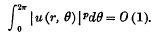
It has been proved by M. Riesz that, for p > 1, if u(r, θ) belongs to Lp, so does v (r, θ). Littlewood and later Hardy and Littlewood have shown that for 0 < p < 1 the theorem is no longer true: there exists an f(z) such that u(r, θ) belongs to every L1−ε and v(r, θ) belongs to no Lε(0 < ε < 1). The proof was based on the theorem (due to F. Riesz) that if, for an ε > 0, we have

then
 f(reiθ) exists for almost every θ.

Absorption measurements and the continuous spectrum of β-rays
-
- Journal:
- Mathematical Proceedings of the Cambridge Philosophical Society / Volume 28 / Issue 3 / July 1932
- Published online by Cambridge University Press:
- 24 October 2008, pp. 319-327
- Print publication:
- July 1932
-
- Article
- Export citation
A mathematical theory of natural and artificial selection. Part IX. Rapid selection
-
- Journal:
- Mathematical Proceedings of the Cambridge Philosophical Society / Volume 28 / Issue 2 / April 1932
- Published online by Cambridge University Press:
- 24 October 2008, pp. 244-248
- Print publication:
- April 1932
-
- Article
- Export citation
Note on the trisecants and quadrisecants of a space curve
-
- Journal:
- Mathematical Proceedings of the Cambridge Philosophical Society / Volume 28 / Issue 2 / April 1932
- Published online by Cambridge University Press:
- 24 October 2008, pp. 206-208
- Print publication:
- April 1932
-
- Article
- Export citation
-
1. Formulae obtained by enumerative methods are always liable to break down owing to the appearance of an infinity of degenerate solutions, and when this happens it is usually necessary to make a fresh start. Enumerative arguments have been used to prove the two following results for a curve
 of order n and genus p in space of three dimensions:
(i) The order of the ruled surface formed by trisecant lines of the curve is
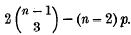
(ii) The number of quadrisecant lines is

 of order
On the canonical curve of genus five
-
- Journal:
- Mathematical Proceedings of the Cambridge Philosophical Society / Volume 28 / Issue 2 / April 1932
- Published online by Cambridge University Press:
- 24 October 2008, pp. 174-189
- Print publication:
- April 1932
-
- Article
- Export citation
On the non-linear difference equation Δxn = kΦ (xn)
-
- Journal:
- Mathematical Proceedings of the Cambridge Philosophical Society / Volume 28 / Issue 2 / April 1932
- Published online by Cambridge University Press:
- 24 October 2008, pp. 234-243
- Print publication:
- April 1932
-
- Article
- Export citation
-
1. Among the equations arising in the theory of natural selection is the finite difference equation
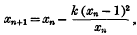
where k is a constant which may have any value between 1 and − ∞ inclusive, but is often small. Its solution is discussed in the accompanying paper(1). It is a particular case of the equation

where Φ(x) is a known one-valued function of x. When k is small this may obviously be solved approximately by treating it as a differential equation

whence


An integral equation
-
- Journal:
- Mathematical Proceedings of the Cambridge Philosophical Society / Volume 28 / Issue 2 / April 1932
- Published online by Cambridge University Press:
- 24 October 2008, pp. 165-173
- Print publication:
- April 1932
-
- Article
- Export citation
-
1. The integral equation

where x, f (x), and λ are real and α positive, may be regarded as a differential equation of order α. Suppose for example that α is a positive integer p, that f (x) tends to 0, when x → ∞, with sufficient rapidity, and that

Then, if we integrate repeatedly by parts, and write z for fp (x), (1·1) becomes

The only solutions are finite combinations of exponentials.

PSP volume 28 issue 2 Cover and Back matter
-
- Journal:
- Mathematical Proceedings of the Cambridge Philosophical Society / Volume 28 / Issue 2 / April 1932
- Published online by Cambridge University Press:
- 24 October 2008, pp. b1-b2
- Print publication:
- April 1932
-
- Article
- Export citation
PSP volume 28 issue 2 Cover, Front matter and Corrigenda
-
- Journal:
- Mathematical Proceedings of the Cambridge Philosophical Society / Volume 28 / Issue 2 / April 1932
- Published online by Cambridge University Press:
- 24 October 2008, pp. f1-f3
- Print publication:
- April 1932
-
- Article
- Export citation
The energy exchanges between molecules
-
- Journal:
- Mathematical Proceedings of the Cambridge Philosophical Society / Volume 28 / Issue 2 / April 1932
- Published online by Cambridge University Press:
- 24 October 2008, pp. 249-255
- Print publication:
- April 1932
-
- Article
- Export citation
