Refine search
Actions for selected content:
26203 results in Theoretical Physics and Mathematical Physics
The disintegration of boron by α-particles
-
- Journal:
- Mathematical Proceedings of the Cambridge Philosophical Society / Volume 30 / Issue 4 / October 1934
- Published online by Cambridge University Press:
- 24 October 2008, pp. 549-560
- Print publication:
- October 1934
-
- Article
- Export citation
Corrigendum
-
- Journal:
- Mathematical Proceedings of the Cambridge Philosophical Society / Volume 30 / Issue 4 / October 1934
- Published online by Cambridge University Press:
- 24 October 2008, p. 567
- Print publication:
- October 1934
-
- Article
-
- You have access
- Export citation
The Cantor manifolds lying on a closed surface
-
- Journal:
- Mathematical Proceedings of the Cambridge Philosophical Society / Volume 30 / Issue 4 / October 1934
- Published online by Cambridge University Press:
- 24 October 2008, pp. 428-444
- Print publication:
- October 1934
-
- Article
- Export citation
On isolated singularities of surfaces which do not affect the conditions of adjunction (Part II.)
-
- Journal:
- Mathematical Proceedings of the Cambridge Philosophical Society / Volume 30 / Issue 4 / October 1934
- Published online by Cambridge University Press:
- 24 October 2008, pp. 460-465
- Print publication:
- October 1934
-
- Article
- Export citation
Die lokale Struktur der ebenen Cantorschen Mannigfaltigkeiten
-
- Journal:
- Mathematical Proceedings of the Cambridge Philosophical Society / Volume 30 / Issue 4 / October 1934
- Published online by Cambridge University Press:
- 24 October 2008, pp. 445-452
- Print publication:
- October 1934
-
- Article
- Export citation
The application of wave-mechanics to reactions involving hydrogen and diplogen
-
- Journal:
- Mathematical Proceedings of the Cambridge Philosophical Society / Volume 30 / Issue 4 / October 1934
- Published online by Cambridge University Press:
- 24 October 2008, pp. 508-513
- Print publication:
- October 1934
-
- Article
- Export citation
Proceedings at the Meetings Held During the Session 1933–1934: Annual General Meeting
-
- Journal:
- Mathematical Proceedings of the Cambridge Philosophical Society / Volume 30 / Issue 4 / October 1934
- Published online by Cambridge University Press:
- 24 October 2008, pp. 568-579
- Print publication:
- October 1934
-
- Article
- Export citation
On isolated singularities of surfaces which do not affect the conditions of adjunction (Part I.)
-
- Journal:
- Mathematical Proceedings of the Cambridge Philosophical Society / Volume 30 / Issue 4 / October 1934
- Published online by Cambridge University Press:
- 24 October 2008, pp. 453-459
- Print publication:
- October 1934
-
- Article
- Export citation
On the minimum modulus of integral functions
-
- Journal:
- Mathematical Proceedings of the Cambridge Philosophical Society / Volume 30 / Issue 4 / October 1934
- Published online by Cambridge University Press:
- 24 October 2008, pp. 412-420
- Print publication:
- October 1934
-
- Article
- Export citation
-
1·1. Let f (z) be an integral function of order ρ, and let

It is well known that, if ρ < 1,
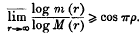
This result was first conjectured by Littlewood, who proved it with cos 2πρ in place of cosπρ; it was afterwards proved independently by Wiman and Valiron about the same time. Many other authors have written on the subject, considering among other things the set of valves of r for which m (r) is comparatively large.
The 6 × 6 Latin squares
-
- Journal:
- Mathematical Proceedings of the Cambridge Philosophical Society / Volume 30 / Issue 4 / October 1934
- Published online by Cambridge University Press:
- 24 October 2008, pp. 492-507
- Print publication:
- October 1934
-
- Article
- Export citation
Some experimental investigations of the polarisation of downcoming wireless waves
-
- Journal:
- Mathematical Proceedings of the Cambridge Philosophical Society / Volume 30 / Issue 4 / October 1934
- Published online by Cambridge University Press:
- 24 October 2008, pp. 540-542
- Print publication:
- October 1934
-
- Article
- Export citation
The capture of electrons by positive ions from neutral gas atoms
-
- Journal:
- Mathematical Proceedings of the Cambridge Philosophical Society / Volume 30 / Issue 4 / October 1934
- Published online by Cambridge University Press:
- 24 October 2008, pp. 514-519
- Print publication:
- October 1934
-
- Article
- Export citation
Improvements to the “scale of two” thyratron counter
-
- Journal:
- Mathematical Proceedings of the Cambridge Philosophical Society / Volume 30 / Issue 4 / October 1934
- Published online by Cambridge University Press:
- 24 October 2008, pp. 543-548
- Print publication:
- October 1934
-
- Article
- Export citation
PSP volume 30 issue 4 Cover and Front matter
-
- Journal:
- Mathematical Proceedings of the Cambridge Philosophical Society / Volume 30 / Issue 4 / October 1934
- Published online by Cambridge University Press:
- 24 October 2008, pp. f1-f2
- Print publication:
- October 1934
-
- Article
-
- You have access
- Export citation
An extension of a fundamental theorem in the theory of surfaces
-
- Journal:
- Mathematical Proceedings of the Cambridge Philosophical Society / Volume 30 / Issue 4 / October 1934
- Published online by Cambridge University Press:
- 24 October 2008, pp. 409-411
- Print publication:
- October 1934
-
- Article
- Export citation
On isolated singularities of surfaces which do not affect the conditions of adjunction (Part III.)
-
- Journal:
- Mathematical Proceedings of the Cambridge Philosophical Society / Volume 30 / Issue 4 / October 1934
- Published online by Cambridge University Press:
- 24 October 2008, pp. 483-491
- Print publication:
- October 1934
-
- Article
- Export citation
-
In the second part of this paper I pointed out how the presence of any singular point or points of the kind considered in the first part, on a rational surface, corresponds to a subgroup of the group of symmetry of the polytope which represents the properties of the system of base points in the plane representation of the surface. The subgroup is generated by reflexions, and may be the direct product of one or more factors (all the primes of symmetry in one factor being perpendicular to all those in any other factor). Each factor corresponds to a singular point on the surface, namely (in Coxeter's notation), a factor [ ] to a conic node C2, a factor [3n] to a binode Bn+2 (n ≥ 1), a factor [3n,1,1] to a unode Un+5, (n ≥ 1), and finally a factor [3n,2,1] to a unode
 The possible subgroups in the finite groups that arise have been enumerated by Coxeter; and we shall find that every subgroup generated by reflexions in the group of symmetry of the polytope in ε dimensions which represents ε base points corresponds to a possible configuration of the base points, in which just those rational curves of grade − 2 are actual which correspond to primes of symmetry belonging to the subgroup; without exception, for ε ≤ 6; with one exception—the subgroup [ ]7—for ε = 7; and with three exceptions—the subgroups [ ]7, [ ]8, and [31,1,1 × [ ]4—for ε = 8. Since moreover the system |k| of cubics passing simply through all the base points is in all these cases an actually existing system, for which all the rational curves of grade − 2 are fundamental, its projective model (or in the case ε = 8, in which |k| is only a pencil, the projective model of the system |2k|) provides a rational surface on which all the sets of curves corresponding to the subgroups in question actually appear as singular points.
 The possible subgroups in the finite groups that arise have been enumerated by Coxeter; and we shall find that every subgroup generated by reflexions in the group of symmetry of the polytope in ε dimensions which represents ε base points corresponds to a possible configuration of the base points, in which just those rational curves of grade − 2 are actual which correspond to primes of symmetry belonging to the subgroup; without exception, for ε ≤ 6; with one exception—the subgroup [ ]
Statement of Accounts of the Cambridge Philosophical Society, from January 1, 1933, to December 31, 1933
-
- Journal:
- Mathematical Proceedings of the Cambridge Philosophical Society / Volume 30 / Issue 4 / October 1934
- Published online by Cambridge University Press:
- 24 October 2008, pp. 580-581
- Print publication:
- October 1934
-
- Article
- Export citation
On the operational solution of linear mixed difference differential equations
-
- Journal:
- Mathematical Proceedings of the Cambridge Philosophical Society / Volume 30 / Issue 4 / October 1934
- Published online by Cambridge University Press:
- 24 October 2008, pp. 389-391
- Print publication:
- October 1934
-
- Article
- Export citation
On quadrics poristically related to a rational norm curve
-
- Journal:
- Mathematical Proceedings of the Cambridge Philosophical Society / Volume 30 / Issue 4 / October 1934
- Published online by Cambridge University Press:
- 24 October 2008, pp. 381-388
- Print publication:
- October 1934
-
- Article
- Export citation
The effect of exchange on the polarisation of electrons by double scattering
-
- Journal:
- Mathematical Proceedings of the Cambridge Philosophical Society / Volume 30 / Issue 4 / October 1934
- Published online by Cambridge University Press:
- 24 October 2008, pp. 520-523
- Print publication:
- October 1934
-
- Article
- Export citation
