Refine search
Actions for selected content:
26203 results in Theoretical Physics and Mathematical Physics
The Virial Theorem and the Theory of Strong Electrolytes
-
- Journal:
- Mathematical Proceedings of the Cambridge Philosophical Society / Volume 31 / Issue 2 / April 1935
- Published online by Cambridge University Press:
- 24 October 2008, pp. 281-284
- Print publication:
- April 1935
-
- Article
- Export citation
The Number of Free Electrons in a Metal
-
- Journal:
- Mathematical Proceedings of the Cambridge Philosophical Society / Volume 31 / Issue 2 / April 1935
- Published online by Cambridge University Press:
- 24 October 2008, pp. 277-280
- Print publication:
- April 1935
-
- Article
- Export citation
A Statistical Derivation of Langmuir's Adsorption Isotherm
-
- Journal:
- Mathematical Proceedings of the Cambridge Philosophical Society / Volume 31 / Issue 2 / April 1935
- Published online by Cambridge University Press:
- 24 October 2008, pp. 260-264
- Print publication:
- April 1935
-
- Article
- Export citation
-
The commonest form of Langmuir's adsorption isotherm is

where θ is the fraction of the surface of the solid covered by adsorbed molecules, p the gas pressure in equilibrium with the adsorbed layer and A = A (T) a function of the temperature alone. This formula is usually derived by a kinetic argument which balances the rates of deposition and re-evaporation. It is perhaps not without interest to show that formula (1) and similar formulae can be obtained directly by the usual statistical methods which evaluate all the properties of the equilibrium state of any assembly. The ordinary derivation is apt to obscure the essentially thermodynamic character of (1) and to lead one to think that its form depends on the precise mechanisms of deposition and re-evaporation, whereas in fact it depends only on the whole set of states, adsorbed and free, accessible to the molecules in question. By suitable use of the usual technique for handling assemblies obeying the Fermi-Dirac statistics the saturation effect can be naturally incorporated in the theory ab initio.
Geometrical Properties of Three Symmetric Matrices
-
- Journal:
- Mathematical Proceedings of the Cambridge Philosophical Society / Volume 31 / Issue 2 / April 1935
- Published online by Cambridge University Press:
- 24 October 2008, pp. 174-182
- Print publication:
- April 1935
-
- Article
- Export citation
-
In the early editions of the Geometry of Three Dimensions Salmon had stated that the equations of any three quadric surfaces could be simultaneously reduced to the sums of five squares. Such a reduction is not possible in general, but can be performed if and only if a certain combinant Λ, of the net of quadrics, vanishes. Algebraically the theory of such a net of quadrics is equivalent, as Hesse(2) showed, to that of a plane quartic curve: and the condition for the equation a quartic to be expressible to the sum of five fourth powers is equivalent to the condition Λ = 0(1). While Clebsch(3) was the first to establish this condition, Lüroth(4) gave it more explicit form by studying the quartic curve
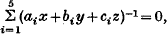
which satisfies the condition. Frahm(5) seems to have been the first to prove the impossibility of the above reduction of three general quadric surfaces, by remarking that the plane quartic curve obtained in Hesse's way from the locus of the vertices of cones of the net of quadrics would be a Lüroth quartic. Frahm further remarked that the three quadrics, so conditioned, could be regarded as the polar quadrics belonging to a cubic surface in ∞2 ways; but that for three general quadrics no such cubic surface exists. An explicit algebraical account of these properties was given by E. Toeplitz(6), who incidentally noticed that certain linear complexes associated with three general quadrics became special linear complexes when Λ = 0. This polar property of three quadrics in [3] was generalized to n dimensions by Anderson (7).
The Mass of the Neutrino
-
- Journal:
- Mathematical Proceedings of the Cambridge Philosophical Society / Volume 31 / Issue 2 / April 1935
- Published online by Cambridge University Press:
- 24 October 2008, pp. 285-290
- Print publication:
- April 1935
-
- Article
- Export citation
The Electronic Structure of

-
- Journal:
- Mathematical Proceedings of the Cambridge Philosophical Society / Volume 31 / Issue 2 / April 1935
- Published online by Cambridge University Press:
- 24 October 2008, pp. 244-259
- Print publication:
- April 1935
-
- Article
- Export citation
-
The molecular-orbital method has been applied to a study of
in its ground state and excited levels, and the relative importance of the perturbation and variational methods has been considered in some detail, as well as the effect of certain integrals which, in discussions of molecular structure, have often been neglected. It appears that the ion should exist in stable equilateral form with a nuclear distance about 0·85 Å., and that all excited levels are unstable.Reasons are given for supposing that the molecule H3 is linear and not triangular.

Limitations of Crystal Symmetry on Physical Phenomena with Particular Reference to Diamagnetic Magnetostriction
-
- Journal:
- Mathematical Proceedings of the Cambridge Philosophical Society / Volume 31 / Issue 2 / April 1935
- Published online by Cambridge University Press:
- 24 October 2008, pp. 265-270
- Print publication:
- April 1935
-
- Article
- Export citation
An Apparatus for Recording Average Amplitudes of Wireless Echoes
-
- Journal:
- Mathematical Proceedings of the Cambridge Philosophical Society / Volume 31 / Issue 2 / April 1935
- Published online by Cambridge University Press:
- 24 October 2008, pp. 295-302
- Print publication:
- April 1935
-
- Article
- Export citation
The Effect of Non-Normality on the t Distribution
-
- Journal:
- Mathematical Proceedings of the Cambridge Philosophical Society / Volume 31 / Issue 2 / April 1935
- Published online by Cambridge University Press:
- 24 October 2008, pp. 223-231
- Print publication:
- April 1935
-
- Article
- Export citation
Note on the Equilibrium of Black-Body Radiation
-
- Journal:
- Mathematical Proceedings of the Cambridge Philosophical Society / Volume 31 / Issue 2 / April 1935
- Published online by Cambridge University Press:
- 24 October 2008, pp. 242-243
- Print publication:
- April 1935
-
- Article
- Export citation
The Genus of a Developable Surface
-
- Journal:
- Mathematical Proceedings of the Cambridge Philosophical Society / Volume 31 / Issue 2 / April 1935
- Published online by Cambridge University Press:
- 24 October 2008, pp. 156-158
- Print publication:
- April 1935
-
- Article
- Export citation
A Note on the Hall and Magneto-Resistance Effects
-
- Journal:
- Mathematical Proceedings of the Cambridge Philosophical Society / Volume 31 / Issue 2 / April 1935
- Published online by Cambridge University Press:
- 24 October 2008, pp. 271-276
- Print publication:
- April 1935
-
- Article
- Export citation
PSP volume 31 issue 2 Cover and Back matter
-
- Journal:
- Mathematical Proceedings of the Cambridge Philosophical Society / Volume 31 / Issue 2 / April 1935
- Published online by Cambridge University Press:
- 24 October 2008, pp. b1-b2
- Print publication:
- April 1935
-
- Article
- Export citation
Some Types of Irregular Surfaces
-
- Journal:
- Mathematical Proceedings of the Cambridge Philosophical Society / Volume 31 / Issue 2 / April 1935
- Published online by Cambridge University Press:
- 24 October 2008, pp. 159-173
- Print publication:
- April 1935
-
- Article
- Export citation
Cauchy's Problem in a Non-Linear Partial Differential Equation of Hyperbolic Type
-
- Journal:
- Mathematical Proceedings of the Cambridge Philosophical Society / Volume 31 / Issue 2 / April 1935
- Published online by Cambridge University Press:
- 24 October 2008, pp. 195-202
- Print publication:
- April 1935
-
- Article
- Export citation
-
Let p (x) be an essentially positive function defined in the interval 0 ≤ x ≤ π. We consider the non-linear partial differential equation
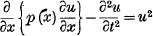
for the boundary conditions u (x, t) = 0,
for x = 0 and x = π,

Some Theorems on Abelian Integrals Associated with an Algebraic Variety
-
- Journal:
- Mathematical Proceedings of the Cambridge Philosophical Society / Volume 31 / Issue 1 / January 1935
- Published online by Cambridge University Press:
- 24 October 2008, pp. 18-25
- Print publication:
- January 1935
-
- Article
- Export citation
-
1. In some recent papers I have developed the theory of what I have called harmonic integrals associated with an algebraic variety. My object has been to provide an apparatus with which to investigate the properties of the classical integrals
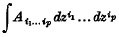
of total differentials which are finite everywhere on an algebraic variety Vm of m dimensions

These integrals are referred to in what follows as “Abelian integrals”, as it is desirable to have a single name to denote all integrals of this type. The usual qualification “of the first kind” is omitted, and is always to be understood. In the present paper it is shown how the theory of harmonic integrals can be applied to deduce certain results concerning Abelian integrals, and a number of interesting problems are suggested by these results.
Further Investigations of the Amplitude Variations of Downcoming Wireless Waves
-
- Journal:
- Mathematical Proceedings of the Cambridge Philosophical Society / Volume 31 / Issue 1 / January 1935
- Published online by Cambridge University Press:
- 24 October 2008, pp. 125-144
- Print publication:
- January 1935
-
- Article
- Export citation
Note on a Paper of Bell and Wolfenden on Electrolytic Separation of Diplogen
-
- Journal:
- Mathematical Proceedings of the Cambridge Philosophical Society / Volume 31 / Issue 1 / January 1935
- Published online by Cambridge University Press:
- 24 October 2008, pp. 116-118
- Print publication:
- January 1935
-
- Article
- Export citation
The Resultant of Two Fourier Kernels
-
- Journal:
- Mathematical Proceedings of the Cambridge Philosophical Society / Volume 31 / Issue 1 / January 1935
- Published online by Cambridge University Press:
- 24 October 2008, pp. 1-6
- Print publication:
- January 1935
-
- Article
- Export citation
-
1. A “Fourier kernel” means here a function K(x) which gives rise to a formula

of the Fourier type. Thus

are Fourier kernels. If K(x) is a Fourier kernel, λ is real, and a positive, then

are Fourier kernels.
On the Resolution of Cremona Transformations and particularly those of Genus One in Space of Three Dimensions
-
- Journal:
- Mathematical Proceedings of the Cambridge Philosophical Society / Volume 31 / Issue 1 / January 1935
- Published online by Cambridge University Press:
- 24 October 2008, pp. 31-47
- Print publication:
- January 1935
-
- Article
- Export citation
