Refine search
Actions for selected content:
26203 results in Theoretical Physics and Mathematical Physics
Pair Production by Magnetic Multipole Radiation
-
- Journal:
- Mathematical Proceedings of the Cambridge Philosophical Society / Volume 31 / Issue 4 / October 1935
- Published online by Cambridge University Press:
- 24 October 2008, pp. 609-611
- Print publication:
- October 1935
-
- Article
- Export citation
On the Asymptotic Periods of Integral Functions
-
- Journal:
- Mathematical Proceedings of the Cambridge Philosophical Society / Volume 31 / Issue 4 / October 1935
- Published online by Cambridge University Press:
- 24 October 2008, pp. 543-554
- Print publication:
- October 1935
-
- Article
- Export citation
-
A period of a function f(z) is defined to be a number ω (≠ 0) such that

is identically zero; and it can be shown that an integral function may either have no periods or else a single sequence kλ (k = ± 1, ± 2, …).
On Positive Harmonic Functions in a Half-Plane
-
- Journal:
- Mathematical Proceedings of the Cambridge Philosophical Society / Volume 31 / Issue 4 / October 1935
- Published online by Cambridge University Press:
- 24 October 2008, pp. 482-507
- Print publication:
- October 1935
-
- Article
- Export citation
-
1. Let ξ, η denote the rectangular Cartesian coordinates of a point in a plane. Let J (ξ, η) denote a harmonic function which is positive in the half-plane η > 0. In this paper, we first show (Theorem I) that every such function J determines a non-negative number d, and a bounded non-diminishing function G(x), such that

Statement of Accounts of the Cambridge Philosophical Society, from January 1, 1934, to December 31, 1934
-
- Journal:
- Mathematical Proceedings of the Cambridge Philosophical Society / Volume 31 / Issue 4 / October 1935
- Published online by Cambridge University Press:
- 24 October 2008, pp. 638-639
- Print publication:
- October 1935
-
- Article
- Export citation
Note Introductory to the Study of Klein's Group of Order 168
-
- Journal:
- Mathematical Proceedings of the Cambridge Philosophical Society / Volume 31 / Issue 4 / October 1935
- Published online by Cambridge University Press:
- 24 October 2008, pp. 468-481
- Print publication:
- October 1935
-
- Article
- Export citation
PSP volume 31 issue 4 Cover and Back matter
-
- Journal:
- Mathematical Proceedings of the Cambridge Philosophical Society / Volume 31 / Issue 4 / October 1935
- Published online by Cambridge University Press:
- 24 October 2008, pp. b1-b11
- Print publication:
- October 1935
-
- Article
-
- You have access
- Export citation
The Gliding of a Plate on a Stream of Finite Depth
-
- Journal:
- Mathematical Proceedings of the Cambridge Philosophical Society / Volume 31 / Issue 4 / October 1935
- Published online by Cambridge University Press:
- 24 October 2008, pp. 589-603
- Print publication:
- October 1935
-
- Article
- Export citation
Proceedings at the Meetings Held During the Session 1934—1935: Annual General Meeting
-
- Journal:
- Mathematical Proceedings of the Cambridge Philosophical Society / Volume 31 / Issue 4 / October 1935
- Published online by Cambridge University Press:
- 24 October 2008, pp. 629-637
- Print publication:
- October 1935
-
- Article
- Export citation
On the Real Zeros of a certain Trigonometric Function
-
- Journal:
- Mathematical Proceedings of the Cambridge Philosophical Society / Volume 31 / Issue 4 / October 1935
- Published online by Cambridge University Press:
- 24 October 2008, pp. 455-467
- Print publication:
- October 1935
-
- Article
- Export citation
-
Suppose that a, c and A are real, and that

Let n (X) be the number of zeros of

in
 ; then it is not difficult to prove that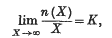
for some K = K (A, a, c, θ). The problem in this paper is to determine the function K explicitly in terms of its variables.
 ; then it is not difficult to prove that
The Double Excitation of Helium by Electron Impact
-
- Journal:
- Mathematical Proceedings of the Cambridge Philosophical Society / Volume 31 / Issue 4 / October 1935
- Published online by Cambridge University Press:
- 24 October 2008, pp. 604-608
- Print publication:
- October 1935
-
- Article
- Export citation
Note on the Flow past a Circular Cylinder
-
- Journal:
- Mathematical Proceedings of the Cambridge Philosophical Society / Volume 31 / Issue 4 / October 1935
- Published online by Cambridge University Press:
- 24 October 2008, pp. 585-588
- Print publication:
- October 1935
-
- Article
- Export citation
The Dissection of Closed Sets of Arbitrary Dimension and the Generalized Brouwer-Alexandroff Theorem
-
- Journal:
- Mathematical Proceedings of the Cambridge Philosophical Society / Volume 31 / Issue 4 / October 1935
- Published online by Cambridge University Press:
- 24 October 2008, pp. 525-535
- Print publication:
- October 1935
-
- Article
- Export citation
The Two Centre Problem in Wave Mechanics
-
- Journal:
- Mathematical Proceedings of the Cambridge Philosophical Society / Volume 31 / Issue 4 / October 1935
- Published online by Cambridge University Press:
- 24 October 2008, pp. 564-581
- Print publication:
- October 1935
-
- Article
- Export citation
Disintegration by slow Neutrons
-
- Journal:
- Mathematical Proceedings of the Cambridge Philosophical Society / Volume 31 / Issue 4 / October 1935
- Published online by Cambridge University Press:
- 24 October 2008, pp. 612-616
- Print publication:
- October 1935
-
- Article
- Export citation
-
All the light elements up to aluminium and some heavier ones have been examined for disintegration by slow neutrons. Large effects have been found in lithium and boron and a small effect in nitrogen, the reactions being
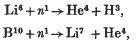
and probably

The charged particles emitted in the disintegration of lithium and boron afford a convenient and sensitive indicator for slow neutrons.
One of us (M. G.) desires to acknowledge the financial assistance received from the International Student Service, London, and from Magdalene College, Cambridge.
On Canonical Threefolds
-
- Journal:
- Mathematical Proceedings of the Cambridge Philosophical Society / Volume 31 / Issue 4 / October 1935
- Published online by Cambridge University Press:
- 24 October 2008, pp. 508-519
- Print publication:
- October 1935
-
- Article
- Export citation
On the Theory of Ionic Recombination: A Correction
-
- Journal:
- Mathematical Proceedings of the Cambridge Philosophical Society / Volume 31 / Issue 3 / July 1935
- Published online by Cambridge University Press:
- 24 October 2008, pp. 429-430
- Print publication:
- July 1935
-
- Article
- Export citation
The Uniqueness of a Certain Trigonometric Integral
-
- Journal:
- Mathematical Proceedings of the Cambridge Philosophical Society / Volume 31 / Issue 3 / July 1935
- Published online by Cambridge University Press:
- 24 October 2008, pp. 382-389
- Print publication:
- July 1935
-
- Article
- Export citation
-
Verblunsky has recently proved the following theorem:
Theorem A. Suppose that

for every positive σ. Write

and suppose that J (σ, x) is bounded in σ, x for σ > 0 and all x. Then

exists almost everywhere, and


almost everywhere.
The Temperature Dependence of the Photo-Electric Effect
-
- Journal:
- Mathematical Proceedings of the Cambridge Philosophical Society / Volume 31 / Issue 3 / July 1935
- Published online by Cambridge University Press:
- 24 October 2008, pp. 416-428
- Print publication:
- July 1935
-
- Article
- Export citation
-
The temperature dependence of the photo-electric effect with the image field is discussed, the result obtained agreeing with Fowler's T2 law near the threshold. Fowler's
 law is discussed, and shown to rest upon a mistake in the normalization of the free wave functions.
The two methods of analysing experimental results due to Fowler and Du Bridge are also discussed, and it is shown that in general the latter should give the more reliable results.
The author wishes to repeat his thanks to Prof. R. H. Fowler and to Mr A. H. Wilson for their constant interest in the work.
 law is discussed, and shown to rest upon a mistake in the normalization of the free wave functions.
A Note on the Surface Temperature of Sliding Metals
-
- Journal:
- Mathematical Proceedings of the Cambridge Philosophical Society / Volume 31 / Issue 3 / July 1935
- Published online by Cambridge University Press:
- 24 October 2008, pp. 431-432
- Print publication:
- July 1935
-
- Article
- Export citation
On the Effective Temperatures of Extended Photospheres
-
- Journal:
- Mathematical Proceedings of the Cambridge Philosophical Society / Volume 31 / Issue 3 / July 1935
- Published online by Cambridge University Press:
- 24 October 2008, pp. 390-393
- Print publication:
- July 1935
-
- Article
- Export citation
-
For material stratified in parallel planes in local thermodynamical equilibrium we have Milne's well-known result that

where πF is the constant net integrated flux of radiation, τ is the optical depth and B is the “ergiebigkeit” which is related to the temperature T by the relation

σ being the Stefan-Boltzmann constant. If we define the effective temperature by the relation

we have from (1)

where T1 is the temperature ar τ = 1. In this note we establish a similar result for extended photospheres where the curvature of the outer layers is properly taken into account.
