Refine search
Actions for selected content:
26203 results in Theoretical Physics and Mathematical Physics
On surfaces of sectional genus six
-
- Journal:
- Mathematical Proceedings of the Cambridge Philosophical Society / Volume 32 / Issue 3 / October 1936
- Published online by Cambridge University Press:
- 24 October 2008, pp. 355-365
- Print publication:
- October 1936
-
- Article
- Export citation
Statistical theory of adsorption with interaction between the adsorbed atoms
-
- Journal:
- Mathematical Proceedings of the Cambridge Philosophical Society / Volume 32 / Issue 3 / October 1936
- Published online by Cambridge University Press:
- 24 October 2008, pp. 471-476
- Print publication:
- October 1936
-
- Article
- Export citation
Probability relations between separated systems
-
- Journal:
- Mathematical Proceedings of the Cambridge Philosophical Society / Volume 32 / Issue 3 / October 1936
- Published online by Cambridge University Press:
- 24 October 2008, pp. 446-452
- Print publication:
- October 1936
-
- Article
- Export citation
Note on hyperelliptic surfaces and certain kummer surfaces
-
- Journal:
- Mathematical Proceedings of the Cambridge Philosophical Society / Volume 32 / Issue 3 / October 1936
- Published online by Cambridge University Press:
- 24 October 2008, pp. 342-354
- Print publication:
- October 1936
-
- Article
- Export citation
Second-order focusing for the mass spectrograph
-
- Journal:
- Mathematical Proceedings of the Cambridge Philosophical Society / Volume 32 / Issue 3 / October 1936
- Published online by Cambridge University Press:
- 24 October 2008, pp. 453-460
- Print publication:
- October 1936
-
- Article
- Export citation
Note on optical methods of measuring the size of small water drops
-
- Journal:
- Mathematical Proceedings of the Cambridge Philosophical Society / Volume 32 / Issue 3 / October 1936
- Published online by Cambridge University Press:
- 24 October 2008, pp. 493-498
- Print publication:
- October 1936
-
- Article
- Export citation
The magnetic properties of antimony
-
- Journal:
- Mathematical Proceedings of the Cambridge Philosophical Society / Volume 32 / Issue 3 / October 1936
- Published online by Cambridge University Press:
- 24 October 2008, pp. 499-502
- Print publication:
- October 1936
-
- Article
- Export citation
Boundary layer growth
-
- Journal:
- Mathematical Proceedings of the Cambridge Philosophical Society / Volume 32 / Issue 3 / October 1936
- Published online by Cambridge University Press:
- 24 October 2008, pp. 392-401
- Print publication:
- October 1936
-
- Article
- Export citation
An attempt to produce artificial radioactivity by an electron beam, with some notes on the behaviour of newly made Geiger-Muller counters
-
- Journal:
- Mathematical Proceedings of the Cambridge Philosophical Society / Volume 32 / Issue 3 / October 1936
- Published online by Cambridge University Press:
- 24 October 2008, pp. 503-505
- Print publication:
- October 1936
-
- Article
- Export citation
A theorem on algebraic correspondences
-
- Journal:
- Mathematical Proceedings of the Cambridge Philosophical Society / Volume 32 / Issue 3 / October 1936
- Published online by Cambridge University Press:
- 24 October 2008, pp. 337-341
- Print publication:
- October 1936
-
- Article
- Export citation
PSP volume 32 issue 2 Cover and Back matter
-
- Journal:
- Mathematical Proceedings of the Cambridge Philosophical Society / Volume 32 / Issue 2 / May 1936
- Published online by Cambridge University Press:
- 24 October 2008, pp. b1-b2
- Print publication:
- May 1936
-
- Article
-
- You have access
- Export citation
Transient Oscillations in a Loud-Speaker Horn
-
- Journal:
- Mathematical Proceedings of the Cambridge Philosophical Society / Volume 32 / Issue 2 / May 1936
- Published online by Cambridge University Press:
- 24 October 2008, pp. 265-275
- Print publication:
- May 1936
-
- Article
- Export citation
-
The steady state theory of sound propagation in exponential loud-speaker horns is well known. The problem of transients, however, has not been treated hitherto, so in this paper it is proposed to consider what happens when the air particles at the throat of the horn are suddenly set in motion. To avoid difficulties which arise in treating sound propagation in the horn when the linear dimensions of the cross-section are comparable with the wave-length of the sound, the following
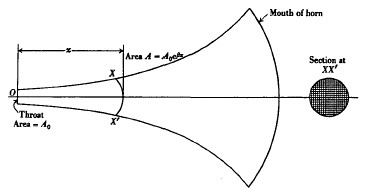
artifice is postulated. The axis of the horn is linear and the air column is divided up into a large number of frictionless conduits by very thin rigid partitions as indicated in Fig. 1. The cross-section of each conduit expands exponentially from the throat towards the mouth of the horn. The major linear dimension of the section of a conduit at the mouth is small in comparison with the wave-length of the highest frequency to be reproduced.
Abstract Definitions for the Symmetry Groups of the Regular Polytopes, in Terms of Two Generators. Part I: The Complete Groups
-
- Journal:
- Mathematical Proceedings of the Cambridge Philosophical Society / Volume 32 / Issue 2 / May 1936
- Published online by Cambridge University Press:
- 24 October 2008, pp. 194-200
- Print publication:
- May 1936
-
- Article
- Export citation
-
The groups of rotations that transform the regular polygons and polyhedra into themselves have. been studied for many years. Lately, increasing interest has been shown in the “extended” groups, which include reflections (and other congruent transformations of negative determinant). Todd has proved that every such group can be defined abstractly in the form

This group is denoted by [k1, k2, …, kn−1], and is the complete (extended) group of symmetries of either of the reciprocal n.-dimensional polytopes {k1, k2,…, kn−1}, {kn−1, kn−2,…, k1}. There is a sense in which these statements hold for arbitrarily large values of the k's. But here we are concerned only with the cases where the groups and the polytopes are finite. The finite groups are

[k] is simply isomorphic with the dihedral group of order 2k (e.g. [2], the Vierergruppe). [3, 3,…, 3] with n − 1 threes, or briefly [3n−1], is simply isomorphic with the symmetric group of order (n + 1)!.
On the Proof of a Lemma Enunciated by Severi
-
- Journal:
- Mathematical Proceedings of the Cambridge Philosophical Society / Volume 32 / Issue 2 / May 1936
- Published online by Cambridge University Press:
- 24 October 2008, pp. 253-259
- Print publication:
- May 1936
-
- Article
- Export citation
On the Fourier Constants of a Bounded Function
-
- Journal:
- Mathematical Proceedings of the Cambridge Philosophical Society / Volume 32 / Issue 2 / May 1936
- Published online by Cambridge University Press:
- 24 October 2008, pp. 201-211
- Print publication:
- May 1936
-
- Article
- Export citation
-
1. In a former paper we solved the following problem (Problem I). Given k + 1 real numbers co, …, ck, to find necessary and sufficient conditions that there shall exist a function f(x) in (0, 1) which satisfies the conditions

On the Geometrical Genus of Certain Surfaces
-
- Journal:
- Mathematical Proceedings of the Cambridge Philosophical Society / Volume 32 / Issue 2 / May 1936
- Published online by Cambridge University Press:
- 24 October 2008, pp. 185-193
- Print publication:
- May 1936
-
- Article
- Export citation
Note on the Gliding of a Plate on the Surface of a Stream
-
- Journal:
- Mathematical Proceedings of the Cambridge Philosophical Society / Volume 32 / Issue 2 / May 1936
- Published online by Cambridge University Press:
- 24 October 2008, pp. 248-252
- Print publication:
- May 1936
-
- Article
- Export citation
-
1. The gliding of bodies on the surface of water has received mathematical treatment by Wagner for both two- and three-dimensional cases. In this note, attention is confined to the two-dimensional gliding of a plane plate on a stream of infinite depth. Wagner's method is approximate and only applies when the angle of incidence of the gliding plate to the stream is small. He expresses such quantities as the total lift on the plate, not in terms of the total length of the plate, but in terms of the length of the pressure surface, which is the distance between the trailing edge of the plate and the point of stagnation. Further, his solution requires that the direction of the jet or spray which is formed should be parallel to the length of the plate. If Lis the total normal lift on the plate, β the small angle of incidence of the plate to the stream, V the velocity of the plate, δ the thickness of the spray and c the length of the pressure surface, then Wagner gives

The Electrical Resistance of Dilute Solid Solutions
-
- Journal:
- Mathematical Proceedings of the Cambridge Philosophical Society / Volume 32 / Issue 2 / May 1936
- Published online by Cambridge University Press:
- 24 October 2008, pp. 281-290
- Print publication:
- May 1936
-
- Article
- Export citation
-
1. As is well known, the electrical resistance of a metal is very greatly in-creased by the addition of a second metal with which it forms a solid solution. The increase Δρ in the resistivity due to the addition of a small percentage of the second metal is in general independent of the temperature (Matthiessen's rule), though there are oertain exceptions (e.g. Cr in Au). The quaritum-mechanical explanation of both these facts was first given by Nordheim, and may be expressed as follows: the electrical conductivity of any metal may be written in the form

where τ is the “time of relaxation”, equal to half the time between collisions, and N is the effective number of free electrons per unit volume: hence, for the resistivity, we have


Determination of the Energy Distribution of Recoil Atoms During β Decay and the Existence of the Neutrino
-
- Journal:
- Mathematical Proceedings of the Cambridge Philosophical Society / Volume 32 / Issue 2 / May 1936
- Published online by Cambridge University Press:
- 24 October 2008, pp. 301-303
- Print publication:
- May 1936
-
- Article
- Export citation
Elementary Theory of the Critical Field of a Dielectric
-
- Journal:
- Mathematical Proceedings of the Cambridge Philosophical Society / Volume 32 / Issue 2 / May 1936
- Published online by Cambridge University Press:
- 24 October 2008, pp. 276-280
- Print publication:
- May 1936
-
- Article
- Export citation
-
It is well known that the eigen-functions corresponding to the free electrons in a one-dimensional lattice are of the form
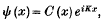
where C (x) is a periodic function with period c (the lattice constant), and Kis a continuous variable.
