Refine search
Actions for selected content:
26204 results in Theoretical Physics and Mathematical Physics
A note on the criterion of maximum overlapping of wave functions
-
- Journal:
- Mathematical Proceedings of the Cambridge Philosophical Society / Volume 33 / Issue 1 / March 1937
- Published online by Cambridge University Press:
- 24 October 2008, pp. 111-114
- Print publication:
- March 1937
-
- Article
- Export citation
PSP volume 33 issue 1 Cover and Back matter
-
- Journal:
- Mathematical Proceedings of the Cambridge Philosophical Society / Volume 33 / Issue 1 / March 1937
- Published online by Cambridge University Press:
- 24 October 2008, p. b1
- Print publication:
- March 1937
-
- Article
-
- You have access
- Export citation
Some properties of the vibrational spectrum of a lattice
-
- Journal:
- Mathematical Proceedings of the Cambridge Philosophical Society / Volume 33 / Issue 1 / March 1937
- Published online by Cambridge University Press:
- 24 October 2008, pp. 94-103
- Print publication:
- March 1937
-
- Article
- Export citation
Born's electrodynamics in complex form
-
- Journal:
- Mathematical Proceedings of the Cambridge Philosophical Society / Volume 33 / Issue 1 / March 1937
- Published online by Cambridge University Press:
- 24 October 2008, pp. 79-93
- Print publication:
- March 1937
-
- Article
- Export citation
A note on the absorbability in cadmium of neutrons slowed down in water and boric acid solutions
-
- Journal:
- Mathematical Proceedings of the Cambridge Philosophical Society / Volume 33 / Issue 1 / March 1937
- Published online by Cambridge University Press:
- 24 October 2008, pp. 137-139
- Print publication:
- March 1937
-
- Article
- Export citation
Some calculations on the diffusion of slow neutrons in hydrogenous media
-
- Journal:
- Mathematical Proceedings of the Cambridge Philosophical Society / Volume 33 / Issue 1 / March 1937
- Published online by Cambridge University Press:
- 24 October 2008, pp. 122-136
- Print publication:
- March 1937
-
- Article
- Export citation
Primary ionization in helium and hydrogen
-
- Journal:
- Mathematical Proceedings of the Cambridge Philosophical Society / Volume 33 / Issue 1 / March 1937
- Published online by Cambridge University Press:
- 24 October 2008, pp. 179-182
- Print publication:
- March 1937
-
- Article
- Export citation
The stability of viscous fluid flow between rotating cylinders
-
- Journal:
- Mathematical Proceedings of the Cambridge Philosophical Society / Volume 33 / Issue 1 / March 1937
- Published online by Cambridge University Press:
- 24 October 2008, pp. 41-61
- Print publication:
- March 1937
-
- Article
- Export citation
-
The stability of the motion of viscous incompressible fluid, of density ρ and kinematic viscosity ν, between two infinitely long coaxial circular cylinders, of radii a and a + d, where d/a is small, is investigated mathematically by the method of small oscillations. The inner cylinder is rotating with angular velocity ω and the outer one with angular velocity αω, and there is a constant pressure gradient parallel to the axis. The fluid therefore has a component velocity W parallel to the axis, in addition to the velocity round the axis. A disturbance is assumed which is symmetrical about the axis and periodic along it. The critical disturbance, which neither increases nor decreases with the time, is periodic with respect to the time (except when W = 0, when the critical disturbance is a steady motion). As Reynolds number of the flow we take |
 | d/ν, where is the average value of W across the annulus, and we denote by l the wave-length of the disturbance along the axis, by σ/2π the time period of the critical flow, by c the wavelength of the critical flow, by ωc the critical value of ω, and we put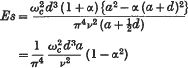
approximately, if α is not nearly equal to 1.
 |
| 
The evaluation of certain integrals occurring in studies of molecular structure
-
- Journal:
- Mathematical Proceedings of the Cambridge Philosophical Society / Volume 33 / Issue 1 / March 1937
- Published online by Cambridge University Press:
- 24 October 2008, pp. 104-110
- Print publication:
- March 1937
-
- Article
- Export citation
On the extension of the Pflastersatz (Part II)
-
- Journal:
- Mathematical Proceedings of the Cambridge Philosophical Society / Volume 33 / Issue 1 / March 1937
- Published online by Cambridge University Press:
- 24 October 2008, pp. 13-20
- Print publication:
- March 1937
-
- Article
- Export citation
On certain Cremona transformations in circle-space connected with the Miquel-Clifford configuration
-
- Journal:
- Mathematical Proceedings of the Cambridge Philosophical Society / Volume 33 / Issue 1 / March 1937
- Published online by Cambridge University Press:
- 24 October 2008, pp. 21-25
- Print publication:
- March 1937
-
- Article
- Export citation
A new group of action functions in the unitary field theory. II
-
- Journal:
- Mathematical Proceedings of the Cambridge Philosophical Society / Volume 33 / Issue 1 / March 1937
- Published online by Cambridge University Press:
- 24 October 2008, pp. 70-78
- Print publication:
- March 1937
-
- Article
- Export citation
PSP volume 33 issue 1 Cover and Front matter
-
- Journal:
- Mathematical Proceedings of the Cambridge Philosophical Society / Volume 33 / Issue 1 / March 1937
- Published online by Cambridge University Press:
- 24 October 2008, pp. f1-f2
- Print publication:
- March 1937
-
- Article
-
- You have access
- Export citation
The structure of a β-ray line by semicircular magnetic focusing
-
- Journal:
- Mathematical Proceedings of the Cambridge Philosophical Society / Volume 33 / Issue 1 / March 1937
- Published online by Cambridge University Press:
- 24 October 2008, pp. 164-178
- Print publication:
- March 1937
-
- Article
- Export citation
The lateral force on a keel and rudder
-
- Journal:
- Mathematical Proceedings of the Cambridge Philosophical Society / Volume 33 / Issue 1 / March 1937
- Published online by Cambridge University Press:
- 24 October 2008, pp. 62-69
- Print publication:
- March 1937
-
- Article
- Export citation
The optical reflectivity of metals in the supraconducting state
-
- Journal:
- Mathematical Proceedings of the Cambridge Philosophical Society / Volume 33 / Issue 1 / March 1937
- Published online by Cambridge University Press:
- 24 October 2008, pp. 140-144
- Print publication:
- March 1937
-
- Article
- Export citation
On a theorem of Paley and Wiener
-
- Journal:
- Mathematical Proceedings of the Cambridge Philosophical Society / Volume 33 / Issue 1 / March 1937
- Published online by Cambridge University Press:
- 24 October 2008, pp. 1-5
- Print publication:
- March 1937
-
- Article
- Export citation
The comparison of series of measures
-
- Journal:
- Mathematical Proceedings of the Cambridge Philosophical Society / Volume 33 / Issue 1 / March 1937
- Published online by Cambridge University Press:
- 24 October 2008, pp. 35-40
- Print publication:
- March 1937
-
- Article
- Export citation
On the excitation of a lithium atom by collision with a slow α-particle
-
- Journal:
- Mathematical Proceedings of the Cambridge Philosophical Society / Volume 33 / Issue 1 / March 1937
- Published online by Cambridge University Press:
- 24 October 2008, pp. 115-121
- Print publication:
- March 1937
-
- Article
- Export citation
-
It has been shown by Mott that it is legitimate in calculating the probability of excitation of an atom by close collision with a slow α-particle to treat the α-particle as a moving centre of force. This method gives for the probability P of excitation

where

and

On the theorem of Riemann-Roch
-
- Journal:
- Mathematical Proceedings of the Cambridge Philosophical Society / Volume 33 / Issue 1 / March 1937
- Published online by Cambridge University Press:
- 24 October 2008, pp. 26-34
- Print publication:
- March 1937
-
- Article
- Export citation
