Refine search
Actions for selected content:
26204 results in Theoretical Physics and Mathematical Physics
Note on an identity connected with diophantine approximation
-
- Journal:
- Mathematical Proceedings of the Cambridge Philosophical Society / Volume 34 / Issue 1 / January 1938
- Published online by Cambridge University Press:
- 24 October 2008, p. 27
- Print publication:
- January 1938
-
- Article
- Export citation
-
In discussing Hecke's function
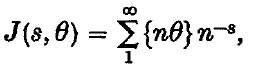
where {t} = t − [t] − ½ Hardy and Littlewood* made use of the identity

Here

θ is an irrational number between 0 and 1, and pν/qν is the νth convergent to θ (beginning with p0 = 0, q0 = 1). The proof of (1) given by Hardy and Littlewood is of an analytic character.
Lattice changes associated with the formation of superlattices in alloys
-
- Journal:
- Mathematical Proceedings of the Cambridge Philosophical Society / Volume 34 / Issue 1 / January 1938
- Published online by Cambridge University Press:
- 24 October 2008, pp. 81-88
- Print publication:
- January 1938
-
- Article
- Export citation
On the velocity and temperature distributions in the turbulent wake behind a heated body of revolution
-
- Journal:
- Mathematical Proceedings of the Cambridge Philosophical Society / Volume 34 / Issue 1 / January 1938
- Published online by Cambridge University Press:
- 24 October 2008, pp. 48-67
- Print publication:
- January 1938
-
- Article
- Export citation
-
The velocity distribution in the wake behind a body of revolution calculated by Miss Swain on the momentum transfer theory with l constant over a cross-section of the wake is not in accordance with experiment.
On the generalized vorticity transfer theory the equation for the first approximation to the velocity defect u far downstream is

There are two methods of simplifying this equation on the analogy of the successful simplification of the corresponding equation for the two-dimensional case. One method gives the same equation as if the turbulence were symmetrical; the other gives the equation of the modified vorticity transfer theory.
For the former there is no real solution if l is constant over a cross-section; for a real solution l must be infinite on the axis of symmetry. The equation was integrated with l ∝ r−1 over a cross-section; this variation of l was suggested by putting the change in the area enclosed by a circular vortex-line proportional to the area of the section of the wake. The agreement with experiment is fairly good over the middle portion of the wake, but not near the edge, where the theoretical value of ∂u/∂r is not zero. If l2 ∝ rp, ∂u/∂r vanishes at the edge of the wake only if p = − 3. The solution is carried through for this case; it shows only fair agreement with experiment over the middle of the wake, and none at the edge.
The calculation on the modified vorticity transfer theory is carried out with l constant over a section; in this case there is no definite edge to the wake, nor does u fall off sufficiently rapidly to make the momentum integral for the drag converge. (u ∝ r−2 for large r.) Even over the middle of the wake there is a discrepancy with experimental results, rather like that shown by the momentum transfer theory.
The temperature distribution behind a heated body was calculated according to each of the foregoing theories.
The temperature distribution was also calculated from the experimental velocity distribution, without any assumption being made concerning the kinematic coefficient of turbulent diffusion, which was eliminated between the equations for the velocity and temperature. The vorticity transfer theory with symmetrical turbulence gives an impossible result. The modified vorticity transfer theory gives θ/θmax < u/umax when the experimental velocity distribution is used.
PSP volume 34 issue 1 Cover and Front matter
-
- Journal:
- Mathematical Proceedings of the Cambridge Philosophical Society / Volume 34 / Issue 1 / January 1938
- Published online by Cambridge University Press:
- 24 October 2008, pp. f1-f2
- Print publication:
- January 1938
-
- Article
-
- You have access
- Export citation
The Hankel transform of Whittaker's function Wk, m(z)
-
- Journal:
- Mathematical Proceedings of the Cambridge Philosophical Society / Volume 34 / Issue 1 / January 1938
- Published online by Cambridge University Press:
- 24 October 2008, pp. 28-29
- Print publication:
- January 1938
-
- Article
- Export citation
-
The Hankel transform of a function x−½νf(x) can be determined by the help of the following rule, obtained for ν = 0, 1 by B. van der Pol and K. Niessen(1), for positive integral values of ν by K. Niessen(2), and for arbitrary values of ν, [R(ν) > − 1], by F. Tricomi(3). If*
F(p) ≒ f(x),
then

A “Scale-of-two” High-Speed Counter Using Hard Vacuum Triodes
-
- Journal:
- Mathematical Proceedings of the Cambridge Philosophical Society / Volume 33 / Issue 4 / October 1937
- Published online by Cambridge University Press:
- 24 October 2008, pp. 549-558
- Print publication:
- October 1937
-
- Article
- Export citation
Superconductors in Alternating Magnetic Fields
-
- Journal:
- Mathematical Proceedings of the Cambridge Philosophical Society / Volume 33 / Issue 4 / October 1937
- Published online by Cambridge University Press:
- 24 October 2008, pp. 559-576
- Print publication:
- October 1937
-
- Article
- Export citation
-
A method of studying magnetic properties in alternating fields and its application to the intermediate state of a superconducting sphere are described. It is shown that the behaviour of the sphere in alternating fields of frequencies between 10 and 100 is different from that in very slowly varying fields, the difference becoming less for lower frequencies and for smaller radius. When the specimen is in the intermediate state, energy losses are produced in it by the alternating field, showing that the induced currents are out of phase with the alternating field. The induced currents do not, however, flow in the same way as in a homogeneous isotropic conductor, and this is probably on account of an anisotropic structure of the specimen when in the intermediate state. This structure depends strongly on the amplitude of the alternating field in such a way that the effective average conductivity is increased with decreasing amplitude, and this amplitude effect depends on the size of the specimen. Evidence is given for a time lag in the magnetocaloric effect, and this time lag decreases with decrease of the size of the specimen, being of order
 sec. for a sphere of about 1 cm. diameter.
In conclusion I wish to thank Prof. Lord Rutherford and Dr Cockcroft for their interest in this work; Dr Peierls for suggesting the experiment and for much valuable advice and assistance; Mr Shire for advice on some technical points; and various members of the staff of the Royal Society Mond Laboratory for help in the measurements.
 sec. for a sphere of about 1 cm. diameter.
Two-Dimensional Potential Problems
-
- Journal:
- Mathematical Proceedings of the Cambridge Philosophical Society / Volume 33 / Issue 4 / October 1937
- Published online by Cambridge University Press:
- 24 October 2008, pp. 474-484
- Print publication:
- October 1937
-
- Article
- Export citation
An A.C. Method of Measuring Resistance
-
- Journal:
- Mathematical Proceedings of the Cambridge Philosophical Society / Volume 33 / Issue 4 / October 1937
- Published online by Cambridge University Press:
- 24 October 2008, pp. 577-582
- Print publication:
- October 1937
-
- Article
- Export citation
Specific Heats of Solids due to Molecular Rotations
-
- Journal:
- Mathematical Proceedings of the Cambridge Philosophical Society / Volume 33 / Issue 4 / October 1937
- Published online by Cambridge University Press:
- 24 October 2008, pp. 524-533
- Print publication:
- October 1937
-
- Article
- Export citation
The Dependence on Composition of the Critical Ordering Temperature in Alloys
-
- Journal:
- Mathematical Proceedings of the Cambridge Philosophical Society / Volume 33 / Issue 4 / October 1937
- Published online by Cambridge University Press:
- 24 October 2008, pp. 502-517
- Print publication:
- October 1937
-
- Article
- Export citation
Statement of Accounts of the Cambridge Philosophical Society, from January 1, 1936, to December 31, 1936
-
- Journal:
- Mathematical Proceedings of the Cambridge Philosophical Society / Volume 33 / Issue 4 / October 1937
- Published online by Cambridge University Press:
- 24 October 2008, pp. 595-596
- Print publication:
- October 1937
-
- Article
- Export citation
The Elastic Stability of a Corrugated Plate Under a Shearing Force
-
- Journal:
- Mathematical Proceedings of the Cambridge Philosophical Society / Volume 33 / Issue 4 / October 1937
- Published online by Cambridge University Press:
- 24 October 2008, pp. 459-473
- Print publication:
- October 1937
-
- Article
- Export citation
On the Smoothing of Observed Data
-
- Journal:
- Mathematical Proceedings of the Cambridge Philosophical Society / Volume 33 / Issue 4 / October 1937
- Published online by Cambridge University Press:
- 24 October 2008, pp. 444-450
- Print publication:
- October 1937
-
- Article
- Export citation
Note on the Invariants of the Canonical System of an Algebraic Variety
-
- Journal:
- Mathematical Proceedings of the Cambridge Philosophical Society / Volume 33 / Issue 4 / October 1937
- Published online by Cambridge University Press:
- 24 October 2008, pp. 438-443
- Print publication:
- October 1937
-
- Article
- Export citation
PSP volume 33 issue 4 Cover and Front matter
-
- Journal:
- Mathematical Proceedings of the Cambridge Philosophical Society / Volume 33 / Issue 4 / October 1937
- Published online by Cambridge University Press:
- 24 October 2008, pp. f1-f8
- Print publication:
- October 1937
-
- Article
-
- You have access
- Export citation
The Radioactivity Produced by the Bombardment of Lithium with Deuterons
-
- Journal:
- Mathematical Proceedings of the Cambridge Philosophical Society / Volume 33 / Issue 4 / October 1937
- Published online by Cambridge University Press:
- 24 October 2008, pp. 534-539
- Print publication:
- October 1937
-
- Article
- Export citation
-
In an investigation of the disintegration of
 by protons, resulting in the emission of three α-particles, Dee and Gilbert* found that the observed distributions of ranges and angles of these particles could be explained by assuming that one α-particle is first ejected, leaving a short-lived, excited
  nucleus which then decomposes into two more α-particles. The half-life of this excited beryllium nucleus was estimated to be about 10–21 sec.
 by protons, resulting in the emission of three α-particles, Dee and Gilbert* found that the observed distributions of ranges and angles of these particles could be explained by assuming that one α-particle is first ejected, leaving a short-lived, excited
  nucleus which then decomposes into two more α-particles. The half-life of this excited beryllium nucleus was estimated to be about 10
The Spectrum of the Normal Frequencies of a Polar Linear Lattice
-
- Journal:
- Mathematical Proceedings of the Cambridge Philosophical Society / Volume 33 / Issue 4 / October 1937
- Published online by Cambridge University Press:
- 24 October 2008, pp. 485-501
- Print publication:
- October 1937
-
- Article
- Export citation
The Application of the Electron Lens to Cloud Chamber Photography
-
- Journal:
- Mathematical Proceedings of the Cambridge Philosophical Society / Volume 33 / Issue 4 / October 1937
- Published online by Cambridge University Press:
- 24 October 2008, pp. 540-548
- Print publication:
- October 1937
-
- Article
- Export citation
Proceedings at the Meetings Held During the Session 1936–1937 Annual General Meeting
-
- Journal:
- Mathematical Proceedings of the Cambridge Philosophical Society / Volume 33 / Issue 4 / October 1937
- Published online by Cambridge University Press:
- 24 October 2008, pp. 586-591
- Print publication:
- October 1937
-
- Article
- Export citation
