Refine search
Actions for selected content:
26204 results in Theoretical Physics and Mathematical Physics
The Shot Effect for Showers
-
- Journal:
- Mathematical Proceedings of the Cambridge Philosophical Society / Volume 33 / Issue 4 / October 1937
- Published online by Cambridge University Press:
- 24 October 2008, pp. 451-458
- Print publication:
- October 1937
-
- Article
- Export citation
-
1. A well-known theorem on probability may be stated as follows. Let λdt be the chance that a certain event will happen in time dt, so that λT is the average number of occurrences of the event in an interval T. If we take a large number of repetitions of the interval T the actual numbers of occurrences will fluctuate about the mean λT, being say λT + x′, λT + x″,…. Then the theorem states that

The ejection of an α-particle by a radioactive substance is an event of the type contemplated and the theorem was applied to this physical problem by von Schweidler in 1905. Much similar work, both theoretical and experimental, has been done at intervals since then*.
Intersections of Loci on an Algebraic V4
-
- Journal:
- Mathematical Proceedings of the Cambridge Philosophical Society / Volume 33 / Issue 4 / October 1937
- Published online by Cambridge University Press:
- 24 October 2008, pp. 425-437
- Print publication:
- October 1937
-
- Article
- Export citation
Quelques Remarques à Propos D'Une Note De G. H. Hardy: The Resultant of two Fourier Kernels (1)
-
- Journal:
- Mathematical Proceedings of the Cambridge Philosophical Society / Volume 33 / Issue 4 / October 1937
- Published online by Cambridge University Press:
- 24 October 2008, pp. 413-418
- Print publication:
- October 1937
-
- Article
- Export citation
Note on a Theorem of Myrberg
-
- Journal:
- Mathematical Proceedings of the Cambridge Philosophical Society / Volume 33 / Issue 4 / October 1937
- Published online by Cambridge University Press:
- 24 October 2008, pp. 419-424
- Print publication:
- October 1937
-
- Article
- Export citation
Hopkins prize, Award, 1930–1933
-
- Journal:
- Mathematical Proceedings of the Cambridge Philosophical Society / Volume 33 / Issue 4 / October 1937
- Published online by Cambridge University Press:
- 24 October 2008, pp. 592-594
- Print publication:
- October 1937
-
- Article
- Export citation
The “Overshoot Phenomenon” in Superconductivity
-
- Journal:
- Mathematical Proceedings of the Cambridge Philosophical Society / Volume 33 / Issue 4 / October 1937
- Published online by Cambridge University Press:
- 24 October 2008, pp. 583-585
- Print publication:
- October 1937
-
- Article
- Export citation
The Statistics of the Hydrogen-Palladium System
-
- Journal:
- Mathematical Proceedings of the Cambridge Philosophical Society / Volume 33 / Issue 4 / October 1937
- Published online by Cambridge University Press:
- 24 October 2008, pp. 518-523
- Print publication:
- October 1937
-
- Article
- Export citation
The numerical calculation of

-
- Journal:
- Mathematical Proceedings of the Cambridge Philosophical Society / Volume 33 / Issue 3 / July 1937
- Published online by Cambridge University Press:
- 24 October 2008, pp. 359-362
- Print publication:
- July 1937
-
- Article
- Export citation
-
The type of integral considered,
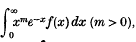 is of frequent occurrence in problems in the kinetic theory of gases and in particular is required in the paper which follows, in calculating viscosity. The result is an extension of one given by Berger, and the analysis follows closely the discussion of Gauss's formula for approximate quadrature in Whittaker and Robinson, The calculus of observations; the novelty lies in the use of Sonine polynomials, which are peculiarly well suited for the discussion of this type of integral.

 is of frequent occurrence in problems in the kinetic theory of gases and in particular is required in the paper which follows, in calculating viscosity. The result is an extension of one given by Berger, and the analysis follows closely the discussion of Gauss's formula for approximate quadrature in Whittaker and Robinson,
 On the canonical systems of certain algebraic surfaces
-
- Journal:
- Mathematical Proceedings of the Cambridge Philosophical Society / Volume 33 / Issue 3 / July 1937
- Published online by Cambridge University Press:
- 24 October 2008, pp. 311-314
- Print publication:
- July 1937
-
- Article
- Export citation
The effect of two isolated forces on the elastic stability of a flat rectangular plate
-
- Journal:
- Mathematical Proceedings of the Cambridge Philosophical Society / Volume 33 / Issue 3 / July 1937
- Published online by Cambridge University Press:
- 24 October 2008, pp. 325-339
- Print publication:
- July 1937
-
- Article
- Export citation
The theory of the single-pass cross-flow heat interchanger
-
- Journal:
- Mathematical Proceedings of the Cambridge Philosophical Society / Volume 33 / Issue 3 / July 1937
- Published online by Cambridge University Press:
- 24 October 2008, pp. 403-411
- Print publication:
- July 1937
-
- Article
- Export citation
Note on the derivation of fluctuation formulae for statistical assemblies
-
- Journal:
- Mathematical Proceedings of the Cambridge Philosophical Society / Volume 33 / Issue 3 / July 1937
- Published online by Cambridge University Press:
- 24 October 2008, pp. 390-393
- Print publication:
- July 1937
-
- Article
- Export citation
-
1. A familiar device in the study of statistical distributions is to form the moment-generating function
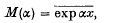
where the bar denotes averaging over all values of the statistical variate x. The moments μr of x are the coefficients of αr/r!, and the derived coefficients in the expansion of K ≡ log M are termed the semi-invariants kr. In particular,

and, for the normal (Gaussian) law,

we have the simple formula

A symmetrical configuration of n + 1 rational normal curves in [2n]
-
- Journal:
- Mathematical Proceedings of the Cambridge Philosophical Society / Volume 33 / Issue 3 / July 1937
- Published online by Cambridge University Press:
- 24 October 2008, pp. 293-300
- Print publication:
- July 1937
-
- Article
- Export citation
Regular canonical surfaces of genus three and four
-
- Journal:
- Mathematical Proceedings of the Cambridge Philosophical Society / Volume 33 / Issue 3 / July 1937
- Published online by Cambridge University Press:
- 24 October 2008, pp. 306-310
- Print publication:
- July 1937
-
- Article
- Export citation
The theory of the shot effect. II
-
- Journal:
- Mathematical Proceedings of the Cambridge Philosophical Society / Volume 33 / Issue 3 / July 1937
- Published online by Cambridge University Press:
- 24 October 2008, pp. 344-358
- Print publication:
- July 1937
-
- Article
- Export citation
-
The previous paper dealt first with the shot effect without secondary emission. We considered a stream of electrons arriving at random, with a fixed probable density N, at the anode of the resistance-capacity coupled first valve of a linear amplifier. This does not allow for the effect whereby the arrival of electrons alters the anode potential, and consequently the probability of arrival of succeeding electrons. The valve must be working with what is conventionally called an infinite internal resistance, and without space-charge effects. Each electron arriving at time tr is supposed to produce at time t an output effect f(t − tr) from the amplifier. We considered the hypotheses, first, that electrons may, with specific probabilities, have lives of any length on the anode system, during which they add − ε/C to the anode potential, and alternatively that each electron adds
 to the anode potential of the valve whose anode to earth capacity is C and whose feed resistance is R. These hypotheses determine the form of f(t − tr) when the behaviour of the main part of the amplifier is known. Since the amplifier is linear, the effects of various electrons are additive, so that the total output is ∂(t) = ∑rf(t − tr).
 to the anode potential of the valve whose anode to earth capacity is
 Abstract definitions for the symmetry groups of the regular polytopes, in terms of two generators. Part II: the rotation groups
-
- Journal:
- Mathematical Proceedings of the Cambridge Philosophical Society / Volume 33 / Issue 3 / July 1937
- Published online by Cambridge University Press:
- 24 October 2008, pp. 315-324
- Print publication:
- July 1937
-
- Article
- Export citation
The determination of intermolecular forces in gases from their viscosity
-
- Journal:
- Mathematical Proceedings of the Cambridge Philosophical Society / Volume 33 / Issue 3 / July 1937
- Published online by Cambridge University Press:
- 24 October 2008, pp. 363-370
- Print publication:
- July 1937
-
- Article
- Export citation
-
A method of determining the coefficient of viscosity of a gas of spherically symmetrical molecules under ordinary conditions has been given by Chapman. His result is equivalent to

where m is the mass of a molecule of the gas, T is the absolute temperature, k is Boltzmann's constant 1·372. 10−16 and ε is a small quantity which later investigations on a gas in which the intermolecular force is inversely proportional to the nth power of the distance have shown to vary from zero when n = 5 to 0·016 when n = ∞ (equivalent to molecules which are elastic spheres); it may reasonably be supposed that ε is positive and less than 0·016 in all cases which are likely to be of interest, and it will be neglected in this paper. Also


π(r) being the mutual potential energy of two molecules (that is, the repulsive force between them is − ∂π/∂r), and r0 the positive zero of the expression in the denominator, or the largest such positive zero if there are several.
A study of the properties of hydrogen films on tungsten by the method of contact potentials
-
- Journal:
- Mathematical Proceedings of the Cambridge Philosophical Society / Volume 33 / Issue 3 / July 1937
- Published online by Cambridge University Press:
- 24 October 2008, pp. 394-402
- Print publication:
- July 1937
-
- Article
- Export citation
PSP volume 33 issue 3 Cover and Front matter
-
- Journal:
- Mathematical Proceedings of the Cambridge Philosophical Society / Volume 33 / Issue 3 / July 1937
- Published online by Cambridge University Press:
- 24 October 2008, pp. f1-f2
- Print publication:
- July 1937
-
- Article
-
- You have access
- Export citation
The postulation of a multiple surface
-
- Journal:
- Mathematical Proceedings of the Cambridge Philosophical Society / Volume 33 / Issue 3 / July 1937
- Published online by Cambridge University Press:
- 24 October 2008, pp. 301-305
- Print publication:
- July 1937
-
- Article
- Export citation
