Refine search
Actions for selected content:
26204 results in Theoretical Physics and Mathematical Physics
The evaporation of concentrated films of sodium
-
- Journal:
- Mathematical Proceedings of the Cambridge Philosophical Society / Volume 34 / Issue 2 / April 1938
- Published online by Cambridge University Press:
- 24 October 2008, pp. 262-271
- Print publication:
- April 1938
-
- Article
- Export citation
The moment of the fluid forces acting on a plate which is gliding on the surface of a stream
-
- Journal:
- Mathematical Proceedings of the Cambridge Philosophical Society / Volume 34 / Issue 2 / April 1938
- Published online by Cambridge University Press:
- 24 October 2008, pp. 167-184
- Print publication:
- April 1938
-
- Article
- Export citation
The shot effect with space charge
-
- Journal:
- Mathematical Proceedings of the Cambridge Philosophical Society / Volume 34 / Issue 2 / April 1938
- Published online by Cambridge University Press:
- 24 October 2008, pp. 158-166
- Print publication:
- April 1938
-
- Article
- Export citation
The diffraction of light by supersonic waves in solids
-
- Journal:
- Mathematical Proceedings of the Cambridge Philosophical Society / Volume 34 / Issue 2 / April 1938
- Published online by Cambridge University Press:
- 24 October 2008, pp. 213-223
- Print publication:
- April 1938
-
- Article
- Export citation
Proof of a theorem of Paley
-
- Journal:
- Mathematical Proceedings of the Cambridge Philosophical Society / Volume 34 / Issue 2 / April 1938
- Published online by Cambridge University Press:
- 24 October 2008, pp. 125-133
- Print publication:
- April 1938
-
- Article
- Export citation
-
1. Let f(x) be a real function of period 2π, integrable L over (0, 2π), and let

By sn(x) and σn (x) we denote respectively the partial sums and the first arithmetic means of the series (1·1). Similarly, by
 and
and  we denote the partial sums and the first arithmetic means of the series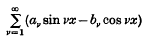
conjugate to (1·1). By
 we mean the function conjugate to f(x), that is
where the integral is taken in the principal-value sense.
 and
and  we denote the partial sums and the first arithmetic means of the series
 we mean the function conjugate to
PSP volume 34 issue 2 Cover and Back matter
-
- Journal:
- Mathematical Proceedings of the Cambridge Philosophical Society / Volume 34 / Issue 2 / April 1938
- Published online by Cambridge University Press:
- 24 October 2008, pp. b1-b2
- Print publication:
- April 1938
-
- Article
-
- You have access
- Export citation
Thermal equilibrium at temperatures below 1° absolute
-
- Journal:
- Mathematical Proceedings of the Cambridge Philosophical Society / Volume 34 / Issue 2 / April 1938
- Published online by Cambridge University Press:
- 24 October 2008, pp. 301-307
- Print publication:
- April 1938
-
- Article
- Export citation
A search for ionization of hydrogen by diffusion through palladium
-
- Journal:
- Mathematical Proceedings of the Cambridge Philosophical Society / Volume 34 / Issue 1 / January 1938
- Published online by Cambridge University Press:
- 24 October 2008, pp. 120-123
- Print publication:
- January 1938
-
- Article
- Export citation
The resolution of monoidal Cremona transformations of three-dimensional space
-
- Journal:
- Mathematical Proceedings of the Cambridge Philosophical Society / Volume 34 / Issue 1 / January 1938
- Published online by Cambridge University Press:
- 24 October 2008, pp. 22-26
- Print publication:
- January 1938
-
- Article
- Export citation
-
A Cremona transformation Tn, n′ between two three-dimensional spaces is said to be monoidal if the surfaces of order n in one space which form the homaloidal system corresponding to the planes of the second space have a fixed (n − 1)-ple point O. If the surfaces of order n′ forming the homaloidal system in the second space have a fixed (n′ − 1)-ple point O′, the transformation is said to be bimonoidal. A particularly simple bimonoidal transformation is that which transforms lines through O into lines through O′, and planes through O into planes through O′. Such a transformation we shall call an M-transformation. Its equations can, by suitable choice of coordinates, be expressed in the form

where φn−1(x, y, z, w) = 0, φn(x, y, z, w) = 0 are monoids with vertex (0, 0, 0, 1).
Soft X-ray bands from dilute alloys
-
- Journal:
- Mathematical Proceedings of the Cambridge Philosophical Society / Volume 34 / Issue 1 / January 1938
- Published online by Cambridge University Press:
- 24 October 2008, pp. 109-114
- Print publication:
- January 1938
-
- Article
- Export citation
Fiducial distribution of several parameters with application to a normal system
-
- Journal:
- Mathematical Proceedings of the Cambridge Philosophical Society / Volume 34 / Issue 1 / January 1938
- Published online by Cambridge University Press:
- 24 October 2008, pp. 41-47
- Print publication:
- January 1938
-
- Article
- Export citation
PSP volume 34 issue 1 Cover and Back matter
-
- Journal:
- Mathematical Proceedings of the Cambridge Philosophical Society / Volume 34 / Issue 1 / January 1938
- Published online by Cambridge University Press:
- 24 October 2008, pp. b1-b2
- Print publication:
- January 1938
-
- Article
-
- You have access
- Export citation
The conductivity of thin metallic films according to the electron theory of metals
-
- Journal:
- Mathematical Proceedings of the Cambridge Philosophical Society / Volume 34 / Issue 1 / January 1938
- Published online by Cambridge University Press:
- 24 October 2008, pp. 100-108
- Print publication:
- January 1938
-
- Article
- Export citation
The critical ordering temperature in alloys. II. The existence of a two-phase region
-
- Journal:
- Mathematical Proceedings of the Cambridge Philosophical Society / Volume 34 / Issue 1 / January 1938
- Published online by Cambridge University Press:
- 24 October 2008, pp. 68-80
- Print publication:
- January 1938
-
- Article
- Export citation
The expansion of an arbitrary function in a series of conal or toroidal functions
-
- Journal:
- Mathematical Proceedings of the Cambridge Philosophical Society / Volume 34 / Issue 1 / January 1938
- Published online by Cambridge University Press:
- 24 October 2008, pp. 30-32
- Print publication:
- January 1938
-
- Article
- Export citation
Further aspects of the theory of multiple regression
-
- Journal:
- Mathematical Proceedings of the Cambridge Philosophical Society / Volume 34 / Issue 1 / January 1938
- Published online by Cambridge University Press:
- 24 October 2008, pp. 33-40
- Print publication:
- January 1938
-
- Article
- Export citation
-
This paper may be regarded as a sequel to a previous papers(1) in these Proceedings. The vector and matrix notation of that paper used for a statistical sample is systematized somewhat further, so that while a sample S refers as before to the matrix of nm values (a sample of m observations in one variate only being a row vector), we write

for the linear regression formula between the dependent and independent variates into which a sample is supposed partitioned (in place of equation (12) of (1)). More generally, a third submatrix S0 is partitioned off, and its effect eliminated (corresponding to equation (13) of (1)), but without loss of generality we assume that S2 in equation (1) above can always stand for S2.0 if necessary.
Determinantal representations of x4+y4+z4
-
- Journal:
- Mathematical Proceedings of the Cambridge Philosophical Society / Volume 34 / Issue 1 / January 1938
- Published online by Cambridge University Press:
- 24 October 2008, pp. 6-21
- Print publication:
- January 1938
-
- Article
- Export citation
Electronic energy bands in metallic copper and silver
-
- Journal:
- Mathematical Proceedings of the Cambridge Philosophical Society / Volume 34 / Issue 1 / January 1938
- Published online by Cambridge University Press:
- 24 October 2008, pp. 89-99
- Print publication:
- January 1938
-
- Article
- Export citation
-
The present discussion of the conduction levels of copper and silver was undertaken in view of the experimental investigations of the absorption and emission bands of metals, in the soft X-ray region, which have been carried out in this laboratory and elsewhere*. It is a well-known result of the electron theory of metals that, for cubic crystals, of lattice constant a, if k is the wave vector of an electron moving in the crystal lattice, there are discontinuities in the energy E of the electron for values of k such that

(n1, n2, n3) being the Miller indices of the planes for which Bragg reflexion of the electron waves takes place. If we draw the energy E as a function of k for a particular direction in the lattice, then we obtain, using the usual notation, curves such as those shown in fig. 1, d being the half-distance between the corresponding planes for which Bragg reflexion takes place.
The fixed part of the canonical system on an algebraic surface
-
- Journal:
- Mathematical Proceedings of the Cambridge Philosophical Society / Volume 34 / Issue 1 / January 1938
- Published online by Cambridge University Press:
- 24 October 2008, pp. 1-5
- Print publication:
- January 1938
-
- Article
- Export citation
Note on the absorption limits for the primary β-particles of mesothorium 2 and uranium X2
-
- Journal:
- Mathematical Proceedings of the Cambridge Philosophical Society / Volume 34 / Issue 1 / January 1938
- Published online by Cambridge University Press:
- 24 October 2008, pp. 115-119
- Print publication:
- January 1938
-
- Article
- Export citation
