Refine search
Actions for selected content:
26204 results in Theoretical Physics and Mathematical Physics
The second order electrical effects in metals
-
- Journal:
- Mathematical Proceedings of the Cambridge Philosophical Society / Volume 33 / Issue 3 / July 1937
- Published online by Cambridge University Press:
- 24 October 2008, pp. 371-379
- Print publication:
- July 1937
-
- Article
- Export citation
-
The theory of transport phenomena in metals depends upon the solution of an integral equation for the velocity distribution function f of the conduction electrons. This integral equation is formed by equating the rate of change in f due to external fields and temperature gradients to the rate of change in f due to the mechanism which produces the resistance. If this latter rate of change is denoted by [∂f/∂t]coll it happens with some mechanisms that

where f0 is the equilibrium distribution, and ℸ is the time of relaxation which does not depend on the external fields. When equation (1) is true, the problem is comparatively simple, but in general [∂/∂t]coll is an integral operator and it is not possible to define a time of relaxation and a free path. It is known that at high temperatures, such that (Θ/T)2 can be neglected, where Θ is the Debye temperature, a free path exists; but, in general, special methods have to be used to solve the integral equation.
The effect of temperature on the reflexion of X-rays
-
- Journal:
- Mathematical Proceedings of the Cambridge Philosophical Society / Volume 33 / Issue 3 / July 1937
- Published online by Cambridge University Press:
- 24 October 2008, pp. 380-384
- Print publication:
- July 1937
-
- Article
- Export citation
-
1. The reflexion of X-rays from an ideal crystal would be independent of temperature if the particles forming the crystal were at rest. Because of the motion of the particles a temperature effect does exist. It can easily be seen that only the component of the displacement at right angles to the reflecting plane is of importance, since it is the path difference between such planes which matters. The complete theory has been worked out by Debye and by Waller. The result is that, owing to the influence of the temperature, the intensity is multiplied by a factor e−2m, where

Here
 and μs is the mean square of the component of the displacement (in a direction at right angles to the reflecting planes) due to a normal mode π is the glancing angle of incidence of the X-rays on the reflecting planes, and λ is the wave-length.
 and μ
and μA critical examination of Benedicks' homogeneous electro-thermal effect
-
- Journal:
- Mathematical Proceedings of the Cambridge Philosophical Society / Volume 33 / Issue 3 / July 1937
- Published online by Cambridge University Press:
- 24 October 2008, pp. 385-389
- Print publication:
- July 1937
-
- Article
- Export citation
On temperature in relation to quantal phenomena
-
- Journal:
- Mathematical Proceedings of the Cambridge Philosophical Society / Volume 33 / Issue 3 / July 1937
- Published online by Cambridge University Press:
- 24 October 2008, pp. 340-343
- Print publication:
- July 1937
-
- Article
- Export citation
PSP volume 33 issue 3 Cover and Back matter
-
- Journal:
- Mathematical Proceedings of the Cambridge Philosophical Society / Volume 33 / Issue 3 / July 1937
- Published online by Cambridge University Press:
- 24 October 2008, pp. b1-b2
- Print publication:
- July 1937
-
- Article
-
- You have access
- Export citation
On an inequality in the elementary theory of numbers
-
- Journal:
- Mathematical Proceedings of the Cambridge Philosophical Society / Volume 33 / Issue 2 / April 1937
- Published online by Cambridge University Press:
- 24 October 2008, pp. 207-209
- Print publication:
- April 1937
-
- Article
- Export citation
-
Let a1, a2, …, an be a set of n positive integers. Then it is easily seen that the set of positive integers not divisible by any aν has a density, i.e. that if Nn(z) is the number of such integers not exceeding z, then z−1Nn(z) tends to a limit when z → ∞; and that

where

and where [u1, …, uμ] denotes the least positive common multiple of the positive integers u1, …, uμ.
A comparison of wave functions for the normal helium atom
-
- Journal:
- Mathematical Proceedings of the Cambridge Philosophical Society / Volume 33 / Issue 2 / April 1937
- Published online by Cambridge University Press:
- 24 October 2008, pp. 253-259
- Print publication:
- April 1937
-
- Article
- Export citation
PSP volume 33 issue 2 Cover and Back matter
-
- Journal:
- Mathematical Proceedings of the Cambridge Philosophical Society / Volume 33 / Issue 2 / April 1937
- Published online by Cambridge University Press:
- 24 October 2008, p. b1
- Print publication:
- April 1937
-
- Article
-
- You have access
- Export citation
A note on molecular orbitals
-
- Journal:
- Mathematical Proceedings of the Cambridge Philosophical Society / Volume 33 / Issue 2 / April 1937
- Published online by Cambridge University Press:
- 24 October 2008, pp. 250-252
- Print publication:
- April 1937
-
- Article
- Export citation
The effect of configuration interaction on the low terms of the spectra of oxygen
-
- Journal:
- Mathematical Proceedings of the Cambridge Philosophical Society / Volume 33 / Issue 2 / April 1937
- Published online by Cambridge University Press:
- 24 October 2008, pp. 240-249
- Print publication:
- April 1937
-
- Article
- Export citation
An infinite integral involving Bessel functions and parabolic cylinder functions
-
- Journal:
- Mathematical Proceedings of the Cambridge Philosophical Society / Volume 33 / Issue 2 / April 1937
- Published online by Cambridge University Press:
- 24 October 2008, pp. 210-211
- Print publication:
- April 1937
-
- Article
- Export citation
-
The object of this paper is to evaluate an infinite integral involving Bessel functions and parabolic cylinder functions. The following two lemmas are required:
Lemma 1.

provided that R(m) > 0.
PSP volume 33 issue 2 Cover and Front matter
-
- Journal:
- Mathematical Proceedings of the Cambridge Philosophical Society / Volume 33 / Issue 2 / April 1937
- Published online by Cambridge University Press:
- 24 October 2008, pp. f1-f2
- Print publication:
- April 1937
-
- Article
-
- You have access
- Export citation
The “closest” estimates of statistical parameters
-
- Journal:
- Mathematical Proceedings of the Cambridge Philosophical Society / Volume 33 / Issue 2 / April 1937
- Published online by Cambridge University Press:
- 24 October 2008, pp. 212-222
- Print publication:
- April 1937
-
- Article
- Export citation
On an equation occurring in Falkner and Skan's approximate treatment of the equations of the boundary layer
-
- Journal:
- Mathematical Proceedings of the Cambridge Philosophical Society / Volume 33 / Issue 2 / April 1937
- Published online by Cambridge University Press:
- 24 October 2008, pp. 223-239
- Print publication:
- April 1937
-
- Article
- Export citation
-
The differential analyser has been used to evaluate solutions of the equation

with boundary conditions y = y′ = 0 at x = 0, y′ → 1 as x → ∞, which occurs in Falkner and Skan's approximate treatment of the laminar boundary layer. A numerical iterative method has been used to improve the accuracy of the solutions, and the results show that the accuracy of the machine solutions is about 1 in 1000, or rather better.
It is shown that the conditions are insufficient to specify a unique solution for negative values of β a discussion of this situation is given, and it is shown that for the application to be made of the solution the appropriate condition is that y′ → 1 from below, and as rapidly as possible, as x → ∞. The condition that y′ → 1 from below can be satisfied only for values of β0, greater than a limiting value β0, whose value is approximately − 0·199, and which is related to the point at which the laminar boundary layer breaks away from the boundary.
Superconducting cylinders
-
- Journal:
- Mathematical Proceedings of the Cambridge Philosophical Society / Volume 33 / Issue 2 / April 1937
- Published online by Cambridge University Press:
- 24 October 2008, pp. 260-276
- Print publication:
- April 1937
-
- Article
- Export citation
The generalized Fermi interaction
-
- Journal:
- Mathematical Proceedings of the Cambridge Philosophical Society / Volume 33 / Issue 2 / April 1937
- Published online by Cambridge University Press:
- 24 October 2008, pp. 277-292
- Print publication:
- April 1937
-
- Article
- Export citation
-
Konopinski and Uhlenbeck have shown that the empirical β-ray spectra seem to require a modification of Fermi's original expression for the interaction leading to β decay‡. Their expression includes a derivative of the neutrino wave function. The purpose of the present paper is to investigate the most general type of such an interaction term and the possibility of introducing second-order derivatives. We have to deal with the transition§
neutron + neutrino → proton + electron
or proton + anti-neutrino → neutron + positron.
The whole system has the equations of motion
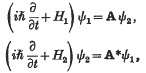
where ψ1 and ψ2 are the wave functions of the initial and final states in configuration space, H1 and H2 are the Hamiltonians of the particles in the initial and final states, and A is a small interaction operator.
The envelope of the subspaces of the polyhedra of an involution on a rational curve
-
- Journal:
- Mathematical Proceedings of the Cambridge Philosophical Society / Volume 33 / Issue 2 / April 1937
- Published online by Cambridge University Press:
- 24 October 2008, pp. 183-187
- Print publication:
- April 1937
-
- Article
- Export citation
-
The following note was suggested by an interesting paper written by F. P. White, where many references are given. It refers to a theorem given by W. F. Meyer, by whom the proof is indicated as possible by generalization of an intricate analytical proof given by him for a simple case. His result is that if on the rational curve of order r, in space [r], say the curve cr [r], there be an involution ∞k, of sets of m points, expressed, suppose, by an equation

then the spaces [r − 1], formed from r points of any one of the polyhedra of m points, are an aggregate ∞k of primes of this space [r], which is of class (m − k, m − r), the notation (p, q) meaning the binomial coefficient p! / q!(p − q)!. By Meyer, the conditions k < r ≤ m are supposed to be satisfied. But there is a theorem for r < k ≤ m − 1, relating to selected [r − 1], formed from r points of any one of the polyhedra of m points. The general theorem may be formulated thus: In a space [r], the equation of any prime may be expressed by λu + μv +... + ρw = 0, where u = 0, v = 0, …w = 0 are any r + 1 given independent primes, and λ, μ, …ρ are coefficients which may be described as prime coordinates of the [r].
On certain surfaces which have unpostulated singularities
-
- Journal:
- Mathematical Proceedings of the Cambridge Philosophical Society / Volume 33 / Issue 2 / April 1937
- Published online by Cambridge University Press:
- 24 October 2008, pp. 199-206
- Print publication:
- April 1937
-
- Article
- Export citation
Projective characters and invariants of algebraic varieties
-
- Journal:
- Mathematical Proceedings of the Cambridge Philosophical Society / Volume 33 / Issue 2 / April 1937
- Published online by Cambridge University Press:
- 24 October 2008, pp. 188-198
- Print publication:
- April 1937
-
- Article
- Export citation
The β- and γ-radiation of RaC″
-
- Journal:
- Mathematical Proceedings of the Cambridge Philosophical Society / Volume 33 / Issue 1 / March 1937
- Published online by Cambridge University Press:
- 24 October 2008, pp. 154-163
- Print publication:
- March 1937
-
- Article
- Export citation
