Refine search
Actions for selected content:
26203 results in Theoretical Physics and Mathematical Physics
Statement of Accounts of the Cambridge Philosophical Society, from January 1, 1935, to December 31, 1935
-
- Journal:
- Mathematical Proceedings of the Cambridge Philosophical Society / Volume 32 / Issue 4 / December 1936
- Published online by Cambridge University Press:
- 24 October 2008, pp. 693-694
- Print publication:
- December 1936
-
- Article
- Export citation
On the parametric representation of bounded functions
-
- Journal:
- Mathematical Proceedings of the Cambridge Philosophical Society / Volume 32 / Issue 4 / December 1936
- Published online by Cambridge University Press:
- 24 October 2008, pp. 521-529
- Print publication:
- December 1936
-
- Article
- Export citation
-
Let a1, a2, … be a sequence of variables. Write

We use the notation Bn = Bn (a1, …, an) to indicate the variables on which Bn depends.
The dissociation of hydrogen by tungsten
-
- Journal:
- Mathematical Proceedings of the Cambridge Philosophical Society / Volume 32 / Issue 4 / December 1936
- Published online by Cambridge University Press:
- 24 October 2008, pp. 648-652
- Print publication:
- December 1936
-
- Article
- Export citation
The information available in small samples
-
- Journal:
- Mathematical Proceedings of the Cambridge Philosophical Society / Volume 32 / Issue 4 / December 1936
- Published online by Cambridge University Press:
- 24 October 2008, pp. 560-566
- Print publication:
- December 1936
-
- Article
- Export citation
On the diffusion of gases through metals
-
- Journal:
- Mathematical Proceedings of the Cambridge Philosophical Society / Volume 32 / Issue 4 / December 1936
- Published online by Cambridge University Press:
- 24 October 2008, pp. 657-662
- Print publication:
- December 1936
-
- Article
- Export citation
Note on the slow motion of fluid
-
- Journal:
- Mathematical Proceedings of the Cambridge Philosophical Society / Volume 32 / Issue 4 / December 1936
- Published online by Cambridge University Press:
- 24 October 2008, pp. 598-613
- Print publication:
- December 1936
-
- Article
- Export citation
A generalization of Abel summability
-
- Journal:
- Mathematical Proceedings of the Cambridge Philosophical Society / Volume 32 / Issue 4 / December 1936
- Published online by Cambridge University Press:
- 24 October 2008, pp. 541-559
- Print publication:
- December 1936
-
- Article
- Export citation
-
The Abel sum of the series
 can be written in the form
where

This suggests that we should define the “Abel limit”, as u → ∞, of any function A(u) as being given by the expression (1) whenever this exists. We shall, however, in this paper, restrict ourselves to functions A(u) which are bounded in any finite interval. Since we are concerned only with the behaviour of A(u) as u → ∞, this does not involve any serious loss of generality, while we avoid difficulties arising from the divergence of integrals at finite points. We note that the expression (1) can be written in the form

where

A1(u) may conveniently be described as the “Abel transform” of A(u).
 can be written in the form
Note on radiationless transitions involving three-body collisions
-
- Journal:
- Mathematical Proceedings of the Cambridge Philosophical Society / Volume 32 / Issue 3 / October 1936
- Published online by Cambridge University Press:
- 24 October 2008, pp. 482-485
- Print publication:
- October 1936
-
- Article
- Export citation
Some canonical triple surfaces
-
- Journal:
- Mathematical Proceedings of the Cambridge Philosophical Society / Volume 32 / Issue 3 / October 1936
- Published online by Cambridge University Press:
- 24 October 2008, pp. 366-372
- Print publication:
- October 1936
-
- Article
- Export citation
-
1. In 1891, Castelnuovo suggested that there may exist canonical surfaces which consist of three sheets covering the same surface. In particular, he remarked that, if the canonical curves of a surface contain a
 then the canonical model of the surface is certainly a three-sheeted surface. An example is the quintic surface with a tacnode, in space of three dimensions; its canonical model is a triple plane, branching along a curve of order 12 with twenty-four cusps which lie on a quartic.
 then the canonical model of the surface is certainly a three-sheeted surface. An example is the quintic surface with a tacnode, in space of three dimensions; its canonical model is a triple plane, branching along a curve of order 12 with twenty-four cusps which lie on a quartic.
Note on the velocity distribution in the wake behind a flat plate placed along the stream
-
- Journal:
- Mathematical Proceedings of the Cambridge Philosophical Society / Volume 32 / Issue 3 / October 1936
- Published online by Cambridge University Press:
- 24 October 2008, pp. 385-391
- Print publication:
- October 1936
-
- Article
- Export citation
-
1. The velocity distribution in fluid of small viscosity, or at large Reynolds number, in the laminar boundary layer associated with a thin flat plate along the main direction of flow, has been worked out by Blasius on the basis of the Prandtl theory. These original investigations covered the region from the forward edge of the plate to the downstream edge. In a recent paper Goldstein investigated the velocity distribution in the wake immediately behind the downstream edge over a region within about 0·5l from it, l being the length of the plate. Later
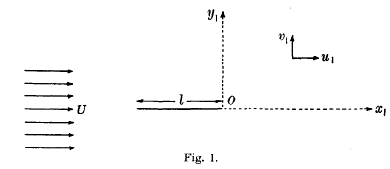
Tollmien obtained a first approximation to the flow at a great distance down-stream. Goldstein § extended Tollmien's solution by finding a second approximation and by joining it up with his previous work on the flow very near the plate.
Movements of electrically charged cloud particles
-
- Journal:
- Mathematical Proceedings of the Cambridge Philosophical Society / Volume 32 / Issue 3 / October 1936
- Published online by Cambridge University Press:
- 24 October 2008, pp. 486-492
- Print publication:
- October 1936
-
- Article
- Export citation
On multiple curves and surfaces as limits
-
- Journal:
- Mathematical Proceedings of the Cambridge Philosophical Society / Volume 32 / Issue 3 / October 1936
- Published online by Cambridge University Press:
- 24 October 2008, pp. 373-377
- Print publication:
- October 1936
-
- Article
- Export citation
PSP volume 32 issue 3 Cover and Front matter
-
- Journal:
- Mathematical Proceedings of the Cambridge Philosophical Society / Volume 32 / Issue 3 / October 1936
- Published online by Cambridge University Press:
- 24 October 2008, pp. f1-f2
- Print publication:
- October 1936
-
- Article
-
- You have access
- Export citation
Note on a theorem enunciated by Todd
-
- Journal:
- Mathematical Proceedings of the Cambridge Philosophical Society / Volume 32 / Issue 3 / October 1936
- Published online by Cambridge University Press:
- 24 October 2008, pp. 378-379
- Print publication:
- October 1936
-
- Article
- Export citation
Potential functions related to groups of circular cylinders
-
- Journal:
- Mathematical Proceedings of the Cambridge Philosophical Society / Volume 32 / Issue 3 / October 1936
- Published online by Cambridge University Press:
- 24 October 2008, pp. 402-415
- Print publication:
- October 1936
-
- Article
- Export citation
On Ising's model of ferromagnetism
-
- Journal:
- Mathematical Proceedings of the Cambridge Philosophical Society / Volume 32 / Issue 3 / October 1936
- Published online by Cambridge University Press:
- 24 October 2008, pp. 477-481
- Print publication:
- October 1936
-
- Article
- Export citation
The mean value of the fluctuations in pressure and pressure gradient in a turbulent fluid
-
- Journal:
- Mathematical Proceedings of the Cambridge Philosophical Society / Volume 32 / Issue 3 / October 1936
- Published online by Cambridge University Press:
- 24 October 2008, pp. 380-384
- Print publication:
- October 1936
-
- Article
- Export citation
-
In the general systems of vortices represented by (1) the mean variation in pressure
 is
is
where K is a number which varies between 1 and √2. When the vortices are confined to cubical partitions, the case most nearly analogous to that of free turbulence, K = 1·06, so that the conjecture which I made some years ago, that
would be equal to  is probably nearly correct.
 is
is
 is probably nearly correct.
Further significance tests
-
- Journal:
- Mathematical Proceedings of the Cambridge Philosophical Society / Volume 32 / Issue 3 / October 1936
- Published online by Cambridge University Press:
- 24 October 2008, pp. 416-445
- Print publication:
- October 1936
-
- Article
- Export citation
-
In a previous paper (afterwards referred to as Paper I) tests have been given for the significance of some quantities found statistically. The results are given in the form P(q | θh)/P (˜ q|θh); here h denotes the previous knowledge and θ the experimental evidence used, while q is the hypothesis that all the variations outstanding can be attributed to accidental error or random variation, and ˜q the hypothesis that at least part of them is systematic. It has been supposed in the analysis that q and ˜q are equally probable on the information h; but if they are not, the only alteration is that the ratios evaluated now represent
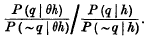
If successive batches of relevant information are available the total effect on the probability of q can therefore be got by multiplying the values of

given by the investigations separately. In each case the assumption that q has prior probability ½ is really a practical working rule rather than a statement of fact.
The intensity of X-ray spectrum lines of heavy elements
-
- Journal:
- Mathematical Proceedings of the Cambridge Philosophical Society / Volume 32 / Issue 3 / October 1936
- Published online by Cambridge University Press:
- 24 October 2008, pp. 461-470
- Print publication:
- October 1936
-
- Article
- Export citation
-
The intensities of X-ray spectral lines resulting from transitions between the K, L and M shells have been calculated using screened relativistic wave functions. The relativistic modifications are shown to decrease the Lβ3β4 doublet ratio but do not alter the Kα1α2 and Kβ1β3 ratios, in agreement with experiment. The calculated intensities of the forbidden lines arising from quadrupole transitions are in good agreement with experiment. Lines due to
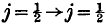 transitions arising from the magnetic dipole moment of the electron are found to be very weak, but the LI → K transition might just be observable for heavy elements.
 transitions arising from the magnetic dipole moment of the electron are found to be very weak, but the
 PSP volume 32 issue 3 Cover and Back matter
-
- Journal:
- Mathematical Proceedings of the Cambridge Philosophical Society / Volume 32 / Issue 3 / October 1936
- Published online by Cambridge University Press:
- 24 October 2008, pp. b1-b2
- Print publication:
- October 1936
-
- Article
-
- You have access
- Export citation
