Refine search
Actions for selected content:
26203 results in Theoretical Physics and Mathematical Physics
Selection Rules in Nuclear Radiation
-
- Journal:
- Mathematical Proceedings of the Cambridge Philosophical Society / Volume 32 / Issue 2 / May 1936
- Published online by Cambridge University Press:
- 24 October 2008, pp. 291-300
- Print publication:
- May 1936
-
- Article
- Export citation
On the Decomposition of an Infinitesimal Group
-
- Journal:
- Mathematical Proceedings of the Cambridge Philosophical Society / Volume 32 / Issue 2 / May 1936
- Published online by Cambridge University Press:
- 24 October 2008, pp. 229-237
- Print publication:
- May 1936
-
- Article
- Export citation
PSP volume 32 issue 2 Cover and Front matter
-
- Journal:
- Mathematical Proceedings of the Cambridge Philosophical Society / Volume 32 / Issue 2 / May 1936
- Published online by Cambridge University Press:
- 24 October 2008, pp. f1-f2
- Print publication:
- May 1936
-
- Article
-
- You have access
- Export citation
The Response of a Non-Linear Electric Circuit to an Impulse
-
- Journal:
- Mathematical Proceedings of the Cambridge Philosophical Society / Volume 32 / Issue 2 / May 1936
- Published online by Cambridge University Press:
- 24 October 2008, pp. 304-320
- Print publication:
- May 1936
-
- Article
- Export citation
On the Extension of the Pflastersatz
-
- Journal:
- Mathematical Proceedings of the Cambridge Philosophical Society / Volume 32 / Issue 2 / May 1936
- Published online by Cambridge University Press:
- 24 October 2008, pp. 238-247
- Print publication:
- May 1936
-
- Article
- Export citation
A Remark on Fourier Transforms
-
- Journal:
- Mathematical Proceedings of the Cambridge Philosophical Society / Volume 32 / Issue 2 / May 1936
- Published online by Cambridge University Press:
- 24 October 2008, pp. 321-327
- Print publication:
- May 1936
-
- Article
- Export citation
-
1. Let f(x) be a complex function belonging to LP (−∞, ∞); i.e. let f(x) be measurable, and |f(x)|p integrable, over (−∞, ∞). The function

is called the Fourier transform of f(x), if the integral on the right exists, in some sense, for almost every value of y. It is well known that, if 1 ≤ p ≤ 2, the integral (1) converges in mean, with index p′ = p/(p – l)† i.e. that

where

The Intensity of the γ-Rays emitted by the Active Deposit of Thorium
-
- Journal:
- Mathematical Proceedings of the Cambridge Philosophical Society / Volume 32 / Issue 2 / May 1936
- Published online by Cambridge University Press:
- 24 October 2008, pp. 328-335
- Print publication:
- May 1936
-
- Article
- Export citation
On Order in Time
-
- Journal:
- Mathematical Proceedings of the Cambridge Philosophical Society / Volume 32 / Issue 2 / May 1936
- Published online by Cambridge University Press:
- 24 October 2008, pp. 216-228
- Print publication:
- May 1936
-
- Article
- Export citation
The Polarizability of Molecular Hydrogen H2
-
- Journal:
- Mathematical Proceedings of the Cambridge Philosophical Society / Volume 32 / Issue 2 / May 1936
- Published online by Cambridge University Press:
- 24 October 2008, pp. 260-264
- Print publication:
- May 1936
-
- Article
- Export citation
The Meromorphisms of an Elliptic Function-Field
-
- Journal:
- Mathematical Proceedings of the Cambridge Philosophical Society / Volume 32 / Issue 2 / May 1936
- Published online by Cambridge University Press:
- 24 October 2008, pp. 212-215
- Print publication:
- May 1936
-
- Article
- Export citation
-
1. Hasse's second proof of the truth of the analogue of Riemann's hypothesis for the congruence zeta-function of an elliptic function-field over a finite field is based on the consideration of the normalized meromorphisms of such a field. The meromorphisms form a ring of characteristic 0 with a unit element and no zero divisors, and have as a subring the natural multiplications n (n = 0, ± 1, …). Two questions concerning the nature of meromorphisms were left open, first whether they are commutative, and secondly whether every meromorphism μ satisfies an algebraic equation

with rational integers n0, … not all zero. I have proved that except in the case
 (which is equivalent to |N−q|=2 √q, where N is the number of solutions of the Weierstrassian equation in the given finite field of q elements), both these results are true. This proof, of which I give an account in this paper, suggested to Hasse a simpler treatment of the subject, which throws still more light on the nature of meromorphisms. Consequently I only give my proof in full in the case in which the given finite field is the mod p field, and indicate briefly in § 4 how it generalizes to the more complicated case.
 (which is equivalent to |
The Stability of Viscous Fluid Flow under Pressure between Parallel Planes
-
- Journal:
- Mathematical Proceedings of the Cambridge Philosophical Society / Volume 32 / Issue 1 / January 1936
- Published online by Cambridge University Press:
- 24 October 2008, pp. 40-54
- Print publication:
- January 1936
-
- Article
- Export citation
-
If we consider, by the method of small oscillations, the stability of a viscous fluid flow in which the undisturbed velocity is parallel to the axis of x and its magnitude U is a function of y only (x, y, z being rectangular Cartesian co-ordinates), and if we assume that any possible disturbance may be analysed into a number (usually infinite) of principal disturbances, each of which involves the time only through a single exponential factor, then it has been proved by Squire, by supposing the disturbance analysed also into constituents which are simple harmonic functions of x and z, and considering only a single constituent, that if instability occurs at all, it will occur for the lowest Reynolds number for a disturbance which is two-dimensional, in the x, y plane. Hence only two-dimensional disturbances need be considered. The velocity components in the disturbed motion will be denoted by (U + u, v). Since only infinitesimal disturbances are considered, all terms in the equations of motion which are quadratic in u and v are neglected. When u and v are taken to be functions of y multiplied by ei(αx−βi), the equation of continuity becomes

and the result of eliminating the pressure in the equations of motion then gives the following equation for v, where ν is the kinematic viscosity of the fluid:


PSP volume 32 issue 1 Cover and Front matter
-
- Journal:
- Mathematical Proceedings of the Cambridge Philosophical Society / Volume 32 / Issue 1 / January 1936
- Published online by Cambridge University Press:
- 24 October 2008, pp. f1-f2
- Print publication:
- January 1936
-
- Article
-
- You have access
- Export citation
Thermal Properties of an Incompletely Degenerate Fermi Gas
-
- Journal:
- Mathematical Proceedings of the Cambridge Philosophical Society / Volume 32 / Issue 1 / January 1936
- Published online by Cambridge University Press:
- 24 October 2008, pp. 108-111
- Print publication:
- January 1936
-
- Article
- Export citation
-
The purpose of this note is to calculate the specific heat and paramagnetic susceptibility of an electron gas obeying the Fermi-Dirac statistics for all temperatures, including those temperatures for which the gas is partially degenerate. The results are applicable to the electrons in a metal, whether free or moving in a periodic field, provided only that the number of electronic states per gram atom with energy between E and E + dE can be expressed in the form

as for free electrons.
On the Stability Problem in Hydrodynamics
-
- Journal:
- Mathematical Proceedings of the Cambridge Philosophical Society / Volume 32 / Issue 1 / January 1936
- Published online by Cambridge University Press:
- 24 October 2008, pp. 55-66
- Print publication:
- January 1936
-
- Article
- Export citation
-
The paper deals with the problem of the effect of two-dimensional first order disturbances on the linear and parabolic flows of a viscous fluid. If the laminar flow is in the direction x and is bounded by the planes y = ±h, and if the stream function of the disturbance is assumed to be of the form
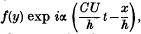 , it is found that, for small Reynolds numbers R (= Uh/v), C can be developed in the power series
The first term in (1) corresponds to a disturbance in still water and is known from Rayleigh's investigation of that problem; the succeeding C's are real and can be obtained by an application of Schrödinger's perturbation theory of wave mechanics. In the case of the parabolic flow, expressions for C0 and C1 were thus derived for both the symmetrical and anti-symmetrical types of disturbance.
The imaginary part of C, as represented by
 in this approximation, is found to be positive. When α is of the order of unity, the value of R which makes the second term
  of the first is about 50 for the symmetrical disturbance and 100 for the antisymmetrical disturbance. C0, the first term in the expression for the phase velocity, is less than 1 and increases with α, which implies a group velocity greater than the phase velocity.
In the case of the linear flow it is found that the C's with even subscripts vanish, implying a vanishing phase velocity. This verifies the assumption to that effect made by Southwell and Chitty, and it also suggests that the region of convergence of (A) is limited to the range of values of R covered by these authors. Expressions are derived for C1 and C3 and are evaluated for α=1. The formulae thus obtained for the damping constant give an initial decrease with R, which is not shown in the corresponding curve of Southwell and Chitty.
An alternative method of determining C is outlined in the last section. Use is made of the orthogonal system of the characteristic functions for the vorticity of a disturbance in still water. The equation determining C is reduced to an infinite determinant in which C occurs only in the diagonal elements. When R→0, the determinant can be evaluated and the roots C are found to coincide with the first two terms in (A).
Finally it is shown that the two-dimensional laminar flow is stable for values of R less than the smaller of the quantities 2α and α3.
 , it is found that, for small Reynolds numbers
 in this approximation, is found to be positive. When α is of the order of unity, the value of
  of the first is about 50 for the symmetrical disturbance and 100 for the antisymmetrical disturbance.
 On the Radiation Emitted by a Multipole and its Angular Momentum
-
- Journal:
- Mathematical Proceedings of the Cambridge Philosophical Society / Volume 32 / Issue 1 / January 1936
- Published online by Cambridge University Press:
- 24 October 2008, pp. 112-126
- Print publication:
- January 1936
-
- Article
- Export citation
The Errors of Approximation in Jeffreys's Phases
-
- Journal:
- Mathematical Proceedings of the Cambridge Philosophical Society / Volume 32 / Issue 1 / January 1936
- Published online by Cambridge University Press:
- 24 October 2008, pp. 161-178
- Print publication:
- January 1936
-
- Article
- Export citation
Adsorption Isotherms. Critical Conditions
-
- Journal:
- Mathematical Proceedings of the Cambridge Philosophical Society / Volume 32 / Issue 1 / January 1936
- Published online by Cambridge University Press:
- 24 October 2008, pp. 144-151
- Print publication:
- January 1936
-
- Article
- Export citation
-
1. In a recent note I showed that Langmuir's adsorption isotherm

where θ is the fraction of the surface covered by adsorbed gas, p the gas pressure in equilibrium with it, and A (T) a specified function of the temperature, can be derived as a theorem in statistical mechanics without any appeal to the mechanism of deposition and re-evaporation. Necessary and sufficient assumptions for the truth of (1) are that the atoms (or molecules) of the gas are adsorbed as wholes on to definite points of attachment on the surface of the adsorber, that each point of attachment can accommodate one and only one adsorbed atom, and that the energies of the states of any adsorbed atom are independent of the presence or absence of other adsorbed atoms on neighbouring points of attachment. Under these assumptions the explicit form of (1) is

where m is the mass of the adsorbed atom or molecule, bg(T) the partition function for its internal states in the gas phase, and vs(T) the partition function for its set of adsorbed states. These sets of states are to be so specified that the energy zero is assigned tot the lowest state of each set in constructing bg(T) and vs(T), and then X is the energy required to transfer a molecule from the lowest adsorbed state tot the lowest gas state. Quite another adsorption isotherm was shown to hold when adsorption of a molecule takes place as atoms and requires two or more points of attachment.
Experiments on the Efficiencies of Production and the Half-Lives of Radio-Carbon and Radio-Nitrogen
-
- Journal:
- Mathematical Proceedings of the Cambridge Philosophical Society / Volume 32 / Issue 1 / January 1936
- Published online by Cambridge University Press:
- 24 October 2008, pp. 179-182
- Print publication:
- January 1936
-
- Article
- Export citation
The New Action Function and the Unitary Field Theory
-
- Journal:
- Mathematical Proceedings of the Cambridge Philosophical Society / Volume 32 / Issue 1 / January 1936
- Published online by Cambridge University Press:
- 24 October 2008, pp. 127-137
- Print publication:
- January 1936
-
- Article
- Export citation
-
A new form of the variation principle is given using the sum T of the Lagrangian L and the Hamiltonian
 as an action function. This new form of the variational principle enables us to find a new special action function, which conserves the chief features of Born's theory while changing some of its former results. To a given charge correspond two static solutions with central symmetry, one giving a finite, the other an infinite energy. The potential of the one (light) particle is analogous to that in Born's theory while the potential of the other resembles a potential barrier. Also, by using the new action function, the symmetry between electric and magnetic fields ceases to exist.
 as an action function. This new form of the variational principle enables us to find a new special action function, which conserves the chief features of Born's theory while changing some of its former results. To a given charge correspond two static solutions with central symmetry, one giving a finite, the other an infinite energy. The potential of the one (light) particle is analogous to that in Born's theory while the potential of the other resembles a potential barrier. Also, by using the new action function, the symmetry between electric and magnetic fields ceases to exist.
The Dissociation Equilibrium of Hydrogen and its Adsorption on Tungsten
-
- Journal:
- Mathematical Proceedings of the Cambridge Philosophical Society / Volume 32 / Issue 1 / January 1936
- Published online by Cambridge University Press:
- 24 October 2008, pp. 152-157
- Print publication:
- January 1936
-
- Article
- Export citation
