Refine search
Actions for selected content:
26203 results in Theoretical Physics and Mathematical Physics
The Two-Dimensional Electrostatic Solutions of Born's new Field Equations
-
- Journal:
- Mathematical Proceedings of the Cambridge Philosophical Society / Volume 31 / Issue 1 / January 1935
- Published online by Cambridge University Press:
- 24 October 2008, pp. 50-68
- Print publication:
- January 1935
-
- Article
- Export citation
Some Generalizations of Montel's Theorem
-
- Journal:
- Mathematical Proceedings of the Cambridge Philosophical Society / Volume 31 / Issue 1 / January 1935
- Published online by Cambridge University Press:
- 24 October 2008, pp. 26-30
- Print publication:
- January 1935
-
- Article
- Export citation
An Attempt to Detect the Neutrino
-
- Journal:
- Mathematical Proceedings of the Cambridge Philosophical Society / Volume 31 / Issue 1 / January 1935
- Published online by Cambridge University Press:
- 24 October 2008, pp. 99-107
- Print publication:
- January 1935
-
- Article
- Export citation
On a Class of Irregular Surfaces
-
- Journal:
- Mathematical Proceedings of the Cambridge Philosophical Society / Volume 31 / Issue 1 / January 1935
- Published online by Cambridge University Press:
- 24 October 2008, pp. 48-49
- Print publication:
- January 1935
-
- Article
- Export citation
-
1. Let P = 0, Q = 0, U = 0, V = 0 represent four independent quadric surfaces, and consider the equation

PSP volume 31 issue 1 Cover and Back matter
-
- Journal:
- Mathematical Proceedings of the Cambridge Philosophical Society / Volume 31 / Issue 1 / January 1935
- Published online by Cambridge University Press:
- 24 October 2008, pp. b1-b2
- Print publication:
- January 1935
-
- Article
-
- You have access
- Export citation
Ramanujan's Continued Fraction
-
- Journal:
- Mathematical Proceedings of the Cambridge Philosophical Society / Volume 31 / Issue 1 / January 1935
- Published online by Cambridge University Press:
- 24 October 2008, pp. 7-17
- Print publication:
- January 1935
-
- Article
- Export citation
-
The best of the theorems on continued fractions, to be found in Ramanujan's manuscript note-book may be stated as follows:

where there are eight gamma-functions in each product and the ambiguous signs are so chosen that the argument of each gamma-function contains one of the specified numbers of minus signs. Then

provided that one of the numbers β, γ δ, ε is equal to ± n, where n is a positive integer; and the products and sums on the right range over the numbers α β, γ δ, ε.
On Subdivisions of Complexes
-
- Journal:
- Mathematical Proceedings of the Cambridge Philosophical Society / Volume 31 / Issue 1 / January 1935
- Published online by Cambridge University Press:
- 24 October 2008, pp. 69-75
- Print publication:
- January 1935
-
- Article
- Export citation
On the Theory of Linear Integral Equations
-
- Journal:
- Mathematical Proceedings of the Cambridge Philosophical Society / Volume 31 / Issue 1 / January 1935
- Published online by Cambridge University Press:
- 24 October 2008, pp. 76-84
- Print publication:
- January 1935
-
- Article
- Export citation
PSP volume 31 issue 1 Cover and Front matter
-
- Journal:
- Mathematical Proceedings of the Cambridge Philosophical Society / Volume 31 / Issue 1 / January 1935
- Published online by Cambridge University Press:
- 24 October 2008, pp. f1-f2
- Print publication:
- January 1935
-
- Article
-
- You have access
- Export citation
Ionization Power of a Neutrino with Magnetic Moment
-
- Journal:
- Mathematical Proceedings of the Cambridge Philosophical Society / Volume 31 / Issue 1 / January 1935
- Published online by Cambridge University Press:
- 24 October 2008, pp. 108-115
- Print publication:
- January 1935
-
- Article
- Export citation
An Investigation of the Upper Limit of the Thorium C + C″ β-ray Spectrum by means of the Wilson Cloud Chamber
-
- Journal:
- Mathematical Proceedings of the Cambridge Philosophical Society / Volume 31 / Issue 1 / January 1935
- Published online by Cambridge University Press:
- 24 October 2008, pp. 119-124
- Print publication:
- January 1935
-
- Article
- Export citation
Some Experiments on the Slowing Down of Neutrons by Collisions with Hydrogen Nuclei
-
- Journal:
- Mathematical Proceedings of the Cambridge Philosophical Society / Volume 31 / Issue 1 / January 1935
- Published online by Cambridge University Press:
- 24 October 2008, pp. 145-152
- Print publication:
- January 1935
-
- Article
- Export citation
The Electric Moment of an Electron
-
- Journal:
- Mathematical Proceedings of the Cambridge Philosophical Society / Volume 31 / Issue 1 / January 1935
- Published online by Cambridge University Press:
- 24 October 2008, pp. 94-98
- Print publication:
- January 1935
-
- Article
- Export citation
Phenomena Attending the Splashing of Water in an Electric Field
-
- Journal:
- Mathematical Proceedings of the Cambridge Philosophical Society / Volume 31 / Issue 1 / January 1935
- Published online by Cambridge University Press:
- 24 October 2008, pp. 85-93
- Print publication:
- January 1935
-
- Article
- Export citation
The fundamental equations of electromagnetism, independent of metrical geometry
-
- Journal:
- Mathematical Proceedings of the Cambridge Philosophical Society / Volume 30 / Issue 4 / October 1934
- Published online by Cambridge University Press:
- 24 October 2008, pp. 421-427
- Print publication:
- October 1934
-
- Article
- Export citation
-
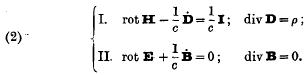
It is trivial that the fundamental equations of electromagnetism are invariant under orthogonal transformations of space. This invariance can be brought into evidence by using the calculus adapted to the orthogonal group, viz. the vector-calculus. The equations can be written either in their integral form

or in their differential form
The influence of screening on the creation and stopping of electrons
-
- Journal:
- Mathematical Proceedings of the Cambridge Philosophical Society / Volume 30 / Issue 4 / October 1934
- Published online by Cambridge University Press:
- 24 October 2008, pp. 524-539
- Print publication:
- October 1934
-
- Article
- Export citation
Finite groups generated by reflections, and their subgroups generated by reflections
-
- Journal:
- Mathematical Proceedings of the Cambridge Philosophical Society / Volume 30 / Issue 4 / October 1934
- Published online by Cambridge University Press:
- 24 October 2008, pp. 466-482
- Print publication:
- October 1934
-
- Article
- Export citation
PSP volume 30 issue 4 Cover and Back matter
-
- Journal:
- Mathematical Proceedings of the Cambridge Philosophical Society / Volume 30 / Issue 4 / October 1934
- Published online by Cambridge University Press:
- 24 October 2008, pp. b1-b10
- Print publication:
- October 1934
-
- Article
-
- You have access
- Export citation
On the regularity of surfaces, III
-
- Journal:
- Mathematical Proceedings of the Cambridge Philosophical Society / Volume 30 / Issue 4 / October 1934
- Published online by Cambridge University Press:
- 24 October 2008, pp. 404-408
- Print publication:
- October 1934
-
- Article
- Export citation
Torsion of beams of ⊥- and ∟- cross-sections
-
- Journal:
- Mathematical Proceedings of the Cambridge Philosophical Society / Volume 30 / Issue 4 / October 1934
- Published online by Cambridge University Press:
- 24 October 2008, pp. 392-403
- Print publication:
- October 1934
-
- Article
- Export citation
