Refine search
Actions for selected content:
26204 results in Theoretical Physics and Mathematical Physics
The quantum mechanics of a bounded linear harmonic oscillator
-
- Journal:
- Mathematical Proceedings of the Cambridge Philosophical Society / Volume 41 / Issue 2 / June 1945
- Published online by Cambridge University Press:
- 24 October 2008, pp. 175-179
- Print publication:
- June 1945
-
- Article
- Export citation
PSP volume 41 issue 2 Cover and Back matter
-
- Journal:
- Mathematical Proceedings of the Cambridge Philosophical Society / Volume 41 / Issue 2 / June 1945
- Published online by Cambridge University Press:
- 24 October 2008, p. b1
- Print publication:
- June 1945
-
- Article
-
- You have access
- Export citation
The elastic stresses produced by the indentation of the plane surface of a semi-infinite elastic solid by a rigid punch
-
- Journal:
- Mathematical Proceedings of the Cambridge Philosophical Society / Volume 41 / Issue 1 / June 1945
- Published online by Cambridge University Press:
- 24 October 2008, pp. 16-26
- Print publication:
- June 1945
-
- Article
- Export citation
On a class of integro-differential equations
-
- Journal:
- Mathematical Proceedings of the Cambridge Philosophical Society / Volume 40 / Issue 3 / November 1944
- Published online by Cambridge University Press:
- 24 October 2008, pp. 199-211
- Print publication:
- November 1944
-
- Article
- Export citation
-
We are concerned in this paper with linear integro-differential equations of the form*

and

where kr(y) are given functions with bounded variation in any finite interval, g(x) is known, and f(x) is to be determined.
PSP volume 40 issue 3 Cover and Front matter
-
- Journal:
- Mathematical Proceedings of the Cambridge Philosophical Society / Volume 40 / Issue 3 / November 1944
- Published online by Cambridge University Press:
- 24 October 2008, pp. f1-f2
- Print publication:
- November 1944
-
- Article
-
- You have access
- Export citation
Note on the multiplication of series by Cauchy's rule
-
- Journal:
- Mathematical Proceedings of the Cambridge Philosophical Society / Volume 40 / Issue 3 / November 1944
- Published online by Cambridge University Press:
- 24 October 2008, pp. 251-252
- Print publication:
- November 1944
-
- Article
- Export citation
-
1. I proved in 1908(1) that if A = Σam and B = Σbn are convergent, and

for large m and n, then

is convergent (necessarily to AB); and this theorem has been extended in a number of directions both by other writers and by myself. Thus we may replace (1), when am and bn are real, by

we may use conditions unsymmetrical in am and bn; we may put the same problem for the product of any number of series; and we may consider modes of ‘Dirichlet multiplication’ based on sequences λm and μn, reducing to Cauchy's when λm = m and μn = n. The appropriate references will be found in(2).
Corrigenda to the paper On the stability of crystal lattices:: IX. Covariant theory of lattice deformations and the stability of some hexagonal lattices*
-
- Journal:
- Mathematical Proceedings of the Cambridge Philosophical Society / Volume 40 / Issue 3 / November 1944
- Published online by Cambridge University Press:
- 24 October 2008, pp. 262-263
- Print publication:
- November 1944
-
- Article
-
- You have access
- Export citation
-
There are several mistakes and misprints in the above paper.
(1) In introducing Voigt's notation for the strain components the well-known factor 2 in the normal components has been omitted, and (3·11) should read

The following formulae in which this notation is used are correct as they stand.
Quadratic and higher reciprocity of modular polynomials
-
- Journal:
- Mathematical Proceedings of the Cambridge Philosophical Society / Volume 40 / Issue 3 / November 1944
- Published online by Cambridge University Press:
- 24 October 2008, pp. 212-214
- Print publication:
- November 1944
-
- Article
- Export citation
Contributions to the theory of cooperative phenomena
-
- Journal:
- Mathematical Proceedings of the Cambridge Philosophical Society / Volume 40 / Issue 3 / November 1944
- Published online by Cambridge University Press:
- 24 October 2008, pp. 239-250
- Print publication:
- November 1944
-
- Article
- Export citation
The stress distribution due to a force in the interior of a semi-infinite elastic medium
-
- Journal:
- Mathematical Proceedings of the Cambridge Philosophical Society / Volume 40 / Issue 3 / November 1944
- Published online by Cambridge University Press:
- 24 October 2008, pp. 229-238
- Print publication:
- November 1944
-
- Article
- Export citation
On hydrodynamical images. Arbitrary irrotational flow disturbed by a sphere
-
- Journal:
- Mathematical Proceedings of the Cambridge Philosophical Society / Volume 40 / Issue 3 / November 1944
- Published online by Cambridge University Press:
- 24 October 2008, pp. 259-261
- Print publication:
- November 1944
-
- Article
- Export citation
The Cambridge Philosophical Society Statement of Accounts for the Year Ended 31 July 1943: General Account
-
- Journal:
- Mathematical Proceedings of the Cambridge Philosophical Society / Volume 40 / Issue 3 / November 1944
- Published online by Cambridge University Press:
- 24 October 2008, pp. 265-266
- Print publication:
- November 1944
-
- Article
- Export citation
An inequality relating means
-
- Journal:
- Mathematical Proceedings of the Cambridge Philosophical Society / Volume 40 / Issue 3 / November 1944
- Published online by Cambridge University Press:
- 24 October 2008, pp. 253-255
- Print publication:
- November 1944
-
- Article
- Export citation
-
1. Let a, b be positive constants; and let y1, y2, …, yn be real exponents, not all equal, having arithmetic mean y defined by

(here, and in what follows, the summation ∑ extends over the values i = 1, 2, …, n). Then it is clear that
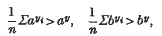
since the right-hand sides are the geometric means of the positive numbers whose arithmetic means stand on the left-hand sides. I know of no results, however, which relate the ratios
 and
and  and I have had occasion recently to require such results. This note gives an inequality between these ratios, subject to certain restrictions on a and b.
 and
and  and I have had occasion recently to require such results. This note gives an inequality between these ratios, subject to certain restrictions on
 Note on the shearing motion of fluid past a projection
-
- Journal:
- Mathematical Proceedings of the Cambridge Philosophical Society / Volume 40 / Issue 3 / November 1944
- Published online by Cambridge University Press:
- 24 October 2008, pp. 214-222
- Print publication:
- November 1944
-
- Article
- Export citation
On the origin of the solar system
-
- Journal:
- Mathematical Proceedings of the Cambridge Philosophical Society / Volume 40 / Issue 3 / November 1944
- Published online by Cambridge University Press:
- 24 October 2008, pp. 256-258
- Print publication:
- November 1944
-
- Article
- Export citation
PSP volume 40 issue 3 Cover and Back matter
-
- Journal:
- Mathematical Proceedings of the Cambridge Philosophical Society / Volume 40 / Issue 3 / November 1944
- Published online by Cambridge University Press:
- 24 October 2008, pp. b1-b5
- Print publication:
- November 1944
-
- Article
-
- You have access
- Export citation
Double Fourier series and boundary value problems
-
- Journal:
- Mathematical Proceedings of the Cambridge Philosophical Society / Volume 40 / Issue 3 / November 1944
- Published online by Cambridge University Press:
- 24 October 2008, pp. 222-228
- Print publication:
- November 1944
-
- Article
- Export citation
Proceedings at the Meetings held during the Session 1943–1944: Annual General Meeting
-
- Journal:
- Mathematical Proceedings of the Cambridge Philosophical Society / Volume 40 / Issue 3 / November 1944
- Published online by Cambridge University Press:
- 24 October 2008, p. 264
- Print publication:
- November 1944
-
- Article
- Export citation
A method of calculating the integral breadths of Debye-Scherrer lines: generalization to non-cubic crystals
-
- Journal:
- Mathematical Proceedings of the Cambridge Philosophical Society / Volume 40 / Issue 2 / June 1944
- Published online by Cambridge University Press:
- 24 October 2008, pp. 197-198
- Print publication:
- June 1944
-
- Article
- Export citation
-
Stokes and Wilson(1,2) have shown that the integral breadths of the Debye-Scherrer lines produced by small or imperfect crystals of the cubic system are given by

or, what is the same thing, that the apparent particle sizes are given by

In these equations λ is the X-ray wave-length, θ is the Bragg angle, Vt is the volume common to the crystal and its ‘ghost’ shifted a distance t in the hkl direction(1), and Jt is the mean value of the product FF of the structure amplitudes of two cells separated by a distance t in the hkl direction (2). The purpose of this note is to outline an argument which establishes the same result for crystals of any symmetry.

On the limiting values for infinite pitch of a parameter occurring in airscrew theory
-
- Journal:
- Mathematical Proceedings of the Cambridge Philosophical Society / Volume 40 / Issue 2 / June 1944
- Published online by Cambridge University Press:
- 24 October 2008, pp. 146-150
- Print publication:
- June 1944
-
- Article
- Export citation
-
In an improved method of strip-theory calculation of the performance of an airscrew a factor K occurs in the formula

which, for an airscrew with N blades, connects the total interference velocity w1 and the circulation Γ at radius r. In this formula ø is the inclination to the plane of rotation of the airscrew of the velocity of the air relative to the airscrew blade; for infinite pitch ø=½π For large but finite pitch the calculation of K is difficult; in computing tables of K it is therefore useful to have the values for infinite pitch, which can be calculated by a much simpler theory than that needed for the general case†.
