Refine search
Actions for selected content:
26204 results in Theoretical Physics and Mathematical Physics
Relativistic wave equations for zero rest-mass
-
- Journal:
- Mathematical Proceedings of the Cambridge Philosophical Society / Volume 41 / Issue 1 / June 1945
- Published online by Cambridge University Press:
- 24 October 2008, pp. 49-56
- Print publication:
- June 1945
-
- Article
- Export citation
-
1. In this paper I establish in a certain sense all the relativistically invariant sets of linear partial homogeneous differential equations in which every unknown function u satisfies
 being the relativistic Laplace operator. Analogous questions for any orthogonal group are dealt with in a previous paper, but it was thought that an independent and not too technical treatment for the Lorentz group might be of interest.
 being the relativistic Laplace operator. Analogous questions for any orthogonal group are dealt with in a previous paper, but it was thought that an independent and not too technical treatment for the Lorentz group might be of interest.
The energy levels of ‘holes’ in liquids
-
- Journal:
- Mathematical Proceedings of the Cambridge Philosophical Society / Volume 41 / Issue 2 / June 1945
- Published online by Cambridge University Press:
- 24 October 2008, pp. 180-183
- Print publication:
- June 1945
-
- Article
- Export citation
The symmetrical vibrations of a thin elastic plate
-
- Journal:
- Mathematical Proceedings of the Cambridge Philosophical Society / Volume 41 / Issue 1 / June 1945
- Published online by Cambridge University Press:
- 24 October 2008, pp. 27-43
- Print publication:
- June 1945
-
- Article
- Export citation
On the representations of a number as a sum of squares and certain related identities
-
- Journal:
- Mathematical Proceedings of the Cambridge Philosophical Society / Volume 41 / Issue 1 / June 1945
- Published online by Cambridge University Press:
- 24 October 2008, pp. 1-11
- Print publication:
- June 1945
-
- Article
- Export citation
-
Let Rc(n) be the number of representations of any non-negative integer n as the sum of c squares; i.e. Rc(n) is the number of different solutions (x1, x2, …, xc) of the equation

where the xμ are integers, and may be positive, negative, or zero. Two such solutions, (x1, x2, …, xc) and
 are only considered to be the same solution if
 are only considered to be the same solution if
On the classical theory of radiating electrons
-
- Journal:
- Mathematical Proceedings of the Cambridge Philosophical Society / Volume 41 / Issue 2 / June 1945
- Published online by Cambridge University Press:
- 24 October 2008, pp. 184-186
- Print publication:
- June 1945
-
- Article
- Export citation
-
1. In Dirac's classical theory of radiating electrons, the relativistic equations of motion of a point-electron in an electromagnetic field are

where (x0, x1, x2, x3) denote the electron's coordinates in flat space-time, dots denote differentiation with respect to the proper time
 , and the external electromagnetic field is described by the usual field quantities Fμν. The units are chosen so that the velocity of light is unity. These equations, which are derived from the principles of conservation of energy and of momentum, are the same as those obtained by Lorentz, when he used the spherical model of the electron and included radiation damping in an approximate way. But Dirac's method of derivation suggests that this treatment of radiation damping, and therefore the resulting scheme of equations, is exact within the limits of the classical theory.
 , and the external electromagnetic field is described by the usual field quantities
 Expansions of coordinates of points of a plane curve in terms of s or Ψ
-
- Journal:
- Mathematical Proceedings of the Cambridge Philosophical Society / Volume 41 / Issue 1 / June 1945
- Published online by Cambridge University Press:
- 24 October 2008, pp. 68-70
- Print publication:
- June 1945
-
- Article
- Export citation
The ‘odd’ number six
-
- Journal:
- Mathematical Proceedings of the Cambridge Philosophical Society / Volume 41 / Issue 1 / June 1945
- Published online by Cambridge University Press:
- 24 October 2008, pp. 66-68
- Print publication:
- June 1945
-
- Article
- Export citation
Negative probability
-
- Journal:
- Mathematical Proceedings of the Cambridge Philosophical Society / Volume 41 / Issue 1 / June 1945
- Published online by Cambridge University Press:
- 24 October 2008, pp. 71-73
- Print publication:
- June 1945
-
- Article
- Export citation
The minima of a pair of indefinite, harmonic, binary quadratic forms
-
- Journal:
- Mathematical Proceedings of the Cambridge Philosophical Society / Volume 41 / Issue 2 / June 1945
- Published online by Cambridge University Press:
- 24 October 2008, pp. 77-96
- Print publication:
- June 1945
-
- Article
- Export citation
-
If f is a real, indefinite, binary quadratic form of discriminant d and if κ(f) is the minimum of | f | taken over all integer values of x, y, not both zero, then it is well known that
 and that this is a ‘best possible’ result.
 and that this is a ‘best possible’ result.
The dynamics of a simple system. I. Observables
-
- Journal:
- Mathematical Proceedings of the Cambridge Philosophical Society / Volume 41 / Issue 1 / June 1945
- Published online by Cambridge University Press:
- 24 October 2008, pp. 57-65
- Print publication:
- June 1945
-
- Article
- Export citation
An extension of a theorem of Mehler's on Hermite polynomials
-
- Journal:
- Mathematical Proceedings of the Cambridge Philosophical Society / Volume 41 / Issue 1 / June 1945
- Published online by Cambridge University Press:
- 24 October 2008, pp. 12-15
- Print publication:
- June 1945
-
- Article
- Export citation
-
It was shown by Mehler (1866) that

where Hk(x) denotes the Hermite polynomial

(Hermite, 1864a, b), which can be expressed in terms of Weber's parabolic cylinder function (Whittaker, 1903). The series is convergent if | ρ | < 1, and divergent if | ρ | > 1. If ρ = 1 and x = y = 0 the series is divergent, and Hille's work (1938) shows that it will therefore be divergent for all real or complex values, except possibly real positive values, of x and y.
Conduction of heat in a slab in contact with well-stirred fluid
-
- Journal:
- Mathematical Proceedings of the Cambridge Philosophical Society / Volume 41 / Issue 1 / June 1945
- Published online by Cambridge University Press:
- 24 October 2008, pp. 43-49
- Print publication:
- June 1945
-
- Article
- Export citation
On multiple curves. II
-
- Journal:
- Mathematical Proceedings of the Cambridge Philosophical Society / Volume 41 / Issue 2 / June 1945
- Published online by Cambridge University Press:
- 24 October 2008, pp. 117-126
- Print publication:
- June 1945
-
- Article
- Export citation
On the summation of certain trigonometric series
-
- Journal:
- Mathematical Proceedings of the Cambridge Philosophical Society / Volume 41 / Issue 2 / June 1945
- Published online by Cambridge University Press:
- 24 October 2008, pp. 145-160
- Print publication:
- June 1945
-
- Article
- Export citation
-
In the present note, which is introductory to the following paper, closed expressions, suitable for computational purposes, are found for the sums of the series

where α > 1, t = 1, 2, 3, …, and n is a positive integer. In each case a recurrent relation is found giving the values of
 and
and  for t > 2 in terms of
 and the series Θκ(α) (κ = 1, 2, …, t), where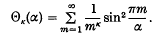
When κ is even the last series is expressed in closed form in terms of the Bernoullian polynomial φκ(l/α) and, when κ is odd and α is rational, a closed form is found involving the polygamma function Ψ(κ)(z), where
 The general expressions for
  and
and  involve Ψ(z) and Ψ′(z) when α is rational, but for special values of α they reduce to a form independent of the Ψ-function.
  and
and  are independent of n and are expressible as simple rational functions of α.
 and
and  for
for 
 and the series Θ
 The general expressions for
  and
and  involve Ψ(
 and
and  are independent of
 PSP volume 41 issue 1 Cover and Back matter
-
- Journal:
- Mathematical Proceedings of the Cambridge Philosophical Society / Volume 41 / Issue 1 / June 1945
- Published online by Cambridge University Press:
- 24 October 2008, p. b1
- Print publication:
- June 1945
-
- Article
-
- You have access
- Export citation
On multiple curves. I
-
- Journal:
- Mathematical Proceedings of the Cambridge Philosophical Society / Volume 41 / Issue 2 / June 1945
- Published online by Cambridge University Press:
- 24 October 2008, pp. 111-117
- Print publication:
- June 1945
-
- Article
- Export citation
A method for computing the resonant wave-length of a type of cavity resonator
-
- Journal:
- Mathematical Proceedings of the Cambridge Philosophical Society / Volume 41 / Issue 2 / June 1945
- Published online by Cambridge University Press:
- 24 October 2008, pp. 160-175
- Print publication:
- June 1945
-
- Article
- Export citation
Note on the equation

-
- Journal:
- Mathematical Proceedings of the Cambridge Philosophical Society / Volume 41 / Issue 1 / June 1945
- Published online by Cambridge University Press:
- 24 October 2008, pp. 74-75
- Print publication:
- June 1945
-
- Article
- Export citation
-
In the solution of certain boundary-value problems by means of complex integrals or by means of the Laplace transformation, transcendental equations of the form

arise, and it is then usually necessary to show that this equation has no roots in the right half of the complex z-plane.
Point-curve correspondences: I. The theory of the base
-
- Journal:
- Mathematical Proceedings of the Cambridge Philosophical Society / Volume 41 / Issue 2 / June 1945
- Published online by Cambridge University Press:
- 24 October 2008, pp. 135-145
- Print publication:
- June 1945
-
- Article
- Export citation
A general form of the covering principle and relative differentiation of additive functions
-
- Journal:
- Mathematical Proceedings of the Cambridge Philosophical Society / Volume 41 / Issue 2 / June 1945
- Published online by Cambridge University Press:
- 24 October 2008, pp. 103-110
- Print publication:
- June 1945
-
- Article
- Export citation
